
Arc Length of Polar Curves
The arc length of a polar curve r = f(θ) from θ = α to θ = β is L = ∫ √(r² + (dr/dθ)²) dθ with limits α and β. It comes from the parametric arc length formula with x = r cos θ and y = r sin θ. As with area, choose limits that trace the curve exactly once.
Before this lesson: Arc Length of Parametric Curves, Derivatives of Polar Functions and Area in Polar Coordinates
The idea: two ways the point moves
As θ increases, a point on a polar curve moves in two ways at once. It slides outward or inward at the rate dr/dθ, and it swings around the origin. Swinging through a small angle Δθ at distance r covers an arc of length about rΔθ.
Those two motions are at right angles, so the Pythagorean theorem combines them: each small piece has length about √(r² + (dr/dθ)²) Δθ. Adding the pieces gives the integral.
Polar arc length formula
L = \int_{\alpha}^{\beta} \sqrt{r^2 + \left(\dfrac{dr}{d\theta}\right)^2}\,d\thetaWhere the formula comes from
\dfrac{dx}{d\theta} = r'\cos\theta - r\sin\theta, \quad \dfrac{dy}{d\theta} = r'\sin\theta + r\cos\thetaDifferentiate x = r cos θ and y = r sin θ with the product rule.
\left(\dfrac{dx}{d\theta}\right)^2 = r'^2\cos^2\theta - 2rr'\sin\theta\cos\theta + r^2\sin^2\thetaSquare the first.
\left(\dfrac{dy}{d\theta}\right)^2 = r'^2\sin^2\theta + 2rr'\sin\theta\cos\theta + r^2\cos^2\thetaSquare the second.
\left(\dfrac{dx}{d\theta}\right)^2 + \left(\dfrac{dy}{d\theta}\right)^2 = r'^2 + r^2Add: the middle terms cancel, and sin² θ + cos² θ = 1 twice.
So the parametric formula ∫ √((dx/dθ)² + (dy/dθ)²) dθ becomes the polar formula.
- Find dr/dθ.
- Compute r² + (dr/dθ)² and simplify. Look for sin² + cos² = 1 or a half-angle identity.
- Take the square root, keeping absolute values where the expression can be negative.
- Integrate over limits that trace the curve once. If there is no antiderivative, use a calculator.
Arc length of polar curves examples
Example 1: A circle centered at the origin
Find the length of r = 5.
r^2 + \left(\dfrac{dr}{d\theta}\right)^2 = 25 + 0 = 25r is constant, so dr/dθ = 0.
L = \int_0^{2\pi} 5\,d\theta = 10\piTake the square root and integrate.
Answer: 10π, the circumference 2π(5).
Example 2: A circle through the origin
Find the length of r = 6 sin θ.
\dfrac{dr}{d\theta} = 6\cos\thetaDifferentiate.
36\sin^2\theta + 36\cos^2\theta = 36
Square, add and use sin² θ + cos² θ = 1 (see fundamental trig identities).
L = \int_0^{\pi} 6\,d\theta = 6\piThe circle is traced once for θ from 0 to π.
Answer: 6π. The curve is a circle of radius 3, and 2π(3) = 6π agrees.
Example 3: A cardioid
Find the length of the cardioid r = 1 + cos θ.
\dfrac{dr}{d\theta} = -\sin\thetaDifferentiate.
(1 + \cos\theta)^2 + \sin^2\theta = 1 + 2\cos\theta + \cos^2\theta + \sin^2\theta
Square and add.
1 + 2\cos\theta + 1 = 2 + 2\cos\theta
Use cos² θ + sin² θ = 1.
2 + 2\cos\theta = 4\cos^2\dfrac{\theta}{2}Use 1 + cos θ = 2 cos²(θ/2) (see half-angle formulas).
L = 2\int_0^{\pi} 2\cos\dfrac{\theta}{2}\,d\thetaUse symmetry: double the top half, where cos(θ/2) is not negative.
L = 2\left[4\sin\dfrac{\theta}{2}\right]_0^{\pi} = 2(4 - 0) = 8Integrate (u = θ/2) and evaluate.
Answer: 8. Integrating 2 cos(θ/2) straight from 0 to 2π would give 0, because cos(θ/2) is negative for θ between π and 2π. The absolute value matters.
Example 4: An exponential spiral
Find the length of r = e^θ for 0 ≤ θ ≤ 1.
\dfrac{dr}{d\theta} = e^{\theta}Differentiate.
e^{2\theta} + e^{2\theta} = 2e^{2\theta}Square and add.
\sqrt{2e^{2\theta}} = \sqrt{2}\,e^{\theta}Take the square root.
L = \int_0^1 \sqrt{2}\,e^{\theta}\,d\theta = \sqrt{2}(e - 1)Integrate and evaluate.
Answer: √2(e − 1) ≈ 2.430. This is the same spiral as x = eᵗ cos t, y = eᵗ sin t in arc length of parametric curves, and the answer matches.
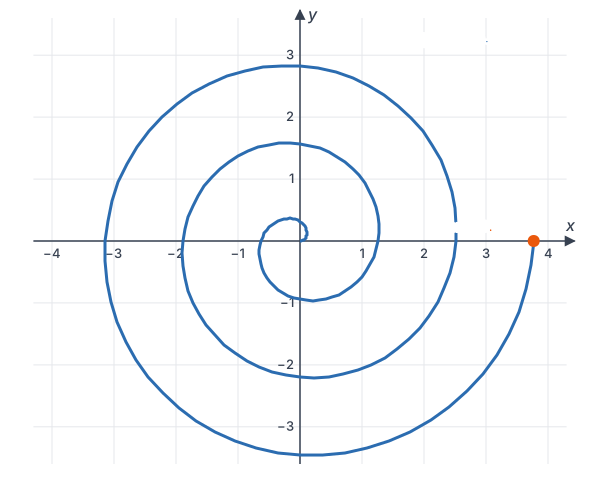
Example 5: A watch spring (word problem)
A flat watch spring follows the spiral r = 0.2θ (in centimeters) for three full turns, 0 ≤ θ ≤ 6π. How long is the spring?
\dfrac{dr}{d\theta} = 0.2Differentiate.
(0.2\theta)^2 + 0.2^2 = 0.04(\theta^2 + 1)
Square, add and factor out 0.04.
L = \int_0^{6\pi} 0.2\sqrt{\theta^2 + 1}\,d\thetaTake the square root: √0.04 = 0.2.
\int \sqrt{\theta^2 + 1}\,d\theta = \tfrac{1}{2}\left[\theta\sqrt{\theta^2 + 1} + \ln\left(\theta + \sqrt{\theta^2 + 1}\right)\right]Use the antiderivative from trigonometric substitution (plus C).
\tfrac{1}{2}\left[355.81 + 3.630\right] \approx 179.72Evaluate at 6π ≈ 18.850; the value at 0 is 0.
L \approx 0.2(179.72) \approx 35.94
Multiply by 0.2.
Answer: about 35.9 cm. A quick check: three circles with the average radius, about 1.9 cm, would be about 35.5 cm, so the answer is reasonable.
Common mistakes
| Mistake | Example of the error | Fix |
|---|---|---|
| Leaving out the r² term | \int \sqrt{1 + (dr/d\theta)^2}\,d\theta | The integrand is \sqrt{r^2 + (dr/d\theta)^2}. |
| Using the x-y slope | \int \sqrt{1 + (dy/dx)^2}\,d\theta | Work with r and dr/dθ, not dy/dx. |
| Dropping the absolute value | \int_0^{2\pi} 2\cos(\theta/2)\,d\theta = 0 for the cardioid | \sqrt{4\cos^2(\theta/2)} = 2|\cos(\theta/2)|. Use symmetry or split the interval. |
| Tracing the curve twice | Using 0 to 2π for r = 6 sin θ and getting 12π | r = 6 sin θ is traced once on [0, π]. |
| Squaring a sum term by term | (1 + \cos\theta)^2 = 1 + \cos^2\theta | Keep the middle term 2 cos θ. |
| Forgetting the constant inside the root | \sqrt{0.04(\theta^2 + 1)} = 0.04\sqrt{\theta^2 + 1} | \sqrt{0.04} = 0.2. |
Related methods
Parametric arc length
The polar formula is arc length of parametric curves with θ as the parameter. If you forget the polar formula, convert to x and y and use the parametric one.
Area inside polar curves
Area in polar coordinates and area between polar curves use the same limits, so the work of finding where a curve starts and stops is shared.
Arc length of graphs
For y = f(x), the formula is ∫ √(1 + (dy/dx)²) dx, from arc length of a curve. All three formulas add up tiny straight pieces.
Practice problems
- Find the length of r = 3.
- Find the length of r = 4 cos θ.
- Find the length of the cardioid r = 2 + 2 cos θ.
- Find the length of r = θ² for 0 ≤ θ ≤ √5.
- Find the length of r = e²ᶿ for 0 ≤ θ ≤ ln 2.
- Find the length of r = 1 − cos θ.
- Find the length of r = sec θ for 0 ≤ θ ≤ π/4, and check it with a sketch.
- Set up, then estimate with a calculator, the length of r = 2 + sin θ.
- Why does integrating the arc length formula for r = 6 sin θ from 0 to 2π give 12π?
- A coiled rope lies in the spiral r = 0.5θ meters for one turn, 0 ≤ θ ≤ 2π. How long is the rope?
Show answers
1.
L = \int_0^{2\pi} 3\,d\theta = 6\pidr/dθ = 0, so the integrand is √9 = 3.
Answer: 6π
2.
16\cos^2\theta + 16\sin^2\theta = 16
dr/dθ = −4 sin θ; square and add.
L = \int_{-\pi/2}^{\pi/2} 4\,d\theta = 4\piThe circle is traced once on [−π/2, π/2].
Answer: 4π (a circle of radius 2)
3.
(2 + 2\cos\theta)^2 + 4\sin^2\theta = 8 + 8\cos\theta = 16\cos^2\dfrac{\theta}{2}dr/dθ = −2 sin θ; square, add and use the half-angle identity.
L = 2\int_0^{\pi} 4\cos\dfrac{\theta}{2}\,d\theta = 2\left[8\sin\dfrac{\theta}{2}\right]_0^{\pi} = 16Double the top half and integrate.
Answer: 16 (twice the length in Example 3)
4.
\theta^4 + (2\theta)^2 = \theta^2(\theta^2 + 4)
dr/dθ = 2θ; square, add and factor.
L = \int_0^{\sqrt{5}} \theta\sqrt{\theta^2 + 4}\,d\thetaTake the square root; θ is not negative.
L = \left[\tfrac{1}{3}(\theta^2 + 4)^{3/2}\right]_0^{\sqrt{5}} = \tfrac{1}{3}(27 - 8)Integrate with u = θ² + 4 (see u-substitution); 9^(3/2) = 27 and 4^(3/2) = 8.
Answer: 19/3 ≈ 6.33
5.
e^{4\theta} + 4e^{4\theta} = 5e^{4\theta}dr/dθ = 2e²ᶿ; square and add.
L = \int_0^{\ln 2} \sqrt{5}\,e^{2\theta}\,d\theta = \dfrac{\sqrt{5}}{2}\left(e^{2\ln 2} - 1\right)Integrate.
L = \dfrac{\sqrt{5}}{2}(4 - 1) = \dfrac{3\sqrt{5}}{2}Use e^(2 ln 2) = 4.
Answer: 3√5/2 ≈ 3.35
6.
(1 - \cos\theta)^2 + \sin^2\theta = 2 - 2\cos\theta = 4\sin^2\dfrac{\theta}{2}dr/dθ = sin θ; square, add and use 1 − cos θ = 2 sin²(θ/2).
L = \int_0^{2\pi} 2\sin\dfrac{\theta}{2}\,d\theta = \left[-4\cos\dfrac{\theta}{2}\right]_0^{2\pi} = 8sin(θ/2) is not negative on [0, 2π].
Answer: 8
7.
\sec^2\theta + \sec^2\theta\tan^2\theta = \sec^2\theta(1 + \tan^2\theta) = \sec^4\theta
dr/dθ = sec θ tan θ; square, add and use 1 + tan² θ = sec² θ.
L = \int_0^{\pi/4} \sec^2\theta\,d\theta = \tan\dfrac{\pi}{4} - \tan 0 = 1Take the square root and integrate.
Answer: 1. The curve r = sec θ is the line x = 1, here from (1, 0) to (1, 1), which has length 1
8.
(2 + \sin\theta)^2 + \cos^2\theta = 5 + 4\sin\theta
dr/dθ = cos θ; expand and use sin² θ + cos² θ = 1.
L = \int_0^{2\pi} \sqrt{5 + 4\sin\theta}\,d\theta \approx 13.36Use numerical integration.
Answer: about 13.36
9.
\int_0^{2\pi} 6\,d\theta = 12\piThe integrand is 6 on any interval.
Answer: r = 6 sin θ traces the circle once on [0, π] and again on [π, 2π], so the integral counts the length twice. The circle’s length is 6π
10.
L = \int_0^{2\pi} 0.5\sqrt{\theta^2 + 1}\,d\thetadr/dθ = 0.5; √(0.25θ² + 0.25) = 0.5√(θ² + 1).
L = 0.25\left[\theta\sqrt{\theta^2 + 1} + \ln\left(\theta + \sqrt{\theta^2 + 1}\right)\right]_0^{2\pi}Use the same antiderivative as Example 5.
L \approx 0.25(39.976 + 2.537) \approx 10.63
Evaluate at 2π ≈ 6.283.
Answer: about 10.6 meters
Polar arc length FAQ
What is the arc length formula for polar curves?
L = ∫ √(r² + (dr/dθ)²) dθ from θ = α to θ = β, where the curve is traced once on that interval.
Where does the polar arc length formula come from?
Write x = r cos θ and y = r sin θ and use the parametric formula. When you square and add the derivatives, the cross terms cancel and leave r² + (dr/dθ)².
Why does the formula need r² and not just dr/dθ?
Even when r stays the same, the point moves along a circle as θ changes. The r² term measures that swinging motion, and dr/dθ measures the in-and-out motion.
What if the integral can’t be done by hand?
Many polar lengths, like the limaçon r = 2 + sin θ, have no simple antiderivative. Use a calculator or a numerical method such as Simpson’s rule.
Summary
- Polar arc length: L = ∫ √(r² + (dr/dθ)²) dθ.
- It is the parametric formula with x = r cos θ and y = r sin θ.
- Simplify with sin² + cos² = 1 and half-angle identities.
- Keep absolute values after a square root, or use symmetry.
- Choose limits that trace the curve once.
Previous lesson: Area Between Polar Curves
Next lesson: Convergence of Sequences
Back to the Calculus 2 Index