
Derivatives of Polar Functions
To find the derivative of a polar function r = f(θ), treat θ as a parameter: x = r cos θ and y = r sin θ. Then the slope is dy/dx = (dy/dθ)/(dx/dθ), where dy/dθ = r′ sin θ + r cos θ and dx/dθ = r′ cos θ − r sin θ. The derivative dr/dθ alone is not the slope.
Before this lesson: Graphing Polar Equations, Derivatives of Parametric Equations and Product Rule
The idea: polar curves are parametric curves
A polar curve r = f(θ) gives a distance r for each angle θ. Converting to x and y, as in polar coordinates, gives x = f(θ) cos θ and y = f(θ) sin θ.
Those are parametric equations with θ as the parameter. So the slope of the curve is the same rise-rate-over-run-rate idea from parametric curves. Each of x and y is a product, so each derivative needs the product rule.
The derivative dr/dθ answers a different question. It tells whether the point is moving away from the origin (positive) or toward it (negative) as θ increases.
Polar derivative formula
\dfrac{dy}{dx} = \dfrac{dy/d\theta}{dx/d\theta} = \dfrac{r'\sin\theta + r\cos\theta}{r'\cos\theta - r\sin\theta}, \qquad r' = \dfrac{dr}{d\theta}- Horizontal tangent: dy/dθ = 0 and dx/dθ ≠ 0.
- Vertical tangent: dx/dθ = 0 and dy/dθ ≠ 0.
- If both are 0, the formula doesn’t decide; look for a cusp, often at the pole (the origin).
- Tangent at the pole: if r = 0 at θ = α and r′(α) ≠ 0, the tangent line there is the line θ = α, with slope tan α.
- For a tangent line, convert the point to (x, y) = (r cos θ, r sin θ) first.
Derivatives of polar functions examples
Example 1: A circle
Find dy/dx for r = 3 sin θ, and its value at θ = π/3.
r' = 3\cos\theta
Differentiate r.
\dfrac{dy}{d\theta} = 3\cos\theta\sin\theta + 3\sin\theta\cos\theta = 3\sin 2\thetaUse r′ sin θ + r cos θ, then 2 sin θ cos θ = sin 2θ (see double-angle formulas).
\dfrac{dx}{d\theta} = 3\cos^2\theta - 3\sin^2\theta = 3\cos 2\thetaUse r′ cos θ − r sin θ, then cos² θ − sin² θ = cos 2θ.
\dfrac{dy}{dx} = \dfrac{3\sin 2\theta}{3\cos 2\theta} = \tan 2\thetaDivide.
\tan\dfrac{2\pi}{3} = -\sqrt{3}Substitute θ = π/3.
Answer: dy/dx = tan 2θ, which is −√3 at θ = π/3. The point is (r cos θ, r sin θ) = (3√3/4, 9/4).
Example 2: Tangent line to a cardioid
Find the tangent line to the cardioid r = 1 + cos θ at θ = π/2.
r = 1 + \cos\dfrac{\pi}{2} = 1, \quad r' = -\sin\dfrac{\pi}{2} = -1Find r and r′ = −sin θ at θ = π/2.
\dfrac{dy}{d\theta} = (-1)(1) + (1)(0) = -1Use r′ sin θ + r cos θ.
\dfrac{dx}{d\theta} = (-1)(0) - (1)(1) = -1Use r′ cos θ − r sin θ.
\dfrac{dy}{dx} = \dfrac{-1}{-1} = 1Divide.
(x, y) = (1 \cdot 0,\; 1 \cdot 1) = (0, 1)
Convert the point to x and y.
y - 1 = 1(x - 0)
Point-slope form.
y = x + 1
Add 1 to both sides.
Answer: y = x + 1.
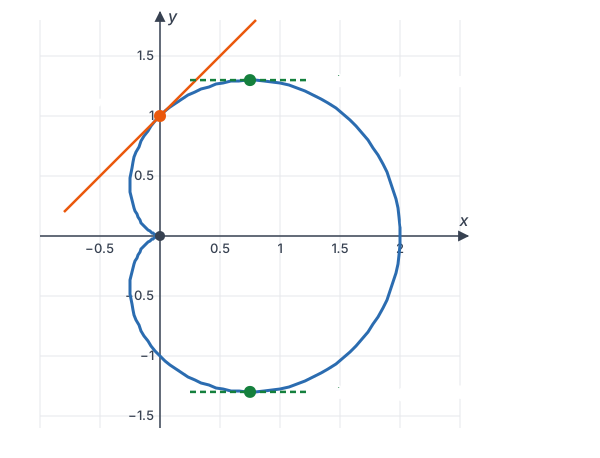
Example 3: Horizontal tangents
Find the points where r = 1 + cos θ has a horizontal tangent, for θ in [0, 2π).
\dfrac{dy}{d\theta} = -\sin^2\theta + (1 + \cos\theta)\cos\thetaUse r′ sin θ + r cos θ with r′ = −sin θ.
-(1 - \cos^2\theta) + \cos\theta + \cos^2\theta
Replace sin² θ with 1 − cos² θ and distribute.
2\cos^2\theta + \cos\theta - 1
Combine like terms.
(2\cos\theta - 1)(\cos\theta + 1) = 0
Factor (see factoring trinomials when a is not 1).
\cos\theta = \tfrac{1}{2} \Rightarrow \theta = \tfrac{\pi}{3}, \tfrac{5\pi}{3}First factor (see solving trig equations).
\cos\theta = -1 \Rightarrow \theta = \pi
Second factor.
\dfrac{dx}{d\theta}\Big|_{\pi/3} = -\sqrt{3}dx/dθ = −sin θ cos θ − (1 + cos θ) sin θ is not 0, so this is a horizontal tangent; 5π/3 gives √3.
\dfrac{dx}{d\theta}\Big|_{\pi} = 0Both derivatives are 0 at θ = π, so no conclusion there.
Answer: horizontal tangents at θ = π/3 and 5π/3, where r = 3/2, at the points (3/4, 3√3/4) and (3/4, −3√3/4). At θ = π the curve has a cusp at the origin.
Example 4: dr/dθ versus dy/dx
For r = 3 − 2 cos θ, at θ = π/2, is the curve moving toward or away from the origin? What is the slope dy/dx?
r' = 2\sin\theta
Differentiate r.
r'\left(\tfrac{\pi}{2}\right) = 2Positive, so r is increasing: moving away from the origin.
r\left(\tfrac{\pi}{2}\right) = 3 - 0 = 3Find r at θ = π/2.
\dfrac{dy}{d\theta} = 2(1) + 3(0) = 2Use r′ sin θ + r cos θ.
\dfrac{dx}{d\theta} = 2(0) - 3(1) = -3Use r′ cos θ − r sin θ.
\dfrac{dy}{dx} = -\dfrac{2}{3}Divide.
Answer: moving away from the origin (dr/dθ = 2), while the curve’s slope is −2/3. The two derivatives answer different questions.
Example 5: A sprinkler’s spray edge (word problem)
The edge of the area a lawn sprinkler reaches is r = 4 + 2 sin θ, in meters. Find the slope of the edge at θ = 0, and the angles where the spray reaches farthest and least far.
r' = 2\cos\theta
Differentiate r.
r(0) = 4, \quad r'(0) = 2
Evaluate at θ = 0.
\dfrac{dy}{d\theta} = 2(0) + 4(1) = 4Use r′ sin θ + r cos θ.
\dfrac{dx}{d\theta} = 2(1) - 4(0) = 2Use r′ cos θ − r sin θ.
\dfrac{dy}{dx} = \dfrac{4}{2} = 2Divide.
2\cos\theta = 0 \Rightarrow \theta = \tfrac{\pi}{2}, \tfrac{3\pi}{2}The distance r is largest or smallest where dr/dθ = 0.
r\left(\tfrac{\pi}{2}\right) = 6, \quad r\left(\tfrac{3\pi}{2}\right) = 2Compare the two values.
Answer: the edge has slope 2 at the point (4, 0). The spray reaches farthest, 6 m, at θ = π/2 and least far, 2 m, at θ = 3π/2.
Common mistakes
| Mistake | Example of the error | Fix |
|---|---|---|
| Using dr/dθ as the slope | For r = 3 − 2 cos θ, slope = 2 at θ = π/2 | Slope is dy/dx = (dy/dθ)/(dx/dθ) = −2/3. |
| Skipping the product rule | \dfrac{dy}{d\theta} = r'\cos\theta | y = r sin θ is a product: dy/dθ = r′ sin θ + r cos θ. |
| Wrong sign in dx/dθ | r'\cos\theta + r\sin\theta | The derivative of cos θ is −sin θ: r′ cos θ − r sin θ. |
| Using polar values in point-slope form | y − 1 = 1(x − π/2) for θ = π/2, r = 1 | Convert to (x, y) = (0, 1) first. |
| Calling every dy/dθ = 0 a horizontal tangent | Listing θ = π for the cardioid | Check dx/dθ. If it is 0 too, there may be a cusp. |
| Calculator in degree mode | Getting tan(120) as a radian value | Keep θ in radians for calculus. |
Related methods
Parametric derivatives
This lesson is derivatives of parametric equations with x = r cos θ and y = r sin θ. Second derivatives and concavity work the same way, with θ in place of t.
Graphing polar curves
Knowing where tangents are horizontal or vertical, and where r is largest, helps when graphing polar equations by hand.
Area and length of polar curves
The next lessons find the area inside a polar curve and the length of a polar curve. Both use the same conversion to x and y in the background.
Practice problems
- Find dy/dx for r = 4 cos θ and its value at θ = π/6.
- Find dy/dx for the spiral r = θ at θ = π/2.
- Find dy/dx for the circle r = 2 at θ = π/4.
- Find the tangent line to r = 1 + sin θ at θ = 0.
- For r = 2 + cos θ, is the curve moving toward or away from the origin at θ = π/2?
- Find the vertical tangents of r = 3 sin θ for θ in [0, π).
- Find the tangent lines at the pole for r = 2 sin 3θ, θ in [0, π).
- Find dy/dx for r = e^θ at θ = 0.
- Find dy/dx for r = 1 − 2 sin θ at θ = 0.
- A garden light’s beam edge is r = 5 − 3 cos θ meters. Where is the edge closest to and farthest from the light, and what is its slope at θ = π/2?
Show answers
1.
\dfrac{dy}{d\theta} = -4\sin^2\theta + 4\cos^2\theta = 4\cos 2\thetar′ = −4 sin θ; use r′ sin θ + r cos θ.
\dfrac{dx}{d\theta} = -8\sin\theta\cos\theta = -4\sin 2\thetaUse r′ cos θ − r sin θ.
\dfrac{dy}{dx} = -\cot 2\thetaDivide.
-\cot\dfrac{\pi}{3} = -\dfrac{\sqrt{3}}{3}Substitute θ = π/6.
Answer: dy/dx = −cot 2θ; −√3/3 at θ = π/6
2.
\dfrac{dy}{d\theta} = 1(1) + \tfrac{\pi}{2}(0) = 1r = π/2 and r′ = 1 at θ = π/2.
\dfrac{dx}{d\theta} = 1(0) - \tfrac{\pi}{2}(1) = -\tfrac{\pi}{2}Use r′ cos θ − r sin θ.
\dfrac{dy}{dx} = \dfrac{1}{-\pi/2} = -\dfrac{2}{\pi}Divide.
Answer: −2/π ≈ −0.637
3.
\dfrac{dy}{d\theta} = 0 + 2\cos\tfrac{\pi}{4} = \sqrt{2}r = 2 and r′ = 0.
\dfrac{dx}{d\theta} = 0 - 2\sin\tfrac{\pi}{4} = -\sqrt{2}Use r′ cos θ − r sin θ.
Answer: dy/dx = −1
4.
r(0) = 1, \quad r'(0) = \cos 0 = 1
Evaluate r and r′ = cos θ.
\dfrac{dy}{d\theta} = 1(0) + 1(1) = 1, \quad \dfrac{dx}{d\theta} = 1(1) - 1(0) = 1Both derivatives at θ = 0.
y - 0 = 1(x - 1)
Slope 1 at the point (1, 0).
Answer: y = x − 1
5.
r' = -\sin\theta
Differentiate r.
r'\left(\tfrac{\pi}{2}\right) = -1Negative, so r is decreasing.
Answer: moving toward the origin
6.
\dfrac{dx}{d\theta} = 3\cos 2\theta = 0From Example 1.
\theta = \tfrac{\pi}{4}, \tfrac{3\pi}{4}Solve 2θ = π/2, 3π/2. There dy/dθ = 3 sin 2θ = ±3, not 0.
r = \tfrac{3\sqrt{2}}{2} \Rightarrow \left(\tfrac{3}{2}, \tfrac{3}{2}\right), \left(-\tfrac{3}{2}, \tfrac{3}{2}\right)Convert to x and y.
Answer: vertical tangents at (3/2, 3/2) and (−3/2, 3/2)
7.
2\sin 3\theta = 0 \Rightarrow \theta = 0, \tfrac{\pi}{3}, \tfrac{2\pi}{3}The curve is at the pole where r = 0.
r' = 6\cos 3\theta = \pm 6
Not 0 at those angles.
y = 0,\; y = \sqrt{3}\,x,\; y = -\sqrt{3}\,xLines θ = α have slope tan α.
Answer: y = 0, y = √3x and y = −√3x
8.
r(0) = 1, \quad r'(0) = 1
r′ = e^θ.
\dfrac{dy}{d\theta} = 1(0) + 1(1) = 1, \quad \dfrac{dx}{d\theta} = 1(1) - 1(0) = 1Both derivatives at θ = 0.
Answer: dy/dx = 1
9.
r(0) = 1, \quad r'(0) = -2\cos 0 = -2
r′ = −2 cos θ.
\dfrac{dy}{d\theta} = -2(0) + 1(1) = 1, \quad \dfrac{dx}{d\theta} = -2(1) - 1(0) = -2Both derivatives at θ = 0.
Answer: dy/dx = −1/2
10.
r' = 3\sin\theta = 0 \Rightarrow \theta = 0, \pi
Largest or smallest r.
r(0) = 2, \quad r(\pi) = 8
Closest at θ = 0, farthest at θ = π.
\dfrac{dy}{d\theta} = 3(1) + 5(0) = 3, \quad \dfrac{dx}{d\theta} = 3(0) - 5(1) = -5At θ = π/2, r = 5 and r′ = 3.
Answer: closest 2 m (θ = 0), farthest 8 m (θ = π); slope −3/5 at θ = π/2
Polar derivatives FAQ
How do you find dy/dx for a polar curve?
Write x = r cos θ and y = r sin θ, differentiate both with respect to θ using the product rule, and divide: dy/dx = (r′ sin θ + r cos θ)/(r′ cos θ − r sin θ).
Is dr/dθ the slope of a polar curve?
No. dr/dθ tells how fast the distance from the origin changes. The slope of the tangent line is dy/dx.
How do you find horizontal tangents of a polar curve?
Set dy/dθ = r′ sin θ + r cos θ equal to 0 and solve. Keep the angles where dx/dθ is not 0.
What is the tangent line at the pole?
If r = 0 at θ = α and r′(α) is not 0, the curve passes through the origin heading along the line θ = α, so that line is the tangent.
Summary
- Treat θ as a parameter: x = r cos θ, y = r sin θ.
- dy/dθ = r′ sin θ + r cos θ and dx/dθ = r′ cos θ − r sin θ.
- dy/dx = (dy/dθ)/(dx/dθ); dr/dθ is not the slope.
- Horizontal: dy/dθ = 0. Vertical: dx/dθ = 0. Both 0: check for a cusp.
- Convert the point to (x, y) before writing a tangent line.
Previous lesson: Vector-Valued Functions
Next lesson: Area in Polar Coordinates
Back to the Calculus 2 Index