
Vector-Valued Functions
A vector-valued function r(t) = ⟨x(t), y(t)⟩ gives the position of a moving point at each time t. Its derivative is the velocity vector v(t) = ⟨x′(t), y′(t)⟩. The speed is the length of velocity, |v(t)| = √(x′(t)² + y′(t)²), and the derivative of velocity is the acceleration vector a(t).
Before this lesson: Arc Length of Parametric Curves, Magnitude and Direction of a Vector and Position, Velocity and Acceleration
The idea: two motions at once
A point moving in the plane is really two motions happening together: one left and right, one up and down. A vector-valued function keeps both in one object, r(t) = ⟨x(t), y(t)⟩.
Each component is an ordinary function of t, so you differentiate and integrate one component at a time. The velocity vector points the way the object is heading, and its length tells how fast it is going.
Velocity, speed and acceleration formulas
\vec{r}(t) = \langle x(t),\, y(t) \rangle, \qquad \vec{v}(t) = \vec{r}\,'(t) = \langle x'(t),\, y'(t) \rangle, \qquad \vec{a}(t) = \vec{v}\,'(t) = \langle x''(t),\, y''(t) \rangle\text{speed} = |\vec{v}(t)| = \sqrt{x'(t)^2 + y'(t)^2}, \qquad \text{distance traveled} = \int_a^b |\vec{v}(t)|\,dt- Velocity is a vector (direction and size). Speed is a number, the length of the velocity vector.
- To go backward, integrate each component and add a separate constant to each. An initial position or velocity gives the constants.
- Displacement from t = a to t = b is ∫ v(t) dt, a vector. Distance traveled is ∫ |v(t)| dt, a number.
- The object is at rest when both components of velocity are 0 at the same time.
Vector-valued functions examples
Example 1: Velocity, speed and acceleration
For r(t) = ⟨t³ − 3t, t²⟩, find the velocity, speed and acceleration at t = 2.
\vec{v}(t) = \langle 3t^2 - 3,\, 2t \rangleDifferentiate each component with the power rule.
\vec{a}(t) = \langle 6t,\, 2 \rangleDifferentiate each component of velocity.
\vec{v}(2) = \langle 3(4) - 3,\, 2(2) \rangle = \langle 9, 4 \rangleSubstitute t = 2.
|\vec{v}(2)| = \sqrt{9^2 + 4^2} = \sqrt{97} \approx 9.85Find the length of the velocity vector.
\vec{a}(2) = \langle 12, 2 \rangleSubstitute t = 2 into the acceleration.
Answer: v(2) = ⟨9, 4⟩, speed √97 ≈ 9.85, and a(2) = ⟨12, 2⟩. At t = 2 the point is at r(2) = ⟨2, 4⟩.
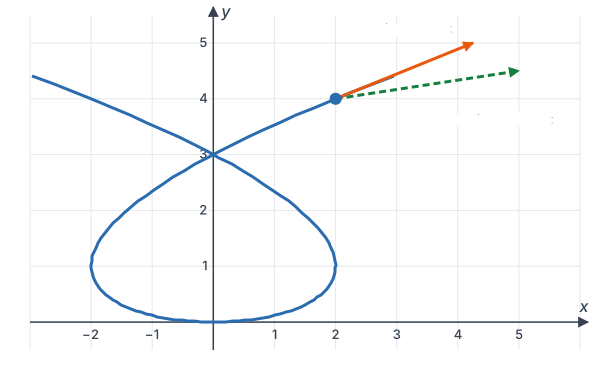
Example 2: Motion around a circle
For r(t) = ⟨4 cos t, 4 sin t⟩, find the speed and the acceleration. Evaluate both at t = π/3.
\vec{v}(t) = \langle -4\sin t,\, 4\cos t \rangleDifferentiate (see derivatives of trig functions).
|\vec{v}(t)| = \sqrt{16\sin^2 t + 16\cos^2 t} = 4Use sin² t + cos² t = 1. The speed never changes.
\vec{a}(t) = \langle -4\cos t,\, -4\sin t \rangle = -\vec{r}(t)Differentiate again. Acceleration points toward the center.
\vec{v}\left(\tfrac{\pi}{3}\right) = \langle -2\sqrt{3},\, 2 \rangleUse sin(π/3) = √3/2 and cos(π/3) = 1/2.
\vec{a}\left(\tfrac{\pi}{3}\right) = \langle -2,\, -2\sqrt{3} \rangleSubstitute t = π/3.
Answer: the speed is always 4, but the acceleration is not zero: a(t) = −r(t) keeps turning the object toward the center. At t = π/3, v = ⟨−2√3, 2⟩ and a = ⟨−2, −2√3⟩.
Example 3: Position from velocity
A particle has velocity v(t) = ⟨3t², 4t − 1⟩ and is at ⟨2, 0⟩ when t = 1. Find r(t) and the position at t = 2.
\vec{r}(t) = \langle t^3 + C_1,\, 2t^2 - t + C_2 \rangleIntegrate each component (see antiderivatives), with its own constant.
\langle 1 + C_1,\, 1 + C_2 \rangle = \langle 2, 0 \rangle
Substitute t = 1 and set equal to the known position.
C_1 = 1, \quad C_2 = -1
Solve each component.
\vec{r}(t) = \langle t^3 + 1,\, 2t^2 - t - 1 \ranglePut the constants back.
\vec{r}(2) = \langle 8 + 1,\, 8 - 2 - 1 \rangle = \langle 9, 5 \rangleSubstitute t = 2.
Answer: r(t) = ⟨t³ + 1, 2t² − t − 1⟩, and the particle is at ⟨9, 5⟩ when t = 2.
Example 4: Displacement vs. distance
A point moves with r(t) = ⟨cos πt, sin πt⟩ for 0 ≤ t ≤ 1. Find its displacement and the distance it travels.
\vec{r}(1) - \vec{r}(0) = \langle -1, 0 \rangle - \langle 1, 0 \rangle = \langle -2, 0 \rangleDisplacement is final position minus starting position.
\vec{v}(t) = \langle -\pi\sin \pi t,\, \pi\cos \pi t \rangleDifferentiate with the chain rule.
|\vec{v}(t)| = \sqrt{\pi^2\sin^2 \pi t + \pi^2\cos^2 \pi t} = \piFactor out π² and use sin² + cos² = 1.
\int_0^1 \pi\,dt = \pi
Integrate the speed.
Answer: the displacement is ⟨−2, 0⟩ (2 units left), but the distance traveled is π ≈ 3.14, half the unit circle.
Example 5: A thrown ball (word problem)
A ball is thrown from 2 meters above the ground with initial velocity ⟨8, 15⟩ m/s. Gravity gives a(t) = ⟨0, −9.8⟩. Find r(t), the highest point, and the speed when the ball lands.
\vec{v}(t) = \langle 8,\, 15 - 9.8t \rangleIntegrate a(t) and use v(0) = ⟨8, 15⟩.
\vec{r}(t) = \langle 8t,\, 2 + 15t - 4.9t^2 \rangleIntegrate v(t) and use r(0) = ⟨0, 2⟩.
15 - 9.8t = 0
At the top, the vertical velocity is 0.
t = \dfrac{15}{9.8} \approx 1.531Add 9.8t and divide by 9.8.
y \approx 2 + 15(1.531) - 4.9(1.531)^2 \approx 13.48
Substitute into y(t).
4.9t^2 - 15t - 2 = 0
The ball lands when y(t) = 0.
t = \dfrac{15 + \sqrt{225 + 39.2}}{9.8} \approx 3.189Use the quadratic formula and keep the positive root.
\vec{v}(3.189) \approx \langle 8,\, -16.25 \rangleSubstitute into v(t).
|\vec{v}| \approx \sqrt{64 + 264.2} \approx 18.12Find the speed.
Answer: r(t) = ⟨8t, 2 + 15t − 4.9t²⟩. The ball peaks at about 13.5 m after 1.53 s, lands after about 3.19 s (25.5 m away), and hits the ground at about 18.1 m/s.
Common mistakes
| Mistake | Example of the error | Fix |
|---|---|---|
| Adding components to get speed | Speed of ⟨9, 4⟩ = 13 | Speed is the length: √(81 + 16) = √97. |
| Calling velocity a number | “The velocity is 9.85” | Velocity is ⟨9, 4⟩; 9.85 is the speed. |
| One constant for both components | \langle t^3, 2t^2 - t \rangle + C, then C = 1 | Each component gets its own constant: C₁ and C₂. |
| Mixing up displacement and distance | Distance = |r(1) − r(0)| = 2 for the half circle | Distance is ∫ |v(t)| dt = π. |
| Thinking constant speed means zero acceleration | a(t) = ⟨0, 0⟩ for circular motion | Turning changes velocity, so a(t) = −r(t) is not zero. |
| Using the wrong starting time | Using t = 0 when the position is given at t = 1 | Substitute the time that matches the given position. |
Related methods
Parametric equations
A vector-valued function is a pair of parametric equations written as one vector. The slope of the path is still dy/dx = y′(t)/x′(t), from derivatives of parametric equations.
Distance traveled
The distance formula here is the same integral as in arc length of parametric curves: the integral of speed.
Vectors and projectile motion
The components work like the vectors in vector word problems, and Example 5 is the calculus version of projectile motion with parametric equations. Calculus 3 extends all of this to curves in space.
Practice problems
- For r(t) = ⟨t², t³⟩, find v(1) and a(1).
- Find the speed in problem 1 at t = 1.
- For r(t) = ⟨e²ᵗ, e⁻ᵗ⟩, find v(0) and the speed at t = 0.
- Show that r(t) = ⟨3 sin t, 3 cos t⟩ has constant speed.
- Find r(t) if v(t) = ⟨2t, 6t²⟩ and r(0) = ⟨1, −2⟩.
- Find v(t) if a(t) = ⟨2, −6t⟩ and v(0) = ⟨1, 4⟩.
- A particle has v(t) = ⟨t² − 4, 2t − 6⟩ for t ≥ 0. When is it moving straight up or down? Is it ever at rest?
- Find the distance traveled when v(t) = ⟨1 − cos t, sin t⟩ for 0 ≤ t ≤ 2π.
- For v(t) = ⟨2t, 3t²⟩ and r(0) = ⟨1, 1⟩, find the displacement from t = 0 to t = 2 and the position at t = 2.
- A particle has v(t) = ⟨3t² − 12, 2t⟩ for t ≥ 0 and r(0) = ⟨0, 5⟩. Where is it, and how fast is it going, when it moves straight up?
Show answers
1.
\vec{v}(t) = \langle 2t,\, 3t^2 \rangle, \quad \vec{a}(t) = \langle 2,\, 6t \rangleDifferentiate twice.
\vec{v}(1) = \langle 2, 3 \rangle, \quad \vec{a}(1) = \langle 2, 6 \rangleSubstitute t = 1.
Answer: v(1) = ⟨2, 3⟩ and a(1) = ⟨2, 6⟩
2.
|\vec{v}(1)| = \sqrt{2^2 + 3^2} = \sqrt{13}Length of ⟨2, 3⟩.
Answer: √13 ≈ 3.61
3.
\vec{v}(t) = \langle 2e^{2t},\, -e^{-t} \rangleDifferentiate with the chain rule.
\vec{v}(0) = \langle 2, -1 \rangleUse e⁰ = 1.
|\vec{v}(0)| = \sqrt{4 + 1} = \sqrt{5}Find the length.
Answer: v(0) = ⟨2, −1⟩, speed √5 ≈ 2.24
4.
\vec{v}(t) = \langle 3\cos t,\, -3\sin t \rangleDifferentiate.
|\vec{v}(t)| = \sqrt{9\cos^2 t + 9\sin^2 t} = 3Use sin² t + cos² t = 1.
Answer: the speed is always 3
5.
\vec{r}(t) = \langle t^2 + C_1,\, 2t^3 + C_2 \rangleIntegrate each component.
C_1 = 1, \quad C_2 = -2
Use r(0) = ⟨1, −2⟩.
Answer: r(t) = ⟨t² + 1, 2t³ − 2⟩
6.
\vec{v}(t) = \langle 2t + C_1,\, -3t^2 + C_2 \rangleIntegrate each component.
C_1 = 1, \quad C_2 = 4
Use v(0) = ⟨1, 4⟩.
Answer: v(t) = ⟨2t + 1, 4 − 3t²⟩
7.
t^2 - 4 = 0 \Rightarrow t = 2
Straight up or down means x′(t) = 0; t ≥ 0.
2(2) - 6 = -2
y′(2) is not 0, so it is moving down at t = 2.
2t - 6 = 0 \Rightarrow t = 3
Rest would need y′(t) = 0 too, which happens only at t = 3.
Answer: straight down at t = 2; never at rest, because x′ and y′ are never 0 at the same time
8.
|\vec{v}(t)| = \sqrt{2 - 2\cos t} = 2\sin\dfrac{t}{2}Same speed as the cycloid in arc length of parametric curves.
\int_0^{2\pi} 2\sin\dfrac{t}{2}\,dt = 8Integrate.
Answer: 8
9.
\int_0^2 \langle 2t,\, 3t^2 \rangle\,dt = \langle 4, 8 \rangle
Integrate each component from 0 to 2.
\langle 1, 1 \rangle + \langle 4, 8 \rangle = \langle 5, 9 \rangle
Add the displacement to the starting position.
Answer: displacement ⟨4, 8⟩; position ⟨5, 9⟩
10.
3t^2 - 12 = 0 \Rightarrow t = 2
Straight up needs x′(t) = 0; t ≥ 0. Then y′(2) = 4 is positive.
\vec{r}(t) = \langle t^3 - 12t,\, t^2 + 5 \rangleIntegrate and use r(0) = ⟨0, 5⟩.
\vec{r}(2) = \langle 8 - 24,\, 4 + 5 \rangle = \langle -16, 9 \rangleSubstitute t = 2.
|\vec{v}(2)| = \sqrt{0^2 + 4^2} = 4Find the speed.
Answer: at (−16, 9), moving at speed 4
Vector-valued functions FAQ
What is a vector-valued function?
It is a function whose output is a vector, such as r(t) = ⟨x(t), y(t)⟩. As t changes, the tip of the vector traces a curve, so it describes motion along a path.
How do you find speed from a velocity vector?
Take the length of the velocity vector: speed = √(x′(t)² + y′(t)²). Speed is never negative.
What is the difference between velocity and speed?
Velocity is a vector that gives both direction and size. Speed is only the size, the length of the velocity vector.
How do you find position from velocity?
Integrate each component of velocity and add a separate constant to each. Then use a known position to find the constants.
Summary
- Position r(t) = ⟨x(t), y(t)⟩; velocity v(t) = r′(t); acceleration a(t) = v′(t).
- Differentiate and integrate one component at a time.
- Speed = |v(t)| = √(x′² + y′²), a number.
- Displacement = ∫ v dt (a vector); distance = ∫ |v| dt (a number).
- Each component gets its own constant of integration.
- Constant speed does not mean zero acceleration when the path curves.
Previous lesson: Arc Length of Parametric Curves
Next lesson: Derivatives of Polar Functions
Back to the Calculus 2 Index