
Vector Word Problems
Vector word problems combine forces, velocities or trips that act in different directions. To solve one, draw a sketch, write each vector in component form, add the components to get the resultant, then turn the resultant back into a magnitude and direction. Work problems use the dot product instead.
Before this lesson: Magnitude and Direction of a Vector, Adding and Subtracting Vectors and Dot Product
How vector word problems work
A boat that points north in a river that flows east does not travel north. It drifts. Its real path is the sum of two vectors: its own velocity through the water and the velocity of the water.
The same idea covers a plane in the wind, two ropes pulling a crate, and a ship sailing two legs of a trip. Each push or motion is a vector, and the combined effect is their sum, the resultant.
Two words come up often. The heading is the way a boat or plane points. The course (or track) is the way it actually moves over the ground.
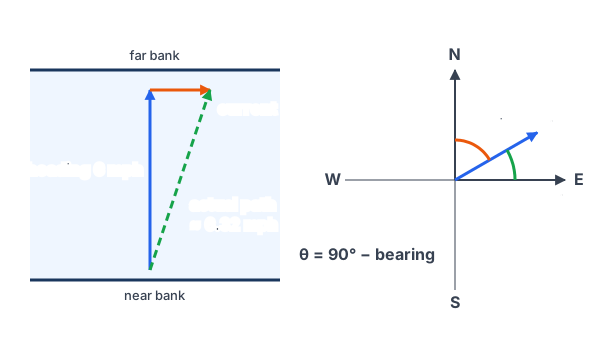
Steps for solving vector word problems
- Sketch the situation and label every vector with its size and direction.
- Write each direction as a standard-position angle, measured counterclockwise from the positive x-axis (east).
- Change each vector to components: \langle \|\vec{v}\|\cos\theta, \|\vec{v}\|\sin\theta \rangle.
- Add the components to find the resultant.
- Find the resultant’s magnitude and direction, and answer in the words of the problem (speed, bearing, newtons).
Navigation problems often give a bearing, an angle measured clockwise from north. Change it with this rule, adding 360° if the answer is negative:
\theta = 90^\circ - \text{bearing}| Bearing | Compass direction | Standard angle |
|---|---|---|
| 0° | North | 90° |
| 90° | East | 0° |
| 180° | South | 270° |
| 270° | West | 180° |
Two more facts finish the toolkit. An object is in equilibrium (it does not move) when all forces add to \langle 0, 0 \rangle. The work done by a constant force F moving an object along a displacement d is W = \vec{F} \cdot \vec{d} = \|\vec{F}\|\,\|\vec{d}\|\cos\theta.
Vector word problems examples
Example 1: A boat crossing a river
A boat heads due north at 6 mph through the water. The current flows due east at 2 mph. Find the boat’s actual speed and direction.
\vec{b} = \langle 0, 6 \rangleThe boat’s own velocity points north, the positive y-direction.
\vec{c} = \langle 2, 0 \rangleThe current points east, the positive x-direction.
\vec{b} + \vec{c} = \langle 2, 6 \rangleAdd the components (see adding vectors).
\|\vec{b} + \vec{c}\| = \sqrt{2^2 + 6^2}Use the magnitude formula.
\|\vec{b} + \vec{c}\| = \sqrt{40}Square and add: 4 + 36 = 40.
\|\vec{b} + \vec{c}\| \approx 6.32Round to the nearest hundredth.
\alpha = \tan^{-1}\left(\frac{2}{6}\right)Find the angle east of north. In the right triangle, 2 is opposite this angle and 6 is next to it (see solving right triangles).
\alpha \approx 18.4^\circ
Use a calculator in degree mode.
Answer: the boat moves at about 6.32 mph, 18.4° east of north (a bearing of about 18.4°).
Example 2: A plane in the wind
A plane flies with an airspeed of 400 mph on a heading of 60° (a bearing). A 50 mph wind blows toward the north. Find the plane’s ground speed and its actual bearing.
\theta_p = 90^\circ - 60^\circ = 30^\circ
Change the bearing 60° to a standard angle for the plane, \theta_p.
\vec{p} = \langle 400\cos 30^\circ, 400\sin 30^\circ \rangleWrite the plane’s velocity in component form.
\vec{p} = \langle 200\sqrt{3}, 200 \rangleUse \cos 30^\circ = \frac{\sqrt{3}}{2} and \sin 30^\circ = \frac{1}{2} (see trig values of special angles).
\vec{p} \approx \langle 346.41, 200 \rangleChange to decimals.
\vec{w} = \langle 0, 50 \rangleThe wind blows toward the north.
\vec{p} + \vec{w} \approx \langle 346.41, 250 \rangleAdd the components.
\|\vec{p} + \vec{w}\| \approx \sqrt{346.41^2 + 250^2}Use the magnitude formula.
\|\vec{p} + \vec{w}\| \approx \sqrt{182500}Square and add. (Exactly, (200\sqrt{3})^2 = 120000.)
\|\vec{p} + \vec{w}\| \approx 427.20Take the square root.
\theta \approx \tan^{-1}\left(\frac{250}{346.41}\right)Both components are positive, so the angle is in Quadrant I.
\theta \approx 35.8^\circ
Use a calculator in degree mode. This is the standard angle.
\text{bearing} \approx 90^\circ - 35.8^\circ = 54.2^\circChange back to a bearing.
Answer: the ground speed is about 427.20 mph on a bearing of about 54.2°. The wind pushed the plane 5.8° to the left of its heading and sped it up.
Example 3: Forces in equilibrium
Two forces act on a ring: \vec{F}_1 = \langle 30, 10 \rangle and \vec{F}_2 = \langle -12, 25 \rangle, in newtons. What third force keeps the ring from moving?
\vec{F}_1 + \vec{F}_2 = \langle 30 + (-12), 10 + 25 \rangleAdd the two given forces.
\vec{F}_1 + \vec{F}_2 = \langle 18, 35 \rangleSimplify.
\vec{F}_3 = -\langle 18, 35 \rangleFor equilibrium, all three forces add to zero, so the third force is the opposite of the sum.
\vec{F}_3 = \langle -18, -35 \rangleChange the sign of each component.
\|\vec{F}_3\| = \sqrt{(-18)^2 + (-35)^2}Use the magnitude formula.
\|\vec{F}_3\| = \sqrt{1549}Square and add: 324 + 1225 = 1549.
\|\vec{F}_3\| \approx 39.36Round to the nearest hundredth.
Answer: \vec{F}_3 = \langle -18, -35 \rangle, a force of about 39.36 N pointing down and to the left.
Example 4: Work done pulling a wagon
A student pulls a wagon 30 meters along flat ground. She pulls the handle with a force of 50 newtons at 25° above the ground. How much work does she do?
W = \|\vec{F}\|\,\|\vec{d}\|\cos\thetaUse the work formula, which comes from the dot product.
W = 50(30)\cos 25^\circ
Substitute the force, the distance and the angle between them.
W = 1500\cos 25^\circ
Multiply 50 by 30.
W \approx 1500(0.9063)
Find the cosine in degree mode.
W \approx 1359
Multiply, and round to the nearest joule.
Answer: about 1,359 joules. Only the part of the force along the ground, 50\cos 25^\circ, does work. The upward part lifts on the handle but does not move the wagon forward.
Example 5: A ship sailing two legs
A ship sails 40 km on a bearing of 120°, then 25 km on a bearing of 210°. How far is it from its starting point, and on what bearing?
\theta_1 = 90^\circ - 120^\circ + 360^\circ = 330^\circ
Change the first bearing to a standard angle. Add 360° because 90° − 120° is negative.
\theta_2 = 90^\circ - 210^\circ + 360^\circ = 240^\circ
Change the second bearing the same way.
\vec{a} = \langle 40\cos 330^\circ, 40\sin 330^\circ \rangle \approx \langle 34.641, -20 \rangleWrite the first leg in components.
\vec{b} = \langle 25\cos 240^\circ, 25\sin 240^\circ \rangle \approx \langle -12.5, -21.651 \rangleWrite the second leg in components.
\vec{a} + \vec{b} \approx \langle 22.141, -41.651 \rangleAdd the components.
\|\vec{a} + \vec{b}\| \approx \sqrt{22.141^2 + (-41.651)^2}Use the magnitude formula.
\|\vec{a} + \vec{b}\| \approx 47.17Square, add and take the root.
\theta_R \approx \tan^{-1}\left(\frac{41.651}{22.141}\right) \approx 62.0^\circFind the reference angle. The sum is in Quadrant IV.
\theta \approx 360^\circ - 62.0^\circ = 298.0^\circ
Find the standard angle in Quadrant IV.
\text{bearing} \approx 90^\circ - 298.0^\circ + 360^\circ = 152.0^\circChange back to a bearing.
Answer: the ship is about 47.17 km from its start, on a bearing of about 152.0°. The two legs happen to meet at a right angle, so \sqrt{40^2 + 25^2} \approx 47.17 confirms the distance.
Common mistakes
| Mistake | Example of the error | Fix |
|---|---|---|
| Using a bearing as a standard angle | Writing a 60° bearing as \langle 400\cos 60^\circ, 400\sin 60^\circ \rangle | Change it first: \theta = 90^\circ - 60^\circ = 30^\circ. |
| Adding speeds that point different ways | Ground speed = 400 + 50 = 450 mph | Add the components, then take the magnitude: about 427.20 mph. |
| Misreading where the wind comes from | “A wind from the west” drawn pointing west | Winds are named for where they come from. A west wind blows toward the east. |
| Giving the resultant for an equilibrium force | Answering \langle 18, 35 \rangle in Example 3 | The balancing force is the opposite: \langle -18, -35 \rangle. |
| Using the full force for work | W = 50(30) = 1500 J for a pull at 25° | Multiply by \cos 25^\circ; only the part along the motion does work. |
| Rounding the components too soon | Using \langle 35, -20 \rangle and \langle -13, -22 \rangle in Example 5 | Keep 3 decimal places until the last step. |
Related methods
The triangle method
A two-leg trip makes a triangle. When you know two sides and the angle between them, the law of cosines gives the third side, and the law of sines gives the angles. Components are usually faster when there are three or more vectors.
Work with components
If the force and displacement are given as components, find the dot product directly. A force \langle 5, 2 \rangle N moving an object along \langle 8, 0 \rangle m does 5(8) + 2(0) = 40 J of work.
Practice problems
- A swimmer heads due east at 3 km/h across a river that flows due south at 1.5 km/h. Find the swimmer’s actual speed and the angle south of east.
- Write the standard-position angle for a bearing of 300°.
- A plane flies due east (bearing 90°) at 250 mph. A 30 mph wind blows toward the south. Find the ground speed and the actual bearing.
- Forces \langle 15, -8 \rangle and \langle -5, 20 \rangle newtons act on an object. Find the resultant force and its magnitude.
- Forces \langle 40, 0 \rangle and \langle 0, -30 \rangle newtons act on a sign. Find the force that holds it in equilibrium, and its magnitude.
- A force \vec{F} = \langle 6, 8 \rangle newtons moves a box along \vec{d} = \langle 10, 0 \rangle meters. Find the work done.
- You push a lawn mower 20 meters with a force of 80 newtons directed 40° below the horizontal. Find the work done.
- Forces of 25 N at a standard angle of 30° and 40 N at 150° act on a point. Find the magnitude and direction of the resultant.
- A hiker walks 3 km due north, then 4 km due east. Find her distance and bearing from the start.
- A boat can go 5 mph in still water. The current flows east at 3 mph. At what angle west of north should the boat head to travel straight north, and what is its speed over the ground?
Show answers
1.
\vec{r} = \langle 3, -1.5 \rangleEast is positive x and south is negative y.
\|\vec{r}\| = \sqrt{3^2 + (-1.5)^2}Use the magnitude formula.
\|\vec{r}\| = \sqrt{11.25}Square and add: 9 + 2.25 = 11.25.
\|\vec{r}\| \approx 3.35Round to the nearest hundredth.
\alpha = \tan^{-1}\left(\frac{1.5}{3}\right)The angle south of east has opposite side 1.5 and adjacent side 3.
\alpha \approx 26.6^\circ
Use a calculator in degree mode.
Answer: about 3.35 km/h, 26.6° south of east.
2.
90^\circ - 300^\circ = -210^\circ
Use \theta = 90^\circ - \text{bearing}. The result is negative.
-210^\circ + 360^\circ = 150^\circ
Add 360° to get an angle from 0° to 360°.
Answer: 150° (northwest).
3.
\vec{g} = \langle 250, -30 \rangleAdd the plane \langle 250, 0 \rangle and the wind \langle 0, -30 \rangle.
\|\vec{g}\| = \sqrt{250^2 + (-30)^2}Use the magnitude formula.
\|\vec{g}\| = \sqrt{63400}Square and add: 62500 + 900 = 63400.
\|\vec{g}\| \approx 251.79Take the square root.
\alpha = \tan^{-1}\left(\frac{30}{250}\right) \approx 6.8^\circThe wind turns the plane south of east by this angle.
\text{bearing} \approx 90^\circ + 6.8^\circ = 96.8^\circSouth of east means clockwise past 90°, so add.
Answer: about 251.79 mph on a bearing of about 96.8°.
4.
\vec{R} = \langle 15 + (-5), -8 + 20 \rangleAdd the components.
\vec{R} = \langle 10, 12 \rangleSimplify.
\|\vec{R}\| = \sqrt{10^2 + 12^2}Use the magnitude formula.
\|\vec{R}\| = \sqrt{244}Square and add: 100 + 144 = 244.
\|\vec{R}\| \approx 15.62Round to the nearest hundredth.
Answer: \langle 10, 12 \rangle, about 15.62 N.
5.
\vec{R} = \langle 40, -30 \rangleAdd the two given forces.
\vec{E} = \langle -40, 30 \rangleThe equilibrium force is the opposite of the resultant.
\|\vec{E}\| = \sqrt{(-40)^2 + 30^2}Use the magnitude formula.
\|\vec{E}\| = \sqrt{2500}Square and add: 1600 + 900 = 2500.
\|\vec{E}\| = 50Take the square root.
Answer: \langle -40, 30 \rangle, a force of 50 N.
6.
W = \vec{F} \cdot \vec{d}Work is the dot product of force and displacement.
W = 6(10) + 8(0)
Multiply matching components and add.
W = 60
Simplify.
Answer: 60 joules
7.
W = \|\vec{F}\|\,\|\vec{d}\|\cos\thetaUse the work formula. The angle between the push and the motion is 40°.
W = 80(20)\cos 40^\circ
Substitute.
W = 1600\cos 40^\circ
Multiply 80 by 20.
W \approx 1600(0.7660)
Find the cosine in degree mode.
W \approx 1226
Multiply, and round to the nearest joule.
Answer: about 1,226 joules
8.
\vec{a} \approx \langle 21.651, 12.5 \rangle\langle 25\cos 30^\circ, 25\sin 30^\circ \rangle
\vec{b} \approx \langle -34.641, 20 \rangle\langle 40\cos 150^\circ, 40\sin 150^\circ \rangle
\vec{a} + \vec{b} \approx \langle -12.990, 32.5 \rangleAdd the components.
\|\vec{a} + \vec{b}\| \approx \sqrt{(-12.990)^2 + 32.5^2}Use the magnitude formula.
\|\vec{a} + \vec{b}\| \approx 35.00Square, add and take the root.
\theta_R \approx \tan^{-1}\left(\frac{32.5}{12.990}\right) \approx 68.2^\circFind the reference angle. The sum is in Quadrant II.
\theta \approx 180^\circ - 68.2^\circ = 111.8^\circ
Find the standard angle.
Answer: about 35.00 N at a standard angle of about 111.8°.
9.
\vec{r} = \langle 4, 3 \rangleAdd north \langle 0, 3 \rangle and east \langle 4, 0 \rangle.
\|\vec{r}\| = \sqrt{4^2 + 3^2} = 5Use the magnitude formula: \sqrt{25} = 5.
\alpha = \tan^{-1}\left(\frac{4}{3}\right) \approx 53.1^\circThe angle east of north has opposite side 4 and adjacent side 3. A bearing is measured from north, so this is the bearing.
Answer: 5 km on a bearing of about 53.1°.
10.
5\sin\alpha = 3
Let α be the angle west of north. The boat’s westward part, 5\sin\alpha, must cancel the 3 mph current.
\sin\alpha = 0.6
Divide both sides by 5.
\alpha = \sin^{-1}(0.6) \approx 36.9^\circUse the inverse sine in degree mode.
\cos\alpha = 0.8
From \sin^2\alpha + \cos^2\alpha = 1: \cos\alpha = \sqrt{1 - 0.36} = 0.8 (see fundamental trig identities).
5\cos\alpha = 4
The northward part of the boat’s velocity is its ground speed.
Answer: head about 36.9° west of north; the ground speed is 4 mph.
Vector word problems FAQ
How do you solve vector word problems?
Sketch the vectors, change each to components, add them, and turn the resultant back into a magnitude and direction. Then answer in the problem’s units, such as mph or newtons.
What is the difference between heading and course?
The heading is the direction a boat or plane points. The course is the direction it actually travels after wind or current is added.
How do you convert a bearing to a standard angle?
Use \theta = 90^\circ - \text{bearing}, and add 360° if the result is negative. A bearing of 120° becomes 330°.
How do you find work with vectors?
Work is the dot product of force and displacement: W = \vec{F} \cdot \vec{d} = \|\vec{F}\|\,\|\vec{d}\|\cos\theta. With newtons and meters, the answer is in joules.
Summary
- Sketch every vector, then change each to components.
- The resultant is the sum of the vectors; the equilibrium force is its opposite.
- Change bearings with \theta = 90^\circ - \text{bearing} (add 360° if negative), and change back at the end.
- Velocity in a current or wind = own velocity + current or wind velocity.
- Work = \vec{F} \cdot \vec{d} = \|\vec{F}\|\,\|\vec{d}\|\cos\theta.
Previous lesson: Dot Product
Next lesson: Parametric Equations
Back to the Precalculus Index