
Adding and Subtracting Vectors
Adding and subtracting vectors is done one component at a time: \langle a, b \rangle + \langle c, d \rangle = \langle a + c, b + d \rangle, and subtraction works the same way. On a graph, place the tail of the second vector at the tip of the first. The arrow from start to finish is the sum, called the resultant.
Before this lesson: Magnitude and Direction of a Vector and Translations
What it means to add vectors
Think of a vector as a trip. Walk 3 blocks east and 1 block north, then walk 1 block east and 4 blocks north. In total you moved 4 blocks east and 5 blocks north. That total trip is the sum of the two vectors, also called the resultant.
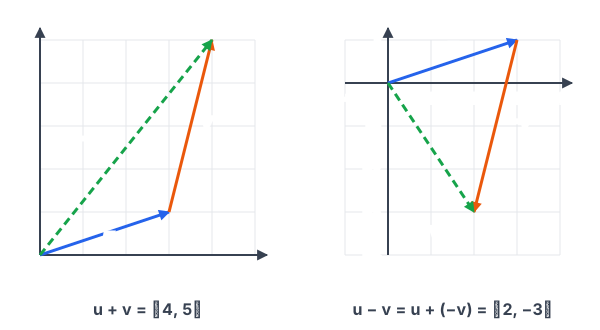
On a graph, this is the tip-to-tail method. Draw the first vector, start the second vector at its tip, and draw an arrow from the first tail to the last tip.
Subtracting works the same way, because \vec{u} - \vec{v} = \vec{u} + (-\vec{v}). The vector -\vec{v} has the same length as \vec{v} but points the opposite way.
Rules for adding, subtracting and scaling vectors
For \vec{u} = \langle a, b \rangle, \vec{v} = \langle c, d \rangle and any real number k:
| Operation | Rule | What it does to the arrow |
|---|---|---|
| Addition | \vec{u} + \vec{v} = \langle a + c, b + d \rangle | Tip to tail; the resultant joins the first tail to the last tip |
| Subtraction | \vec{u} - \vec{v} = \langle a - c, b - d \rangle | Adds the opposite of v |
| Scalar multiplication | k\vec{u} = \langle ka, kb \rangle | Stretches or shrinks the arrow by k; a negative k also flips it |
| Opposite | -\vec{u} = \langle -a, -b \rangle | Same length, opposite direction |
A scalar is a plain number. Multiplying by a scalar changes the length, so \|k\vec{u}\| = |k|\,\|\vec{u}\|. Vector addition is also commutative, so \vec{u} + \vec{v} = \vec{v} + \vec{u}.
Adding and subtracting vectors examples
Example 1: Add two vectors
Find \vec{u} + \vec{v} for \vec{u} = \langle 3, 1 \rangle and \vec{v} = \langle 1, 4 \rangle.
\vec{u} + \vec{v} = \langle 3 + 1, 1 + 4 \rangleAdd the x-components and add the y-components.
\vec{u} + \vec{v} = \langle 4, 5 \rangleAdd.
Answer: \langle 4, 5 \rangle. This is the left graph above: 3 right and 1 up, then 1 right and 4 up, ends at (4, 5).
Example 2: Subtract two vectors
Find \vec{u} - \vec{v} for \vec{u} = \langle 2, -5 \rangle and \vec{v} = \langle -4, 3 \rangle.
\vec{u} - \vec{v} = \langle 2 - (-4), -5 - 3 \rangleSubtract each component of v from the matching component of u.
\vec{u} - \vec{v} = \langle 2 + 4, -5 - 3 \rangleSubtracting −4 is the same as adding 4 (see subtracting integers).
\vec{u} - \vec{v} = \langle 6, -8 \rangleSimplify each component.
Answer: \langle 6, -8 \rangle.
Example 3: Scalar multiples and a combination
Find 3\vec{u} - 2\vec{v} for \vec{u} = \langle 4, -1 \rangle and \vec{v} = \langle -2, 5 \rangle.
3\vec{u} = \langle 3(4), 3(-1) \rangleMultiply each component of u by 3.
3\vec{u} = \langle 12, -3 \rangleMultiply (see multiplying integers).
2\vec{v} = \langle 2(-2), 2(5) \rangleMultiply each component of v by 2.
2\vec{v} = \langle -4, 10 \rangleMultiply.
3\vec{u} - 2\vec{v} = \langle 12 - (-4), -3 - 10 \rangleSubtract the components.
3\vec{u} - 2\vec{v} = \langle 16, -13 \rangleSimplify each component.
Answer: \langle 16, -13 \rangle.
Example 4: Add vectors given by magnitude and direction
Vector a has magnitude 10 and direction angle 30°. Vector b has magnitude 6 and direction angle 120°. Find the magnitude and direction of \vec{a} + \vec{b}.
\vec{a} = \langle 10\cos 30^\circ, 10\sin 30^\circ \rangleWrite a in component form (see magnitude and direction of a vector).
\vec{a} \approx \langle 8.660, 5 \rangleUse \cos 30^\circ \approx 0.8660 and \sin 30^\circ = 0.5.
\vec{b} = \langle 6\cos 120^\circ, 6\sin 120^\circ \rangleWrite b in component form.
\vec{b} \approx \langle -3, 5.196 \rangleUse \cos 120^\circ = -0.5 and \sin 120^\circ \approx 0.8660 (see the unit circle).
\vec{a} + \vec{b} \approx \langle 8.660 + (-3), 5 + 5.196 \rangleAdd the components.
\vec{a} + \vec{b} \approx \langle 5.660, 10.196 \rangleSimplify.
\|\vec{a} + \vec{b}\| \approx \sqrt{5.660^2 + 10.196^2}Use the magnitude formula.
\|\vec{a} + \vec{b}\| \approx \sqrt{135.99}Square each component and add.
\|\vec{a} + \vec{b}\| \approx 11.66Take the square root and round to the nearest hundredth.
\theta \approx \tan^{-1}\left(\frac{10.196}{5.660}\right)Both components are positive, so the sum is in Quadrant I.
\theta \approx 61.0^\circ
Use a calculator in degree mode.
Answer: \vec{a} + \vec{b} has magnitude about 11.66 and direction angle about 61.0°. You cannot just add the lengths (16) or the angles (150°).
Example 5: Word problem with a delivery drone
A drone flies from its base along \langle 4, 3 \rangle, then along \langle -6, 2 \rangle, in kilometers (east and north are positive). Where does it end up, how far is that from the base, and what vector takes it straight home?
\vec{r} = \langle 4 + (-6), 3 + 2 \rangleAdd the two legs to get the resultant r.
\vec{r} = \langle -2, 5 \rangleSimplify. The drone is 2 km west and 5 km north of the base.
\|\vec{r}\| = \sqrt{(-2)^2 + 5^2}Use the magnitude formula.
\|\vec{r}\| = \sqrt{4 + 25}Square each component.
\|\vec{r}\| = \sqrt{29}Add.
\|\vec{r}\| \approx 5.39Round to the nearest hundredth.
-\vec{r} = \langle 2, -5 \rangleThe trip home is the opposite of r.
Answer: the drone ends at (−2, 5), about 5.39 km from the base. Flying \langle 2, -5 \rangle brings it straight home.
Common mistakes
| Mistake | Example of the error | Fix |
|---|---|---|
| Adding the lengths instead of the components | \|\langle 3, 0 \rangle + \langle 0, 4 \rangle\| = 3 + 4 = 7 | Add first: \langle 3, 4 \rangle, whose length is \sqrt{3^2 + 4^2} = 5. |
| Adding the direction angles | 30° and 120° give a sum at 150° | Change both to components, add, then find the new angle (61.0° in Example 4). |
| Dropping a negative sign when subtracting | \langle 2, -5 \rangle - \langle -4, 3 \rangle = \langle -2, -2 \rangle | Subtract each component: \langle 2 + 4, -5 - 3 \rangle = \langle 6, -8 \rangle. |
| Scaling only one component | 3\langle 2, 5 \rangle = \langle 6, 5 \rangle | Multiply both: \langle 6, 15 \rangle. |
| Drawing the sum from tip to tip | Arrows u and v drawn from the same point, with u + v drawn from the tip of v to the tip of u | That arrow is u − v. For u + v, place v at the tip of u, or draw the long diagonal of the parallelogram. |
| Switching the order of subtraction | Finding v − u when asked for u − v | The two answers are opposites, so the order matters. |
Related methods
The parallelogram method
Draw u and v from the same starting point and complete the parallelogram. The diagonal from the shared tail is \vec{u} + \vec{v}. The other diagonal, from the tip of v to the tip of u, is \vec{u} - \vec{v}.
Unit vectors
A unit vector has length 1. To get the unit vector in the direction of v, divide v by its magnitude: \frac{\vec{v}}{\|\vec{v}\|}. For \langle 3, 4 \rangle, the unit vector is \left\langle \frac{3}{5}, \frac{4}{5} \right\rangle.
i and j form
With \mathbf{i} = \langle 1, 0 \rangle and \mathbf{j} = \langle 0, 1 \rangle, add like terms: (3\mathbf{i} + \mathbf{j}) + (\mathbf{i} + 4\mathbf{j}) = 4\mathbf{i} + 5\mathbf{j}. It works just like combining like terms.
Practice problems
- Find \langle 5, -2 \rangle + \langle -1, 7 \rangle.
- Find \langle 3, 8 \rangle - \langle 6, -2 \rangle.
- Find 4\langle -2, 3 \rangle.
- Find -\frac{1}{2}\langle 6, -10 \rangle.
- For \vec{u} = \langle 1, -4 \rangle and \vec{v} = \langle 3, 5 \rangle, find 2\vec{u} + \vec{v}.
- For \vec{u} = \langle 7, 2 \rangle and \vec{v} = \langle 2, -1 \rangle, find \vec{u} - 3\vec{v}.
- For \vec{u} = \langle 2, 6 \rangle and \vec{v} = \langle 4, 2 \rangle, find \|\vec{u} + \vec{v}\|.
- Find the unit vector in the direction of \langle -5, 12 \rangle.
- Find the vector w so that \langle 3, -1 \rangle + \vec{w} = \langle -2, 6 \rangle.
- Two ropes pull on a crate. One pulls with 20 newtons at 0° and the other with 15 newtons at 60°. Find the magnitude and direction of the total force.
Show answers
1.
\langle 5, -2 \rangle + \langle -1, 7 \rangle = \langle 5 + (-1), -2 + 7 \rangle
Add the matching components.
\langle 5, -2 \rangle + \langle -1, 7 \rangle = \langle 4, 5 \rangle
Simplify.
Answer: \langle 4, 5 \rangle
2.
\langle 3, 8 \rangle - \langle 6, -2 \rangle = \langle 3 - 6, 8 - (-2) \rangle
Subtract the matching components.
\langle 3, 8 \rangle - \langle 6, -2 \rangle = \langle -3, 10 \rangle
Simplify. Subtracting −2 adds 2.
Answer: \langle -3, 10 \rangle
3.
4\langle -2, 3 \rangle = \langle 4(-2), 4(3) \rangle
Multiply each component by 4.
4\langle -2, 3 \rangle = \langle -8, 12 \rangle
Multiply.
Answer: \langle -8, 12 \rangle
4.
-\frac{1}{2}\langle 6, -10 \rangle = \left\langle -\frac{1}{2}(6), -\frac{1}{2}(-10) \right\rangleMultiply each component by -\frac{1}{2} (see multiplying fractions).
-\frac{1}{2}\langle 6, -10 \rangle = \langle -3, 5 \rangleMultiply. The arrow is half as long and points the opposite way.
Answer: \langle -3, 5 \rangle
5.
2\vec{u} = \langle 2, -8 \rangleMultiply each component of u by 2.
2\vec{u} + \vec{v} = \langle 2 + 3, -8 + 5 \rangleAdd v.
2\vec{u} + \vec{v} = \langle 5, -3 \rangleSimplify.
Answer: \langle 5, -3 \rangle
6.
3\vec{v} = \langle 6, -3 \rangleMultiply each component of v by 3.
\vec{u} - 3\vec{v} = \langle 7 - 6, 2 - (-3) \rangleSubtract from u.
\vec{u} - 3\vec{v} = \langle 1, 5 \rangleSimplify.
Answer: \langle 1, 5 \rangle
7.
\vec{u} + \vec{v} = \langle 2 + 4, 6 + 2 \rangleAdd the components first.
\vec{u} + \vec{v} = \langle 6, 8 \rangleSimplify.
\|\vec{u} + \vec{v}\| = \sqrt{6^2 + 8^2}Use the magnitude formula.
\|\vec{u} + \vec{v}\| = \sqrt{100}Square and add: 36 + 64 = 100.
\|\vec{u} + \vec{v}\| = 10Take the square root.
Answer: 10
8.
\|\vec{v}\| = \sqrt{(-5)^2 + 12^2}Find the magnitude first.
\|\vec{v}\| = \sqrt{169}Square and add: 25 + 144 = 169.
\|\vec{v}\| = 13Take the square root.
\frac{\vec{v}}{\|\vec{v}\|} = \frac{1}{13}\langle -5, 12 \rangleDivide the vector by its magnitude.
\frac{\vec{v}}{\|\vec{v}\|} = \left\langle -\frac{5}{13}, \frac{12}{13} \right\rangleDivide each component by 13.
Answer: \left\langle -\frac{5}{13}, \frac{12}{13} \right\rangle. Check: \frac{25}{169} + \frac{144}{169} = 1, so its length is 1.
9.
\vec{w} = \langle -2, 6 \rangle - \langle 3, -1 \rangleSubtract \langle 3, -1 \rangle from both sides.
\vec{w} = \langle -2 - 3, 6 - (-1) \rangleSubtract the components.
\vec{w} = \langle -5, 7 \rangleSimplify.
Answer: \langle -5, 7 \rangle
10.
\vec{p} = \langle 20, 0 \rangleThe first rope pulls 20 N along the positive x-axis.
\vec{q} = \langle 15\cos 60^\circ, 15\sin 60^\circ \rangleWrite the second force in component form.
\vec{q} \approx \langle 7.5, 12.990 \rangleUse \cos 60^\circ = 0.5 and \sin 60^\circ \approx 0.8660.
\vec{p} + \vec{q} \approx \langle 27.5, 12.990 \rangleAdd the components.
\|\vec{p} + \vec{q}\| \approx \sqrt{27.5^2 + 12.990^2}Use the magnitude formula.
\|\vec{p} + \vec{q}\| \approx \sqrt{924.99}Square each component and add.
\|\vec{p} + \vec{q}\| \approx 30.41Take the square root.
\theta \approx \tan^{-1}\left(\frac{12.990}{27.5}\right)Both components are positive, so the angle is in Quadrant I.
\theta \approx 25.3^\circ
Use a calculator in degree mode.
Answer: about 30.41 N at a direction angle of about 25.3°.
Adding and subtracting vectors FAQ
How do you add two vectors?
Add the x-components and add the y-components: \langle a, b \rangle + \langle c, d \rangle = \langle a + c, b + d \rangle. On a graph, place them tip to tail and draw the resultant from the first tail to the last tip.
How do you subtract vectors?
Subtract the matching components, or add the opposite: \vec{u} - \vec{v} = \vec{u} + (-\vec{v}). Order matters, since \vec{v} - \vec{u} is the opposite of \vec{u} - \vec{v}.
What is a resultant vector?
It is the single vector equal to the sum of two or more vectors. It has the same effect as all of them together, like one trip that replaces several legs.
How do you find a unit vector?
Divide the vector by its magnitude. The result points the same way and has length 1, as in \frac{1}{13}\langle -5, 12 \rangle.
Summary
- Add or subtract vectors one component at a time.
- On a graph, add tip to tail; the resultant runs from the first tail to the last tip.
- Subtracting v is adding -\vec{v}, the same length pointing the opposite way.
- A scalar k multiplies every component and stretches the vector by |k|; a negative k flips it.
- To add vectors given by magnitude and direction, change them to components first.
Previous lesson: Magnitude and Direction of a Vector
Next lesson: Dot Product
Back to the Precalculus Index