
Parametric Equations
Parametric equations describe a curve with two equations, x = f(t) and y = g(t), that share a third variable t, called the parameter. Each value of t gives one point (x, y). Plotting the points in order of t shows the curve and the direction it is traced. Eliminating t gives one equation in x and y.
Before this lesson: Function Notation, Graphing Quadratic Functions, Ellipses and Fundamental Trig Identities
What parametric equations describe
Picture an ant walking across a sheet of graph paper. An equation like y = x^2 shows the path, but not where the ant is at each moment. Parametric equations give both: x and y are each written in terms of t, which often stands for time.
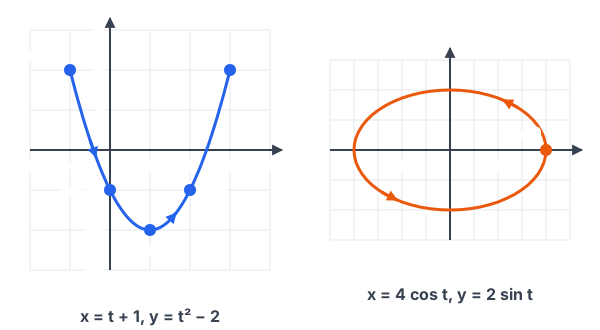
Because t moves forward, a parametric curve has a direction, called its orientation. We show it with arrows on the graph.
Parametric equations can also draw curves that are not functions, such as circles and ellipses, because x and y are handled separately.
How to graph and eliminate the parameter
To graph: make a table with columns t, x and y. Choose several values of t, find x and y for each, plot the points and connect them in order of t. Draw arrows in the direction of increasing t.
To eliminate the parameter (write one equation in x and y), use one of two methods:
| Method | When to use it | How |
|---|---|---|
| Solve and substitute | One equation is easy to solve for t | Solve that equation for t, then substitute into the other equation. |
| Use an identity | The equations use \cos t and \sin t | Solve for \cos t and \sin t, then use \cos^2 t + \sin^2 t = 1. |
Watch for limits on x or y. If x = \sqrt{t}, then x can never be negative, so the x-y equation only describes part of its graph.
Parametric equations examples
Example 1: Graph a curve from a table
Graph x = t + 1 and y = t^2 - 2 for -2 \le t \le 2.
| t | x = t + 1 | y = t² − 2 | Point |
|---|---|---|---|
| −2 | −1 | 2 | (−1, 2) |
| −1 | 0 | −1 | (0, −1) |
| 0 | 1 | −2 | (1, −2) |
| 1 | 2 | −1 | (2, −1) |
| 2 | 3 | 2 | (3, 2) |
x = -2 + 1 = -1
For t = −2, substitute into x = t + 1.
y = (-2)^2 - 2 = 2
For t = −2, substitute into y = t^2 - 2. Square first, then subtract.
x = 0 + 1 = 1
For t = 0, find x.
y = 0^2 - 2 = -2
For t = 0, find y.
Answer: plot the five points and connect them in order. The curve is a parabola with its lowest point at (1, −2), traced from left to right (left graph above). The other rows of the table work the same way.
Example 2: Eliminate the parameter from a line
Eliminate the parameter: x = 2t - 3 and y = 4t + 1.
x = 2t - 3
Start with the equation that is easier to solve for t.
x + 3 = 2t
Add 3 to both sides.
t = \frac{x + 3}{2}Divide both sides by 2 (see literal equations).
y = 4\left(\frac{x + 3}{2}\right) + 1Substitute for t in the y-equation.
y = 2(x + 3) + 1
Simplify: 4 divided by 2 is 2.
y = 2x + 6 + 1
Distribute the 2 (see distributive property).
y = 2x + 7
Combine like terms.
Answer: y = 2x + 7, a line with slope 2.
Example 3: Eliminate the parameter from a parabola
Eliminate the parameter from Example 1: x = t + 1 and y = t^2 - 2.
t = x - 1
Solve x = t + 1 for t by subtracting 1 from both sides.
y = (x - 1)^2 - 2
Substitute for t in the y-equation.
y = x^2 - 2x + 1 - 2
Square the binomial (see special products of binomials).
y = x^2 - 2x - 1
Combine like terms.
Answer: y = (x - 1)^2 - 2, or y = x^2 - 2x - 1. The vertex form shows the vertex (1, −2), which matches the graph. Since t only ran from −2 to 2, the graph is the part of this parabola from x = −1 to x = 3.
Example 4: Eliminate the parameter with an identity
Eliminate the parameter: x = 4\cos t and y = 2\sin t for 0 \le t \lt 2\pi.
\cos t = \frac{x}{4}Divide the x-equation by 4.
\sin t = \frac{y}{2}Divide the y-equation by 2.
\cos^2 t + \sin^2 t = 1
Use the Pythagorean identity (see fundamental trig identities).
\left(\frac{x}{4}\right)^2 + \left(\frac{y}{2}\right)^2 = 1Substitute for \cos t and \sin t.
\frac{x^2}{16} + \frac{y^2}{4} = 1Square each fraction.
Answer: \frac{x^2}{16} + \frac{y^2}{4} = 1, an ellipse centered at the origin. At t = 0 the point is (4, 0), and at t = \frac{\pi}{2} it is (0, 2), so the curve is traced counterclockwise once.
Example 5: Word problem with a crawling bug
A bug crawls on a grid so that its position after t seconds is x = 2 + 3t and y = 1 + 4t, in centimeters. Where is it after 2 seconds, how far has it gone, and when does it reach the line x = 11?
x = 2 + 3(2) = 8
Substitute t = 2 into the x-equation.
y = 1 + 4(2) = 9
Substitute t = 2 into the y-equation.
d = \sqrt{(8 - 2)^2 + (9 - 1)^2}At t = 0 the bug was at (2, 1). Use the distance formula.
d = \sqrt{36 + 64}Subtract and square.
d = 10
Add and take the square root: \sqrt{100} = 10.
2 + 3t = 11
Set x equal to 11.
3t = 9
Subtract 2 from both sides.
t = 3
Divide both sides by 3.
y = 1 + 4(3) = 13
Find y at t = 3.
Answer: after 2 seconds the bug is at (8, 9), 10 cm from where it started (a speed of 5 cm per second). It reaches x = 11 at t = 3 seconds, at the point (11, 13).
Common mistakes
| Mistake | Example of the error | Fix |
|---|---|---|
| Connecting points out of order or leaving off arrows | A graph of x = t + 1, y = t^2 - 2 with no direction shown | Plot in order of increasing t and draw arrows that way. |
| Substituting the wrong expression | Using t = x + 1 for x = t + 1 | Solve correctly: subtract 1 to get t = x - 1. |
| Forgetting to square the whole binomial | (x - 1)^2 = x^2 + 1 | (x - 1)^2 = x^2 - 2x + 1. |
| Squaring only the top of a fraction | \left(\frac{x}{4}\right)^2 = \frac{x^2}{4} | Square the top and bottom: \frac{x^2}{16}. |
| Ignoring limits on x | Writing y = 4 - x^2 for x = \sqrt{t} with no restriction | Add x \ge 0, since a square root is never negative. |
| Thinking the parameter must be time | Refusing to use t as an angle in x = 4\cos t | t can be any variable that links x and y, including an angle. |
Related forms
Writing parametric equations for a graph
Any function y = f(x) can be written in parametric form by letting x = t and y = f(t). For y = x^2 + 1, use x = t and y = t^2 + 1.
A line through two points
The segment from (x_1, y_1) to (x_2, y_2) is x = x_1 + (x_2 - x_1)t and y = y_1 + (y_2 - y_1)t for 0 \le t \le 1. This is the starting point plus t times the vector between the points (see adding and subtracting vectors).
Polar curves
A polar curve r = f(\theta) is a parametric curve in disguise: x = f(\theta)\cos\theta and y = f(\theta)\sin\theta.
Practice problems
- Make a table and list the points for x = 2t and y = t + 3 when t = −1, 0, 1 and 2.
- Eliminate the parameter: x = t - 4 and y = 3t.
- Eliminate the parameter: x = 5 - t and y = 2t + 1.
- Eliminate the parameter: x = t + 2 and y = t^2.
- Eliminate the parameter: x = 2\cos t and y = 2\sin t.
- Eliminate the parameter: x = 5\cos t and y = 3\sin t.
- Eliminate the parameter and state any limit on x: x = \sqrt{t} and y = 4 - t.
- Find the point on x = t^2 - 1, y = 2t + 5 when t = 3.
- Write parametric equations for the segment from (1, 2) to (7, 5), with 0 \le t \le 1.
- A drone’s position after t seconds is x = 10 + 4t and y = 30 - 3t, in meters. When does it reach x = 30, where is it then, and how far has it flown?
Show answers
1.
x = 2(-1) = -2
For t = −1, find x.
y = -1 + 3 = 2
For t = −1, find y.
x = 2(0) = 0
For t = 0.
y = 0 + 3 = 3
For t = 0.
x = 2(1) = 2
For t = 1.
y = 1 + 3 = 4
For t = 1.
x = 2(2) = 4
For t = 2.
y = 2 + 3 = 5
For t = 2.
Answer: (−2, 2), (0, 3), (2, 4), (4, 5). The points lie on a line traced up and to the right.
2.
t = x + 4
Add 4 to both sides of x = t − 4.
y = 3(x + 4)
Substitute for t.
y = 3x + 12
Distribute.
Answer: y = 3x + 12
3.
t = 5 - x
Solve x = 5 − t for t: add t to both sides and subtract x.
y = 2(5 - x) + 1
Substitute for t.
y = 10 - 2x + 1
Distribute.
y = -2x + 11
Combine like terms.
Answer: y = -2x + 11
4.
t = x - 2
Subtract 2 from both sides of x = t + 2.
y = (x - 2)^2
Substitute for t.
Answer: y = (x - 2)^2, a parabola with vertex (2, 0).
5.
\cos t = \frac{x}{2}Divide the x-equation by 2.
\sin t = \frac{y}{2}Divide the y-equation by 2.
\frac{x^2}{4} + \frac{y^2}{4} = 1Substitute into \cos^2 t + \sin^2 t = 1.
x^2 + y^2 = 4
Multiply both sides by 4.
Answer: x^2 + y^2 = 4, a circle of radius 2 (see equation of a circle).
6.
\cos t = \frac{x}{5}Divide the x-equation by 5.
\sin t = \frac{y}{3}Divide the y-equation by 3.
\frac{x^2}{25} + \frac{y^2}{9} = 1Substitute into \cos^2 t + \sin^2 t = 1 and square each fraction.
Answer: \frac{x^2}{25} + \frac{y^2}{9} = 1, an ellipse.
7.
t = x^2
Square both sides of x = \sqrt{t}.
y = 4 - x^2
Substitute for t.
Answer: y = 4 - x^2 with x \ge 0, the right half of a downward parabola.
8.
x = 3^2 - 1 = 8
Substitute t = 3 into the x-equation.
y = 2(3) + 5 = 11
Substitute t = 3 into the y-equation.
Answer: (8, 11)
9.
x = 1 + (7 - 1)t
Start at x = 1 and add t times the change in x.
x = 1 + 6t
Subtract.
y = 2 + (5 - 2)t
Start at y = 2 and add t times the change in y.
y = 2 + 3t
Subtract.
Answer: x = 1 + 6t, y = 2 + 3t, for 0 \le t \le 1. At t = 1 the point is (7, 5).
10.
10 + 4t = 30
Set x equal to 30.
4t = 20
Subtract 10 from both sides.
t = 5
Divide both sides by 4.
y = 30 - 3(5) = 15
Find y at t = 5.
d = \sqrt{(30 - 10)^2 + (15 - 30)^2}The drone started at (10, 30). Use the distance formula.
d = \sqrt{400 + 225}Subtract and square.
d = 25
Add and take the square root: \sqrt{625} = 25.
Answer: at t = 5 seconds, at (30, 15), after flying 25 m.
Parametric equations FAQ
What is a parameter?
It is the extra variable, usually t, that both x and y depend on. It often stands for time, but it can also be an angle or any other quantity.
How do you eliminate the parameter?
Solve one equation for t and substitute into the other. When the equations use sine and cosine, solve for \cos t and \sin t and use \cos^2 t + \sin^2 t = 1.
Why use parametric equations instead of y = f(x)?
They show where an object is at each time and which way it moves. They can also draw curves that fail the vertical line test, like circles.
What does the orientation of a parametric curve mean?
It is the direction the curve is traced as t increases. Show it with arrows on the graph.
Summary
- Parametric equations give x and y separately in terms of a parameter t.
- Graph them with a table of t, x and y, and show the orientation with arrows.
- Eliminate t by solving and substituting, or with \cos^2 t + \sin^2 t = 1.
- Check for limits on x or y, such as x \ge 0 when x = \sqrt{t}.
- The segment from one point to another is the start point plus t times the change, for 0 \le t \le 1.
Previous lesson: Vector Word Problems
Next lesson: Projectile Motion with Parametric Equations
Back to the Precalculus Index