
Graphing Polar Equations
Graphing polar equations means plotting every point (r, \theta) that makes an equation like r = 2 + 2 \cos \theta true. Make a table of \theta and r values, plot the points on a polar grid, and connect them in order. Learn the common shapes: circles, rose curves, cardioids and limaçons.
Before this lesson: You should know Polar Coordinates, The Unit Circle and Graphs of Sine and Cosine.
How Polar Graphs Work
In a polar equation, r depends on \theta. As the angle sweeps around from 0 to 2\pi, the distance from the pole grows and shrinks. The curve traces where those points land.
If r comes out negative, plot the point in the opposite direction. For example, r = -3 at \theta = \frac{\pi}{2} lands 3 units straight down, not up.
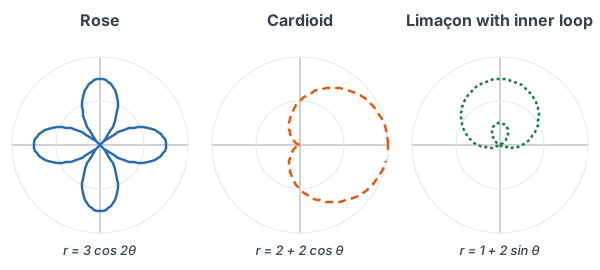
Common Polar Graphs
| Equation | Shape | Key facts |
|---|---|---|
| r = a | Circle at the pole | Radius \lvert a \rvert |
| \theta = \alpha | Line through the pole | Makes angle \alpha with the polar axis |
| r = a \cos \theta or r = a \sin \theta | Circle through the pole | Diameter \lvert a \rvert |
| r = a \cos n\theta or r = a \sin n\theta | Rose curve | n petals if n is odd, 2n if n is even; petal length \lvert a \rvert |
| r = a + a \cos \theta (or with \sin, or minus) | Cardioid | Heart shape that touches the pole |
| r = a + b \cos \theta (or with \sin) | Limaçon | Inner loop if \lvert a \rvert \lt \lvert b \rvert; dimple if \lvert b \rvert \lt \lvert a \rvert \lt 2\lvert b \rvert; no dimple if \lvert a \rvert \ge 2\lvert b \rvert |
Symmetry shortcuts
- Equations with \cos \theta are symmetric about the polar axis (the x-axis), because \cos(-\theta) = \cos \theta.
- Equations with \sin \theta are symmetric about the line \theta = \frac{\pi}{2} (the y-axis).
- Use symmetry to plot half the points, then mirror them.
Steps for Graphing a Polar Equation
- Identify the shape from the table above, if you can.
- Make a table of values for \theta from 0 to 2\pi, using unit circle angles.
- Plot each point (r, \theta). For a negative r, go the opposite way.
- Connect the points in order of \theta, and use symmetry to check.
Worked Examples
Example 1: A circle through the pole
Graph r = 4 \sin \theta.
Make a table for 0 \le \theta \le \pi: at \theta = 0, r = 4 \sin 0 = 0
r = 4 \cdot \frac{1}{2} = 2At \theta = \frac{\pi}{6}.
r = 4 \cdot \frac{\sqrt{3}}{2} = 2\sqrt{3} \approx 3.46At \theta = \frac{\pi}{3}.
r = 4 \cdot 1 = 4
At \theta = \frac{\pi}{2}.
At \theta = \frac{5\pi}{6} and \theta = \pi, the values repeat in reverse: r = 2, then r = 0
Plot and connect: the points form a circle through the pole, reaching up to (4, \frac{\pi}{2})
Answer: a circle with diameter 4, centered at (0, 2) in rectangular coordinates. From \pi to 2\pi, r is negative and the graph traces the same circle again.
Example 2: A cardioid
Graph r = 2 + 2 \cos \theta.
Identify the shape: a = b = 2, so it is a cardioid, symmetric about the polar axis
r = 2 + 2(1) = 4
At \theta = 0.
r = 2 + 2 \cdot \frac{1}{2} = 3At \theta = \frac{\pi}{3}.
r = 2 + 2(0) = 2
At \theta = \frac{\pi}{2}.
r = 2 + 2(-\frac{1}{2}) = 1At \theta = \frac{2\pi}{3}.
At \theta = \pi: r = 2 + 2(-1) = 0, so the curve touches the pole
Mirror these points across the polar axis for \pi \lt \theta \lt 2\pi
Answer: a heart shape that reaches 4 on the right and has its point at the pole, as in the middle graph above.
Example 3: A rose curve
Graph r = 3 \cos 2\theta.
Identify the shape: a rose with n = 2. Since n is even, there are 2n = 4 petals, each 3 long
At \theta = 0: r = 3 \cos 0 = 3, the tip of a petal on the polar axis
r = 3 \cos \frac{\pi}{3} = 1.5At \theta = \frac{\pi}{6}.
r = 3 \cos \frac{\pi}{2} = 0At \theta = \frac{\pi}{4} (back at the pole).
At \theta = \frac{\pi}{2}: r = 3 \cos \pi = -3. Plot it 3 units in the opposite direction, straight down
Keep going around: the petals point along \theta = 0, \frac{\pi}{2}, \pi, \frac{3\pi}{2}
Answer: a four-petal rose with petal tips 3 units out on each axis, as in the left graph above.
Example 4: A limaçon with an inner loop
Graph r = 1 + 2 \sin \theta.
Identify the shape: a = 1 and b = 2, and 1 \lt 2, so it is a limaçon with an inner loop, symmetric about \theta = \frac{\pi}{2}
Find the largest r: at \theta = \frac{\pi}{2}, r = 1 + 2(1) = 3
Find where it passes through the pole: 1 + 2 \sin \theta = 0, so \sin \theta = -\frac{1}{2} and \theta = \frac{7\pi}{6}, \frac{11\pi}{6}
Between those angles, r is negative. At \theta = \frac{3\pi}{2}: r = 1 + 2(-1) = -1, which plots 1 unit straight up
r = 1 + 2(0) = 1
At \theta = 0 and \theta = \pi.
Answer: a large loop reaching 3 at the top, with a small inner loop that reaches 1 above the pole, as in the right graph above.
Example 5: Word problem with a microphone
A cardioid microphone picks up a singer within r = 5 + 5 \cos \theta feet, where \theta = 0 points straight out the front. How far away can the singer be when standing in front, to the side (\theta = \frac{\pi}{2}), behind, and at \theta = \frac{\pi}{3}?
r = 5 + 5(1) = 10
In front, \theta = 0 (feet).
r = 5 + 5(0) = 5
To the side, \theta = \frac{\pi}{2} (feet).
r = 5 + 5(-1) = 0
Behind, \theta = \pi (feet).
r = 5 + 5 \cdot \frac{1}{2} = 7.5At \theta = \frac{\pi}{3} (feet).
Answer: 10 ft in front, 5 ft to the side, 7.5 ft at \frac{\pi}{3}, and none from directly behind. That is why these microphones block noise from the back.
Common Mistakes
| Mistake | Example of the error | Fix |
|---|---|---|
| Plotting negative r on the same ray | Plotting r = -3 at \theta = \frac{\pi}{2} as 3 units up | Negative r goes the opposite way: 3 units down. |
| Wrong number of petals | Saying r = 3 \cos 2\theta has 2 petals | If n is even, there are 2n petals: 4. |
| Too few points | Plotting only \theta = 0, \frac{\pi}{2}, \pi, \frac{3\pi}{2} | Use steps of \frac{\pi}{6} or smaller so you see the shape. |
| Mixing up the limaçon types | Calling r = 1 + 2 \sin \theta a cardioid | A cardioid needs \lvert a \rvert = \lvert b \rvert. Here 1 \lt 2, so there is an inner loop. |
| Stopping at \pi | Graphing a cardioid only for 0 \le \theta \le \pi | Most curves need 0 \le \theta \lt 2\pi. Use symmetry to fill in the rest. |
Related Methods
Convert to rectangular form
Circles are easy to check by converting. Multiply r = 4 \sin \theta by r to get x^2 + y^2 = 4y, a circle, as shown in polar coordinates.
Use a graphing calculator
Set the calculator to polar mode, enter r as a function of \theta, and set \theta from 0 to 2\pi. Compare the screen with your hand-drawn sketch.
Think of it like a sine graph
The table of r values follows the same ups and downs as the sine and cosine graphs. Picture r against \theta first, then wrap that graph around the pole.
Practice Problems
- Name the graph of r = 5.
- Name the graph of \theta = \frac{\pi}{3}.
- Name the graph of r = 6 \cos \theta and give its center and radius in rectangular coordinates.
- How many petals does r = 4 \sin 3\theta have, and how long is each?
- How many petals does r = 2 \cos 4\theta have?
- Name the graph of r = 3 - 3 \sin \theta. Find its largest r and the angle where it happens.
- Name the graph of r = 2 + 4 \cos \theta and find where it passes through the pole on [0, 2\pi).
- Name the graph of r = 4 + 2 \cos \theta. Find its largest and smallest r.
- For r = 2 \sin 2\theta, find r at \theta = \frac{\pi}{12}, \frac{\pi}{4}, \frac{5\pi}{12}, \frac{\pi}{2}.
- A microphone picks up sound within r = 4 + 4 \cos \theta feet. How far away can a singer be at \theta = \frac{2\pi}{3}? At \theta = \frac{\pi}{4}?
Show answers
1.
r is always 5, at every angle
Answer: a circle centered at the pole with radius 5
2.
Every point has angle \frac{\pi}{3}, with any r, positive or negative
Answer: a line through the pole at angle \frac{\pi}{3}
3.
r^2 = 6r \cos \theta
Multiply by r.
x^2 + y^2 = 6x
Replace r squared with x squared plus y squared, and r cos θ with x.
x^2 - 6x + 9 + y^2 = 9
Complete the square.
(x - 3)^2 + y^2 = 9
Factor the perfect square.
Answer: a circle through the pole, center (3, 0), radius 3
4.
n = 3 is odd, so there are 3 petals
Petal length is \lvert a \rvert = 4
Answer: 3 petals, each 4 long
5.
n = 4 is even, so there are 2n = 2 \cdot 4 = 8 petals
Answer: 8 petals, each 2 long
6.
a = b = 3, so it is a cardioid, symmetric about \theta = \frac{\pi}{2}
r = 3 - 3(-1) = 6
r is largest when \sin \theta = -1, at \theta = \frac{3\pi}{2}.
Answer: a cardioid with largest r = 6 at \theta = \frac{3\pi}{2}
7.
\lvert a \rvert = 2 \lt \lvert b \rvert = 4, so it is a limaçon with an inner loop
2 + 4 \cos \theta = 0
Set r = 0.
\cos \theta = -\frac{1}{2}Subtract 2 and divide by 4.
Answer: an inner-loop limaçon through the pole at \theta = \frac{2\pi}{3} and \frac{4\pi}{3}
8.
\lvert a \rvert = 4 \ge 2\lvert b \rvert = 4, so it is a limaçon with no dimple
Largest: \theta = 0 gives r = 4 + 2(1) = 6
Smallest: \theta = \pi gives r = 4 + 2(-1) = 2
Answer: a limaçon with no dimple, r from 2 to 6
9.
\theta = \frac{\pi}{12}: r = 2 \sin \frac{\pi}{6} = 2 \cdot \frac{1}{2} = 1
\theta = \frac{\pi}{4}: r = 2 \sin \frac{\pi}{2} = 2
\theta = \frac{5\pi}{12}: r = 2 \sin \frac{5\pi}{6} = 1
\theta = \frac{\pi}{2}: r = 2 \sin \pi = 0
Answer: r = 1, 2, 1, 0, one petal in Quadrant I
10.
r = 4 + 4(-\frac{1}{2}) = 4 - 2 = 2Substitute \frac{2\pi}{3}. The distance is in feet.
r = 4 + 4 \cdot \frac{\sqrt{2}}{2} = 4 + 2\sqrt{2} \approx 6.83Substitute \frac{\pi}{4}. The distance is in feet.
Answer: 2 ft and about 6.83 ft
FAQ
How do you graph a polar equation?
Make a table of \theta and r values, plot each point on a polar grid, and connect them in order. Knowing the basic shapes helps you check the result.
How do you know how many petals a rose curve has?
For r = a \cos n\theta or r = a \sin n\theta, there are n petals when n is odd and 2n petals when n is even.
What is the difference between a cardioid and a limaçon?
Both have the form r = a + b \cos \theta or r = a + b \sin \theta. A cardioid is the special limaçon with \lvert a \rvert = \lvert b \rvert, so it just touches the pole.
What does a negative r mean on a polar graph?
It means plot the point in the opposite direction from the angle. That is how a rose gets petals on the other side and how a limaçon gets its inner loop.
Summary
- Graph by making a table of \theta and r, plotting, and connecting in order.
- r = a is a circle; \theta = \alpha is a line; r = a \cos \theta and r = a \sin \theta are circles through the pole.
- Roses r = a \cos n\theta: n petals if n is odd, 2n if even.
- Cardioids have \lvert a \rvert = \lvert b \rvert; limaçons with \lvert a \rvert \lt \lvert b \rvert have an inner loop.
- Cosine graphs are symmetric about the polar axis; sine graphs about \theta = \frac{\pi}{2}.
Previous lesson: Polar Coordinates
Next lesson: Trigonometric Form of Complex Numbers
Back to the Trigonometry Index