
Trigonometric Form of Complex Numbers
The trigonometric form of a complex number (also called polar form) writes a + bi as r(\cos \theta + i \sin \theta). Here r = \sqrt{a^2 + b^2} is the modulus, the distance from 0, and \theta is the argument, the angle from the positive real axis. This form makes multiplying and dividing complex numbers easy.
Before this lesson: You should know Operations with Complex Numbers, Polar Coordinates and Reference Angles.
What Trigonometric Form Means
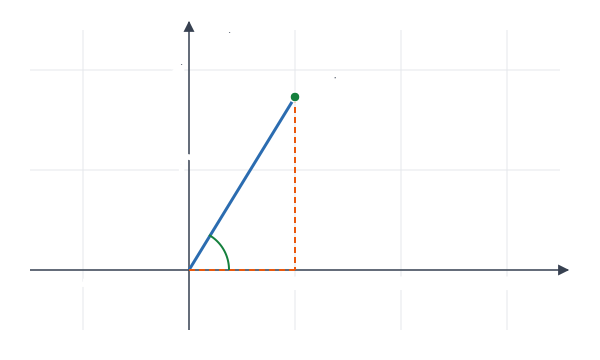
Plot a + bi in the complex plane: go a units along the real (horizontal) axis and b units along the imaginary (vertical) axis. This is just like plotting the point (a, b).
Now describe that point with polar coordinates instead. Its distance from 0 is r, and its direction is \theta. Since a = r \cos \theta and b = r \sin \theta, the number is r \cos \theta + (r \sin \theta) i, which factors to r(\cos \theta + i \sin \theta).
Formulas
z = a + bi = r(\cos \theta + i \sin \theta)
- Modulus: r = \lvert z \rvert = \sqrt{a^2 + b^2}
- Argument: \tan \theta = \frac{b}{a}, with \theta in the same quadrant as (a, b)
- Some books write r \operatorname{cis} \theta as a short way to write r(\cos \theta + i \sin \theta).
Multiplying and dividing
If z_1 = r_1(\cos \theta_1 + i \sin \theta_1) and z_2 = r_2(\cos \theta_2 + i \sin \theta_2), then:
z_1 z_2 = r_1 r_2 [\cos(\theta_1 + \theta_2) + i \sin(\theta_1 + \theta_2)]
\frac{z_1}{z_2} = \frac{r_1}{r_2} [\cos(\theta_1 - \theta_2) + i \sin(\theta_1 - \theta_2)]In words: to multiply, multiply the moduli and add the angles. To divide, divide the moduli and subtract the angles. This comes from the sum and difference formulas.
Worked Examples
Example 1: Write a number in trigonometric form
Write 1 + i\sqrt{3} in trigonometric form, with 0 \le \theta \lt 2\pi.
Identify a = 1 and b = \sqrt{3}
r = \sqrt{1^2 + (\sqrt{3})^2} = \sqrt{1 + 3} = \sqrt{4} = 2Find the modulus.
\tan \theta = \frac{\sqrt{3}}{1} = \sqrt{3}Find the tangent.
The point (1, \sqrt{3}) is in Quadrant I, so \theta = \frac{\pi}{3}
Answer: 2(\cos \frac{\pi}{3} + i \sin \frac{\pi}{3}), as in the picture above.
Example 2: A number in Quadrant III
Write -4 - 4i in trigonometric form.
r = \sqrt{(-4)^2 + (-4)^2} = \sqrt{16 + 16} = \sqrt{32}Find the modulus.
\sqrt{32} = \sqrt{16 \cdot 2} = 4\sqrt{2}Simplify the radical (see simplifying square roots)
Find the tangent: \tan \theta = \frac{-4}{-4} = 1, so the reference angle is \frac{\pi}{4}
\theta = \pi + \frac{\pi}{4} = \frac{5\pi}{4}The point (-4, -4) is in Quadrant III.
Answer: 4\sqrt{2}(\cos \frac{5\pi}{4} + i \sin \frac{5\pi}{4}). A calculator gives \tan^{-1}(1) = \frac{\pi}{4}, which is in the wrong quadrant.
Example 3: Back to standard form
Write 6(\cos \frac{5\pi}{6} + i \sin \frac{5\pi}{6}) in the form a + bi.
Use the unit circle: \cos \frac{5\pi}{6} = -\frac{\sqrt{3}}{2} and \sin \frac{5\pi}{6} = \frac{1}{2}
6(-\frac{\sqrt{3}}{2} + \frac{1}{2} i)Substitute.
-\frac{6\sqrt{3}}{2} + \frac{6}{2} iDistribute the 6 (see distributive property)
-3\sqrt{3} + 3iSimplify.
Answer: -3\sqrt{3} + 3i, which is about -5.20 + 3i
Example 4: Multiply in trigonometric form
Multiply z_1 = 3(\cos \frac{\pi}{4} + i \sin \frac{\pi}{4}) and z_2 = 2(\cos \frac{\pi}{12} + i \sin \frac{\pi}{12}). Write the answer in both forms.
3 \cdot 2 = 6
Multiply the moduli.
\frac{\pi}{4} + \frac{\pi}{12} = \frac{3\pi}{12} + \frac{\pi}{12} = \frac{4\pi}{12} = \frac{\pi}{3}Add the angles with a common denominator (see adding fractions)
z_1 z_2 = 6(\cos \frac{\pi}{3} + i \sin \frac{\pi}{3})Write the product.
6(\frac{1}{2} + \frac{\sqrt{3}}{2} i)Use \cos \frac{\pi}{3} = \frac{1}{2} and \sin \frac{\pi}{3} = \frac{\sqrt{3}}{2}.
3 + 3\sqrt{3} iDistribute.
Answer: 6(\cos \frac{\pi}{3} + i \sin \frac{\pi}{3}) = 3 + 3\sqrt{3} i
Example 5: Word problem with an AC circuit
In an AC circuit, current I, voltage V and impedance Z are complex numbers with I = \frac{V}{Z}. A circuit has V = 120(\cos 0^\circ + i \sin 0^\circ) volts and Z = 40(\cos 30^\circ + i \sin 30^\circ) ohms. Find the current in both forms.
\frac{120}{40} = 3Divide the moduli.
0^\circ - 30^\circ = -30^\circ
Subtract the angles.
I = 3(\cos(-30^\circ) + i \sin(-30^\circ))
Write the quotient.
I = 3(\frac{\sqrt{3}}{2} - \frac{1}{2} i)Use \cos(-30^\circ) = \frac{\sqrt{3}}{2} and \sin(-30^\circ) = -\frac{1}{2}.
I = \frac{3\sqrt{3}}{2} - \frac{3}{2} i \approx 2.60 - 1.5iDistribute.
Answer: I = 3(\cos(-30^\circ) + i \sin(-30^\circ)) \approx 2.60 - 1.5i amps. The current has size 3 amps and lags the voltage by 30^\circ.
Common Mistakes
| Mistake | Example of the error | Fix |
|---|---|---|
| Wrong quadrant for the argument | -4 - 4i with \theta = \frac{\pi}{4} | (-4, -4) is in Quadrant III, so \theta = \frac{5\pi}{4}. |
| Multiplying the angles | \frac{\pi}{4} \cdot \frac{\pi}{12} for a product | Multiply the moduli but add the angles. |
| Adding the moduli | 3 + 2 = 5 for a product | Multiply the moduli: 3 \cdot 2 = 6. |
| Forgetting the square root in r | r = 1 + 3 = 4 for 1 + i\sqrt{3} | r = \sqrt{1 + 3} = 2. |
| Mixing up the parts | Writing r(\sin \theta + i \cos \theta) | Cosine goes with the real part, sine with the imaginary part. |
Related Methods
Powers and roots
Multiplying a number by itself many times means multiplying the modulus many times and adding the angle many times. That shortcut for powers and roots is De Moivre’s theorem.
Standard form for adding
Trigonometric form is great for multiplying and dividing, but not for adding. To add or subtract, convert to a + bi first and use operations with complex numbers.
Non-special angles
If \frac{b}{a} is not a unit circle value, use the inverse tangent (see inverse trig functions) for the reference angle, then adjust for the quadrant.
Practice Problems
Use 0 \le \theta \lt 2\pi unless the problem uses degrees.
- Write 3 + 3i in trigonometric form.
- Write -2\sqrt{3} + 2i in trigonometric form.
- Write -5i in trigonometric form.
- Write 7 in trigonometric form.
- Write 4(\cos \frac{2\pi}{3} + i \sin \frac{2\pi}{3}) in the form a + bi.
- Write 3 - 4i in trigonometric form. Round \theta to the nearest hundredth of a radian.
- Multiply 2(\cos \frac{\pi}{6} + i \sin \frac{\pi}{6}) by 5(\cos \frac{\pi}{3} + i \sin \frac{\pi}{3}). Give the answer as a + bi.
- Divide 12(\cos \frac{3\pi}{4} + i \sin \frac{3\pi}{4}) by 3(\cos \frac{\pi}{4} + i \sin \frac{\pi}{4}). Give the answer as a + bi.
- Multiply 4(\cos 70^\circ + i \sin 70^\circ) by 1.5(\cos 50^\circ + i \sin 50^\circ). Give the answer as a + bi.
- A circuit has V = 240(\cos 45^\circ + i \sin 45^\circ) volts and Z = 60(\cos 15^\circ + i \sin 15^\circ) ohms. Find I = \frac{V}{Z} in both forms.
Show answers
1.
r = \sqrt{3^2 + 3^2} = \sqrt{18} = 3\sqrt{2}Find the modulus r.
\tan \theta = \frac{3}{3} = 1, Quadrant I, so \theta = \frac{\pi}{4}
Answer: 3\sqrt{2}(\cos \frac{\pi}{4} + i \sin \frac{\pi}{4})
2.
r = \sqrt{(-2\sqrt{3})^2 + 2^2} = \sqrt{12 + 4} = \sqrt{16} = 4Find the modulus r.
\tan \theta = \frac{2}{-2\sqrt{3}} = -\frac{1}{\sqrt{3}}, so the reference angle is \frac{\pi}{6}
\theta = \pi - \frac{\pi}{6} = \frac{5\pi}{6}Quadrant II: subtract the reference angle from π.
Answer: 4(\cos \frac{5\pi}{6} + i \sin \frac{5\pi}{6})
3.
-5i is the point (0, -5), so r = 5
It is on the negative imaginary axis, so \theta = \frac{3\pi}{2}
Answer: 5(\cos \frac{3\pi}{2} + i \sin \frac{3\pi}{2})
4.
7 is the point (7, 0), so r = 7 and \theta = 0
Answer: 7(\cos 0 + i \sin 0)
5.
\cos \frac{2\pi}{3} = -\frac{1}{2} and \sin \frac{2\pi}{3} = \frac{\sqrt{3}}{2}
4(-\frac{1}{2} + \frac{\sqrt{3}}{2} i)Substitute.
-2 + 2\sqrt{3} iDistribute.
Answer: -2 + 2\sqrt{3} i
6.
r = \sqrt{3^2 + (-4)^2} = \sqrt{9 + 16} = \sqrt{25} = 5Find the modulus r.
\tan^{-1}(\frac{4}{3}) \approx 0.9273Find the reference angle.
\theta \approx 2\pi - 0.9273 \approx 5.36
Quadrant IV: subtract the reference angle from 2π.
Answer: 5(\cos 5.36 + i \sin 5.36)
7.
2 \cdot 5 = 10
Multiply the moduli.
\frac{\pi}{6} + \frac{\pi}{3} = \frac{\pi}{6} + \frac{2\pi}{6} = \frac{3\pi}{6} = \frac{\pi}{2}Add the angles.
10(\cos \frac{\pi}{2} + i \sin \frac{\pi}{2}) = 10(0 + 1i)Write the product and evaluate.
Answer: 10i
8.
\frac{12}{3} = 4Divide the moduli.
\frac{3\pi}{4} - \frac{\pi}{4} = \frac{2\pi}{4} = \frac{\pi}{2}Subtract the angles.
4(\cos \frac{\pi}{2} + i \sin \frac{\pi}{2}) = 4(0 + 1i)Write the quotient and evaluate.
Answer: 4i
9.
4 \cdot 1.5 = 6
Multiply the moduli.
70^\circ + 50^\circ = 120^\circ
Add the angles.
6(\cos 120^\circ + i \sin 120^\circ) = 6(-\frac{1}{2} + \frac{\sqrt{3}}{2} i)Write the product and evaluate.
-3 + 3\sqrt{3} iDistribute.
Answer: -3 + 3\sqrt{3} i \approx -3 + 5.20i
10.
\frac{240}{60} = 4Divide the moduli.
45^\circ - 15^\circ = 30^\circ
Subtract the angles.
I = 4(\cos 30^\circ + i \sin 30^\circ) = 4(\frac{\sqrt{3}}{2} + \frac{1}{2} i)Write the quotient and evaluate.
I = 2\sqrt{3} + 2iDistribute.
Answer: I = 4(\cos 30^\circ + i \sin 30^\circ) = 2\sqrt{3} + 2i \approx 3.46 + 2i amps
FAQ
What is the trigonometric form of a complex number?
It is r(\cos \theta + i \sin \theta), where r is the distance from 0 in the complex plane and \theta is the angle from the positive real axis.
How do you find the modulus and argument?
The modulus is r = \sqrt{a^2 + b^2}. The argument is the angle with \tan \theta = \frac{b}{a}, placed in the same quadrant as the point (a, b).
How do you multiply complex numbers in trigonometric form?
Multiply the moduli and add the arguments. To divide, divide the moduli and subtract the arguments.
Is polar form the same as trigonometric form?
Yes. Both names mean r(\cos \theta + i \sin \theta), because the number is described by polar coordinates (r, \theta).
Summary
- a + bi = r(\cos \theta + i \sin \theta), with r = \sqrt{a^2 + b^2}.
- Choose \theta from \tan \theta = \frac{b}{a} in the correct quadrant.
- To go back, find r \cos \theta and r \sin \theta.
- Multiply: multiply the moduli, add the angles.
- Divide: divide the moduli, subtract the angles.
Previous lesson: Graphing Polar Equations
Next lesson: De Moivre’s Theorem
Back to the Trigonometry Index