
De Moivre’s Theorem
De Moivre’s theorem says that to raise a complex number in trigonometric form to a power, raise the modulus to the power and multiply the angle by it: [r(\cos \theta + i \sin \theta)]^n = r^n(\cos n\theta + i \sin n\theta). A related formula finds all n of the nth roots of a complex number.
Before this lesson: You should know the Trigonometric Form of Complex Numbers, Coterminal Angles and nth Roots.
Why De Moivre’s Theorem Works
To multiply complex numbers in trigonometric form, you multiply the moduli and add the angles. A power is just the same number multiplied by itself again and again.
So z^2 has modulus r \cdot r = r^2 and angle \theta + \theta = 2\theta. Then z^3 has modulus r^3 and angle 3\theta. The pattern continues for every whole number n. Without it, (1 + i)^8 would take seven long multiplications.
The Formulas
Powers
[r(\cos \theta + i \sin \theta)]^n = r^n(\cos n\theta + i \sin n\theta)
Roots
Every nonzero complex number has exactly n different nth roots. They are:
r^{1/n}\left[\cos\left(\frac{\theta + 2\pi k}{n}\right) + i \sin\left(\frac{\theta + 2\pi k}{n}\right)\right], \quad k = 0, 1, \ldots, n - 1All the roots sit on a circle of radius r^{1/n}, spaced evenly, \frac{2\pi}{n} apart. In degrees, replace 2\pi k with 360^\circ k.
Worked Examples
Example 1: A power that lands on the real axis
Find (1 + i)^8.
Write 1 + i in trigonometric form: r = \sqrt{1^2 + 1^2} = \sqrt{2} and \theta = \frac{\pi}{4}
(1 + i)^8 = (\sqrt{2})^8 (\cos \frac{8\pi}{4} + i \sin \frac{8\pi}{4})Apply De Moivre’s theorem.
(\sqrt{2})^8 = (2^{1/2})^8 = 2^4 = 16Find the power (see exponent rules)
\frac{8\pi}{4} = 2\piSimplify the angle.
16(1 + 0i) = 16
Use \cos 2\pi = 1 and \sin 2\pi = 0.
Answer: (1 + i)^8 = 16
Example 2: A power with a special angle
Find (1 + i\sqrt{3})^5 in the form a + bi.
Trigonometric form: r = \sqrt{1 + 3} = 2 and \theta = \frac{\pi}{3}
2^5 (\cos \frac{5\pi}{3} + i \sin \frac{5\pi}{3})Apply the theorem.
2^5 = 32
Find the power.
Use the unit circle: \cos \frac{5\pi}{3} = \frac{1}{2} and \sin \frac{5\pi}{3} = -\frac{\sqrt{3}}{2}
32(\frac{1}{2} - \frac{\sqrt{3}}{2} i)Substitute.
16 - 16\sqrt{3} iDistribute.
Answer: 16 - 16\sqrt{3} i, about 16 - 27.71i
Example 3: Cube roots
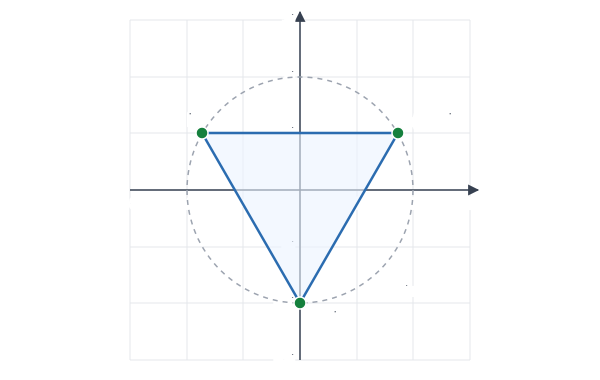
Find the three cube roots of 8i.
r = 8,\ \theta = \frac{\pi}{2}Write 8i in trigonometric form.
8^{1/3} = 2Find the modulus of each root.
\frac{\frac{\pi}{2} + 0}{3} = \frac{\pi}{6}For k = 0, find the angle.
2(\cos \frac{\pi}{6} + i \sin \frac{\pi}{6}) = 2(\frac{\sqrt{3}}{2} + \frac{1}{2} i)Write the root and use the unit circle values.
2(\frac{\sqrt{3}}{2} + \frac{1}{2} i) = \sqrt{3} + iDistribute the 2.
\frac{\frac{\pi}{2} + 2\pi}{3} = \frac{\frac{5\pi}{2}}{3}For k = 1, add 2π to the angle.
\frac{\frac{5\pi}{2}}{3} = \frac{5\pi}{6}Divide by 3.
2(-\frac{\sqrt{3}}{2} + \frac{1}{2} i) = -\sqrt{3} + iWrite the root and distribute the 2.
\frac{\frac{\pi}{2} + 4\pi}{3} = \frac{\frac{9\pi}{2}}{3}For k = 2, add 4π to the angle.
\frac{\frac{9\pi}{2}}{3} = \frac{3\pi}{2}Divide by 3.
2(0 - 1i) = -2i
Write the root and distribute the 2.
Answer: \sqrt{3} + i, -\sqrt{3} + i and -2i. Check one: (-2i)^3 = -8i^3 = -8(-i) = 8i.
Example 4: Solve an equation with roots
Solve z^4 = 16 over the complex numbers.
The solutions are the fourth roots of 16.
r = 16,\ \theta = 0
Write 16 in trigonometric form.
16^{1/4} = 2Find the modulus of each root.
\frac{0 + 2\pi k}{4} = \frac{\pi k}{2}Find the angles for k = 0, 1, 2, 3.
0,\ \frac{\pi}{2},\ \pi,\ \frac{3\pi}{2}List the four angles.
2(\cos 0 + i \sin 0) = 2
Convert the first root.
2(\cos \frac{\pi}{2} + i \sin \frac{\pi}{2}) = 2iConvert the second root.
2(\cos \pi + i \sin \pi) = -2
Convert the third root.
2(\cos \frac{3\pi}{2} + i \sin \frac{3\pi}{2}) = -2iConvert the fourth root.
Answer: z = 2, 2i, -2, -2i. A degree-4 equation has 4 solutions, as the fundamental theorem of algebra says.
Example 5: Word problem with a bolt pattern
An engineer places 5 bolts evenly around a circle of radius 3 cm, with one bolt straight up from the center. The bolt centers are the fifth roots of 243(\cos 90^\circ + i \sin 90^\circ). Find where each bolt goes.
The modulus of each root is 243^{1/5} = 3, since 3^5 = 243
The angles are \frac{90^\circ + 360^\circ k}{5} = 18^\circ + 72^\circ k
For k = 0, 1, 2, 3, 4, the angles are 18^\circ, 90^\circ, 162^\circ, 234^\circ, 306^\circ
3(\cos 18^\circ + i \sin 18^\circ) \approx 2.853 + 0.927i
Convert the first.
Convert the rest the same way: 3i, -2.853 + 0.927i, -1.763 - 2.427i, 1.763 - 2.427i
Answer: The bolts go at about (2.85, 0.93), (0, 3), (-2.85, 0.93), (-1.76, -2.43) and (1.76, -2.43) cm, 72^\circ apart.
Common Mistakes
| Mistake | Example of the error | Fix |
|---|---|---|
| Multiplying the modulus by n | (1 + i)^8 with modulus 8\sqrt{2} | Raise the modulus to the power: (\sqrt{2})^8 = 16. |
| Raising the angle to the power | Angle (\frac{\pi}{4})^8 | Multiply the angle by n: 8 \cdot \frac{\pi}{4} = 2\pi. |
| Finding only one root | Giving only \sqrt{3} + i as a cube root of 8i | There are n roots. Use k = 0, 1, \ldots, n - 1. |
| Adding 2πk after dividing | Angles \frac{\pi}{6} + 2\pi k | Add 2\pi k first, then divide by n: the roots are \frac{2\pi}{n} apart. |
| Using it in standard form | Raising 1 and i to the 8th separately | Convert to trigonometric form first. |
Related Methods
Roots of unity
The nth roots of 1 are called the nth roots of unity. They are \cos \frac{2\pi k}{n} + i \sin \frac{2\pi k}{n} and make a regular polygon with one corner at 1.
Binomial expansion
You could expand (1 + i)^8 with the binomial theorem, but it takes nine terms. De Moivre’s theorem is much faster for high powers.
Trig identities
Expanding (\cos \theta + i \sin \theta)^2 and matching it to \cos 2\theta + i \sin 2\theta gives the double-angle formulas.
Practice Problems
Give answers in the form a + bi. Round to the nearest hundredth when needed.
- Find (1 - i)^4.
- Find [2(\cos \frac{\pi}{12} + i \sin \frac{\pi}{12})]^6.
- Find (\sqrt{3} + i)^4.
- Find (-1 + i)^5.
- Find [3(\cos 40^\circ + i \sin 40^\circ)]^3.
- Find the two square roots of 9i.
- Find the three cube roots of 1.
- Solve z^3 = -8 over the complex numbers.
- Find the four fourth roots of -16.
- A designer places the corners of a regular hexagon at the sixth roots of 64, with one corner at 2. Find all six corners.
Show answers
1.
1 - i: r = \sqrt{2}, \theta = \frac{7\pi}{4}
Power: (\sqrt{2})^4 = 4; angle: 4 \cdot \frac{7\pi}{4} = 7\pi, which is coterminal with \pi
4(\cos \pi + i \sin \pi) = 4(-1 + 0i)
Use the unit circle values.
Answer: -4
2.
Power: 2^6 = 64; angle: 6 \cdot \frac{\pi}{12} = \frac{\pi}{2}
64(\cos \frac{\pi}{2} + i \sin \frac{\pi}{2}) = 64(0 + 1i)Use the unit circle values.
Answer: 64i
3.
\sqrt{3} + i: r = \sqrt{3 + 1} = 2, \theta = \frac{\pi}{6}
Power: 2^4 = 16; angle: 4 \cdot \frac{\pi}{6} = \frac{2\pi}{3}
16(-\frac{1}{2} + \frac{\sqrt{3}}{2} i)Use the unit circle values.
Answer: -8 + 8\sqrt{3} i \approx -8 + 13.86i
4.
-1 + i: r = \sqrt{2}, \theta = \frac{3\pi}{4}
Power: (\sqrt{2})^5 = 4\sqrt{2}; angle: 5 \cdot \frac{3\pi}{4} = \frac{15\pi}{4}, coterminal with \frac{15\pi}{4} - 2\pi = \frac{7\pi}{4}
4\sqrt{2}(\frac{\sqrt{2}}{2} - \frac{\sqrt{2}}{2} i)Use the unit circle values.
4 - 4i
Distribute, using \sqrt{2} \cdot \sqrt{2} = 2.
Answer: 4 - 4i
5.
Power: 3^3 = 27; angle: 3 \cdot 40^\circ = 120^\circ
27(-\frac{1}{2} + \frac{\sqrt{3}}{2} i)Use the unit circle values.
Answer: -13.5 + 13.5\sqrt{3} i \approx -13.5 + 23.38i
6.
9i: r = 9, \theta = \frac{\pi}{2}; root modulus 9^{1/2} = 3
k = 0: angle \frac{\pi}{4}, root 3(\frac{\sqrt{2}}{2} + \frac{\sqrt{2}}{2} i) = \frac{3\sqrt{2}}{2} + \frac{3\sqrt{2}}{2} i
k = 1: angle \frac{\pi}{4} + \pi = \frac{5\pi}{4}, root -\frac{3\sqrt{2}}{2} - \frac{3\sqrt{2}}{2} i
Answer: \pm(\frac{3\sqrt{2}}{2} + \frac{3\sqrt{2}}{2} i) \approx \pm(2.12 + 2.12i)
7.
1: r = 1, \theta = 0; angles \frac{2\pi k}{3}: 0, \frac{2\pi}{3}, \frac{4\pi}{3}
Roots: 1, \cos \frac{2\pi}{3} + i \sin \frac{2\pi}{3} = -\frac{1}{2} + \frac{\sqrt{3}}{2} i, \cos \frac{4\pi}{3} + i \sin \frac{4\pi}{3} = -\frac{1}{2} - \frac{\sqrt{3}}{2} i
Answer: 1, -\frac{1}{2} \pm \frac{\sqrt{3}}{2} i
8.
-8: r = 8, \theta = \pi; root modulus 8^{1/3} = 2
Angles: \frac{\pi + 2\pi k}{3} gives \frac{\pi}{3}, \pi, \frac{5\pi}{3}
Roots: 2(\frac{1}{2} + \frac{\sqrt{3}}{2} i) = 1 + \sqrt{3} i, 2(-1) = -2, 2(\frac{1}{2} - \frac{\sqrt{3}}{2} i) = 1 - \sqrt{3} i
Answer: z = -2, 1 \pm \sqrt{3} i
9.
-16: r = 16, \theta = \pi; root modulus 16^{1/4} = 2
Angles: \frac{\pi + 2\pi k}{4} gives \frac{\pi}{4}, \frac{3\pi}{4}, \frac{5\pi}{4}, \frac{7\pi}{4}
2(\pm\frac{\sqrt{2}}{2} \pm \frac{\sqrt{2}}{2} i) = \pm\sqrt{2} \pm \sqrt{2} iWrite each root and distribute.
Answer: \sqrt{2} + \sqrt{2} i, -\sqrt{2} + \sqrt{2} i, -\sqrt{2} - \sqrt{2} i, \sqrt{2} - \sqrt{2} i
10.
64: r = 64, \theta = 0; root modulus 64^{1/6} = 2
Angles: \frac{2\pi k}{6} = \frac{\pi k}{3}: 0, \frac{\pi}{3}, \frac{2\pi}{3}, \pi, \frac{4\pi}{3}, \frac{5\pi}{3}
Convert: 2, 1 + \sqrt{3} i, -1 + \sqrt{3} i, -2, -1 - \sqrt{3} i, 1 - \sqrt{3} i
Answer: those six corners
FAQ
What is De Moivre’s theorem used for?
It raises complex numbers to powers quickly and finds all of their roots. It also helps derive trig identities like the double-angle formulas.
How many nth roots does a complex number have?
Every nonzero complex number has exactly n different nth roots. They are evenly spaced around a circle of radius r^{1/n}.
Does De Moivre’s theorem work for negative powers?
Yes. For a negative whole number n, the same formula works, with r^n meaning \frac{1}{r^{\lvert n \rvert}}.
Why are the roots evenly spaced?
Each root’s angle is \frac{\theta + 2\pi k}{n}. Raising k by 1 adds \frac{2\pi}{n} to the angle, so the roots are equal steps apart.
Summary
- Powers: [r(\cos \theta + i \sin \theta)]^n = r^n(\cos n\theta + i \sin n\theta).
- Raise the modulus to the power; multiply the angle by the power.
- Roots: modulus r^{1/n} and angles \frac{\theta + 2\pi k}{n} for k = 0 to n - 1.
- The n roots are evenly spaced on a circle, \frac{2\pi}{n} apart.
- Convert to trigonometric form first.
Previous lesson: Trigonometric Form of Complex Numbers
Next course: Precalculus Index
Back to the Trigonometry Index