
Projectile Motion with Parametric Equations
Projectile motion with parametric equations models a thrown or launched object with one equation for horizontal distance and one for height. With launch speed v_0, angle \theta and starting height h, in feet, x = (v_0\cos\theta)t and y = h + (v_0\sin\theta)t - 16t^2. In meters, replace 16 with 4.9.
Before this lesson: Parametric Equations, Magnitude and Direction of a Vector and Quadratic Formula
Why a projectile needs two equations
When you throw a ball, two things happen at once. It moves forward at a steady speed, and it rises and then falls because gravity pulls it down. Parametric equations let us handle these two motions separately, with time t as the parameter.
The launch velocity is a vector. Its horizontal part is v_0\cos\theta and its vertical part is v_0\sin\theta, just like the components of any vector. Gravity only changes the vertical part.
These equations ignore air resistance. That is a good model for a short throw and a rough one for a fast golf ball.
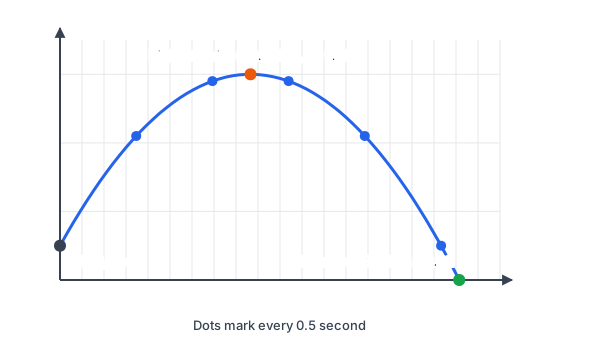
Projectile motion equations
| Units | Horizontal position | Height |
|---|---|---|
| Feet and seconds | x = (v_0\cos\theta)t | y = h + (v_0\sin\theta)t - 16t^2 |
| Meters and seconds | x = (v_0\cos\theta)t | y = h + (v_0\sin\theta)t - 4.9t^2 |
Here v_0 is the launch speed, \theta is the launch angle above the horizontal, and h is the launch height. The 16 and 4.9 are half of the acceleration due to gravity, 32 ft/s² or 9.8 m/s².
The height equation is a quadratic in t, so its graph over time is a parabola. Use these tools:
| Question | How to answer it |
|---|---|
| When is the object highest? | At the vertex, t = -\frac{b}{2a} for y = at^2 + bt + c |
| How high does it go? | Substitute that t into the height equation |
| When does it land? | Set y = 0 and solve, often with the quadratic formula |
| How far does it go? | Substitute the landing time into the x-equation |
| Does it clear an obstacle? | Solve x = (distance) for t, then find y at that t |
Projectile motion examples
Example 1: Write the parametric equations
A ball is thrown at 80 feet per second at an angle of 30° from a height of 5 feet. Write parametric equations for its path.
x = (80\cos 30^\circ)t
Use x = (v_0\cos\theta)t with v_0 = 80 and \theta = 30^\circ.
x = 40\sqrt{3}\,tUse \cos 30^\circ = \frac{\sqrt{3}}{2} (see trig values of special angles).
x \approx 69.28t
Change to a decimal.
y = 5 + (80\sin 30^\circ)t - 16t^2
Use the height equation in feet with h = 5.
y = 5 + 40t - 16t^2
Use \sin 30^\circ = \frac{1}{2}.
Answer: x \approx 69.28t and y = 5 + 40t - 16t^2.
Example 2: Maximum height
For the ball in Example 1, when does it reach its highest point, and how high is it?
y = -16t^2 + 40t + 5
Write the height in standard form: a = −16, b = 40, c = 5.
t = -\frac{40}{2(-16)}The highest point is at the vertex, t = -\frac{b}{2a} (see graphing quadratic functions).
t = 1.25
Simplify: −40 divided by −32.
y = 5 + 40(1.25) - 16(1.25)^2
Substitute t = 1.25 into the height equation.
y = 5 + 50 - 25
Multiply. Note (1.25)^2 = 1.5625 and 16(1.5625) = 25.
y = 30
Add and subtract.
x \approx 69.28(1.25) \approx 86.6
Find the horizontal distance at that time.
Answer: the ball is highest at t = 1.25 seconds, 30 feet up and about 86.6 feet out.
Example 3: Time in the air and distance
When does the ball from Example 1 hit the ground, and how far away does it land?
-16t^2 + 40t + 5 = 0
The ball lands when its height is 0.
t = \frac{-40 \pm \sqrt{40^2 - 4(-16)(5)}}{2(-16)}Use the quadratic formula with a = −16, b = 40, c = 5.
t = \frac{-40 \pm \sqrt{1600 + 320}}{-32}Simplify under the root and in the denominator.
t = \frac{-40 \pm \sqrt{1920}}{-32}Add.
t \approx \frac{-40 - 43.818}{-32}Use the minus sign. The plus sign gives a negative time, which does not fit the problem.
t \approx 2.619
Divide.
x \approx 69.28(2.619) \approx 181
Substitute the landing time into the x-equation.
Answer: the ball lands after about 2.62 seconds, about 181 feet away.
Example 4: Does the ball clear the fence?
A batter hits a ball at 120 ft/s at an angle of 35°, from 3 feet above the ground. The outfield fence is 10 feet tall and 400 feet away. Does the ball clear it?
x = (120\cos 35^\circ)t \approx 98.298t
Write the horizontal equation.
y = 3 + (120\sin 35^\circ)t - 16t^2 \approx 3 + 68.829t - 16t^2
Write the height equation.
98.298t = 400
Find when the ball reaches the fence: set x = 400.
t \approx 4.0692
Divide both sides by 98.298.
y \approx 3 + 68.829(4.0692) - 16(4.0692)^2
Substitute that time into the height equation.
y \approx 3 + 280.08 - 264.93
Multiply.
y \approx 18
Add and subtract, and round to the nearest foot.
Answer: yes. When the ball reaches the fence it is about 18 feet high, about 8 feet above the 10-foot fence. It’s a home run.
Example 5: Eliminate the parameter to find the path
Write the path from Example 1 as one equation in x and y, using the exact form x = 40\sqrt{3}\,t.
t = \frac{x}{40\sqrt{3}}Solve the x-equation for t.
y = 5 + 40\left(\frac{x}{40\sqrt{3}}\right) - 16\left(\frac{x}{40\sqrt{3}}\right)^2Substitute into the height equation.
y = 5 + \frac{x}{\sqrt{3}} - \frac{16x^2}{4800}Simplify each term: (40\sqrt{3})^2 = 1600 \cdot 3 = 4800.
y = 5 + \frac{x}{\sqrt{3}} - \frac{x^2}{300}Reduce \frac{16}{4800} = \frac{1}{300}.
Answer: y = -\frac{x^2}{300} + \frac{x}{\sqrt{3}} + 5. The path is a downward parabola, which is why a thrown ball arcs the way it does. The parametric form also tells you when the ball is at each point; this form does not.
Common mistakes
| Mistake | Example of the error | Fix |
|---|---|---|
| Using the full speed for both directions | x = 80t for a throw at 30° | Split the speed: x = (80\cos 30^\circ)t. |
| Using −32t² instead of −16t² | y = 5 + 40t - 32t^2 | The term is half of 32: -16t^2 (or -4.9t^2 in meters). |
| Mixing feet and meters | Speed in m/s with −16t² | Use −4.9t² with meters and −16t² with feet. |
| Keeping the negative root for landing time | t ≈ −0.12 s | Time after launch must be positive, so keep t ≈ 2.62. |
| Forgetting the starting height | y = 40t - 16t^2 for a throw from 5 ft | Add h: y = 5 + 40t - 16t^2. |
| Calculator in radian mode | \cos 30 \approx 0.154 | Use degree mode: \cos 30^\circ \approx 0.866. |
Related methods
Quick formulas for a launch from the ground
When h = 0, the object lands at t = \frac{2v_0\sin\theta}{g}, where g is 32 ft/s² or 9.8 m/s². You get this by factoring t out of (v_0\sin\theta)t - \frac{1}{2}gt^2 = 0 (see factoring out the GCF).
Height over time alone
If a problem only asks about height, you only need the y-equation. This is the same model used in quadratic equation word problems about objects thrown straight up.
Practice problems
- A ball is thrown at 60 ft/s at 45° from a height of 6 feet. Write parametric equations for its path.
- A ball follows x = 50t and y = 4 + 30t - 16t^2, in feet. Where is it at t = 2? What is happening then?
- When does y = 3 + 48t - 16t^2 reach its maximum height, and what is that height?
- A ball’s height is y = 64t - 16t^2. When does it hit the ground?
- An arrow is shot at 40 m/s at 20° from 1.5 meters high. Write parametric equations, in meters.
- A rock is launched from the ground at 30 m/s at 60°. How long is it in the air?
- How far does the rock in problem 6 travel horizontally?
- A golf ball is hit from the ground at 150 ft/s at 12°. How high does it go?
- Eliminate the parameter: x = 50t and y = 4 + 30t - 16t^2.
- A ball is hit at 100 ft/s at 40° from 3 feet high. Does it clear a 12-foot wall 330 feet away?
Show answers
1.
x = (60\cos 45^\circ)t
Write the horizontal equation.
x = 30\sqrt{2}\,t \approx 42.43tUse \cos 45^\circ = \frac{\sqrt{2}}{2}.
y = 6 + (60\sin 45^\circ)t - 16t^2
Write the height equation with h = 6.
y = 6 + 30\sqrt{2}\,t - 16t^2 \approx 6 + 42.43t - 16t^2Use \sin 45^\circ = \frac{\sqrt{2}}{2}.
Answer: x \approx 42.43t, y \approx 6 + 42.43t - 16t^2
2.
x = 50(2) = 100
Substitute t = 2 into the x-equation.
y = 4 + 30(2) - 16(2)^2
Substitute t = 2 into the y-equation.
y = 4 + 60 - 64 = 0
Multiply, then add and subtract.
Answer: (100, 0). The height is 0, so the ball hits the ground 100 feet away at t = 2.
3.
t = -\frac{48}{2(-16)} = 1.5The vertex is at t = -\frac{b}{2a}.
y = 3 + 48(1.5) - 16(1.5)^2
Substitute t = 1.5.
y = 3 + 72 - 36 = 39
Multiply, then add and subtract.
Answer: at t = 1.5 seconds, 39 feet high.
4.
64t - 16t^2 = 0
Set the height equal to 0.
16t(4 - t) = 0
Factor out 16t.
t = 0 \text{ or } t = 4Set each factor equal to 0 (see solving quadratics by factoring). t = 0 is the launch.
Answer: it lands at t = 4 seconds.
5.
x = (40\cos 20^\circ)t \approx 37.59t
Write the horizontal equation.
y = 1.5 + (40\sin 20^\circ)t - 4.9t^2
Write the height equation in meters with h = 1.5.
y \approx 1.5 + 13.68t - 4.9t^2
Find the sine in degree mode and multiply.
Answer: x \approx 37.59t, y \approx 1.5 + 13.68t - 4.9t^2
6.
y = (30\sin 60^\circ)t - 4.9t^2 \approx 25.981t - 4.9t^2
Write the height equation, with h = 0.
25.981t - 4.9t^2 = 0
Set the height equal to 0.
t(25.981 - 4.9t) = 0
Factor out t.
t \approx \frac{25.981}{4.9} \approx 5.30Solve 25.981 - 4.9t = 0 (t = 0 is the launch).
Answer: about 5.30 seconds
7.
x = (30\cos 60^\circ)t = 15t
Write the horizontal equation, using \cos 60^\circ = \frac{1}{2}.
x \approx 15(5.302) \approx 79.5
Substitute the landing time from problem 6.
Answer: about 79.5 meters
8.
v_y = 150\sin 12^\circ \approx 31.19
Find the vertical part of the launch speed.
t \approx \frac{31.19}{32} \approx 0.975The vertex of y = 31.19t - 16t^2 is at t = -\frac{b}{2a} = \frac{31.19}{32}.
y \approx 31.19(0.975) - 16(0.975)^2
Substitute that time into the height equation.
y \approx 30.41 - 15.21 \approx 15.2
Multiply, then subtract.
Answer: about 15.2 feet
9.
t = \frac{x}{50}Solve the x-equation for t.
y = 4 + 30\left(\frac{x}{50}\right) - 16\left(\frac{x}{50}\right)^2Substitute into the y-equation.
y = 4 + 0.6x - \frac{16x^2}{2500}Simplify each term.
y = 4 + 0.6x - 0.0064x^2
Divide: 16 ÷ 2500 = 0.0064.
Answer: y = -0.0064x^2 + 0.6x + 4
10.
x \approx 76.604t
x = (100\cos 40^\circ)t
y \approx 3 + 64.279t - 16t^2
y = 3 + (100\sin 40^\circ)t - 16t^2
76.604t = 330
Set x = 330, the distance to the wall.
t \approx 4.308
Divide both sides by 76.604.
y \approx 3 + 64.279(4.308) - 16(4.308)^2
Find the height at that time.
y \approx 3 + 276.91 - 296.94 \approx -17.0
Multiply, then add and subtract.
Answer: no. The height would be negative, which means the ball has already landed before it reaches the wall.
Projectile motion FAQ
What are the parametric equations for projectile motion?
In feet, x = (v_0\cos\theta)t and y = h + (v_0\sin\theta)t - 16t^2. In meters, use -4.9t^2 instead of -16t^2.
How do you find the maximum height of a projectile?
Find the vertex of the height equation, t = -\frac{b}{2a}, then substitute that time into y.
How do you find how far a projectile travels?
Set y = 0 and solve for the positive time. Substitute that time into the x-equation.
Why is the path of a projectile a parabola?
x grows at a steady rate while y is a quadratic in t. Eliminating t gives y as a quadratic in x, and the graph of a quadratic is a parabola.
Summary
- Split the launch speed into v_0\cos\theta (horizontal) and v_0\sin\theta (vertical).
- Feet: y = h + (v_0\sin\theta)t - 16t^2. Meters: y = h + (v_0\sin\theta)t - 4.9t^2.
- Highest point: the vertex, t = -\frac{b}{2a}.
- Landing: set y = 0 and keep the positive root; distance: put that t into x.
- To test an obstacle, solve x = distance for t, then find y.
Previous lesson: Parametric Equations
Next lesson: Permutations and Combinations
Back to the Precalculus Index