
Ellipses
An ellipse is an oval: every point on it has the same total distance to two fixed points called foci. Its standard form is \frac{(x - h)^2}{a^2} + \frac{(y - k)^2}{b^2} = 1, with center (h, k). To graph it, plot the center, then the vertices a units away and the co-vertices b units away. The foci are c units from the center, where c^2 = a^2 - b^2.
Before this lesson: Equation of a Circle, Completing the Square and Focus and Directrix of a Parabola
What an ellipse is
Tie the ends of a string to two pins and pull it tight with a pencil. As you move the pencil around, the string keeps the total distance to the two pins the same. The curve you draw is an ellipse, and the pins are its foci.
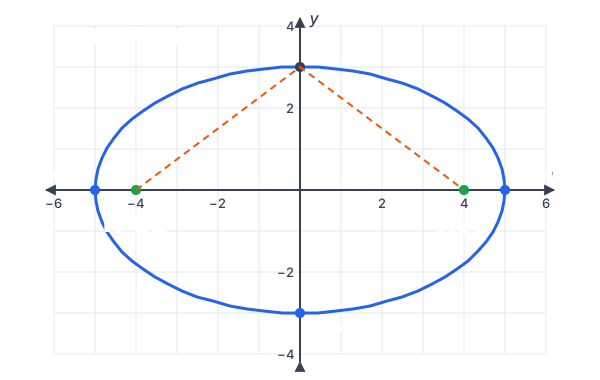
The long direction is the major axis, and its ends are the vertices. The short direction is the minor axis, and its ends are the co-vertices. The distances add to 2a, the length of the major axis.
Ellipse equation and formulas
In standard form, a is the larger of the two numbers a and b. Whichever variable has a^2 under it tells you the direction of the major axis.
\frac{(x - h)^2}{a^2} + \frac{(y - k)^2}{b^2} = 1 \quad \text{(horizontal major axis)}\frac{(x - h)^2}{b^2} + \frac{(y - k)^2}{a^2} = 1 \quad \text{(vertical major axis)}c^2 = a^2 - b^2
| Part | Horizontal major axis | Vertical major axis |
|---|---|---|
| Center | (h, k) | (h, k) |
| Vertices | (h \pm a, k) | (h, k \pm a) |
| Co-vertices | (h, k \pm b) | (h \pm b, k) |
| Foci | (h \pm c, k) | (h, k \pm c) |
| Length of major axis | 2a | 2a |
| Length of minor axis | 2b | 2b |
How to graph an ellipse
- Write the equation in standard form, with 1 on the right side.
- Find the center (h, k). The larger denominator is a^2; the smaller is b^2.
- Plot the vertices a units from the center along the major axis, and the co-vertices b units along the minor axis.
- Find c from c^2 = a^2 - b^2 and mark the foci on the major axis.
- Sketch a smooth oval through the four points.
Ellipse examples
Example 1: Center at the origin
Find the vertices, co-vertices and foci of \frac{x^2}{25} + \frac{y^2}{9} = 1.
\frac{x^2}{25} + \frac{y^2}{9} = 1The larger denominator, 25, is under x^2, so the major axis is horizontal. The center is (0, 0).
a = \sqrt{25} = 5Take the square root of the larger denominator.
b = \sqrt{9} = 3Take the square root of the smaller denominator.
c^2 = a^2 - b^2
Write the focus formula.
c^2 = 25 - 9
Substitute.
c^2 = 16
Subtract.
c = 4
Take the square root.
(0 \pm 5, 0) = (\pm 5, 0)
Find the vertices, 5 units left and right of the center.
(0, 0 \pm 3) = (0, \pm 3)
Find the co-vertices, 3 units up and down.
(0 \pm 4, 0) = (\pm 4, 0)
Find the foci, 4 units left and right.
Answer: vertices (\pm 5, 0), co-vertices (0, \pm 3) and foci (\pm 4, 0). This is the ellipse in the graph above.
Example 2: A vertical ellipse that is not centered at the origin
Find the center, vertices, co-vertices and foci of \frac{(x - 1)^2}{4} + \frac{(y + 2)^2}{16} = 1.
\frac{(x - 1)^2}{4} + \frac{(y + 2)^2}{16} = 1The larger denominator, 16, is under the y term, so the major axis is vertical. Since y + 2 = y - (-2), the center is (1, −2).
a = \sqrt{16} = 4Take the square root of the larger denominator.
b = \sqrt{4} = 2Take the square root of the smaller denominator.
c^2 = 16 - 4
Use c^2 = a^2 - b^2.
c^2 = 12
Subtract.
c = \sqrt{12} = 2\sqrt{3}Take the square root and simplify (see simplifying square roots).
(h, k + a) = (1, -2 + 4) = (1, 2)
Find the top vertex.
(h, k - a) = (1, -2 - 4) = (1, -6)
Find the bottom vertex.
(h \pm b, k) = (1 \pm 2, -2)
Find the co-vertices: (3, −2) and (−1, −2).
(h, k \pm c) = (1, -2 \pm 2\sqrt{3})Find the foci, 2\sqrt{3} units above and below the center.
Answer: center (1, −2), vertices (1, 2) and (1, −6), co-vertices (3, −2) and (−1, −2), foci (1, -2 \pm 2\sqrt{3}), or about (1, 1.46) and (1, −5.46).
Example 3: Write the equation from the center, a vertex and a focus
An ellipse has center (2, 1), a vertex at (7, 1) and a focus at (5, 1). Write its equation.
a = 7 - 2 = 5
a is the distance from the center to a vertex. The vertex is to the right, so the major axis is horizontal.
c = 5 - 2 = 3
c is the distance from the center to a focus.
b^2 = a^2 - c^2
Solve c^2 = a^2 - b^2 for b^2.
b^2 = 25 - 9
Substitute.
b^2 = 16
Subtract.
\frac{(x - 2)^2}{25} + \frac{(y - 1)^2}{16} = 1Put a^2 = 25 under the x term, since the major axis is horizontal.
Answer: \frac{(x - 2)^2}{25} + \frac{(y - 1)^2}{16} = 1
Example 4: From general form to standard form
Write 4x^2 + 9y^2 - 16x + 18y - 11 = 0 in standard form. Then find the center, vertices and foci.
4x^2 - 16x + 9y^2 + 18y - 11 = 0
Group the x terms and the y terms.
4x^2 - 16x + 9y^2 + 18y = 11
Add 11 to both sides.
4(x^2 - 4x) + 9(y^2 + 2y) = 11
Factor 4 out of the x terms and 9 out of the y terms.
4(x^2 - 4x + 4) + 9(y^2 + 2y + 1) = 11 + 16 + 9
Complete each square (see completing the square). Adding 4 inside the first group really adds 4 \cdot 4 = 16, and adding 1 inside the second really adds 9 \cdot 1 = 9.
4(x^2 - 4x + 4) + 9(y^2 + 2y + 1) = 36
Add on the right side.
4(x - 2)^2 + 9(y + 1)^2 = 36
Factor each perfect square trinomial.
\frac{(x - 2)^2}{9} + \frac{(y + 1)^2}{4} = 1Divide both sides by 36.
c^2 = 9 - 4
Use c^2 = a^2 - b^2 with a^2 = 9 and b^2 = 4.
c^2 = 5
Subtract.
c = \sqrt{5}Take the square root.
Answer: \frac{(x - 2)^2}{9} + \frac{(y + 1)^2}{4} = 1. The center is (2, −1), the major axis is horizontal with a = 3, the vertices are (5, −1) and (−1, −1), and the foci are (2 \pm \sqrt{5}, -1).
Example 5: An arch shaped like half an ellipse
A bridge arch is the top half of an ellipse. It is 40 feet wide at the road and 10 feet high at the center. How high is the arch 12 feet from the center?
\frac{x^2}{400} + \frac{y^2}{100} = 1Put the center at the middle of the road. Then a = 20 (half the width) and b = 10 (the height), so a^2 = 400 and b^2 = 100.
\frac{12^2}{400} + \frac{y^2}{100} = 1Substitute x = 12.
\frac{144}{400} + \frac{y^2}{100} = 1Square 12.
\frac{y^2}{100} = 1 - \frac{144}{400}Subtract \frac{144}{400} from both sides.
\frac{y^2}{100} = \frac{256}{400}Write 1 as \frac{400}{400} and subtract (see subtracting fractions).
y^2 = 64
Multiply both sides by 100.
y = 8
Take the positive square root, since the arch is above the road.
Answer: The arch is 8 feet high at 12 feet from the center.
Common mistakes
| Mistake | Example of the error | Fix |
|---|---|---|
| Using c^2 = a^2 + b^2 | For \frac{x^2}{25} + \frac{y^2}{9} = 1, getting c^2 = 34 | For an ellipse, c^2 = a^2 - b^2 = 16. The plus sign is for hyperbolas. |
| Using a^2 as the distance | Putting the vertices at (±25, 0) | Take the square root: a = 5, so the vertices are (±5, 0). |
| Assuming a^2 is always under x^2 | Calling \frac{x^2}{9} + \frac{y^2}{25} = 1 horizontal | a^2 is the larger denominator. Here it is under y^2, so the major axis is vertical. |
| Wrong signs for the center | Reading the center of \frac{(x + 3)^2}{16} + \frac{(y - 2)^2}{7} = 1 as (3, 2) | Since x + 3 = x - (-3), the center is (−3, 2). |
| Not balancing when completing the square | Adding only 4 and 1 to the right side in Example 4 | Multiply what you add inside each group by the factor in front: add 16 and 9. |
| Reading a and b before the right side is 1 | Taking a^2 = 9 from 4(x - 2)^2 + 9(y + 1)^2 = 36 | Divide both sides by 36 first. |
Ellipses and circles
A circle is a special ellipse with a = b. Then c^2 = a^2 - a^2 = 0, so both foci sit at the center, and the equation becomes the one in equation of a circle.
How stretched an ellipse looks is measured by its eccentricity, e = \frac{c}{a}. It is always between 0 and 1. An e near 0 is almost a circle, and an e near 1 is long and thin.
Practice problems
For problems 1–4 and 8, find the vertices and foci. For problems 5–7, write the equation.
- \frac{x^2}{36} + \frac{y^2}{16} = 1
- \frac{x^2}{9} + \frac{y^2}{25} = 1
- \frac{(x + 3)^2}{16} + \frac{(y - 2)^2}{7} = 1
- 25x^2 + 4y^2 = 100
- Center (0, 0), a vertex at (0, 13) and a focus at (0, 12)
- Vertices (−4, 1) and (6, 1), and a co-vertex at (1, 4)
- Foci (±3, 0) and a major axis of length 10
- x^2 + 4y^2 + 6x - 8y - 3 = 0
- Find the y-values of the points on \frac{x^2}{25} + \frac{y^2}{9} = 1 where x = 3.
- A whispering gallery is a room shaped like an ellipse, 100 feet long and 60 feet wide. A whisper at one focus can be heard at the other. Where should two people stand?
Show answers
1.
a = \sqrt{36} = 6The larger denominator is under x^2, so the major axis is horizontal.
b = \sqrt{16} = 4Take the square root of the smaller denominator.
c^2 = 36 - 16 = 20
Use c^2 = a^2 - b^2 and subtract.
c = \sqrt{20} = 2\sqrt{5}Take the square root and simplify.
Answer: vertices (\pm 6, 0), co-vertices (0, \pm 4), foci (\pm 2\sqrt{5}, 0)
2.
a = \sqrt{25} = 5The larger denominator is under y^2, so the major axis is vertical.
b = \sqrt{9} = 3Take the square root of the smaller denominator.
c^2 = 25 - 9 = 16
Use c^2 = a^2 - b^2 and subtract.
c = 4
Take the square root.
Answer: vertices (0, \pm 5), co-vertices (\pm 3, 0), foci (0, \pm 4)
3.
a = \sqrt{16} = 4The center is (−3, 2), and the larger denominator is under the x term, so the major axis is horizontal.
b = \sqrt{7}Take the square root of the smaller denominator.
c^2 = 16 - 7 = 9
Use c^2 = a^2 - b^2 and subtract.
c = 3
Take the square root.
(h + a, k) = (-3 + 4, 2) = (1, 2)
Find the right vertex.
(h - a, k) = (-3 - 4, 2) = (-7, 2)
Find the left vertex.
(h + c, k) = (-3 + 3, 2) = (0, 2)
Find the right focus.
(h - c, k) = (-3 - 3, 2) = (-6, 2)
Find the left focus.
Answer: vertices (1, 2) and (−7, 2), foci (0, 2) and (−6, 2)
4.
\frac{25x^2}{100} + \frac{4y^2}{100} = \frac{100}{100}Divide both sides by 100.
\frac{x^2}{4} + \frac{y^2}{25} = 1Simplify each fraction. The larger denominator is under y^2, so the major axis is vertical.
a = \sqrt{25} = 5Take the square root of the larger denominator.
b = \sqrt{4} = 2Take the square root of the smaller denominator.
c^2 = 25 - 4 = 21
Use c^2 = a^2 - b^2 and subtract.
c = \sqrt{21}Take the square root.
Answer: vertices (0, \pm 5), co-vertices (\pm 2, 0), foci (0, \pm\sqrt{21})
5.
a = 13 - 0 = 13
The vertex is 13 units above the center, so the major axis is vertical.
c = 12 - 0 = 12
The focus is 12 units above the center.
b^2 = 169 - 144 = 25
Use b^2 = a^2 - c^2 and subtract.
\frac{x^2}{25} + \frac{y^2}{169} = 1Put a^2 under the y term.
Answer: \frac{x^2}{25} + \frac{y^2}{169} = 1
6.
h = \frac{-4 + 6}{2} = 1The center is the midpoint of the vertices (see midpoint formula), so it is (1, 1).
a = 6 - 1 = 5
Find the distance from the center to a vertex. The major axis is horizontal.
b = 4 - 1 = 3
Find the distance from the center to the co-vertex.
\frac{(x - 1)^2}{25} + \frac{(y - 1)^2}{9} = 1Put a^2 = 25 under the x term and b^2 = 9 under the y term.
Answer: \frac{(x - 1)^2}{25} + \frac{(y - 1)^2}{9} = 1
7.
2a = 10
The major axis has length 2a.
a = 5
Divide both sides by 2.
c = 3
The foci are 3 units from the center (0, 0), along the x-axis.
b^2 = 25 - 9 = 16
Use b^2 = a^2 - c^2 and subtract.
\frac{x^2}{25} + \frac{y^2}{16} = 1Put a^2 under the x term.
Answer: \frac{x^2}{25} + \frac{y^2}{16} = 1
8.
x^2 + 6x + 4y^2 - 8y = 3
Group the x terms and the y terms, and add 3 to both sides.
(x^2 + 6x) + 4(y^2 - 2y) = 3
Factor 4 out of the y terms.
(x^2 + 6x + 9) + 4(y^2 - 2y + 1) = 3 + 9 + 4
Complete each square. Adding 1 inside the y group really adds 4 \cdot 1 = 4.
(x^2 + 6x + 9) + 4(y^2 - 2y + 1) = 16
Add on the right side.
(x + 3)^2 + 4(y - 1)^2 = 16
Factor each perfect square trinomial.
\frac{(x + 3)^2}{16} + \frac{(y - 1)^2}{4} = 1Divide both sides by 16. The center is (−3, 1) and the major axis is horizontal.
c^2 = 16 - 4 = 12
Use c^2 = a^2 - b^2 and subtract.
c = 2\sqrt{3}Take the square root and simplify.
Answer: vertices (1, 1) and (−7, 1), foci (-3 \pm 2\sqrt{3}, 1)
9.
\frac{9}{25} + \frac{y^2}{9} = 1Substitute x = 3 and square it.
\frac{y^2}{9} = \frac{16}{25}Subtract \frac{9}{25} from both sides.
y^2 = \frac{144}{25}Multiply both sides by 9.
y = \pm\frac{12}{5}Take the square root of both sides.
Answer: y = \frac{12}{5} or y = -\frac{12}{5}
10.
a = \frac{100}{2} = 50Half the length gives a.
b = \frac{60}{2} = 30Half the width gives b.
c^2 = 2500 - 900 = 1600
Use c^2 = a^2 - b^2 and subtract.
c = 40
Take the square root.
Answer: stand at the foci, on the long axis 40 feet from the center on each side, which puts them 80 feet apart.
Ellipse FAQ
How do you find the foci of an ellipse?
Find a and b from the standard form, then use c^2 = a^2 - b^2. The foci are c units from the center along the major axis.
How can you tell if an ellipse is horizontal or vertical?
Look at the denominators in standard form. If the larger one is under the x term, the major axis is horizontal. If it is under the y term, the major axis is vertical.
What is the difference between a circle and an ellipse?
A circle is an ellipse whose two axes have the same length, so a = b and both foci are at the center. A general ellipse is stretched in one direction.
What is the eccentricity of an ellipse?
It is e = \frac{c}{a}, a number between 0 and 1. Values near 0 give a nearly round ellipse, and values near 1 give a long, flat one.
Summary
- An ellipse is every point whose distances to two foci add to 2a.
- Standard form: \frac{(x - h)^2}{a^2} + \frac{(y - k)^2}{b^2} = 1, with a^2 as the larger denominator.
- The vertices are a units from the center along the major axis, and the co-vertices are b units along the minor axis.
- The foci are c units from the center, where c^2 = a^2 - b^2.
- Complete the square to change general form into standard form.
Previous lesson: Focus and Directrix of a Parabola
Next lesson: Hyperbolas
Back to the Precalculus Index