
Focus and Directrix of a Parabola
Every point on a parabola is the same distance from a fixed point, the focus, and a fixed line, the directrix. To find the focus and directrix of a parabola, write its equation as (x - h)^2 = 4p(y - k) or (y - k)^2 = 4p(x - h). The focus is p units from the vertex, and the directrix is p units on the other side.
Before this lesson: Graphing Quadratic Functions, Distance Formula and Completing the Square
What the focus and directrix mean
Pick a point, the focus, and a line, the directrix. Now mark every point that is exactly as far from the focus as it is from the line. Those points form a parabola.
The vertex sits halfway between the focus and the directrix, since it is the closest point to both. The parabola always wraps around the focus and opens away from the directrix.
This shape is useful. Light or radio waves that travel straight into a parabola bounce off it and meet at the focus. That is why satellite dishes put the receiver at the focus, and why headlights put the bulb there.
Focus and directrix formulas
Let p be the distance from the vertex (h, k) to the focus, with a sign that shows the direction. The squared variable tells you which way the parabola opens.
(x - h)^2 = 4p(y - k)
(y - k)^2 = 4p(x - h)
| Equation | Opens | Focus | Directrix |
|---|---|---|---|
| (x - h)^2 = 4p(y - k), p \gt 0 | Up | (h, k + p) | y = k - p |
| (x - h)^2 = 4p(y - k), p \lt 0 | Down | (h, k + p) | y = k - p |
| (y - k)^2 = 4p(x - h), p \gt 0 | Right | (h + p, k) | x = h - p |
| (y - k)^2 = 4p(x - h), p \lt 0 | Left | (h + p, k) | x = h - p |
How to find the focus and directrix
- Write the equation in one of the two forms above. Complete the square if you need to.
- Read the vertex (h, k).
- Set 4p equal to the number in front of (y - k) or (x - h), and solve for p.
- Move p units from the vertex to get the focus, and p units the other way to get the directrix.
Focus and directrix examples
Example 1: A parabola with its vertex at the origin
Find the vertex, focus and directrix of x^2 = 12y.
x^2 = 12y
Compare with (x - h)^2 = 4p(y - k). Here h = 0 and k = 0, so the vertex is (0, 0).
4p = 12
Match 4p with the number in front of y.
p = 3
Divide both sides by 4. Since p \gt 0 and x is squared, the parabola opens up.
(h, k + p) = (0, 0 + 3) = (0, 3)
Find the focus, 3 units above the vertex.
k - p = 0 - 3 = -3
Find the directrix, y = k - p, 3 units below the vertex.
Answer: The vertex is (0, 0), the focus is (0, 3), and the directrix is y = -3.
Example 2: A parabola that opens left
Find the vertex, focus and directrix of (y - 2)^2 = -8(x - 1).
(y - 2)^2 = -8(x - 1)
Compare with (y - k)^2 = 4p(x - h). The vertex is (h, k) = (1, 2).
4p = -8
Match 4p with the number in front of (x - 1).
p = -2
Divide both sides by 4. Since p \lt 0 and y is squared, the parabola opens left.
(h + p, k) = (1 + (-2), 2) = (-1, 2)
Find the focus, 2 units left of the vertex.
h - p = 1 - (-2) = 3
Find the directrix, x = h - p, 2 units right of the vertex.
Answer: The vertex is (1, 2), the focus is (−1, 2), and the directrix is x = 3.
Example 3: Use the definition to write the equation
Write the equation of the parabola with focus (2, 5) and directrix y = 1.
\sqrt{(x - 2)^2 + (y - 5)^2} = |y - 1|A point (x, y) on the parabola is as far from the focus as from the directrix (see distance formula).
(x - 2)^2 + (y - 5)^2 = (y - 1)^2
Square both sides.
(x - 2)^2 + y^2 - 10y + 25 = y^2 - 2y + 1
Expand (y - 5)^2 and (y - 1)^2 (see special products of binomials).
(x - 2)^2 - 10y + 25 = -2y + 1
Subtract y^2 from both sides.
(x - 2)^2 + 25 = 8y + 1
Add 10y to both sides.
(x - 2)^2 = 8y - 24
Subtract 25 from both sides.
(x - 2)^2 = 8(y - 3)
Factor 8 out of the right side (see factoring out the GCF).
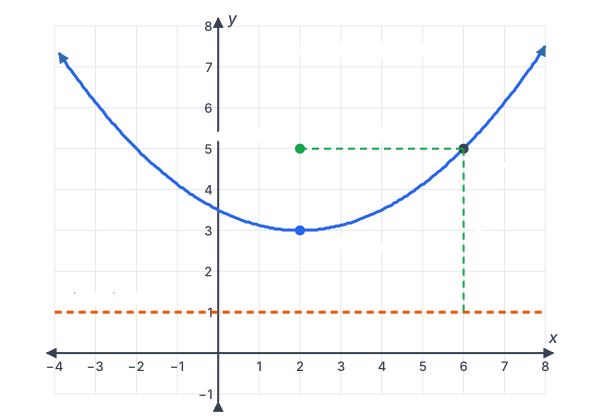
Answer: (x - 2)^2 = 8(y - 3). The vertex is (2, 3), halfway between the focus and the directrix, and p = 2. This is the parabola in the graph above.
Example 4: Complete the square first
Find the vertex, focus and directrix of y = \frac{1}{8}x^2 - x + 5.
y - 5 = \frac{1}{8}x^2 - xSubtract 5 from both sides.
8y - 40 = x^2 - 8x
Multiply both sides by 8.
8y - 40 + 16 = x^2 - 8x + 16
Add 16 to both sides to complete the square, since \left(\frac{-8}{2}\right)^2 = 16 (see completing the square).
8y - 24 = x^2 - 8x + 16
Simplify the left side.
8y - 24 = (x - 4)^2
Factor the perfect square trinomial.
8(y - 3) = (x - 4)^2
Factor 8 out of the left side. Now h = 4 and k = 3.
4p = 8
Match 4p with the number in front of (y - 3).
p = 2
Divide both sides by 4. The parabola opens up.
(h, k + p) = (4, 3 + 2) = (4, 5)
Find the focus.
k - p = 3 - 2 = 1
Find the directrix, y = k - p.
Answer: The vertex is (4, 3), the focus is (4, 5), and the directrix is y = 1.
Example 5: Where to put the bulb
A flashlight reflector is shaped like a parabola. It is 6 inches across at the rim and 2 inches deep. The bulb goes at the focus. How far from the vertex should the bulb be?
x^2 = 4py
Put the vertex at the origin with the parabola opening up.
3^2 = 4p(2)
The rim point (3, 2) is on the parabola: half of 6 inches across, and 2 inches up.
9 = 8p
Simplify both sides.
p = \frac{9}{8}Divide both sides by 8.
p = 1.125
Write the fraction as a decimal.
Answer: The bulb goes on the axis, \frac{9}{8} = 1.125 inches from the vertex.
Common mistakes
| Mistake | Example of the error | Fix |
|---|---|---|
| Using 4p as the distance | For x^2 = 12y, putting the focus at (0, 12) | Solve 4p = 12 first. Then p = 3, so the focus is (0, 3). |
| Opening the wrong way | Saying x^2 = 12y opens right | If x is squared, it opens up or down. If y is squared, it opens left or right. |
| Ignoring the sign of p | Putting the focus of x^2 = -6y above the vertex | A negative p means the parabola opens down or left. |
| Sign errors in the vertex | Reading the vertex of (x + 1)^2 = 4(y - 3) as (1, 3) | Since x + 1 = x - (-1), h = −1 and the vertex is (−1, 3). |
| Directrix on the same side as the focus | Focus (0, 3) with directrix y = 3 | The directrix is on the other side of the vertex: y = k - p = -3. |
| Reading p before factoring | Reading p from x^2 - 8x + 16 = 8y - 24 | Write (x - 4)^2 = 8(y - 3) first, then match 4p = 8. |
Focus and directrix from vertex form
In vertex form, y = a(x - h)^2 + k, the number a and the focal distance p are linked by a = \frac{1}{4p}. So p = \frac{1}{4a}. A small a gives a wide parabola with the focus far from the vertex.
For example, y = \frac{1}{8}(x - 4)^2 + 3 has a = \frac{1}{8}, so p = \frac{1}{4 \cdot \frac{1}{8}} = 2. That matches Example 4. Circles, ellipses and hyperbolas also have focus-based definitions; the circle’s is in equation of a circle.
Practice problems
For problems 1–4, find the vertex, focus and directrix. For problems 5–7 and 9, write the equation of the parabola.
- y^2 = 20x
- x^2 = -6y
- (x + 1)^2 = 4(y - 3)
- (y - 4)^2 = -12(x + 2)
- Focus (0, −4) and directrix y = 4
- Focus (3, 2) and directrix x = -1
- Vertex (2, −1) and focus (2, 1). Also give the directrix.
- Find the vertex, focus and directrix of y = \frac{1}{4}x^2 + 2x + 1.
- Use the distance definition with focus (0, 1) and directrix y = -1.
- A satellite dish is a parabola 4 feet across and 0.5 feet deep. How far from the vertex should the receiver be?
Show answers
1.
y^2 = 20x
Compare with (y - k)^2 = 4p(x - h). The vertex is (0, 0).
4p = 20
Match 4p with the number in front of x.
p = 5
Divide both sides by 4. It opens right.
(h + p, k) = (0 + 5, 0) = (5, 0)
Find the focus.
h - p = 0 - 5 = -5
Find the directrix, x = h - p.
Answer: vertex (0, 0), focus (5, 0), directrix x = -5
2.
x^2 = -6y
Compare with (x - h)^2 = 4p(y - k). The vertex is (0, 0).
4p = -6
Match 4p with the number in front of y.
p = -\frac{3}{2}Divide both sides by 4. It opens down.
(h, k + p) = \left(0, 0 + \left(-\frac{3}{2}\right)\right) = \left(0, -\frac{3}{2}\right)Find the focus.
k - p = 0 - \left(-\frac{3}{2}\right) = \frac{3}{2}Find the directrix, y = k - p.
Answer: vertex (0, 0), focus \left(0, -\frac{3}{2}\right), directrix y = \frac{3}{2}
3.
(x + 1)^2 = 4(y - 3)
Since x + 1 = x - (-1), the vertex is (−1, 3).
4p = 4
Match 4p with the number in front of (y - 3).
p = 1
Divide both sides by 4. It opens up.
(h, k + p) = (-1, 3 + 1) = (-1, 4)
Find the focus.
k - p = 3 - 1 = 2
Find the directrix, y = k - p.
Answer: vertex (−1, 3), focus (−1, 4), directrix y = 2
4.
(y - 4)^2 = -12(x + 2)
The vertex is (h, k) = (−2, 4).
4p = -12
Match 4p with the number in front of (x + 2).
p = -3
Divide both sides by 4. It opens left.
(h + p, k) = (-2 + (-3), 4) = (-5, 4)
Find the focus.
h - p = -2 - (-3) = 1
Find the directrix, x = h - p.
Answer: vertex (−2, 4), focus (−5, 4), directrix x = 1
5.
k = \frac{-4 + 4}{2} = 0The vertex is halfway between the focus and the directrix (see midpoint formula), so it is (0, 0).
p = -4 - 0 = -4
p is the distance from the vertex to the focus, negative because the focus is below.
4p = -16
Multiply by 4.
x^2 = -16y
Use (x - h)^2 = 4p(y - k) with h = 0 and k = 0.
Answer: x^2 = -16y
6.
h = \frac{3 + (-1)}{2} = 1The directrix is vertical, so the vertex is halfway between x = 3 and x = −1. The vertex is (1, 2).
p = 3 - 1 = 2
The focus is 2 units right of the vertex.
4p = 8
Multiply by 4.
(y - 2)^2 = 8(x - 1)
Use (y - k)^2 = 4p(x - h).
Answer: (y - 2)^2 = 8(x - 1)
7.
p = 1 - (-1) = 2
The focus is 2 units above the vertex, so it opens up.
4p = 8
Multiply by 4.
(x - 2)^2 = 8(y + 1)
Use (x - h)^2 = 4p(y - k) with h = 2 and k = −1.
k - p = -1 - 2 = -3
Find the directrix, y = k - p.
Answer: (x - 2)^2 = 8(y + 1) with directrix y = -3
8.
y - 1 = \frac{1}{4}x^2 + 2xSubtract 1 from both sides.
4y - 4 = x^2 + 8x
Multiply both sides by 4.
4y - 4 + 16 = x^2 + 8x + 16
Add 16 to both sides to complete the square.
4y + 12 = x^2 + 8x + 16
Simplify the left side.
4y + 12 = (x + 4)^2
Factor the perfect square trinomial.
4(y + 3) = (x + 4)^2
Factor 4 out of the left side. The vertex is (−4, −3).
4p = 4
Match 4p with the number in front of (y + 3).
p = 1
Divide both sides by 4. It opens up.
(h, k + p) = (-4, -3 + 1) = (-4, -2)
Find the focus.
k - p = -3 - 1 = -4
Find the directrix, y = k - p.
Answer: vertex (−4, −3), focus (−4, −2), directrix y = -4
9.
\sqrt{x^2 + (y - 1)^2} = |y + 1|Set the distance to the focus equal to the distance to the directrix.
x^2 + (y - 1)^2 = (y + 1)^2
Square both sides.
x^2 + y^2 - 2y + 1 = y^2 + 2y + 1
Expand both squares.
x^2 - 2y + 1 = 2y + 1
Subtract y^2 from both sides.
x^2 + 1 = 4y + 1
Add 2y to both sides.
x^2 = 4y
Subtract 1 from both sides.
Answer: x^2 = 4y
10.
x^2 = 4py
Put the vertex at the origin with the dish opening up.
2^2 = 4p(0.5)
The rim point (2, 0.5) is on the parabola.
4 = 2p
Simplify both sides.
p = 2
Divide both sides by 2.
Answer: the receiver goes on the axis, 2 feet from the vertex.
Focus and directrix FAQ
What is the focus of a parabola?
It is the fixed point inside the curve. Every point on the parabola is as far from the focus as from the directrix, and rays that come in parallel to the axis reflect through the focus.
How do you find the directrix of a parabola?
Find the vertex and p. Then go p units from the vertex in the direction away from the focus. The directrix is y = k - p for a parabola that opens up or down, and x = h - p for one that opens left or right.
What does p mean in a parabola equation?
p is the distance from the vertex to the focus, and also from the vertex to the directrix. Its sign gives the direction the parabola opens.
How do you find the focus of y = ax²?
Use p = \frac{1}{4a}. The vertex is (0, 0), so the focus is \left(0, \frac{1}{4a}\right) and the directrix is y = -\frac{1}{4a}.
Summary
- A parabola is every point that is the same distance from the focus as from the directrix.
- Use (x - h)^2 = 4p(y - k) for parabolas that open up or down, and (y - k)^2 = 4p(x - h) for ones that open left or right.
- The vertex (h, k) is halfway between the focus and the directrix.
- Solve 4p = (the number in front) for p. Positive p opens up or right; negative p opens down or left.
- The focus is p units from the vertex, and the directrix is p units on the other side.
Previous lesson: Matrix Transformations
Next lesson: Ellipses
Back to the Precalculus Index