
Hyperbolas
A hyperbola is a curve with two branches. Every point on it has the same difference of distances to two fixed points, the foci. Its standard form is \frac{(x - h)^2}{a^2} - \frac{(y - k)^2}{b^2} = 1 or \frac{(y - k)^2}{a^2} - \frac{(x - h)^2}{b^2} = 1. The vertices are a units from the center, the foci are c units away with c^2 = a^2 + b^2, and two asymptotes guide the branches.
Before this lesson: Ellipses, Completing the Square and Slope-Intercept Form
What a hyperbola is
An ellipse keeps the sum of the distances to two foci the same. A hyperbola keeps the difference the same. That difference is 2a, the distance between the two vertices.
Far from the center, each branch gets closer and closer to two straight lines called asymptotes. The asymptotes cross at the center and pass through the corners of a box that is 2a wide and 2b tall.
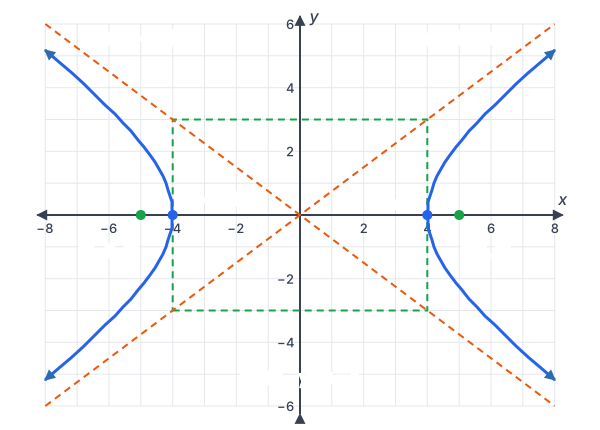
Hyperbola equations and formulas
The positive term tells you the direction. If the x term is positive, the hyperbola opens left and right. If the y term is positive, it opens up and down. Here a^2 is always under the positive term, even if it is smaller.
\frac{(x - h)^2}{a^2} - \frac{(y - k)^2}{b^2} = 1 \quad \text{(opens left and right)}\frac{(y - k)^2}{a^2} - \frac{(x - h)^2}{b^2} = 1 \quad \text{(opens up and down)}c^2 = a^2 + b^2
| Part | Opens left and right | Opens up and down |
|---|---|---|
| Center | (h, k) | (h, k) |
| Vertices | (h \pm a, k) | (h, k \pm a) |
| Foci | (h \pm c, k) | (h, k \pm c) |
| Asymptotes | y - k = \pm\frac{b}{a}(x - h) | y - k = \pm\frac{a}{b}(x - h) |
How to graph a hyperbola
- Write the equation in standard form, with 1 on the right side.
- Find the center (h, k), and read a^2 under the positive term and b^2 under the negative term.
- Plot the vertices a units from the center in the opening direction.
- Draw a box 2a by 2b around the center, and draw the asymptotes through its corners.
- Sketch each branch from a vertex, bending toward the asymptotes. Mark the foci, c units from the center, where c^2 = a^2 + b^2.
Hyperbola examples
Example 1: Center at the origin
Find the vertices, foci and asymptotes of \frac{x^2}{16} - \frac{y^2}{9} = 1.
\frac{x^2}{16} - \frac{y^2}{9} = 1The x term is positive, so the hyperbola opens left and right. The center is (0, 0).
a = \sqrt{16} = 4Take the square root of the denominator under the positive term.
b = \sqrt{9} = 3Take the square root of the other denominator.
c^2 = a^2 + b^2
Write the focus formula for a hyperbola.
c^2 = 16 + 9
Substitute.
c^2 = 25
Add.
c = 5
Take the square root.
(0 \pm 4, 0) = (\pm 4, 0)
Find the vertices, 4 units left and right of the center.
(0 \pm 5, 0) = (\pm 5, 0)
Find the foci, 5 units left and right.
\frac{b}{a} = \frac{3}{4}Find the slope of the asymptotes, \pm\frac{b}{a}.
Answer: vertices (\pm 4, 0), foci (\pm 5, 0) and asymptotes y = \pm\frac{3}{4}x. This is the hyperbola in the graph above.
Example 2: A hyperbola that opens up and down
Find the center, vertices, foci and asymptotes of \frac{(y - 1)^2}{25} - \frac{(x + 2)^2}{144} = 1.
\frac{(y - 1)^2}{25} - \frac{(x + 2)^2}{144} = 1The y term is positive, so the hyperbola opens up and down. Since x + 2 = x - (-2), the center is (−2, 1).
a = \sqrt{25} = 5Take the square root of the denominator under the positive term.
b = \sqrt{144} = 12Take the square root of the other denominator.
c^2 = 25 + 144
Use c^2 = a^2 + b^2.
c^2 = 169
Add.
c = 13
Take the square root.
(h, k + a) = (-2, 1 + 5) = (-2, 6)
Find the top vertex.
(h, k - a) = (-2, 1 - 5) = (-2, -4)
Find the bottom vertex.
(h, k + c) = (-2, 1 + 13) = (-2, 14)
Find the top focus.
(h, k - c) = (-2, 1 - 13) = (-2, -12)
Find the bottom focus.
\frac{a}{b} = \frac{5}{12}For a hyperbola that opens up and down, the asymptote slopes are \pm\frac{a}{b}.
Answer: center (−2, 1), vertices (−2, 6) and (−2, −4), foci (−2, 14) and (−2, −12), and asymptotes y - 1 = \pm\frac{5}{12}(x + 2).
Example 3: Write the equation from the vertices and foci
A hyperbola has vertices (±3, 0) and foci (±5, 0). Write its equation.
a = 3
The vertices are 3 units from the center (0, 0), along the x-axis, so the hyperbola opens left and right.
c = 5
The foci are 5 units from the center.
b^2 = c^2 - a^2
Solve c^2 = a^2 + b^2 for b^2.
b^2 = 25 - 9
Substitute.
b^2 = 16
Subtract.
\frac{x^2}{9} - \frac{y^2}{16} = 1Put a^2 = 9 under the positive x term.
Answer: \frac{x^2}{9} - \frac{y^2}{16} = 1
Example 4: From general form to standard form
Write 9x^2 - 4y^2 - 18x - 16y - 43 = 0 in standard form. Then find the center, vertices and asymptotes.
9x^2 - 18x - 4y^2 - 16y - 43 = 0
Group the x terms and the y terms.
9x^2 - 18x - 4y^2 - 16y = 43
Add 43 to both sides.
9(x^2 - 2x) - 4(y^2 + 4y) = 43
Factor 9 out of the x terms and −4 out of the y terms.
9(x^2 - 2x + 1) - 4(y^2 + 4y + 4) = 43 + 9 - 16
Complete each square (see completing the square). Adding 1 inside the first group adds 9 \cdot 1 = 9. Adding 4 inside the second group adds -4 \cdot 4 = -16.
9(x^2 - 2x + 1) - 4(y^2 + 4y + 4) = 36
Simplify the right side.
9(x - 1)^2 - 4(y + 2)^2 = 36
Factor each perfect square trinomial.
\frac{(x - 1)^2}{4} - \frac{(y + 2)^2}{9} = 1Divide both sides by 36.
a = \sqrt{4} = 2The x term is positive, so it opens left and right. The center is (1, −2).
b = \sqrt{9} = 3Take the square root of the other denominator.
\frac{b}{a} = \frac{3}{2}Find the slope of the asymptotes.
Answer: \frac{(x - 1)^2}{4} - \frac{(y + 2)^2}{9} = 1, with center (1, −2), vertices (3, −2) and (−1, −2), and asymptotes y + 2 = \pm\frac{3}{2}(x - 1).
Example 5: Locating a ship
Two radio stations are 10 miles apart, one at (−5, 0) and one at (5, 0), with distances in miles. A ship’s signals show that it is 6 miles closer to the east station than to the west station. The ship is 4 miles north of the line between the stations. Where is it?
2a = 6
The difference of the distances to the two stations is 2a, so the ship is on a hyperbola with the stations as foci.
a = 3
Divide both sides by 2.
c = 5
The stations are 5 miles from the center (0, 0).
b^2 = 25 - 9 = 16
Use b^2 = c^2 - a^2 and subtract.
\frac{x^2}{9} - \frac{y^2}{16} = 1Write the equation of the hyperbola.
\frac{x^2}{9} - \frac{4^2}{16} = 1Substitute y = 4.
\frac{x^2}{9} - 1 = 1Simplify \frac{16}{16}.
\frac{x^2}{9} = 2Add 1 to both sides.
x^2 = 18
Multiply both sides by 9.
x = \sqrt{18} = 3\sqrt{2}Take the positive root, since the ship is closer to the east station (see simplifying square roots).
Answer: The ship is at (3\sqrt{2}, 4) \approx (4.24, 4), about 4.24 miles east of the center and 4 miles north.
Common mistakes
| Mistake | Example of the error | Fix |
|---|---|---|
| Using c^2 = a^2 - b^2 | For \frac{x^2}{16} - \frac{y^2}{9} = 1, getting c^2 = 7 | For a hyperbola, c^2 = a^2 + b^2 = 25. The minus sign is for ellipses. |
| Taking a^2 as the larger denominator | Using a^2 = 144 in Example 2 | a^2 is always under the positive term. In Example 2 that is 25. |
| Opening the wrong way | Saying \frac{y^2}{9} - \frac{x^2}{16} = 1 opens left and right | The positive term decides: here y is positive, so it opens up and down. |
| Upside-down asymptote slope | Using \pm\frac{a}{b} for a hyperbola that opens left and right | Opening left and right, the slopes are \pm\frac{b}{a}. Opening up and down, they are \pm\frac{a}{b}. |
| Wrong signs for the center | Reading the center of \frac{(x - 1)^2}{4} - \frac{(y + 2)^2}{9} = 1 as (1, 2) | Since y + 2 = y - (-2), the center is (1, −2). |
| Sign slip when completing the square | Adding +16 instead of −16 in Example 4 | The y group has −4 in front, so adding 4 inside adds -4 \cdot 4 = -16. |
Hyperbolas, ellipses and parabolas
The three conic sections differ in one sign or one square. An ellipse adds two squared terms, a hyperbola subtracts them, and a parabola has only one squared variable, as in focus and directrix of a parabola.
The graph of y = \frac{1}{x} is also a hyperbola, turned 45°. Its asymptotes are the x-axis and the y-axis, the same ones you met in graphing rational functions.
Practice problems
For problems 1–4 and 8, find the center, vertices, foci and asymptotes. For problems 5–7, write the equation.
- \frac{x^2}{36} - \frac{y^2}{64} = 1
- \frac{y^2}{9} - \frac{x^2}{16} = 1
- \frac{(x - 2)^2}{9} - \frac{(y + 1)^2}{16} = 1
- 4y^2 - 25x^2 = 100
- Vertices (0, ±4) and foci (0, ±6)
- Vertices (−1, 3) and (7, 3), and foci (−2, 3) and (8, 3)
- Vertices (±2, 0) and asymptotes y = \pm 3x
- x^2 - 4y^2 + 4x + 24y - 36 = 0
- Find the asymptotes of 16x^2 - 9y^2 = 144.
- Two microphones are 2,000 feet apart. A sound reaches one microphone 1 second before the other, and sound travels 1,100 feet per second. Place the microphones at (±1,000, 0) and write the equation of the hyperbola the sound came from.
Show answers
1.
a = \sqrt{36} = 6The x term is positive, so it opens left and right. The center is (0, 0).
b = \sqrt{64} = 8Take the square root of the other denominator.
c^2 = 36 + 64 = 100
Use c^2 = a^2 + b^2 and add.
c = 10
Take the square root.
\frac{b}{a} = \frac{8}{6} = \frac{4}{3}Find the asymptote slope and simplify.
Answer: vertices (\pm 6, 0), foci (\pm 10, 0), asymptotes y = \pm\frac{4}{3}x
2.
a = \sqrt{9} = 3The y term is positive, so it opens up and down. The center is (0, 0).
b = \sqrt{16} = 4Take the square root of the other denominator.
c^2 = 9 + 16 = 25
Use c^2 = a^2 + b^2 and add.
c = 5
Take the square root.
\frac{a}{b} = \frac{3}{4}Opening up and down, the asymptote slope is \pm\frac{a}{b}.
Answer: vertices (0, \pm 3), foci (0, \pm 5), asymptotes y = \pm\frac{3}{4}x
3.
a = \sqrt{9} = 3The x term is positive, so it opens left and right. The center is (2, −1).
b = \sqrt{16} = 4Take the square root of the other denominator.
c^2 = 9 + 16 = 25
Use c^2 = a^2 + b^2 and add.
c = 5
Take the square root.
(h \pm a, k) = (2 \pm 3, -1)
Find the vertices: (5, −1) and (−1, −1).
(h \pm c, k) = (2 \pm 5, -1)
Find the foci: (7, −1) and (−3, −1).
Answer: center (2, −1), vertices (5, −1) and (−1, −1), foci (7, −1) and (−3, −1), asymptotes y + 1 = \pm\frac{4}{3}(x - 2)
4.
\frac{4y^2}{100} - \frac{25x^2}{100} = \frac{100}{100}Divide both sides by 100.
\frac{y^2}{25} - \frac{x^2}{4} = 1Simplify each fraction. The y term is positive, so it opens up and down.
a = \sqrt{25} = 5Take the square root of the denominator under the positive term.
b = \sqrt{4} = 2Take the square root of the other denominator.
c^2 = 25 + 4 = 29
Use c^2 = a^2 + b^2 and add.
c = \sqrt{29}Take the square root.
\frac{a}{b} = \frac{5}{2}Find the asymptote slope.
Answer: center (0, 0), vertices (0, \pm 5), foci (0, \pm\sqrt{29}), asymptotes y = \pm\frac{5}{2}x
5.
a = 4
The vertices are 4 units above and below the center (0, 0), so it opens up and down.
c = 6
The foci are 6 units from the center.
b^2 = 36 - 16 = 20
Use b^2 = c^2 - a^2 and subtract.
\frac{y^2}{16} - \frac{x^2}{20} = 1Put a^2 = 16 under the positive y term.
Answer: \frac{y^2}{16} - \frac{x^2}{20} = 1
6.
h = \frac{-1 + 7}{2} = 3The center is the midpoint of the vertices, (3, 3).
a = 7 - 3 = 4
Find the distance from the center to a vertex. It opens left and right.
c = 8 - 3 = 5
Find the distance from the center to a focus.
b^2 = 25 - 16 = 9
Use b^2 = c^2 - a^2 and subtract.
\frac{(x - 3)^2}{16} - \frac{(y - 3)^2}{9} = 1Put a^2 = 16 under the positive x term.
Answer: \frac{(x - 3)^2}{16} - \frac{(y - 3)^2}{9} = 1
7.
a = 2
The vertices are 2 units from the center (0, 0), so it opens left and right.
\frac{b}{a} = 3The asymptote slopes are \pm\frac{b}{a}, and here they are ±3.
b = 3a = 6
Multiply both sides by a, then substitute a = 2.
\frac{x^2}{4} - \frac{y^2}{36} = 1Use a^2 = 4 and b^2 = 36.
Answer: \frac{x^2}{4} - \frac{y^2}{36} = 1
8.
x^2 + 4x - 4y^2 + 24y = 36
Group the x and y terms, and add 36 to both sides.
(x^2 + 4x) - 4(y^2 - 6y) = 36
Factor −4 out of the y terms.
(x^2 + 4x + 4) - 4(y^2 - 6y + 9) = 36 + 4 - 36
Complete each square. Adding 9 inside the y group adds -4 \cdot 9 = -36.
(x^2 + 4x + 4) - 4(y^2 - 6y + 9) = 4
Simplify the right side.
(x + 2)^2 - 4(y - 3)^2 = 4
Factor each perfect square trinomial.
\frac{(x + 2)^2}{4} - \frac{(y - 3)^2}{1} = 1Divide both sides by 4. The center is (−2, 3) and it opens left and right.
c^2 = 4 + 1 = 5
Use c^2 = a^2 + b^2 with a = 2 and b = 1.
c = \sqrt{5}Take the square root.
Answer: center (−2, 3), vertices (0, 3) and (−4, 3), foci (-2 \pm \sqrt{5}, 3), asymptotes y - 3 = \pm\frac{1}{2}(x + 2)
9.
\frac{16x^2}{144} - \frac{9y^2}{144} = \frac{144}{144}Divide both sides by 144.
\frac{x^2}{9} - \frac{y^2}{16} = 1Simplify each fraction. It opens left and right with a = 3 and b = 4.
\frac{b}{a} = \frac{4}{3}Find the asymptote slope.
Answer: y = \pm\frac{4}{3}x
10.
2a = 1{,}100The difference of the distances is 1,100 feet per second times 1 second.
a = 550
Divide both sides by 2.
c = 1{,}000The microphones, the foci, are 1,000 feet from the center.
b^2 = 1{,}000{,}000 - 302{,}500 = 697{,}500Use b^2 = c^2 - a^2, with c^2 = 1{,}000{,}000 and a^2 = 302{,}500.
\frac{x^2}{302{,}500} - \frac{y^2}{697{,}500} = 1Put a^2 under the positive x term.
Answer: \frac{x^2}{302{,}500} - \frac{y^2}{697{,}500} = 1. The sound came from the branch closer to the microphone it reached first.
Hyperbola FAQ
How do you find the asymptotes of a hyperbola?
Draw the box 2a by 2b around the center; the asymptotes pass through its corners. For a hyperbola that opens left and right, they are y - k = \pm\frac{b}{a}(x - h). For one that opens up and down, they are y - k = \pm\frac{a}{b}(x - h).
How do you find the foci of a hyperbola?
Use c^2 = a^2 + b^2. The foci are c units from the center, in the same direction as the vertices.
What is the difference between an ellipse and a hyperbola?
In standard form, an ellipse adds its two squared terms and a hyperbola subtracts them. An ellipse keeps the sum of the distances to the foci the same, while a hyperbola keeps the difference the same.
How do you know which way a hyperbola opens?
Look at the positive squared term in standard form. A positive x term means it opens left and right; a positive y term means it opens up and down.
Summary
- A hyperbola is every point whose distances to two foci differ by 2a.
- The positive term decides the direction, and a^2 is always under it.
- The vertices are a units from the center, and the foci are c units away, with c^2 = a^2 + b^2.
- The asymptotes pass through the corners of the 2a by 2b box: slopes \pm\frac{b}{a} for left and right, \pm\frac{a}{b} for up and down.
- Complete the square to change general form into standard form.
Previous lesson: Ellipses
Next lesson: Identifying Conic Sections
Back to the Precalculus Index