
Derivatives of Parametric Equations
To find the derivative of parametric equations x = x(t) and y = y(t), divide the two rates: dy/dx = (dy/dt)/(dx/dt), as long as dx/dt is not zero. For the second derivative, differentiate dy/dx with respect to t, then divide by dx/dt again.
Before this lesson: Parametric Equations, Chain Rule and Equation of a Tangent Line
The idea: slope is rise rate over run rate
In a parametric curve, a point moves as t (often time) changes. At each moment it has a vertical speed, dy/dt, and a horizontal speed, dx/dt.
The slope of the path is how much it rises for each unit it runs. If the point rises 6 units per second while it moves right 2 units per second, the path rises 3 units for every 1 unit across. So the slope is 6/2 = 3.
The chain rule says the same thing with symbols: dy/dt = (dy/dx)(dx/dt). Divide both sides by dx/dt to get the formula below.
Parametric derivative formulas
\dfrac{dy}{dx} = \dfrac{dy/dt}{dx/dt} \qquad \dfrac{d^2y}{dx^2} = \dfrac{\dfrac{d}{dt}\left(\dfrac{dy}{dx}\right)}{dx/dt}- Horizontal tangent: dy/dt = 0 and dx/dt ≠ 0.
- Vertical tangent: dx/dt = 0 and dy/dt ≠ 0.
- If both are 0 at the same t, the formula doesn’t decide. The curve may have a cusp or a sharp turn there.
- The second derivative tells concavity: positive means concave up, negative means concave down.
The second derivative is not d²y/dt² divided by d²x/dt². It is the derivative of the slope with respect to t, divided by dx/dt.
Derivatives of parametric equations examples
Example 1: Slope and tangent line
For x = t² + 1 and y = t³ − 3t, find dy/dx and the tangent line at t = 2.
\dfrac{dx}{dt} = 2t, \quad \dfrac{dy}{dt} = 3t^2 - 3Differentiate each equation with the power rule.
\dfrac{dy}{dx} = \dfrac{3t^2 - 3}{2t}Divide dy/dt by dx/dt.
\dfrac{3(2)^2 - 3}{2(2)} = \dfrac{9}{4}Substitute t = 2 to get the slope.
x(2) = 2^2 + 1 = 5
Find the x-coordinate at t = 2.
y(2) = 2^3 - 3(2) = 2
Find the y-coordinate at t = 2.
y - 2 = \tfrac{9}{4}(x - 5)Use point-slope form with (5, 2).
Answer: dy/dx = (3t² − 3)/(2t), and the tangent line at t = 2 is y − 2 = (9/4)(x − 5).
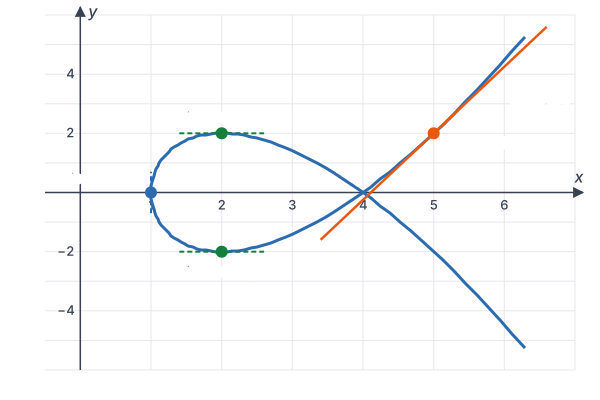
Example 2: Second derivative
For the same curve, x = t² + 1 and y = t³ − 3t, find d²y/dx² and the concavity at t = 2.
\dfrac{dy}{dx} = \dfrac{3t^2 - 3}{2t} = \dfrac{3}{2}t - \dfrac{3}{2}t^{-1}Split the fraction so it is easy to differentiate.
\dfrac{d}{dt}\left(\dfrac{dy}{dx}\right) = \dfrac{3}{2} + \dfrac{3}{2}t^{-2}Differentiate with respect to t.
\dfrac{d^2y}{dx^2} = \dfrac{\tfrac{3}{2} + \tfrac{3}{2}t^{-2}}{2t}Divide by dx/dt = 2t.
\dfrac{d^2y}{dx^2} = \dfrac{3t^2 + 3}{4t^3}Multiply top and bottom by 2t² (see complex rational expressions).
\dfrac{3(2)^2 + 3}{4(2)^3} = \dfrac{15}{32}Substitute t = 2.
Answer: d²y/dx² = (3t² + 3)/(4t³), which is 15/32 at t = 2. It is positive, so the curve is concave up there.
Example 3: A trig curve
For the ellipse x = 3 cos t, y = 2 sin t, find dy/dx and the tangent line at t = π/4.
\dfrac{dx}{dt} = -3\sin t, \quad \dfrac{dy}{dt} = 2\cos tDifferentiate (see derivatives of trig functions).
\dfrac{dy}{dx} = \dfrac{2\cos t}{-3\sin t} = -\dfrac{2}{3}\cot tDivide, and use cos t / sin t = cot t.
-\dfrac{2}{3}\cot\dfrac{\pi}{4} = -\dfrac{2}{3}Substitute t = π/4; cot(π/4) = 1.
\left(3 \cdot \dfrac{\sqrt{2}}{2},\; 2 \cdot \dfrac{\sqrt{2}}{2}\right) = \left(\dfrac{3\sqrt{2}}{2},\; \sqrt{2}\right)Find the point, using cos(π/4) = sin(π/4) = √2/2.
y - \sqrt{2} = -\tfrac{2}{3}\left(x - \tfrac{3\sqrt{2}}{2}\right)Use point-slope form.
Answer: dy/dx = −(2/3)cot t, and the tangent line at t = π/4 is y − √2 = −(2/3)(x − 3√2/2).
Example 4: Horizontal and vertical tangents
Find all points where x = t² − 4t, y = t³ − 3t has a horizontal or a vertical tangent.
\dfrac{dx}{dt} = 2t - 4, \quad \dfrac{dy}{dt} = 3t^2 - 3Differentiate each equation.
3t^2 - 3 = 0
Horizontal tangents need dy/dt = 0.
t = 1 \text{ or } t = -1Divide by 3, then t² = 1 (see solving quadratics with square roots).
\dfrac{dx}{dt} = -2 \text{ and } -6Check dx/dt at t = 1 and t = −1. Neither is 0.
(-3, -2) \text{ and } (5, 2)Points at t = 1 and t = −1.
2t - 4 = 0
Vertical tangents need dx/dt = 0.
t = 2
Add 4 and divide by 2.
\dfrac{dy}{dt} = 3(2)^2 - 3 = 9Check dy/dt at t = 2. It is not 0.
(2^2 - 4(2),\; 2^3 - 3(2)) = (-4, 2)
Point at t = 2.
Answer: horizontal tangents at (−3, −2) and (5, 2); a vertical tangent at (−4, 2).
Example 5: The path of a ball (word problem)
A ball’s position in meters after t seconds is x = 30t, y = 40t − 4.9t². Find the slope of its path at t = 2, the highest point, and d²y/dx².
\dfrac{dy}{dx} = \dfrac{40 - 9.8t}{30}dy/dt = 40 − 9.8t and dx/dt = 30.
\dfrac{40 - 9.8(2)}{30} = \dfrac{20.4}{30} = 0.68Substitute t = 2.
40 - 9.8t = 0
At the highest point the path is level, so dy/dt = 0.
t = \dfrac{40}{9.8} \approx 4.082Add 9.8t and divide by 9.8.
y \approx 40(4.082) - 4.9(4.082)^2 \approx 81.63
Substitute into y.
x \approx 30(4.082) \approx 122.45
Substitute into x.
\dfrac{d^2y}{dx^2} = \dfrac{-9.8/30}{30} \approx -0.01089Differentiate dy/dx with respect to t and divide by dx/dt = 30.
Answer: the slope is 0.68 at t = 2; the highest point is about (122.4, 81.6) meters, reached after about 4.08 seconds; and d²y/dx² ≈ −0.0109, so the path is always concave down.
Common mistakes
| Mistake | Example of the error | Fix |
|---|---|---|
| Dividing the wrong way | \dfrac{dy}{dx} = \dfrac{dx/dt}{dy/dt} | y-rate on top: \dfrac{dy/dt}{dx/dt}. |
| Stopping after d/dt of the slope | Giving \tfrac{3}{2} + \tfrac{3}{2}t^{-2} as d²y/dx² | Divide by dx/dt as well. |
| Dividing second derivatives | \dfrac{d^2y}{dx^2} = \dfrac{d^2y/dt^2}{d^2x/dt^2} | Use \dfrac{d}{dt}(dy/dx) \div \dfrac{dx}{dt}. |
| Using t as a coordinate | Tangent line y − 2 = (9/4)(x − 2) at t = 2 | Find the point (x(2), y(2)) = (5, 2) first. |
| Mixing up horizontal and vertical | Calling dx/dt = 0 a horizontal tangent | dy/dt = 0 gives horizontal; dx/dt = 0 gives vertical. |
| Ignoring the 0/0 case | Calling t = 0 a horizontal tangent of the cycloid x = t − sin t, y = 1 − cos t | When both rates are 0, look more closely. The cycloid has a cusp there. |
Related methods
Implicit differentiation
The ellipse in Example 3 can also be written as x²/9 + y²/4 = 1. Implicit differentiation gives the same slope, −4x/(9y), at the same point.
Eliminating the parameter
Sometimes you can solve for t and write y as a function of x, as in parametric equations. For x = eᵗ, y = e²ᵗ, that gives y = x². The parametric formula is still faster when elimination is messy.
Motion along a path
Parametric curves also give speed and distance traveled. Those are the next lesson, Arc Length of Parametric Curves, and Vector-Valued Functions, later in this unit. In one dimension, the same ideas appear in position, velocity and acceleration.
Practice problems
- Find dy/dx for x = 2t + 1, y = t² − 4.
- Find dy/dx for x = t³, y = t² + t, and its value at t = 1.
- Find the tangent line to the curve in problem 2 at t = 1.
- Find dy/dx for x = eᵗ, y = e²ᵗ. Write it in terms of x.
- Find the slope of x = 4 cos t, y = 4 sin t at t = π/6.
- Find d²y/dx² for x = 2t + 1, y = t² − 4.
- Find d²y/dx² for x = t², y = t³, with t positive.
- Find the horizontal and vertical tangents of x = t² − 2t, y = t² + 2t.
- For the cycloid x = t − sin t, y = 1 − cos t, find dy/dx at t = π/2. What happens at t = 0?
- A drone flies along x = 5t, y = 20 + 6t − t² (meters, seconds). When is it flying level, and how high is it then?
Show answers
1.
\dfrac{dx}{dt} = 2, \quad \dfrac{dy}{dt} = 2tDifferentiate each equation.
\dfrac{dy}{dx} = \dfrac{2t}{2} = tDivide and simplify.
Answer: dy/dx = t
2.
\dfrac{dx}{dt} = 3t^2, \quad \dfrac{dy}{dt} = 2t + 1Differentiate each equation.
\dfrac{dy}{dx} = \dfrac{2t + 1}{3t^2}Divide.
\dfrac{2(1) + 1}{3(1)^2} = 1Substitute t = 1.
Answer: dy/dx = (2t + 1)/(3t²), which is 1 at t = 1
3.
(1^3,\; 1^2 + 1) = (1, 2)
Find the point at t = 1.
y - 2 = 1(x - 1)
Point-slope form with slope 1.
y = x + 1
Add 2 to both sides.
Answer: y = x + 1
4.
\dfrac{dy}{dx} = \dfrac{2e^{2t}}{e^{t}} = 2e^{t}Divide; subtract exponents.
2e^{t} = 2xReplace eᵗ with x.
Answer: dy/dx = 2eᵗ = 2x (matches y = x²)
5.
\dfrac{dy}{dx} = \dfrac{4\cos t}{-4\sin t} = -\cot tDivide the derivatives.
-\cot\dfrac{\pi}{6} = -\sqrt{3}Substitute t = π/6; cot(π/6) = √3.
Answer: −√3
6.
\dfrac{d}{dt}(t) = 1Differentiate dy/dx = t (problem 1) with respect to t.
\dfrac{d^2y}{dx^2} = \dfrac{1}{2}Divide by dx/dt = 2.
Answer: 1/2
7.
\dfrac{dy}{dx} = \dfrac{3t^2}{2t} = \dfrac{3}{2}tDivide the first derivatives and simplify.
\dfrac{d}{dt}\left(\dfrac{3}{2}t\right) = \dfrac{3}{2}Differentiate with respect to t.
\dfrac{d^2y}{dx^2} = \dfrac{3/2}{2t} = \dfrac{3}{4t}Divide by dx/dt = 2t.
Answer: 3/(4t)
8.
\dfrac{dx}{dt} = 2t - 2, \quad \dfrac{dy}{dt} = 2t + 2Differentiate each equation.
2t + 2 = 0 \Rightarrow t = -1
Horizontal: dy/dt = 0. Then dx/dt = −4, not 0.
(1 + 2,\; 1 - 2) = (3, -1)
Point at t = −1.
2t - 2 = 0 \Rightarrow t = 1
Vertical: dx/dt = 0. Then dy/dt = 4, not 0.
(1 - 2,\; 1 + 2) = (-1, 3)
Point at t = 1.
Answer: horizontal tangent at (3, −1); vertical tangent at (−1, 3)
9.
\dfrac{dy}{dx} = \dfrac{\sin t}{1 - \cos t}dy/dt = sin t and dx/dt = 1 − cos t.
\dfrac{\sin(\pi/2)}{1 - \cos(\pi/2)} = \dfrac{1}{1} = 1Substitute t = π/2.
\dfrac{\sin 0}{1 - \cos 0} = \dfrac{0}{0}At t = 0 both rates are 0.
Answer: slope 1 at t = π/2. At t = 0 the formula gives 0/0; the cycloid has a cusp (a sharp point) at the origin
10.
\dfrac{dy}{dt} = 6 - 2t = 0Level flight means a horizontal tangent; dx/dt = 5 is never 0.
t = 3
Add 2t and divide by 2.
y(3) = 20 + 18 - 9 = 29
Substitute t = 3 into y.
Answer: level at t = 3 seconds, 29 meters high (at x = 15 m)
Parametric derivatives FAQ
How do you find dy/dx for parametric equations?
Differentiate x and y with respect to t, then divide: dy/dx = (dy/dt)/(dx/dt). Substitute a value of t to get the slope at a point.
How do you find the second derivative of parametric equations?
Take the derivative of dy/dx with respect to t, then divide by dx/dt. In symbols, d²y/dx² = [d/dt (dy/dx)] / (dx/dt).
How do you find horizontal and vertical tangents of a parametric curve?
Horizontal tangents are where dy/dt = 0 and dx/dt is not 0. Vertical tangents are where dx/dt = 0 and dy/dt is not 0.
What if dy/dt and dx/dt are both zero?
Then the formula gives 0/0 and doesn’t tell you the slope. Look at the curve or take a limit; the point is often a cusp or a sharp turn.
Summary
- dy/dx = (dy/dt)/(dx/dt), as long as dx/dt is not 0.
- d²y/dx² = [d/dt (dy/dx)] / (dx/dt). Don’t forget the second division.
- Horizontal tangent: dy/dt = 0. Vertical tangent: dx/dt = 0.
- Both rates 0: no conclusion; look for a cusp.
- For a tangent line, find the point (x(t), y(t)) and the slope at the same t.
Previous lesson: Logistic Differential Equations
Next lesson: Arc Length of Parametric Curves
Back to the Calculus 2 Index