
Logistic Differential Equations
A logistic differential equation, dP/dt = kP(1 − P/L), models growth that slows down as it nears a carrying capacity L. Its solution is P = L/(1 + Ae^(−kt)), an S-shaped curve. The population grows fastest when it reaches half the carrying capacity, P = L/2, and it approaches L over time.
Before this lesson: Exponential Models with Differential Equations, Integration by Partial Fractions and Logistic Functions
The idea: growth with a brake
Exponential growth, dP/dt = kP, never slows down. Real populations run out of food or space. The logistic equation multiplies kP by a brake factor, (1 − P/L).
When P is small, the brake factor is close to 1, so growth looks exponential. As P nears L, the factor shrinks toward 0, so growth stops. If P starts above L, the factor is negative, so the population falls back toward L.
L is the carrying capacity, the largest population the environment can support over time. k is the growth rate when the population is small.
Logistic differential equation formula
\dfrac{dP}{dt} = kP\left(1 - \dfrac{P}{L}\right) \quad\Longrightarrow\quad P(t) = \dfrac{L}{1 + A\,e^{-kt}}, \quad A = \dfrac{L - P_0}{P_0}- If P₀ is positive, P approaches L as t grows: the limit of P(t) is L.
- The growth rate dP/dt is largest when P = L/2. That is the inflection point of the S-curve.
- P = 0 and P = L are equilibrium (constant) solutions.
- If P₀ is greater than L, A is negative and P decreases toward L.
Where the solution comes from
The equation is separable. The left side needs partial fractions.
\dfrac{L}{P(L - P)}\,dP = k\,dtWrite 1 − P/L as (L − P)/L, then separate the variables.
\left(\dfrac{1}{P} + \dfrac{1}{L - P}\right)dP = k\,dtSplit into partial fractions.
\ln|P| - \ln|L - P| = kt + C
Integrate both sides (see integrals that give natural logarithms).
\ln\left|\dfrac{P}{L - P}\right| = kt + CCombine the logs (see properties of logarithms).
\dfrac{P}{L - P} = B\,e^{kt}Exponentiate and let B = ±e^C.
\dfrac{L - P}{P} = A\,e^{-kt}Take reciprocals of both sides, with A = 1/B.
\dfrac{L}{P} - 1 = A\,e^{-kt}Split the fraction.
P = \dfrac{L}{1 + A\,e^{-kt}}Add 1 to both sides, then take reciprocals and multiply by L.
At t = 0, the last line gives P₀ = L/(1 + A), so A = (L − P₀)/P₀.
Logistic differential equation examples
Example 1: Read the equation
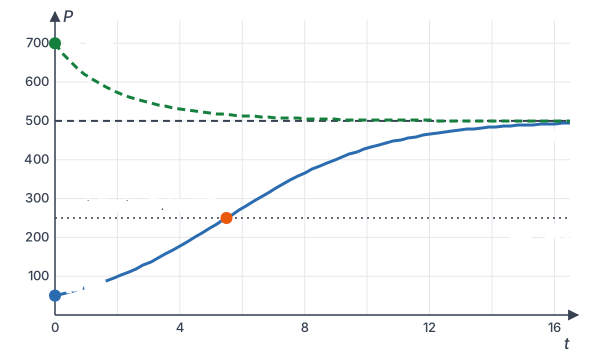
For dP/dt = 0.4P(1 − P/500), find the growth constant, the carrying capacity, the population where growth is fastest, and the fastest growth rate.
k = 0.4, \quad L = 500
Match the equation to dP/dt = kP(1 − P/L).
P = \dfrac{L}{2} = 250Growth is fastest at half the carrying capacity.
\dfrac{dP}{dt} = 0.4(250)\left(1 - \dfrac{250}{500}\right)Substitute P = 250 into the equation.
\dfrac{dP}{dt} = 100(0.5) = 50Multiply.
Answer: k = 0.4, L = 500, and growth is fastest at P = 250, where it is 50 per unit of time.
Example 2: Rewrite the equation first
Find k and L for dP/dt = 0.002P(300 − P).
300 - P = 300\left(1 - \dfrac{P}{300}\right)Factor 300 out of 300 − P.
\dfrac{dP}{dt} = 0.002(300)P\left(1 - \dfrac{P}{300}\right)Substitute into the equation.
\dfrac{dP}{dt} = 0.6P\left(1 - \dfrac{P}{300}\right)Multiply 0.002 by 300.
Answer: k = 0.6 and L = 300. The number 0.002 is not k; it is k/L.
Example 3: Solve with an initial value
Solve dP/dt = 0.4P(1 − P/500) with P(0) = 50. Find P(5) and the time when growth is fastest.
A = \dfrac{500 - 50}{50} = 9Use A = (L − P₀)/P₀.
P = \dfrac{500}{1 + 9e^{-0.4t}}Substitute L = 500, A = 9 and k = 0.4.
P(5) = \dfrac{500}{1 + 9e^{-2}}Substitute t = 5.
P(5) \approx \dfrac{500}{1 + 1.21802} \approx 225.43Evaluate 9e^(−2) and divide.
250 = \dfrac{500}{1 + 9e^{-0.4t}}Fastest growth is at P = 250.
1 + 9e^{-0.4t} = 2Multiply both sides by the denominator and divide by 250.
e^{-0.4t} = \dfrac{1}{9}Subtract 1 and divide by 9.
t = \dfrac{\ln 9}{0.4} \approx 5.49Take the natural log and divide by −0.4.
Answer: P = 500/(1 + 9e^(−0.4t)), P(5) ≈ 225, and growth is fastest at t ≈ 5.49.
Example 4: Fish in a lake (word problem)
A lake can support 2,000 fish. It is stocked with 400 fish, and after 2 years there are 800. Assuming logistic growth, find k and when the lake will hold 1,600 fish.
A = \dfrac{2000 - 400}{400} = 4Use A = (L − P₀)/P₀.
800 = \dfrac{2000}{1 + 4e^{-2k}}Substitute t = 2 and P = 800.
1 + 4e^{-2k} = 2.5Multiply by the denominator and divide by 800.
e^{-2k} = 0.375Subtract 1 and divide by 4.
k = \dfrac{\ln 0.375}{-2} \approx 0.4904Take the natural log and divide by −2.
1600 = \dfrac{2000}{1 + 4e^{-kt}}Set P = 1600.
1 + 4e^{-kt} = 1.25Multiply by the denominator and divide by 1600.
e^{-kt} = 0.0625Subtract 1 and divide by 4.
t = \dfrac{\ln 16}{k} \approx \dfrac{2.7726}{0.4904} \approx 5.65Take the natural log, use −ln 0.0625 = ln 16, and divide by k.
Answer: k ≈ 0.49 per year, and the lake reaches 1,600 fish after about 5.7 years.
Example 5: Starting above the carrying capacity
Solve dP/dt = 0.4P(1 − P/500) with P(0) = 700. Is the population rising or falling, and what is its limit?
\dfrac{dP}{dt} = 0.4(700)\left(1 - \dfrac{700}{500}\right) = 280(-0.4) = -112Substitute P = 700. The rate is negative.
A = \dfrac{500 - 700}{700} = -\dfrac{2}{7}Use A = (L − P₀)/P₀.
P = \dfrac{500}{1 - \tfrac{2}{7}e^{-0.4t}}Substitute L, A and k.
P(2) = \dfrac{500}{1 - \tfrac{2}{7}e^{-0.8}} \approx \dfrac{500}{0.87162} \approx 573.65Substitute t = 2 and evaluate.
\lim_{t \to \infty} P(t) = \dfrac{500}{1 - 0} = 500As t grows, e^(−0.4t) approaches 0.
Answer: P = 500/(1 − (2/7)e^(−0.4t)). The population falls (by 112 per unit of time at first), is about 574 at t = 2, and approaches 500.
Common mistakes
| Mistake | Example of the error | Fix |
|---|---|---|
| Reading k from the wrong form | For dP/dt = 0.002P(300 − P), saying k = 0.002 | Factor out L first: k = 0.002 · 300 = 0.6. |
| Flipping A | A = \dfrac{P_0}{L - P_0} | A = \dfrac{L - P_0}{P_0}. |
| Fastest growth at the carrying capacity | “Growth is fastest at P = 500” | At P = L, growth is zero. It is fastest at P = L/2. |
| Mixing up P and t | “Growth is fastest at t = 250” | L/2 is a population. Solve P(t) = L/2 to find the time. |
| Assuming every population grows | Saying P rises when P₀ = 700 and L = 500 | Above L, the brake factor is negative, so P falls. |
| Using e^(kt) in the denominator | P = \dfrac{L}{1 + Ae^{kt}} | The exponent is −kt, so the denominator shrinks to 1. |
Related methods
Exponential models
For small P, the logistic equation acts like dP/dt = kP from exponential models with differential equations. The brake factor is what bends the curve into an S.
Logistic functions without calculus
Logistic functions in Precalculus use the same S-shaped formula. This lesson shows where the formula comes from.
Slope fields and Euler’s method
A slope field for a logistic equation shows flat slopes along P = 0 and P = L. Euler’s method can estimate logistic populations without solving the equation.
Other limited-growth models
Newton’s law of cooling also approaches a limiting value, but it never has an S-shape: it changes fastest at the start.
Practice problems
- For dP/dt = 0.3P(1 − P/800), find k, L and the population where growth is fastest.
- Find k and L for dP/dt = 0.01P(50 − P).
- For dP/dt = 2P(1 − P/90) with P(0) = 10, find the limit of P(t) as t grows.
- Solve dP/dt = 0.5P(1 − P/100) with P(0) = 20.
- For problem 4, find P(4).
- For problem 4, when does P reach 50?
- Find the fastest growth rate for dP/dt = 0.2P(1 − P/1000).
- A rumor spreads through a school of 1,200 students by dN/dt = 0.8N(1 − N/1200), with t in days. Six students start it. When have half the students heard it?
- For dP/dt = 0.5P(1 − P/100) with P(0) = 150, is P increasing or decreasing at the start? What is its limit?
- Show that for dP/dt = kP(1 − P/L), the second derivative is k²P(1 − P/L)(1 − 2P/L), and find where it is zero.
Show answers
1.
k = 0.3, \quad L = 800
Match to dP/dt = kP(1 − P/L).
P = \dfrac{800}{2} = 400Fastest growth at L/2.
Answer: k = 0.3, L = 800, fastest at P = 400
2.
50 - P = 50\left(1 - \dfrac{P}{50}\right)Factor out 50.
\dfrac{dP}{dt} = 0.5P\left(1 - \dfrac{P}{50}\right)Multiply 0.01 by 50.
Answer: k = 0.5, L = 50
3.
L = 90
Match the equation; P₀ = 10 is positive.
\lim_{t \to \infty} P(t) = L = 90Logistic solutions approach L.
Answer: 90
4.
A = \dfrac{100 - 20}{20} = 4Use A = (L − P₀)/P₀.
P = \dfrac{100}{1 + 4e^{-0.5t}}Substitute L, A and k.
Answer: P = 100/(1 + 4e^(−0.5t))
5.
P(4) = \dfrac{100}{1 + 4e^{-2}}Substitute t = 4.
P(4) \approx \dfrac{100}{1.54134} \approx 64.88Evaluate and divide.
Answer: P(4) ≈ 64.9
6.
1 + 4e^{-0.5t} = 2Set P = 50, multiply by the denominator and divide by 50.
e^{-0.5t} = \dfrac{1}{4}Subtract 1 and divide by 4.
t = \dfrac{\ln 4}{0.5} \approx 2.77Take the natural log and divide by −0.5.
Answer: t ≈ 2.77
7.
P = \dfrac{1000}{2} = 500Fastest at L/2.
\dfrac{dP}{dt} = 0.2(500)(1 - 0.5) = 50Substitute P = 500.
Answer: 50 per unit of time
8.
A = \dfrac{1200 - 6}{6} = 199Use A = (L − N₀)/N₀.
1 + 199e^{-0.8t} = 2Set N = 600, multiply by the denominator and divide by 600.
e^{-0.8t} = \dfrac{1}{199}Subtract 1 and divide by 199.
t = \dfrac{\ln 199}{0.8} \approx 6.62Take the natural log and divide by −0.8.
Answer: after about 6.6 days
9.
\dfrac{dP}{dt} = 0.5(150)\left(1 - \dfrac{150}{100}\right)Substitute P = 150.
\dfrac{dP}{dt} = 75(-0.5) = -37.5Multiply.
Answer: decreasing at first (rate −37.5), with limit 100
10.
\dfrac{dP}{dt} = kP - \dfrac{k}{L}P^2Distribute kP.
\dfrac{d^2P}{dt^2} = k\dfrac{dP}{dt} - \dfrac{2k}{L}P\dfrac{dP}{dt}Differentiate with the chain rule.
\dfrac{d^2P}{dt^2} = k\dfrac{dP}{dt}\left(1 - \dfrac{2P}{L}\right)Factor out k dP/dt.
\dfrac{d^2P}{dt^2} = k^2P\left(1 - \dfrac{P}{L}\right)\left(1 - \dfrac{2P}{L}\right)Substitute dP/dt = kP(1 − P/L).
Answer: it is zero at P = 0, P = L and P = L/2. The S-curve’s inflection point is at P = L/2
Logistic differential equation FAQ
What is the logistic differential equation?
It is dP/dt = kP(1 − P/L), where k is the growth constant and L is the carrying capacity. It models growth that is nearly exponential at first and then levels off at L.
What is the carrying capacity?
The carrying capacity L is the population the environment can support in the long run. Logistic solutions with a positive starting value approach L as time goes on.
When is a logistic population growing fastest?
At half the carrying capacity, P = L/2. There the second derivative is zero, so the S-curve has an inflection point.
What is the solution to the logistic differential equation?
P(t) = L/(1 + Ae^(−kt)), where A = (L − P₀)/P₀ and P₀ is the starting population.
Summary
- Logistic equation: dP/dt = kP(1 − P/L), with carrying capacity L.
- Solution: P = L/(1 + Ae^(−kt)) with A = (L − P₀)/P₀.
- P approaches L; P = 0 and P = L are equilibrium solutions.
- Growth is fastest at P = L/2, the inflection point.
- Factor the equation into the form kP(1 − P/L) before reading k and L.
- A population above L decreases toward L.
Previous lesson: Newton’s Law of Cooling
Next lesson: Derivatives of Parametric Equations
Back to the Calculus 2 Index