
Exponential Models with Differential Equations
Exponential models with differential equations start from dy/dt = ky, which says the rate of change is proportional to the amount present. Separating the variables gives the solution y = y₀e^(kt), where y₀ is the starting amount. A positive k means exponential growth, and a negative k means exponential decay.
Before this lesson: Separable Differential Equations, The Number e and Solving Exponential Equations
The idea: the rate depends on the amount
Many quantities change at a rate that depends on how much is there. A colony with more bacteria has more cells dividing each hour. A sample with more radioactive atoms has more atoms breaking down each second.
“Proportional” means the rate equals a constant k times the amount. If y doubles, the rate doubles too. That feedback is what makes the graph curve upward faster and faster (growth) or level off toward zero (decay).
| In words | Differential equation | Sign of k |
|---|---|---|
| Grows at a rate proportional to its size | \dfrac{dy}{dt} = ky | k \gt 0 |
| Decays at a rate proportional to the amount left | \dfrac{dy}{dt} = ky | k \lt 0 |
| Grows continuously at 6% per year | \dfrac{dy}{dt} = 0.06y | k = 0.06 |
| Shrinks continuously at 2% per hour | \dfrac{dy}{dt} = -0.02y | k = -0.02 |
Solving dy/dt = ky
The equation is separable, so you can solve it once and reuse the result.
\dfrac{1}{y}\,dy = k\,dtDivide both sides by y and multiply by dt.
\ln|y| = kt + C
Integrate both sides.
|y| = e^{C}e^{kt}Exponentiate and split the power.
y = A\,e^{kt}Let A = ±e^C.
y(0) = A\,e^{0} = AAt t = 0, the amount is A, so A is the starting amount y₀.
y = y_0\,e^{kt}- y₀ is the amount at t = 0, and k is the relative growth rate (as a decimal, per unit of time).
- Doubling time (positive k): T = ln 2 / k.
- Half-life (negative k): T = ln 2 / |k|, so k = −ln 2 / T.
- To find k from two data points, divide one value by the other and take the natural log.
Exponential models examples
Example 1: Solve and evaluate
Solve dy/dt = 0.3y with y(0) = 20. Then find y(5).
y = y_0\,e^{kt}The equation has the form dy/dt = ky.
y = 20e^{0.3t}Use y₀ = 20 and k = 0.3.
y(5) = 20e^{0.3(5)}Substitute t = 5.
y(5) = 20e^{1.5}Multiply the exponent.
y(5) \approx 20(4.4817)
Evaluate e^1.5 with a calculator.
y(5) \approx 89.63
Multiply.
Answer: y = 20e^(0.3t), and y(5) ≈ 89.63.
Example 2: Find k from data
A culture has 500 bacteria at t = 0 and 1,500 bacteria after 4 hours. Assume dP/dt = kP. Find k, then predict the population after 10 hours.
P = 500e^{kt}Use P₀ = 500.
1500 = 500e^{4k}Substitute t = 4 and P = 1500.
3 = e^{4k}Divide both sides by 500.
\ln 3 = 4k
Take the natural log of both sides (see solving exponential equations).
k = \dfrac{\ln 3}{4} \approx 0.2747Divide both sides by 4.
P(10) = 500e^{10k} = 500e^{2.5\ln 3}Substitute t = 10 and simplify 10(ln 3)/4.
500e^{2.5\ln 3} = 500 \cdot 3^{2.5}Use e^(a ln b) = b^a (see properties of logarithms).
500 \cdot 3^{2.5} \approx 500(15.588) \approx 7794Evaluate.
Answer: k ≈ 0.2747 per hour, and about 7,794 bacteria after 10 hours.
Example 3: Half-life
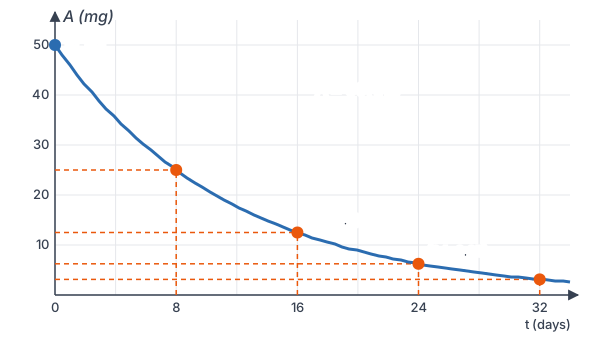
A medical isotope has a half-life of 8 days. A patient receives 50 mg. How much is left after 20 days, and when does the amount drop to 5 mg?
k = -\dfrac{\ln 2}{8} \approx -0.08664Use k = −ln 2 / (half-life).
A = 50e^{kt} = 50\left(\tfrac{1}{2}\right)^{t/8}Since e^(−t ln 2 / 8) = (1/2)^(t/8).
A(20) = 50\left(\tfrac{1}{2}\right)^{2.5}Substitute t = 20; 20/8 = 2.5 half-lives.
A(20) \approx 50(0.17678) \approx 8.84
Evaluate.
5 = 50\left(\tfrac{1}{2}\right)^{t/8}Set A = 5.
0.1 = \left(\tfrac{1}{2}\right)^{t/8}Divide both sides by 50.
\ln 0.1 = \dfrac{t}{8}\ln 0.5Take the natural log of both sides.
t = \dfrac{8\ln 0.1}{\ln 0.5} \approx 26.58Multiply by 8 and divide by ln 0.5.
Answer: about 8.84 mg after 20 days, and the dose drops to 5 mg after about 26.6 days.
Example 4: Continuous interest (word problem)
You invest $2,000 in an account where the balance A grows by dA/dt = 0.04A, with t in years. Find the balance after 10 years and the doubling time.
A = 2000e^{0.04t}Use A₀ = 2000 and k = 0.04.
A(10) = 2000e^{0.4}Substitute t = 10.
A(10) \approx 2000(1.49182) \approx 2983.65
Evaluate.
4000 = 2000e^{0.04t}Doubling means A = 4000.
2 = e^{0.04t}Divide both sides by 2000.
\ln 2 = 0.04t
Take the natural log of both sides.
t = \dfrac{\ln 2}{0.04} \approx 17.33Divide both sides by 0.04.
Answer: about $2,983.65 after 10 years, and the money doubles in about 17.3 years. This is continuous compound interest.
Example 5: Two data points, neither at t = 0
A quantity follows dy/dt = ky with y(2) = 40 and y(5) = 135. Find k and the starting amount y₀.
\dfrac{y_0 e^{5k}}{y_0 e^{2k}} = \dfrac{135}{40}Divide the two equations, so y₀ cancels.
e^{3k} = 3.375Subtract exponents and simplify 135/40 (see exponent rules).
3k = \ln 3.375
Take the natural log of both sides.
k = \dfrac{\ln 3.375}{3} = \ln 1.5 \approx 0.4055Divide by 3; since 1.5³ = 3.375, this is ln 1.5.
40 = y_0\,e^{2\ln 1.5}Substitute t = 2 and y = 40.
40 = y_0(1.5)^2 = 2.25\,y_0
Use e^(2 ln 1.5) = 1.5².
y_0 = \dfrac{40}{2.25} = \dfrac{160}{9} \approx 17.78Divide both sides by 2.25.
Answer: k = ln 1.5 ≈ 0.4055 and y₀ = 160/9 ≈ 17.78, so y = (160/9)(1.5)^t.
Common mistakes
| Mistake | Example of the error | Fix |
|---|---|---|
| Adding the starting amount | y = e^{kt} + 20 | The starting amount multiplies: y = 20e^{kt}. |
| Positive k for decay | Half-life 8 days, so k = \dfrac{\ln 2}{8} | Decay needs k \lt 0: k = -\dfrac{\ln 2}{8}. |
| Using a percent as a whole number | “Grows 4% per year” written as k = 4 | Write the rate as a decimal: k = 0.04. |
| Mixing up yearly and continuous rates | “Grows 5% each year” written as k = 0.05 | A yearly 5% increase means e^k = 1.05, so k = \ln 1.05 \approx 0.0488. |
| Taking logs of each number separately | \ln 1500 \div \ln 500 = 4k | Divide first: \ln(1500/500) = 4k. |
| Forgetting the units of k | Using k per hour with t in minutes | Keep t in the same unit that k uses. |
Related methods
Exponential functions without calculus
Exponential growth and decay in Algebra 1 uses the same curves, written as y = a(1 + r)^t. The differential equation explains why those curves appear: the rate is proportional to the amount.
Estimating with Euler’s method
Before solving exactly, Euler’s method can estimate the solution step by step. For dy/dt = ky, each step multiplies y by (1 + kh), which is ordinary compounding.
Models that level off
Pure exponential growth never stops, which is unrealistic for most populations. Newton’s law of cooling (the next lesson) and logistic growth change the equation so the solution approaches a limit. Both are still separable, like the separable differential equations you solved before.
Practice problems
- Solve dy/dt = 0.2y with y(0) = 15, and find y(3).
- Solve dP/dt = −0.05P with P(0) = 400, and find P(10).
- A quantity that follows dy/dt = ky doubles every 6 hours. Find k.
- Cesium-137 has a half-life of about 30 years. Find k, and the fraction left after 90 years.
- A town grows from 2,000 to 2,600 people in 3 years. Assuming dP/dt = kP, find k and predict P(10).
- An 80 g sample decays to 60 g in 5 days. Find its half-life.
- How long does $5,000 take to grow to $8,000 if dA/dt = 0.03A?
- A quantity follows dy/dt = ky with y(1) = 12 and y(3) = 48. Find k and y₀.
- A town grows 2% each year. Find the continuous rate k.
- A bone has 30% of its original carbon-14. The half-life of carbon-14 is 5,730 years. About how old is the bone?
Show answers
1.
y = 15e^{0.2t}Use y₀ = 15 and k = 0.2.
y(3) = 15e^{0.6}Substitute t = 3.
y(3) \approx 15(1.82212) \approx 27.33
Evaluate.
Answer: y = 15e^(0.2t); y(3) ≈ 27.33
2.
P = 400e^{-0.05t}Use P₀ = 400 and k = −0.05.
P(10) = 400e^{-0.5}Substitute t = 10.
P(10) \approx 400(0.60653) \approx 242.61
Evaluate.
Answer: P = 400e^(−0.05t); P(10) ≈ 242.6
3.
2y_0 = y_0\,e^{6k}After 6 hours the amount is 2y₀.
2 = e^{6k}Divide both sides by y₀.
k = \dfrac{\ln 2}{6} \approx 0.1155Take the natural log and divide by 6.
Answer: k ≈ 0.1155 per hour
4.
k = -\dfrac{\ln 2}{30} \approx -0.0231Use k = −ln 2 / (half-life).
\dfrac{90}{30} = 390 years is 3 half-lives.
\left(\tfrac{1}{2}\right)^3 = \tfrac{1}{8}Halve three times.
Answer: k ≈ −0.0231 per year; 1/8 is left
5.
2600 = 2000e^{3k}Substitute t = 3 and P = 2600.
1.3 = e^{3k}Divide both sides by 2000.
k = \dfrac{\ln 1.3}{3} \approx 0.08745Take the natural log and divide by 3.
P(10) = 2000e^{10k} \approx 2000e^{0.8745}Substitute t = 10.
P(10) \approx 2000(2.3977) \approx 4795
Evaluate.
Answer: k ≈ 0.0875 per year; about 4,795 people
6.
60 = 80e^{5k}Substitute t = 5 and A = 60.
0.75 = e^{5k}Divide both sides by 80.
k = \dfrac{\ln 0.75}{5} \approx -0.05754Take the natural log and divide by 5.
T = \dfrac{\ln 2}{0.05754} \approx 12.05Half-life = ln 2 / |k|.
Answer: about 12.0 days
7.
8000 = 5000e^{0.03t}Set A = 8000.
1.6 = e^{0.03t}Divide both sides by 5000.
\ln 1.6 = 0.03t
Take the natural log of both sides.
t = \dfrac{\ln 1.6}{0.03} \approx 15.67Divide both sides by 0.03.
Answer: about 15.7 years
8.
\dfrac{y_0 e^{3k}}{y_0 e^{k}} = \dfrac{48}{12}Divide the two equations.
e^{2k} = 4Subtract exponents and simplify.
k = \dfrac{\ln 4}{2} = \ln 2 \approx 0.6931Take the natural log and divide by 2.
12 = y_0\,e^{\ln 2} = 2y_0Substitute t = 1; e^(ln 2) = 2.
y_0 = 6
Divide both sides by 2.
Answer: k = ln 2 ≈ 0.693 and y₀ = 6, so y = 6·2^t
9.
y_0\,e^{k} = 1.02\,y_0After 1 year the amount is 102% of the start.
e^{k} = 1.02Divide both sides by y₀.
k = \ln 1.02 \approx 0.0198
Take the natural log.
Answer: k ≈ 0.0198 per year (slightly less than 0.02)
10.
k = -\dfrac{\ln 2}{5730}Use the half-life.
0.3 = e^{kt}30% of the original is left.
\ln 0.3 = kt
Take the natural log of both sides.
t = \dfrac{\ln 0.3}{k} = \dfrac{5730\ln 0.3}{-\ln 2} \approx 9953Divide both sides by k.
Answer: about 9,950 years old
Exponential models FAQ
What does dy/dt = ky mean?
It means the rate of change of y is proportional to y itself. The bigger y gets, the faster it changes. Its solutions are exactly the exponential functions y = y₀e^(kt).
How do you find k in an exponential model?
Substitute a known data point into y = y₀e^(kt), divide by y₀, take the natural log of both sides, and divide by t. For a half-life T, k = −ln 2 / T.
What is the formula for half-life?
For a decay model y = y₀e^(kt) with a negative k, the half-life is T = ln 2 / |k|. The amount after t time units is y₀(1/2)^(t/T).
Is dy/dt = ky the same as continuous compound interest?
Yes. A balance that earns interest at rate r compounded continuously satisfies dA/dt = rA, so A = A₀e^(rt), the formula from compound interest.
Summary
- dy/dt = ky means the rate of change is proportional to the amount.
- The solution is y = y₀e^(kt), where y₀ is the amount at t = 0.
- A positive k means growth; a negative k means decay.
- Doubling time and half-life are both ln 2 / |k|.
- Find k by dividing two values and taking the natural log.
- A yearly percent increase r gives k = ln(1 + r), not k = r.
Previous lesson: Separable Differential Equations
Next lesson: Newton’s Law of Cooling
Back to the Calculus 2 Index