
Newton’s Law of Cooling
Newton’s law of cooling says an object’s temperature changes at a rate proportional to the difference between its temperature and the temperature around it: dT/dt = k(T − Tₛ). Solving this differential equation gives T = Tₛ + (T₀ − Tₛ)e^(kt), so the temperature moves toward the surrounding temperature Tₛ over time.
Before this lesson: Exponential Models with Differential Equations and Separable Differential Equations
The idea: the gap shrinks exponentially
A cup of hot coffee cools quickly at first, then more and more slowly. The reason is the gap between the coffee and the room. A big gap means fast cooling, and a small gap means slow cooling.
So it is the gap, T − Tₛ, that behaves like an exponential decay model. The gap shrinks toward 0, which means the temperature T moves toward the room temperature Tₛ but never quite reaches it.
The same law works for warming. A cold drink in a warm room has a negative gap, and that gap also shrinks toward 0, so the drink warms up toward room temperature.
Newton’s law of cooling formula
Let T be the object’s temperature at time t, Tₛ the surrounding (ambient) temperature, and T₀ the starting temperature. The model is separable.
\dfrac{dT}{dt} = k(T - T_s)The rate is proportional to the gap.
\dfrac{1}{T - T_s}\,dT = k\,dtDivide both sides by T − Tₛ and multiply by dt.
\ln|T - T_s| = kt + C
Integrate both sides.
T - T_s = A\,e^{kt}Exponentiate and let A = ±e^C.
T_0 - T_s = A\,e^{0} = AAt t = 0, T = T₀, so A is the starting gap.
T(t) = T_s + (T_0 - T_s)\,e^{kt}- k is negative for both cooling and warming, because the gap always shrinks.
- T₀ − Tₛ is the starting gap. It is negative when the object starts colder than its surroundings.
- As t grows, e^(kt) approaches 0, so T approaches Tₛ. The line T = Tₛ is a horizontal asymptote.
- To find k, use one more reading: divide the later gap by the starting gap and take the natural log.
Newton’s law of cooling examples
Example 1: Cooling coffee
Coffee at 90°C sits in a 20°C room, and k = −0.1 per minute. Find the temperature after 6 minutes and when the coffee reaches 40°C.
T = 20 + (90 - 20)e^{-0.1t}Substitute Tₛ = 20, T₀ = 90 and k = −0.1.
T = 20 + 70e^{-0.1t}Subtract inside the parentheses.
T(6) = 20 + 70e^{-0.6}Substitute t = 6.
T(6) \approx 20 + 70(0.54881)
Evaluate e^(−0.6).
T(6) \approx 20 + 38.42 = 58.42
Multiply, then add.
40 = 20 + 70e^{-0.1t}Set T = 40.
20 = 70e^{-0.1t}Subtract 20 from both sides.
\dfrac{2}{7} = e^{-0.1t}Divide both sides by 70.
\ln\dfrac{2}{7} = -0.1tTake the natural log of both sides (see solving exponential equations).
t = \dfrac{\ln(2/7)}{-0.1} \approx 12.53Divide both sides by −0.1.
Answer: about 58.4°C after 6 minutes, and 40°C after about 12.5 minutes. In Euler’s method, the same coffee was estimated at 55.8°C after 6 minutes; the exact model gives 58.4°C.
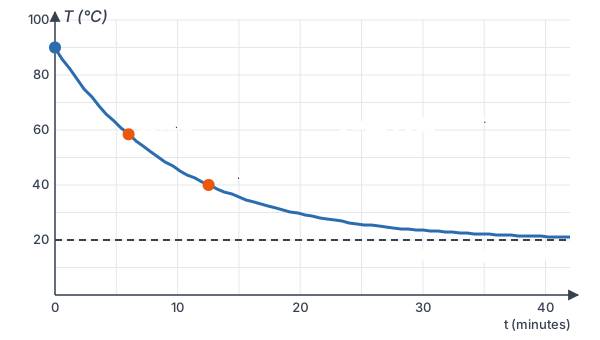
Example 2: Find k from a reading
Soup at 95°C is left in a 25°C room. After 5 minutes it is 75°C. Find k, then find the temperature after 15 minutes.
T = 25 + 70e^{kt}The starting gap is 95 − 25 = 70.
75 = 25 + 70e^{5k}Substitute t = 5 and T = 75.
50 = 70e^{5k}Subtract 25 from both sides.
\dfrac{5}{7} = e^{5k}Divide both sides by 70 and simplify 50/70.
k = \dfrac{\ln(5/7)}{5} \approx -0.06729Take the natural log and divide by 5.
T(15) = 25 + 70e^{15k} = 25 + 70\left(\tfrac{5}{7}\right)^3Substitute t = 15; e^(15k) = (e^(5k))³ (see exponent rules).
70\left(\tfrac{5}{7}\right)^3 = 70 \cdot \dfrac{125}{343} \approx 25.51Cube 5/7 and multiply.
T(15) \approx 25 + 25.51 = 50.51
Add.
Answer: k ≈ −0.0673 per minute, and the soup is about 50.5°C after 15 minutes.
Example 3: Warming up
A drink at 4°C is taken out of a fridge into a 30°C room. After 10 minutes it is 10°C. When will it reach 20°C?
T = 30 + (4 - 30)e^{kt} = 30 - 26e^{kt}The starting gap is 4 − 30 = −26, a negative number.
10 = 30 - 26e^{10k}Substitute t = 10 and T = 10.
-20 = -26e^{10k}Subtract 30 from both sides.
\dfrac{10}{13} = e^{10k}Divide both sides by −26 and simplify 20/26.
k = \dfrac{\ln(10/13)}{10} \approx -0.02624Take the natural log and divide by 10.
20 = 30 - 26e^{kt}Set T = 20.
\dfrac{5}{13} = e^{kt}Subtract 30, then divide both sides by −26.
t = \dfrac{\ln(5/13)}{k} \approx 36.42Take the natural log and divide by k.
Answer: about 36.4 minutes after it leaves the fridge. Notice that k is negative even though the drink is warming.
Example 4: Time of death (word problem)
At 10:00 pm, investigators find a body at 30°C in a room kept at 20°C. At 11:00 pm the body is 28°C. Assuming the body was 37°C at death, estimate the time of death.
T = 20 + 10e^{kt}Let t = 0 at 10:00 pm, with t in hours. The gap then is 30 − 20 = 10.
28 = 20 + 10e^{k}Substitute t = 1 and T = 28.
0.8 = e^{k}Subtract 20 and divide by 10.
k = \ln 0.8 \approx -0.22314
Take the natural log.
37 = 20 + 10e^{kt}Set T = 37, the temperature at death.
1.7 = e^{kt}Subtract 20 and divide by 10.
t = \dfrac{\ln 1.7}{\ln 0.8} \approx -2.378Take the natural log and divide by k.
0.378 \times 60 \approx 23
Change the decimal part of an hour to minutes.
Answer: t ≈ −2.38 hours, about 2 hours 23 minutes before 10:00 pm, so death occurred at about 7:37 pm. The negative t means a time before the first reading.
Example 5: Find the starting temperature
A pie comes out of the oven into a 22°C kitchen. Ten minutes later it is 120°C, and twenty minutes after leaving the oven it is 80°C. Estimate the oven temperature, the pie’s starting temperature.
T - 22 = A\,e^{kt}Write the gap form, with A = T₀ − 22 unknown.
98 = A\,e^{10k}At t = 10, the gap is 120 − 22 = 98.
58 = A\,e^{20k}At t = 20, the gap is 80 − 22 = 58.
\dfrac{58}{98} = e^{10k}Divide the second equation by the first; A cancels.
A = \dfrac{98}{e^{10k}} = 98 \cdot \dfrac{98}{58} \approx 165.59Solve the first equation for A.
T_0 = 22 + 165.59 = 187.59
Add the room temperature back.
Answer: the pie started at about 188°C. Each 10 minutes multiplied the gap by 58/98, so the gap before the first reading was 98 ÷ (58/98).
Common mistakes
| Mistake | Example of the error | Fix |
|---|---|---|
| Using T instead of the gap | \dfrac{dT}{dt} = kT | The rate depends on the gap: \dfrac{dT}{dt} = k(T - T_s). |
| Leaving out the room temperature | T = 90e^{-0.1t} | Add Tₛ back: T = 20 + 70e^{-0.1t}. |
| Using a positive k | k = 0.1 for cooling coffee | The gap shrinks in every case, so k is negative. |
| Wrong sign on the starting gap when warming | Starting gap 26 for a 4°C drink in a 30°C room | The gap is 4 − 30 = −26. |
| Taking the log of a negative number | \ln(-20) = \ln(-26) + 10k | Divide first, so the ratio 20/26 is positive. |
| Expecting the object to reach Tₛ | Solving 20 = 20 + 70e^(−0.1t) | T approaches Tₛ but never equals it. There is no solution. |
Related methods
Exponential models
The gap T − Tₛ follows the same law as exponential models with differential equations. Every tool from that lesson, such as half-life, works on the gap.
Estimating with Euler’s method
If the room temperature changes over time, the equation may have no simple solution. Then a numerical method like Euler’s method gives estimates.
Models with a limit
Like this law, logistic growth (the next lesson) approaches a limiting value. The difference is that logistic growth starts slowly, speeds up, then slows down, giving an S-shaped curve.
Practice problems
- An object at 80°C is placed in a 20°C room with k = −0.05 per minute. Find its temperature after 10 minutes.
- A 100°C object cools in a 25°C room with k = −0.2. Write T(t).
- For the object in problem 2, when is it 40°C?
- Tea at 85°C cools to 65°C in 4 minutes in a 21°C room. Find k.
- For the tea in problem 4, find its temperature after 10 minutes.
- An ice pack at −10°C is left in a 25°C room. After 20 minutes it is 0°C. Find its temperature after 1 hour.
- If dT/dt = −0.08(T − 22), how fast is the temperature changing when T = 72?
- Can an object at 90°C in a 20°C room ever cool to 15°C? Explain.
- A body is 31°C at 9:00 am and 29.5°C at 10:00 am in a 21°C room. Assuming 37°C at death, estimate the time of death.
- If k = −0.1 per minute, how long does it take the gap between an object and the room to shrink by half?
Show answers
1.
T = 20 + 60e^{-0.05t}The starting gap is 80 − 20 = 60.
T(10) = 20 + 60e^{-0.5}Substitute t = 10.
T(10) \approx 20 + 60(0.60653) \approx 56.39
Evaluate, multiply and add.
Answer: about 56.4°C
2.
T = 25 + (100 - 25)e^{-0.2t}Substitute into the formula.
T = 25 + 75e^{-0.2t}Subtract inside the parentheses.
Answer: T(t) = 25 + 75e^(−0.2t)
3.
40 = 25 + 75e^{-0.2t}Set T = 40.
0.2 = e^{-0.2t}Subtract 25 and divide by 75.
t = \dfrac{\ln 0.2}{-0.2} \approx 8.05Take the natural log and divide by −0.2.
Answer: about 8.05 minutes
4.
65 = 21 + 64e^{4k}The starting gap is 85 − 21 = 64.
0.6875 = e^{4k}Subtract 21 and divide by 64 (44/64 = 0.6875).
k = \dfrac{\ln 0.6875}{4} \approx -0.09367Take the natural log and divide by 4.
Answer: k ≈ −0.0937 per minute
5.
T(10) = 21 + 64e^{10k} = 21 + 64(0.6875)^{2.5}e^(10k) = (e^(4k))^2.5.
64(0.6875)^{2.5} \approx 64(0.39192) \approx 25.08Evaluate the power and multiply.
T(10) \approx 21 + 25.08 = 46.08
Add.
Answer: about 46.1°C
6.
T = 25 - 35e^{kt}The starting gap is −10 − 25 = −35.
0 = 25 - 35e^{20k}Substitute t = 20 and T = 0.
\dfrac{5}{7} = e^{20k}Subtract 25, divide by −35 and simplify.
T(60) = 25 - 35\left(\tfrac{5}{7}\right)^3e^(60k) = (e^(20k))³.
35\left(\tfrac{5}{7}\right)^3 = 35 \cdot \dfrac{125}{343} \approx 12.76Cube 5/7 and multiply.
T(60) \approx 25 - 12.76 = 12.24
Subtract.
Answer: about 12.2°C
7.
\dfrac{dT}{dt} = -0.08(72 - 22)Substitute T = 72.
\dfrac{dT}{dt} = -0.08(50) = -4Simplify.
Answer: falling at 4°C per minute
8.
T - 20 = 70e^{kt}Gap form with T₀ = 90 and Tₛ = 20.
70e^{kt} \gt 0An exponential is always positive.
T \gt 20
Add 20 to both sides.
Answer: no. The temperature stays above 20°C, the room temperature, for all time
9.
T = 21 + 10e^{kt}Let t = 0 at 9:00 am; the gap is 31 − 21 = 10.
29.5 = 21 + 10e^{k}Substitute t = 1 and T = 29.5.
k = \ln 0.85 \approx -0.16252
Subtract 21, divide by 10 and take the natural log.
37 = 21 + 10e^{kt}Set T = 37.
t = \dfrac{\ln 1.6}{\ln 0.85} \approx -2.892Subtract 21, divide by 10, take the natural log and divide by k.
0.892 \times 60 \approx 54
Change the decimal part of an hour to minutes.
Answer: about 2 hours 54 minutes before 9:00 am, so about 6:06 am
10.
\dfrac{1}{2} = e^{-0.1t}The gap is multiplied by 1/2.
\ln 0.5 = -0.1t
Take the natural log of both sides.
t = \dfrac{\ln 2}{0.1} \approx 6.93Divide by −0.1; −ln 0.5 = ln 2.
Answer: about 6.9 minutes
Newton’s law of cooling FAQ
What is the formula for Newton’s law of cooling?
The differential equation is dT/dt = k(T − Tₛ), and its solution is T = Tₛ + (T₀ − Tₛ)e^(kt). Tₛ is the surrounding temperature and T₀ is the starting temperature.
Is k positive or negative in Newton’s law of cooling?
k is negative. Written as dT/dt = k(T − Tₛ), a negative k makes the gap shrink, whether the object is cooling or warming. Some books write dT/dt = −k(T − Tₛ) with a positive k instead.
Does Newton’s law of cooling work for warming?
Yes. When the object starts colder than its surroundings, the starting gap is negative, and the same formula shows the temperature rising toward Tₛ.
How is Newton’s law of cooling used to find the time of death?
Two body temperatures taken an hour or so apart give k. Then you solve for the time when the temperature was 37°C. Real investigators use more detailed models, but the idea is the same.
Summary
- Newton’s law of cooling: dT/dt = k(T − Tₛ), with k negative.
- Solution: T = Tₛ + (T₀ − Tₛ)e^(kt).
- The gap T − Tₛ decays exponentially, so T approaches Tₛ but never reaches it.
- The same formula handles warming; the starting gap is then negative.
- Find k from one extra reading: divide the gaps and take the natural log.
- A negative t answer means a time before the first reading.
Previous lesson: Exponential Models with Differential Equations
Next lesson: Logistic Differential Equations
Back to the Calculus 2 Index