
Arc Length of Parametric Curves
The arc length of a parametric curve x = x(t), y = y(t) from t = a to t = b is L = ∫ₐᵇ √((dx/dt)² + (dy/dt)²) dt. The expression under the integral is the speed of a point moving along the curve, so the arc length is the distance the point travels if it traces the curve once.
Before this lesson: Derivatives of Parametric Equations and Arc Length of a Curve
The idea: add up tiny straight pieces
Zoom in on a curve and a tiny piece of it looks straight. If x changes by Δx and y changes by Δy, that piece has length √(Δx² + Δy²), by the Pythagorean theorem.
Over a short time Δt, Δx ≈ (dx/dt)Δt and Δy ≈ (dy/dt)Δt. So each piece is about √((dx/dt)² + (dy/dt)²) Δt long. Adding the pieces and letting Δt shrink turns the sum into an integral.
The square root is the speed: how fast the point moves along its path. Distance equals speed times time, and the integral adds it up when the speed keeps changing.
Arc length formula for parametric curves
L = \int_a^b \sqrt{\left(\dfrac{dx}{dt}\right)^2 + \left(\dfrac{dy}{dt}\right)^2}\,dt- Find dx/dt and dy/dt.
- Square each one and add them.
- Simplify. The sum is often a perfect square, or it simplifies with sin² t + cos² t = 1.
- Take the square root and integrate from t = a to t = b.
- Check that the curve is traced only once on [a, b]. If it repeats, the integral counts the repeat too.
If the integral can’t be done by hand, use a calculator’s numerical integration. Many curves, such as most ellipses, have no simple formula for their length.
Arc length of parametric curves examples
Example 1: A line segment
Find the length of x = 3t, y = 4t for 0 ≤ t ≤ 2.
\dfrac{dx}{dt} = 3, \quad \dfrac{dy}{dt} = 4Differentiate each equation.
3^2 + 4^2 = 25
Square and add.
\sqrt{25} = 5The speed is a constant 5.
L = \int_0^2 5\,dt = 5(2) - 5(0) = 10
Integrate from 0 to 2.
Answer: L = 10. Check: the segment runs from (0, 0) to (6, 8), and the distance formula gives √(36 + 64) = 10.
Example 2: A circle
Find the length of x = 5 cos t, y = 5 sin t for 0 ≤ t ≤ 2π.
\dfrac{dx}{dt} = -5\sin t, \quad \dfrac{dy}{dt} = 5\cos tDifferentiate each equation.
25\sin^2 t + 25\cos^2 t
Square and add.
25(\sin^2 t + \cos^2 t) = 25
Factor out 25 and use sin² t + cos² t = 1 (see fundamental trig identities).
L = \int_0^{2\pi} 5\,dt = 10\piTake the square root and integrate.
Answer: L = 10π ≈ 31.42, the circumference of a circle with radius 5, as expected.
Example 3: A curve that needs u-substitution
Find the length of x = t², y = (2/3)t³ for 0 ≤ t ≤ √3.
\dfrac{dx}{dt} = 2t, \quad \dfrac{dy}{dt} = 2t^2Differentiate each equation.
(2t)^2 + (2t^2)^2 = 4t^2 + 4t^4
Square and add.
4t^2 + 4t^4 = 4t^2(1 + t^2)
Factor out 4t².
\sqrt{4t^2(1 + t^2)} = 2t\sqrt{1 + t^2}Take the square root; t is not negative here.
L = \int_0^{\sqrt{3}} 2t\sqrt{1 + t^2}\,dtSet up the integral.
L = \int_1^{4} u^{1/2}\,duLet u = 1 + t², so du = 2t dt; t = 0 gives u = 1 and t = √3 gives u = 4 (see u-substitution with definite integrals).
L = \left[\tfrac{2}{3}u^{3/2}\right]_1^4Integrate with the power rule.
L = \tfrac{2}{3}(8) - \tfrac{2}{3}(1) = \dfrac{14}{3}Use 4^(3/2) = 8 and 1^(3/2) = 1.
Answer: L = 14/3 ≈ 4.667.
Example 4: A spiral
Find the length of x = eᵗ cos t, y = eᵗ sin t for 0 ≤ t ≤ 1.
\dfrac{dx}{dt} = e^t(\cos t - \sin t)Use the product rule.
\dfrac{dy}{dt} = e^t(\sin t + \cos t)Use the product rule again.
e^{2t}\left[(\cos t - \sin t)^2 + (\sin t + \cos t)^2\right]Square and add, factoring out e²ᵗ.
e^{2t}\left[2\cos^2 t + 2\sin^2 t\right] = 2e^{2t}Expand; the −2 sin t cos t and +2 sin t cos t cancel, and sin² t + cos² t = 1.
\sqrt{2e^{2t}} = \sqrt{2}\,e^tTake the square root.
L = \int_0^1 \sqrt{2}\,e^t\,dt = \sqrt{2}(e - 1)Integrate.
Answer: L = √2(e − 1) ≈ 2.430.
Example 5: A point on a rolling wheel (word problem)
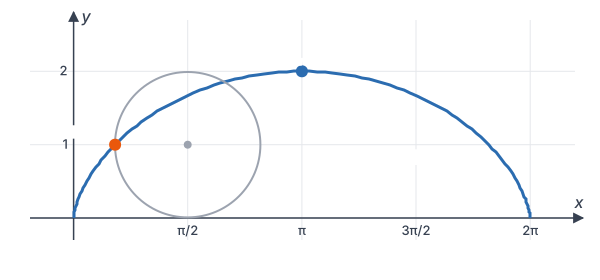
A reflector sits on the rim of a bike wheel with radius 1 foot. As the wheel rolls, the reflector follows the cycloid x = t − sin t, y = 1 − cos t. How far does it travel during one full turn of the wheel, 0 ≤ t ≤ 2π?
\dfrac{dx}{dt} = 1 - \cos t, \quad \dfrac{dy}{dt} = \sin tDifferentiate each equation.
(1 - \cos t)^2 + \sin^2 t
Square and add.
1 - 2\cos t + \cos^2 t + \sin^2 t = 2 - 2\cos t
Expand and use sin² t + cos² t = 1.
2 - 2\cos t = 4\sin^2\dfrac{t}{2}Use the half-angle identity 1 − cos t = 2 sin²(t/2) (see half-angle formulas).
\sqrt{4\sin^2\dfrac{t}{2}} = 2\sin\dfrac{t}{2}Take the square root; sin(t/2) is not negative for t in [0, 2π].
L = \int_0^{2\pi} 2\sin\dfrac{t}{2}\,dt = \left[-4\cos\dfrac{t}{2}\right]_0^{2\pi}Integrate, using u = t/2.
L = -4\cos\pi + 4\cos 0 = 4 + 4 = 8
Evaluate at the limits.
Answer: 8 feet. The wheel itself only rolls forward 2π ≈ 6.28 feet, but the reflector travels farther because it also goes up and down.
Common mistakes
| Mistake | Example of the error | Fix |
|---|---|---|
| Squaring a sum term by term | (1 - \cos t)^2 = 1 - \cos^2 t | Expand fully: 1 - 2\cos t + \cos^2 t (see special products of binomials). |
| Dropping the absolute value | \sqrt{4\sin^2(t/2)} = 2\sin(t/2) on an interval where sin(t/2) is negative | \sqrt{u^2} = |u|. Check the sign on the interval, or split it. |
| Using x-values as the limits | For x = t² from x = 0 to x = 3, writing ∫₀³ … dt | The limits are values of t. Here x = 3 means t = √3. |
| Counting a repeat | For x = cos 2t, y = sin 2t on [0, 2π], calling 4π the circle’s length | The circle is traced twice. Its length is 2π. |
| Mixing the two formulas | \int \sqrt{1 + (dy/dx)^2}\,dt | With t as the variable, use \sqrt{(dx/dt)^2 + (dy/dt)^2}\,dt. |
| Forgetting the square root | L = \int_0^2 25\,dt | The integrand is the speed, the square root of the sum. |
Related methods
Arc length of a graph
For a graph y = f(x), let x = t and y = f(t). The parametric formula becomes ∫ √(1 + (dy/dx)²) dx, the formula from arc length of a curve.
Speed and distance traveled
The integrand is speed. Integrating speed gives total distance, just as in displacement and total distance for motion on a line. Vector-Valued Functions, later in this unit, write the same speed as the length of the velocity vector.
Surface area and polar curves
The same arc-length piece appears in surface area of revolution. Arc Length of Polar Curves, at the end of this unit, uses it with x = r cos θ and y = r sin θ.
Practice problems
- Find the length of x = 6t, y = 8t for 0 ≤ t ≤ 1.
- Find the length of x = 2 cos t, y = 2 sin t for 0 ≤ t ≤ π.
- Find the length of x = 3t², y = 2t³ for 0 ≤ t ≤ 1.
- Find the length of the astroid piece x = cos³ t, y = sin³ t for 0 ≤ t ≤ π/2.
- Find the length of x = t, y = (2/3)t^(3/2) for 0 ≤ t ≤ 3.
- Find the length of x = eᵗ + e⁻ᵗ, y = 2t for 0 ≤ t ≤ 1.
- For x = cos 2t, y = sin 2t on 0 ≤ t ≤ 2π, find the integral of the speed. Is it the length of the circle?
- Find the length of half an arch of the cycloid, x = t − sin t, y = 1 − cos t for 0 ≤ t ≤ π.
- A particle moves along x = 2t, y = t² for 0 ≤ t ≤ 2. How far does it travel?
- Use a calculator to estimate the length of the ellipse x = 3 cos t, y = 2 sin t, 0 ≤ t ≤ 2π.
Show answers
1.
\sqrt{6^2 + 8^2} = \sqrt{100} = 10Square and add the derivatives 6 and 8, then take the root.
L = \int_0^1 10\,dt = 10
Integrate.
Answer: 10
2.
4\sin^2 t + 4\cos^2 t = 4
dx/dt = −2 sin t and dy/dt = 2 cos t; square, add and use sin² t + cos² t = 1.
L = \int_0^{\pi} 2\,dt = 2\piTake the square root and integrate.
Answer: 2π (half the circle of radius 2)
3.
(6t)^2 + (6t^2)^2 = 36t^2(1 + t^2)
Square and add the derivatives 6t and 6t², then factor.
\sqrt{36t^2(1 + t^2)} = 6t\sqrt{1 + t^2}Take the square root; t is not negative.
L = \int_1^2 3u^{1/2}\,duLet u = 1 + t², du = 2t dt, so 6t dt = 3 du; limits 1 and 2.
L = \left[2u^{3/2}\right]_1^2 = 2(2\sqrt{2}) - 2Integrate and evaluate; 2^(3/2) = 2√2.
L = 4\sqrt{2} - 2 \approx 3.657Simplify.
Answer: 4√2 − 2 ≈ 3.657
4.
\dfrac{dx}{dt} = -3\cos^2 t\sin t, \quad \dfrac{dy}{dt} = 3\sin^2 t\cos tUse the chain rule.
9\cos^4 t\sin^2 t + 9\sin^4 t\cos^2 t = 9\sin^2 t\cos^2 t
Square, add, factor out 9 sin² t cos² t and use sin² t + cos² t = 1.
\sqrt{9\sin^2 t\cos^2 t} = 3\sin t\cos tBoth are not negative on [0, π/2].
L = \left[\tfrac{3}{2}\sin^2 t\right]_0^{\pi/2} = \tfrac{3}{2}Integrate with u = sin t and evaluate.
Answer: 3/2 (the whole astroid is 6)
5.
1 + \left(t^{1/2}\right)^2 = 1 + tdx/dt = 1 and dy/dt = t^(1/2); square and add.
L = \int_0^3 (1 + t)^{1/2}\,dtTake the square root.
L = \left[\tfrac{2}{3}(1 + t)^{3/2}\right]_0^3 = \tfrac{2}{3}(8 - 1) = \dfrac{14}{3}Integrate and evaluate.
Answer: 14/3 ≈ 4.667
6.
(e^t - e^{-t})^2 + 2^2 = e^{2t} - 2 + e^{-2t} + 4Square and add the derivatives eᵗ − e⁻ᵗ and 2.
e^{2t} + 2 + e^{-2t} = (e^t + e^{-t})^2Combine −2 + 4 and spot a perfect square.
L = \int_0^1 (e^t + e^{-t})\,dt = \left[e^t - e^{-t}\right]_0^1Take the square root and integrate.
L = e - e^{-1} \approx 2.350Evaluate; the value at 0 is 1 − 1 = 0.
Answer: e − 1/e ≈ 2.350
7.
4\sin^2 2t + 4\cos^2 2t = 4
dx/dt = −2 sin 2t and dy/dt = 2 cos 2t; square and add.
\int_0^{2\pi} 2\,dt = 4\piThe speed is 2.
Answer: 4π, but the unit circle is traced twice, so its length is 2π
8.
L = \int_0^{\pi} 2\sin\dfrac{t}{2}\,dtSame speed as Example 5.
L = \left[-4\cos\dfrac{t}{2}\right]_0^{\pi} = 0 + 4 = 4Evaluate; cos(π/2) = 0 and cos 0 = 1.
Answer: 4 (half of 8)
9.
2^2 + (2t)^2 = 4(1 + t^2)
Square and add the derivatives 2 and 2t.
L = \int_0^2 2\sqrt{1 + t^2}\,dtTake the square root.
L = \left[t\sqrt{1 + t^2} + \ln\left(t + \sqrt{1 + t^2}\right)\right]_0^2Integrate (see trigonometric substitution).
L = 2\sqrt{5} + \ln(2 + \sqrt{5}) \approx 5.916Evaluate; the value at 0 is 0.
Answer: about 5.92 units
10.
L = \int_0^{2\pi} \sqrt{9\sin^2 t + 4\cos^2 t}\,dtdx/dt = −3 sin t and dy/dt = 2 cos t; square and add.
L \approx 15.865
Use numerical integration on a calculator.
Answer: about 15.87
Parametric arc length FAQ
What is the arc length formula for parametric equations?
L = ∫ₐᵇ √((dx/dt)² + (dy/dt)²) dt, where the curve is traced once as t goes from a to b.
How is it different from the arc length formula for y = f(x)?
The y = f(x) formula integrates √(1 + (dy/dx)²) with respect to x. The parametric formula integrates with respect to t. The first is a special case of the second, with x = t.
Is arc length the same as distance traveled?
Only if the curve is traced exactly once. If the point goes over part of the path again, the integral of speed counts that part twice, so it gives distance traveled, not the curve’s length.
Why can’t some arc length integrals be done by hand?
The square root often has no elementary antiderivative, as for most ellipses. Then a numerical method, like Simpson’s rule or a calculator, gives the length.
Summary
- Parametric arc length: L = ∫ₐᵇ √((dx/dt)² + (dy/dt)²) dt.
- The integrand is the speed along the curve.
- Square and add the derivatives, then look for a perfect square or sin² + cos² = 1.
- The limits are values of t, not x.
- Make sure the curve is traced only once on the interval.
- When there is no antiderivative, estimate the integral numerically.
Previous lesson: Derivatives of Parametric Equations
Next lesson: Vector-Valued Functions
Back to the Calculus 2 Index