
Implicit Differentiation
Implicit differentiation finds dy/dx when y is not written by itself, as in x^2 + y^2 = 25. Differentiate both sides with respect to x, treating y as a function of x. Each time you differentiate a y term, multiply by dy/dx (the chain rule). Then solve for dy/dx.
Before this lesson: Chain Rule, Product Rule and Literal Equations
Explicit and implicit equations
An equation like y = x^3 - 4x is explicit: y is already alone, so you can differentiate the right side directly. An equation like x^2 + y^2 = 25 is implicit: x and y are mixed together, and solving for y would give two functions, y = \pm\sqrt{25 - x^2}.
Implicit differentiation skips that solving step. You keep the equation as it is and differentiate both sides. The key idea is that y stands for some function of x, so the derivative of a y expression needs the chain rule:
\frac{d}{dx}\left[y^2\right] = 2y \cdot \frac{dy}{dx}, \qquad \frac{d}{dx}\left[x^2\right] = 2xThe x term gets no extra factor, because the derivative of x with respect to x is 1. We will often write y′ for dy/dx.
How to do implicit differentiation
- Differentiate both sides of the equation with respect to x.
- Each time you differentiate a term with y, multiply by y′. Use the product rule for terms like xy.
- Move every term with y′ to one side and every other term to the other side.
- Factor out y′.
- Divide to solve for y′. To get a slope at a point, substitute both x and y.
The answer usually contains both x and y. That is expected: on a circle, two points can share the same x but have different slopes, so the slope depends on y too.
Implicit differentiation examples
Example 1: The slope of a circle
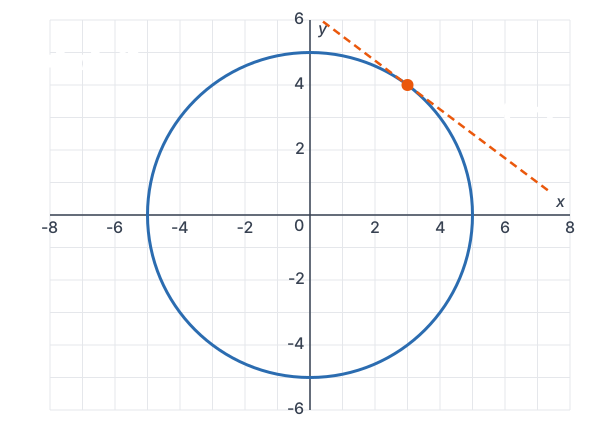
Find dy/dx for x^2 + y^2 = 25, and find the tangent line at (3, 4).
2x + 2y\,y' = 0
Differentiate both sides. The y² term gets a factor of y′; the derivative of 25 is 0.
2y\,y' = -2x
Subtract 2x from both sides.
y' = \frac{-2x}{2y} = -\frac{x}{y}Divide both sides by 2y and simplify.
y' = -\frac{3}{4}Substitute x = 3 and y = 4.
y - 4 = -\frac{3}{4}(x - 3)Use point-slope form (see point-slope form).
y = -\frac{3}{4}x + \frac{25}{4}Distribute, then add 4 = 16/4 to both sides.
Answer: \frac{dy}{dx} = -\frac{x}{y}, and the tangent line at (3, 4) is y = -\frac{3}{4}x + \frac{25}{4}.
Example 2: A product of x and y
Find dy/dx for x^2y + y^3 = 10, then find the slope at (1, 2).
2xy + x^2y' + 3y^2y' = 0
Product rule on x²y: (2x)(y) + (x²)(y′). Chain rule on y³.
x^2y' + 3y^2y' = -2xy
Subtract 2xy from both sides.
y'(x^2 + 3y^2) = -2xy
Factor out y′ (see factoring out the GCF).
y' = \frac{-2xy}{x^2 + 3y^2}Divide both sides by x² + 3y².
y' = \frac{-2(1)(2)}{1 + 3(4)} = -\frac{4}{13}Substitute x = 1 and y = 2.
Answer: \frac{dy}{dx} = \frac{-2xy}{x^2 + 3y^2}, and the slope at (1, 2) is -\frac{4}{13}. Check that the point is on the curve first: 1 \cdot 2 + 8 = 10.
Example 3: The folium of Descartes
Find dy/dx for x^3 + y^3 = 6xy, and find the slope at (3, 3).
3x^2 + 3y^2y' = 6y + 6xy'
Differentiate both sides. Use the product rule on 6xy.
3y^2y' - 6xy' = 6y - 3x^2
Move the y′ terms left and the others right.
y'(3y^2 - 6x) = 6y - 3x^2
Factor out y′.
y' = \frac{6y - 3x^2}{3y^2 - 6x} = \frac{2y - x^2}{y^2 - 2x}Divide, then cancel the common factor 3.
y' = \frac{6 - 9}{9 - 6} = -1Substitute x = 3 and y = 3.
Answer: \frac{dy}{dx} = \frac{2y - x^2}{y^2 - 2x}, and the slope at (3, 3) is −1. Solving this equation for y would be very hard, so implicit differentiation is the only practical method.
Example 4: Finding horizontal tangent lines
Find every point on x^2 - xy + y^2 = 12 where the tangent line is horizontal.
2x - (y + xy') + 2yy' = 0
Differentiate. The product rule on xy gives y + xy′.
-xy' + 2yy' = y - 2x
Remove the parentheses and move the other terms right.
y' = \frac{y - 2x}{2y - x}Factor out y′ and divide.
y - 2x = 0 \Rightarrow y = 2x
A horizontal tangent needs y′ = 0, so the numerator is 0.
x^2 - x(2x) + (2x)^2 = 12
Substitute y = 2x into the original equation.
3x^2 = 12
Combine like terms: 1 − 2 + 4 = 3.
x^2 = 4 \Rightarrow x = \pm 2
Divide by 3, then take the square root.
Answer: the horizontal tangents are at (2, 4) and (−2, −4), where y = 2x. At both points the denominator 2y − x is 6 or −6, not 0, so the slope really is 0.
Example 5: Word problem with price and demand
A shop finds that the price p (in dollars) and weekly sales q of a product are related by pq + 2q^2 = 3000. Right now it sells 30 per week. Find dp/dq and explain what it means.
30p + 2(900) = 3000
Substitute q = 30 to find the current price.
30p = 1200 \Rightarrow p = 40
Subtract 1800, then divide by 30.
p + q\frac{dp}{dq} + 4q = 0Differentiate with respect to q. Product rule on pq; p is a function of q.
\frac{dp}{dq} = -\frac{p + 4q}{q}Subtract p + 4q from both sides, then divide by q.
\frac{dp}{dq} = -\frac{40 + 120}{30} = -\frac{16}{3}Substitute p = 40 and q = 30.
-\frac{16}{3} \approx -5.33Divide.
Answer: \frac{dp}{dq} \approx -5.33. To sell one more item per week, the shop must lower the price by about $5.33.
Common mistakes
| Mistake | Example of the error | Fix |
|---|---|---|
| Forgetting y′ on a y term | \frac{d}{dx}[y^2] = 2y | Chain rule: 2y \cdot y'. |
| Adding y′ to an x term | \frac{d}{dx}[x^2] = 2x \cdot y' | Only y terms get y′: the derivative of x² is 2x. |
| Skipping the product rule on xy | \frac{d}{dx}[xy] = y' | \frac{d}{dx}[xy] = y + xy'. |
| Differentiating a constant to something other than 0 | Writing 25 as 25 after differentiating | The derivative of a constant is 0. |
| Substituting only x at a point | Leaving y in -\frac{x}{y} at (3, 4) | Substitute both coordinates: -\frac{3}{4}. |
Related methods
Solving for y first
For the circle, you could write the top half as y = \sqrt{25 - x^2} and use the chain rule: y' = \frac{-x}{\sqrt{25 - x^2}}. Since \sqrt{25 - x^2} = y on the top half, that is the same as -\frac{x}{y}. Implicit differentiation gets there faster and covers both halves at once.
Second derivatives by implicit differentiation
Differentiate y′ again and replace any y′ you get. For the circle, y' = -\frac{x}{y} and the quotient rule gives y'' = -\frac{y - xy'}{y^2}. Substituting y' = -\frac{x}{y} and x^2 + y^2 = 25 simplifies this to y'' = -\frac{25}{y^3}. At (3, 4), y'' = -\frac{25}{64}.
Coming next
Implicit differentiation is how you find the derivatives of inverse functions, which is the next lesson, and it is the main tool in related rates problems.
Practice problems
- Find dy/dx for x^2 + y^2 = 100, then find the slope at (6, 8).
- Find dy/dx for y^2 = 4x.
- Find the slope of x^2 + 3y^2 = 13 at (1, 2).
- Find dy/dx for xy = 12 and the slope at (3, 4).
- Find dy/dx for x^2y = 8 and the slope at (2, 2).
- Find the slope of y^3 + y = x^2 + 1 at (1, 1).
- Find the tangent line to x^2 + xy + y^2 = 7 at (1, 2).
- Find the slope of \sqrt{x} + \sqrt{y} = 5 at (4, 9).
- Find the points on x^2 + y^2 - 6x = 0 where the tangent line is vertical.
- A gas at constant temperature follows PV = 600, where P is pressure and V is volume. Find dV/dP when P = 20 and V = 30, and explain its meaning.
Show answers
1.
2x + 2yy' = 0
Differentiate both sides.
y' = -\frac{x}{y}Subtract 2x, then divide by 2y.
y' = -\frac{6}{8} = -\frac{3}{4}Substitute (6, 8).
Answer: y' = -\frac{x}{y}; slope -\frac{3}{4}
2.
2yy' = 4
Differentiate both sides.
y' = \frac{4}{2y} = \frac{2}{y}Divide both sides by 2y.
Answer: y' = \frac{2}{y}
3.
2x + 6yy' = 0
Differentiate both sides.
y' = -\frac{2x}{6y} = -\frac{x}{3y}Subtract 2x, divide by 6y and simplify.
y' = -\frac{1}{3(2)} = -\frac{1}{6}Substitute (1, 2).
Answer: -\frac{1}{6}
4.
y + xy' = 0
Product rule on xy; the derivative of 12 is 0.
y' = -\frac{y}{x}Subtract y, then divide by x.
y' = -\frac{4}{3}Substitute (3, 4).
Answer: y' = -\frac{y}{x}; slope -\frac{4}{3}
5.
2xy + x^2y' = 0
Product rule on x²y.
y' = -\frac{2xy}{x^2} = -\frac{2y}{x}Subtract 2xy, divide by x² and simplify.
y' = -\frac{2(2)}{2} = -2Substitute (2, 2).
Answer: y' = -\frac{2y}{x}; slope −2
6.
3y^2y' + y' = 2x
Differentiate both sides.
y'(3y^2 + 1) = 2x
Factor out y′.
y' = \frac{2x}{3y^2 + 1}Divide both sides by 3y² + 1.
y' = \frac{2}{4} = \frac{1}{2}Substitute (1, 1).
Answer: \frac{1}{2}
7.
2x + y + xy' + 2yy' = 0
Differentiate; product rule on xy.
y'(x + 2y) = -(2x + y)
Move the other terms right and factor out y′.
y' = -\frac{2x + y}{x + 2y} = -\frac{4}{5}Divide, then substitute (1, 2).
y - 2 = -\frac{4}{5}(x - 1)Point-slope form.
y = -\frac{4}{5}x + \frac{14}{5}Distribute, then add 2 = 10/5.
Answer: y = -\frac{4}{5}x + \frac{14}{5}
8.
\frac{1}{2\sqrt{x}} + \frac{y'}{2\sqrt{y}} = 0Differentiate both sides; the y term gets y′.
y' = -\frac{\sqrt{y}}{\sqrt{x}}Subtract the first term, then multiply both sides by 2√y.
y' = -\frac{3}{2}Substitute (4, 9): √9 = 3 and √4 = 2.
Answer: -\frac{3}{2}
9.
2x + 2yy' - 6 = 0
Differentiate both sides.
y' = \frac{3 - x}{y}Solve for y′ and simplify.
y = 0
A vertical tangent is where the denominator is 0 (and the numerator isn’t).
x^2 - 6x = 0
Substitute y = 0 into the original equation.
x(x - 6) = 0 \Rightarrow x = 0 \text{ or } x = 6Factor out x, then set each factor equal to 0.
Answer: (0, 0) and (6, 0)
10.
V + P\frac{dV}{dP} = 0Differentiate PV = 600 with respect to P, using the product rule.
\frac{dV}{dP} = -\frac{V}{P}Subtract V, then divide by P.
\frac{dV}{dP} = -\frac{30}{20} = -1.5Substitute P = 20 and V = 30.
Answer: −1.5. At that moment, each 1-unit rise in pressure shrinks the volume by about 1.5 units.
Implicit differentiation FAQ
When do you use implicit differentiation?
Use it when y is not alone and is hard or impossible to isolate, as in x^3 + y^3 = 6xy. It also works on equations you could solve, like circles.
Why do you multiply by dy/dx?
Because y is a function of x. By the chain rule, the derivative of an expression in y is its derivative with respect to y times dy/dx.
Why does the answer have both x and y?
An implicit curve can pass through several points with the same x. The slope can differ at each one, so you need y to tell which point you mean.
How do you find horizontal and vertical tangents?
A horizontal tangent is where the numerator of dy/dx is 0. A vertical tangent is where the denominator is 0. Check each point on the original curve.
Summary
- Differentiate both sides with respect to x, treating y as a function of x.
- Every y term gets a factor of y′. Use the product rule on terms like xy.
- Collect the y′ terms, factor out y′, and divide.
- Substitute both coordinates to get a slope at a point.
- Horizontal tangent: numerator 0. Vertical tangent: denominator 0.
Previous lesson: Chain Rule
Next lesson: Derivatives of Inverse Functions
Back to the Calculus 1 Index