
Related Rates
Related rates problems find how fast one quantity changes when you know how fast a related quantity changes. Write an equation that connects the quantities, differentiate both sides with respect to time t, then substitute the values at the moment you care about and solve for the unknown rate.
Before this lesson: Implicit Differentiation, Chain Rule and Pythagorean Theorem
What related rates means
When a balloon inflates, its radius and its volume both grow. They are linked by V = \frac{4}{3}\pi r^3, so their rates of change are linked too. If you know how fast the air goes in (dV/dt), you can find how fast the radius grows (dr/dt).
Every quantity in these problems is a function of time t. Differentiating an equation with respect to t uses the chain rule on each variable: for example, \frac{d}{dt}\left[r^2\right] = 2r\frac{dr}{dt}. That is implicit differentiation with t as the variable.
How to solve related rates problems
- Draw a picture and name each changing quantity with a variable.
- Write down the rates you know and the rate you want, with units. A shrinking quantity has a negative rate.
- Write an equation that connects the variables (geometry, the Pythagorean theorem, similar triangles or a volume formula).
- Differentiate both sides with respect to t.
- Substitute the values at the moment in the problem, then solve for the unknown rate.
Substitute numbers only after you differentiate. If you plug in a changing value too early, it turns into a constant, and its rate disappears.
Related rates examples
Example 1: A spreading ripple
A stone dropped in a pond makes a circular ripple. Its radius grows at 2 cm/s. How fast is the area inside the ripple growing when the radius is 10 cm?
A = \pi r^2
Connect area and radius.
\frac{dA}{dt} = 2\pi r\frac{dr}{dt}Differentiate both sides with respect to t.
\frac{dA}{dt} = 2\pi(10)(2)Substitute r = 10 and dr/dt = 2.
\frac{dA}{dt} = 40\pi \approx 125.7Multiply.
Answer: the area grows at 40\pi \approx 125.7 cm²/s at that moment.
Example 2: A sliding ladder
A 13-foot ladder leans against a wall. Its bottom slides away from the wall at 2 ft/s. How fast is the top sliding down when the bottom is 5 ft from the wall?
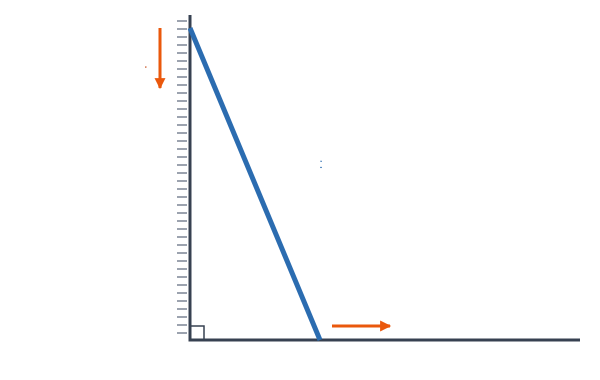
x^2 + y^2 = 169
Let x = distance from the wall and y = height of the top. Use the Pythagorean theorem with 13² = 169.
y = \sqrt{169 - 25} = 12Find y when x = 5.
2x\frac{dx}{dt} + 2y\frac{dy}{dt} = 0Differentiate both sides with respect to t. The ladder’s length doesn’t change.
2(5)(2) + 2(12)\frac{dy}{dt} = 0Substitute x = 5, y = 12 and dx/dt = 2.
20 + 24\frac{dy}{dt} = 0Multiply.
\frac{dy}{dt} = -\frac{20}{24} = -\frac{5}{6}Subtract 20, divide by 24 and simplify.
Answer: the top slides down at \frac{5}{6} ft/s (dy/dt = −5/6; the minus sign means y is decreasing).
Example 3: Inflating a balloon
Air is pumped into a spherical balloon at 100 cm³/s. How fast is the radius increasing when the radius is 5 cm?
V = \frac{4}{3}\pi r^3Volume of a sphere.
\frac{dV}{dt} = 4\pi r^2\frac{dr}{dt}Differentiate with respect to t.
100 = 4\pi(5)^2\frac{dr}{dt}Substitute dV/dt = 100 and r = 5.
100 = 100\pi\frac{dr}{dt}Simplify: 4 · 25 = 100.
\frac{dr}{dt} = \frac{1}{\pi} \approx 0.318Divide both sides by 100π.
Answer: the radius grows at about 0.318 cm/s. At a bigger radius the same airflow makes the radius grow more slowly.
Example 4: Filling a cone-shaped tank
Water flows at 9 ft³/min into a tank shaped like an upside-down cone, 10 ft tall with a top radius of 5 ft. How fast is the water level rising when the water is 6 ft deep?
\frac{r}{h} = \frac{5}{10} \Rightarrow r = \frac{h}{2}The water forms a smaller cone with the same shape, so use similar triangles (see similar polygons).
V = \frac{1}{3}\pi r^2 h = \frac{1}{3}\pi\left(\frac{h}{2}\right)^2 hVolume of a cone, with r replaced by h/2.
V = \frac{\pi h^3}{12}Simplify: (1/3)(1/4) = 1/12.
\frac{dV}{dt} = \frac{\pi h^2}{4}\frac{dh}{dt}Differentiate: 3/12 = 1/4.
9 = \frac{\pi(36)}{4}\frac{dh}{dt} = 9\pi\frac{dh}{dt}Substitute dV/dt = 9 and h = 6.
\frac{dh}{dt} = \frac{1}{\pi} \approx 0.318Divide both sides by 9π.
Answer: the water level rises at about 0.318 ft/min. Removing r before differentiating is the key step; otherwise you would need dr/dt too.
Example 5: Two cars leaving an intersection
Car A drives north from an intersection at 60 mph. At the same moment, car B drives east from it at 45 mph. How fast is the distance between them growing after 2 hours?
x = 45(2) = 90, \; y = 60(2) = 120
Let x = car B’s distance east and y = car A’s distance north after 2 hours.
z = \sqrt{90^2 + 120^2} = \sqrt{22500} = 150Distance between the cars by the Pythagorean theorem.
z^2 = x^2 + y^2
This holds at every moment.
2z\frac{dz}{dt} = 2x\frac{dx}{dt} + 2y\frac{dy}{dt}Differentiate with respect to t.
150\frac{dz}{dt} = 90(45) + 120(60)Divide both sides by 2 and substitute.
150\frac{dz}{dt} = 4050 + 7200 = 11250Multiply, then add.
\frac{dz}{dt} = 75Divide both sides by 150.
Answer: the distance between the cars grows at 75 mph.
Common mistakes
| Mistake | Example of the error | Fix |
|---|---|---|
| Substituting before differentiating | Putting x = 5 into x^2 + y^2 = 169 first, so dx/dt disappears | Differentiate the general equation, then substitute. |
| Forgetting dr/dt on a variable | \frac{d}{dt}[\pi r^2] = 2\pi r | Every changing variable gets its rate: 2\pi r\frac{dr}{dt}. |
| Wrong sign on a shrinking quantity | Using dy/dt = 1 for a top sliding down 1 ft/s | Decreasing quantities have negative rates: dy/dt = −1. |
| Keeping two unknown rates in the cone problem | Differentiating V = \frac{1}{3}\pi r^2 h with both r and h changing | Use similar triangles to replace r with h/2 first. |
| Treating a constant like a variable | Differentiating the ladder length 13 as if it changes | Constants have rate 0: the derivative of 169 is 0. |
Related methods
Angle problems
Some problems ask how fast an angle changes. Connect the angle to the sides with a trig ratio, such as \tan\theta = \frac{h}{300}, and differentiate with the derivatives of trig functions: \sec^2\theta\frac{d\theta}{dt} = \frac{1}{300}\frac{dh}{dt}.
Rates in a product
When a quantity is a product, like area A = LW, the product rule gives \frac{dA}{dt} = \frac{dL}{dt}W + L\frac{dW}{dt}. That is a related rates problem too.
Practice problems
- A square’s sides grow at 3 cm/s. How fast is its area growing when each side is 8 cm?
- A circle’s area grows at 20 cm²/s. How fast is its radius growing when the radius is 5 cm?
- A cube’s edges grow at 0.5 cm/s. How fast is its volume growing when each edge is 4 cm?
- A 10-ft ladder’s top slides down a wall at 1 ft/s. How fast does the bottom move away when the top is 6 ft high?
- A sphere’s radius grows at 0.2 cm/s. How fast is its surface area S = 4\pi r^2 growing when r = 10 cm?
- A 6-ft person walks away from a 15-ft streetlight at 5 ft/s. How fast does the person’s shadow grow?
- A kite flies 100 ft high and drifts horizontally away at 8 ft/s. How fast is the string being let out when 260 ft of string is out?
- Water flows at 4 ft³/min into the cone-shaped tank from Example 4. How fast is the level rising when the water is 8 ft deep?
- Water is pumped out of a cylindrical tank with radius 3 m at 2 m³/min. How fast is the water level changing?
- A rectangle’s length grows at 2 cm/s and its width shrinks at 1 cm/s. When it is 10 cm long and 6 cm wide, how fast is its diagonal changing?
Show answers
1.
A = s^2
Area of a square.
\frac{dA}{dt} = 2s\frac{ds}{dt}Differentiate with respect to t.
\frac{dA}{dt} = 2(8)(3) = 48Substitute s = 8 and ds/dt = 3.
Answer: 48 cm²/s
2.
\frac{dA}{dt} = 2\pi r\frac{dr}{dt}Differentiate A = πr².
20 = 2\pi(5)\frac{dr}{dt} = 10\pi\frac{dr}{dt}Substitute dA/dt = 20 and r = 5.
\frac{dr}{dt} = \frac{2}{\pi} \approx 0.637Divide both sides by 10π.
Answer: about 0.637 cm/s
3.
\frac{dV}{dt} = 3s^2\frac{ds}{dt}Differentiate V = s³.
\frac{dV}{dt} = 3(16)(0.5) = 24Substitute s = 4 and ds/dt = 0.5.
Answer: 24 cm³/s
4.
x = \sqrt{100 - 36} = 8Find the bottom’s distance when y = 6, using x² + y² = 100.
2x\frac{dx}{dt} + 2y\frac{dy}{dt} = 0Differentiate with respect to t.
2(8)\frac{dx}{dt} + 2(6)(-1) = 0Substitute; dy/dt = −1 because the top moves down.
16\frac{dx}{dt} = 12 \Rightarrow \frac{dx}{dt} = 0.75Add 12, then divide by 16.
Answer: 0.75 ft/s
5.
\frac{dS}{dt} = 8\pi r\frac{dr}{dt}Differentiate S = 4πr².
\frac{dS}{dt} = 8\pi(10)(0.2) = 16\piSubstitute r = 10 and dr/dt = 0.2.
16\pi \approx 50.3
Multiply by π.
Answer: about 50.3 cm²/s
6.
\frac{15}{x + s} = \frac{6}{s}Similar triangles: x = person’s distance from the light, s = shadow length.
15s = 6x + 6s
Cross-multiply (see proportions).
9s = 6x \Rightarrow s = \frac{2}{3}xSubtract 6s, then divide by 9.
\frac{ds}{dt} = \frac{2}{3}\frac{dx}{dt} = \frac{2}{3}(5) = \frac{10}{3}Differentiate and substitute dx/dt = 5.
Answer: about 3.33 ft/s
7.
x = \sqrt{260^2 - 100^2} = \sqrt{57600} = 240Horizontal distance when the string z = 260.
z^2 = x^2 + 100^2
The height stays 100.
2z\frac{dz}{dt} = 2x\frac{dx}{dt}Differentiate with respect to t.
\frac{dz}{dt} = \frac{240(8)}{260} = \frac{96}{13} \approx 7.38Solve and substitute.
Answer: about 7.38 ft/s
8.
\frac{dV}{dt} = \frac{\pi h^2}{4}\frac{dh}{dt}From Example 4.
4 = \frac{\pi(64)}{4}\frac{dh}{dt} = 16\pi\frac{dh}{dt}Substitute dV/dt = 4 and h = 8.
\frac{dh}{dt} = \frac{1}{4\pi} \approx 0.0796Divide both sides by 16π.
Answer: about 0.080 ft/min
9.
V = \pi(3)^2 h = 9\pi h
Volume of a cylinder with radius 3.
\frac{dV}{dt} = 9\pi\frac{dh}{dt}Differentiate.
-2 = 9\pi\frac{dh}{dt}Water is leaving, so dV/dt = −2.
\frac{dh}{dt} = -\frac{2}{9\pi} \approx -0.0707Divide both sides by 9π.
Answer: the level falls about 0.071 m/min
10.
D = \sqrt{10^2 + 6^2} = \sqrt{136}Diagonal at that moment, from D² = L² + W².
2D\frac{dD}{dt} = 2L\frac{dL}{dt} + 2W\frac{dW}{dt}Differentiate D² = L² + W².
\frac{dD}{dt} = \frac{10(2) + 6(-1)}{\sqrt{136}}Divide by 2D and substitute.
\frac{dD}{dt} = \frac{14}{\sqrt{136}} \approx 1.20Simplify.
Answer: about 1.20 cm/s
Related rates FAQ
What are related rates in calculus?
They are problems where two or more quantities change over time and are linked by an equation. Differentiating that equation with respect to time links their rates.
What are the steps to solve a related rates problem?
Draw and label, list the known and unknown rates, write an equation, differentiate with respect to t, then substitute and solve.
Why do you differentiate with respect to time?
Every rate in the problem is a change per unit of time. Differentiating with respect to t puts dx/dt, dy/dt and so on into the equation.
When do you plug in the numbers?
After you differentiate. Only constants, like a ladder’s length, can go in before.
Summary
- Link the changing quantities with one equation, then differentiate both sides with respect to t.
- Each variable gets its own rate by the chain rule.
- Substitute values only after differentiating.
- Decreasing quantities have negative rates.
- Use similar triangles or other facts to remove extra variables first.
Previous lesson: Derivatives of Inverse Trig Functions
Next lesson: Linear Approximation
Back to the Calculus 1 Index