
Derivatives of Inverse Trig Functions
The derivatives of inverse trig functions are algebraic, with no trig left in them. The two you will use most are \frac{d}{dx}\arcsin x = \frac{1}{\sqrt{1 - x^2}} and \frac{d}{dx}\arctan x = \frac{1}{1 + x^2}. Arccosine, arccotangent and arccosecant have the same derivatives as their partners, with a minus sign.
Before this lesson: Inverse Trig Functions, Derivatives of Trig Functions and Implicit Differentiation
Where the formulas come from
Start with y = \arcsin x, which means \sin y = x with y between -\frac{\pi}{2} and \frac{\pi}{2}. Differentiate both sides with respect to x:
\cos y \cdot \frac{dy}{dx} = 1 \quad \Rightarrow \quad \frac{dy}{dx} = \frac{1}{\cos y}Now write cos y in terms of x. From the Pythagorean identity, \cos y = \sqrt{1 - \sin^2 y} = \sqrt{1 - x^2} (see fundamental trig identities). The square root is positive because cos y ≥ 0 for y in that interval. So the derivative of arcsin x is \frac{1}{\sqrt{1 - x^2}}. The same steps with \tan y = x and \sec^2 y = 1 + \tan^2 y give the arctangent formula.
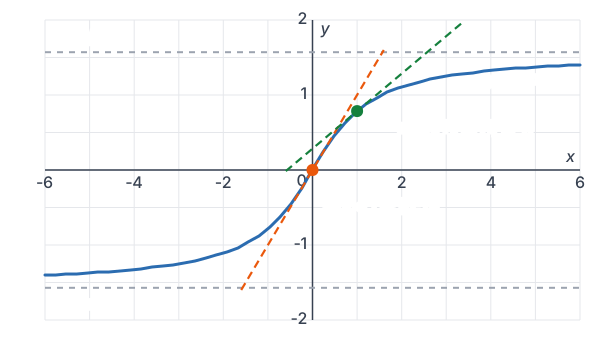
Inverse trig derivative formulas
| Function | Derivative | Function | Derivative |
|---|---|---|---|
| \arcsin x | \frac{1}{\sqrt{1 - x^2}} | \arccos x | -\frac{1}{\sqrt{1 - x^2}} |
| \arctan x | \frac{1}{1 + x^2} | \text{arccot}\, x | -\frac{1}{1 + x^2} |
| \text{arcsec}\, x | \frac{1}{|x|\sqrt{x^2 - 1}} | \text{arccsc}\, x | -\frac{1}{|x|\sqrt{x^2 - 1}} |
The arcsine and arccosine formulas need -1 \lt x \lt 1, and the arcsecant pair needs |x| \gt 1. Arctangent works for every x. You may also see the notation \sin^{-1} x for arcsin x; it means the inverse, not 1/sin x.
With an inside function u, multiply by u′ (chain rule): for example, \frac{d}{dx}\arctan u = \frac{u'}{1 + u^2}.
Derivatives of inverse trig functions examples
Example 1: Arcsine with the chain rule
Differentiate y = \arcsin(3x).
u = 3x, \; u' = 3
The inside function is 3x.
y' = \frac{1}{\sqrt{1 - (3x)^2}} \cdot 3Arcsine formula with u = 3x, times u′.
y' = \frac{3}{\sqrt{1 - 9x^2}}Square 3x and multiply.
Answer: y' = \frac{3}{\sqrt{1 - 9x^2}}, for -\frac{1}{3} \lt x \lt \frac{1}{3}.
Example 2: Arctangent with the chain rule
Differentiate y = \arctan(x^2).
y' = \frac{1}{1 + (x^2)^2} \cdot 2xArctangent formula with u = x², times u′ = 2x.
y' = \frac{2x}{1 + x^4}Simplify: (x²)² = x⁴.
Answer: y' = \frac{2x}{1 + x^4}.
Example 3: Product rule with arctangent
Differentiate y = x\arctan x.
y' = 1 \cdot \arctan x + x \cdot \frac{1}{1 + x^2}Product rule (see product rule).
y' = \arctan x + \frac{x}{1 + x^2}Simplify.
Answer: y' = \arctan x + \frac{x}{1 + x^2}.
Example 4: A tangent line to arcsine
Find the tangent line to y = \arcsin x at x = \frac{1}{2}.
y = \arcsin\frac{1}{2} = \frac{\pi}{6}Find the point. The angle whose sine is ½ is π/6.
y' = \frac{1}{\sqrt{1 - \frac{1}{4}}} = \frac{1}{\sqrt{\frac{3}{4}}}Substitute x = ½ into the derivative.
y' = \frac{2}{\sqrt{3}} = \frac{2\sqrt{3}}{3}√(3/4) = √3/2, then rationalize (see rationalizing the denominator).
y - \frac{\pi}{6} = \frac{2\sqrt{3}}{3}\left(x - \frac{1}{2}\right)Use point-slope form (see point-slope form).
Answer: y = \frac{2\sqrt{3}}{3}\left(x - \frac{1}{2}\right) + \frac{\pi}{6}, or about y = 1.155x − 0.054.
Example 5: Word problem with a rocket
A rocket rises straight up from a launch pad. An observer stands 300 m from the pad. When the rocket is h meters high, the angle of elevation is \theta = \arctan\frac{h}{300}. How fast is the angle changing per meter of height when h = 400 m? If the rocket climbs at 50 m/s, how fast is the angle changing per second?
\frac{d\theta}{dh} = \frac{1}{1 + \left(\frac{h}{300}\right)^2} \cdot \frac{1}{300}Arctangent formula with u = h/300 and u′ = 1/300.
\frac{d\theta}{dh} = \frac{300}{300^2 + h^2}Multiply the top and bottom by 300².
\frac{d\theta}{dh} = \frac{300}{90000 + 160000} = \frac{300}{250000}Substitute h = 400.
\frac{d\theta}{dh} = 0.0012Divide. The units are radians per meter.
\frac{d\theta}{dt} = 0.0012 \cdot 50 = 0.06Chain rule: dθ/dt = (dθ/dh)(dh/dt).
Answer: at 400 m, the angle grows by 0.0012 radian per meter, or 0.06 radian (about 3.4°) per second. This kind of chained rate is the topic of the next lesson, related rates.
Common mistakes
| Mistake | Example of the error | Fix |
|---|---|---|
| Reading sin⁻¹x as 1/sin x | \frac{d}{dx}\sin^{-1}x = -\frac{\cos x}{\sin^2 x} | \sin^{-1}x is arcsin x: the derivative is \frac{1}{\sqrt{1 - x^2}}. |
| Mixing up the arcsine and arctangent formulas | \frac{d}{dx}\arctan x = \frac{1}{\sqrt{1 - x^2}} | Arctangent has no root: \frac{1}{1 + x^2}. |
| Forgetting to square the inside | \frac{d}{dx}\arcsin(3x) = \frac{3}{\sqrt{1 - 3x^2}} | Square all of u: (3x)^2 = 9x^2. |
| Forgetting the chain rule factor | \frac{d}{dx}\arctan(x^2) = \frac{1}{1 + x^4} | Multiply by u′ = 2x. |
| Dropping the minus sign for the co-functions | \frac{d}{dx}\arccos x = \frac{1}{\sqrt{1 - x^2}} | Arccosine falls, so its derivative is negative. |
Related methods
Using the inverse function rule
You can also get these formulas from the rule for derivatives of inverse functions: (f^{-1})'(x) = \frac{1}{f'(f^{-1}(x))}. With f = sin, that is \frac{1}{\cos(\arcsin x)} = \frac{1}{\sqrt{1 - x^2}}.
Why these derivatives matter for integrals
Read backward, the formulas say that an antiderivative of \frac{1}{1 + x^2} is arctan x and an antiderivative of \frac{1}{\sqrt{1 - x^2}} is arcsin x. Integrals like these show up later in Calculus 1, in Integrals That Give Inverse Trig Functions.
Practice problems
- Differentiate y = \arcsin x + \arccos x. What does the answer tell you?
- Differentiate y = \arctan(5x).
- Differentiate y = \arcsin\frac{x}{2}.
- Find the slope of y = \text{arcsec}\, x at x = 2.
- Differentiate y = \arctan\sqrt{x}.
- Differentiate y = (\arcsin x)^2.
- Differentiate y = \arctan(e^x).
- Find the tangent line to y = \arctan x at x = 1.
- Differentiate y = x^2\arccos x.
- Differentiate y = \arctan\frac{1}{x} and simplify.
Show answers
1.
y' = \frac{1}{\sqrt{1 - x^2}} - \frac{1}{\sqrt{1 - x^2}}Use both formulas.
y' = 0
The terms cancel.
Answer: y′ = 0, so arcsin x + arccos x is a constant. (It equals π/2.)
2.
y' = \frac{1}{1 + (5x)^2} \cdot 5Arctangent formula with u = 5x.
y' = \frac{5}{1 + 25x^2}Simplify.
Answer: y' = \frac{5}{1 + 25x^2}
3.
y' = \frac{1}{\sqrt{1 - \frac{x^2}{4}}} \cdot \frac{1}{2}Arcsine formula with u = x/2 and u′ = ½.
y' = \frac{1}{2\sqrt{\frac{4 - x^2}{4}}} = \frac{1}{\sqrt{4 - x^2}}Write 1 − x²/4 over 4; √4 = 2 cancels the 2.
Answer: y' = \frac{1}{\sqrt{4 - x^2}}
4.
y' = \frac{1}{|x|\sqrt{x^2 - 1}}Arcsecant formula.
y'(2) = \frac{1}{2\sqrt{3}} = \frac{\sqrt{3}}{6}Substitute x = 2 and rationalize.
Answer: \frac{\sqrt{3}}{6} \approx 0.289
5.
y' = \frac{1}{1 + x} \cdot \frac{1}{2\sqrt{x}}Arctangent formula with u = √x; (√x)² = x and u′ = 1/(2√x).
y' = \frac{1}{2\sqrt{x}(1 + x)}Multiply.
Answer: y' = \frac{1}{2\sqrt{x}(1 + x)}
6.
y' = 2\arcsin x \cdot \frac{1}{\sqrt{1 - x^2}}General power rule: the inside is arcsin x.
Answer: y' = \frac{2\arcsin x}{\sqrt{1 - x^2}}
7.
y' = \frac{1}{1 + (e^x)^2} \cdot e^xArctangent formula with u = eˣ.
y' = \frac{e^x}{1 + e^{2x}}(eˣ)² = e²ˣ.
Answer: y' = \frac{e^x}{1 + e^{2x}}
8.
y(1) = \arctan 1 = \frac{\pi}{4}Find the point.
y'(1) = \frac{1}{1 + 1} = \frac{1}{2}Substitute x = 1 into 1/(1 + x²).
y - \frac{\pi}{4} = \frac{1}{2}(x - 1)Point-slope form.
Answer: y = \frac{1}{2}x - \frac{1}{2} + \frac{\pi}{4}, or about y = 0.5x + 0.285
9.
y' = 2x\arccos x + x^2 \cdot \left(-\frac{1}{\sqrt{1 - x^2}}\right)Product rule.
Answer: y' = 2x\arccos x - \frac{x^2}{\sqrt{1 - x^2}}
10.
y' = \frac{1}{1 + \frac{1}{x^2}} \cdot \left(-\frac{1}{x^2}\right)Arctangent formula with u = 1/x and u′ = −1/x².
y' = \frac{-1}{x^2 + 1}Multiply the denominators: x²(1 + 1/x²) = x² + 1.
Answer: y' = -\frac{1}{x^2 + 1}
Derivatives of inverse trig functions FAQ
What is the derivative of arctan x?
\frac{d}{dx}\arctan x = \frac{1}{1 + x^2}, for every real x.
What is the derivative of arcsin x?
\frac{d}{dx}\arcsin x = \frac{1}{\sqrt{1 - x^2}}, for -1 \lt x \lt 1. At x = ±1 the graph has vertical tangents, so there is no derivative.
Is sin⁻¹x the same as 1/sin x?
No. \sin^{-1}x means arcsin x, the inverse function. The reciprocal 1/sin x is csc x.
Why is the derivative of arccos x negative?
Arccosine decreases from π to 0 as x goes from −1 to 1, so its slope is always negative. Its derivative is the arcsine derivative with a minus sign.
Summary
- (\arcsin x)' = \frac{1}{\sqrt{1 - x^2}} and (\arccos x)' = -\frac{1}{\sqrt{1 - x^2}}.
- (\arctan x)' = \frac{1}{1 + x^2} and (\text{arcsec}\, x)' = \frac{1}{|x|\sqrt{x^2 - 1}}.
- The co-functions get a minus sign.
- With an inside u, multiply by u′ and square all of u.
- The formulas come from implicit differentiation and the Pythagorean identity.
Previous lesson: Logarithmic Differentiation
Next lesson: Related Rates
Back to the Calculus 1 Index