
Derivatives of Inverse Functions
The derivative of an inverse function is the reciprocal of the original function’s derivative at the matching point. If f(a) = b, then (f^{-1})'(b) = \frac{1}{f'(a)}, as long as f'(a) \ne 0. You can find the slope of the inverse without finding a formula for the inverse.
Before this lesson: Inverse Functions, Chain Rule and Implicit Differentiation
Why the slopes are reciprocals
The graph of f^{-1} is the graph of f reflected over the line y = x. Reflecting swaps x and y, so the point (a, b) on f becomes (b, a) on f^{-1}.
Slope is rise over run. Swapping x and y swaps the rise and the run, so the slope flips. If f has slope 4 at (1, 4), then f^{-1} has slope \frac{1}{4} at (4, 1).
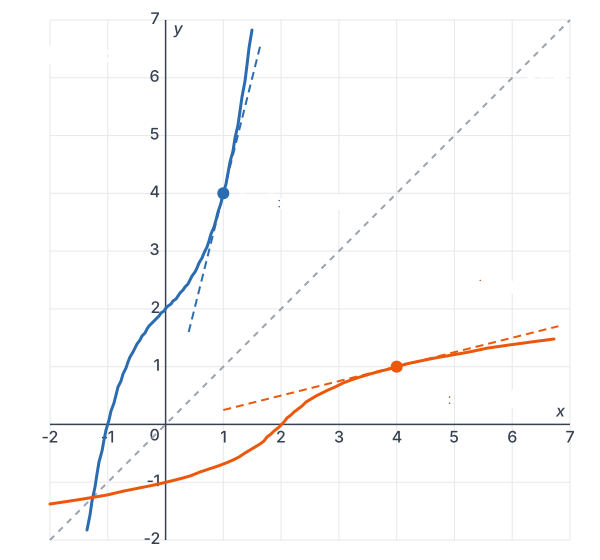
The inverse function derivative formula
\left(f^{-1}\right)'(b) = \frac{1}{f'(a)}, \quad \text{where } f(a) = bAnother way to write it, for every x in the domain of f^{-1}:
\left(f^{-1}\right)'(x) = \frac{1}{f'\left(f^{-1}(x)\right)}- To find the slope of the inverse at x = b, first find a: solve f(a) = b. This is the step students skip most often.
- Find f′(x) and evaluate it at a, not at b.
- Take the reciprocal: \frac{1}{f'(a)}.
The rule needs f'(a) \ne 0. Where f has a horizontal tangent, the inverse has a vertical tangent, and its derivative does not exist.
Derivatives of inverse functions examples
Example 1: Without a formula for the inverse
Let f(x) = x^3 + x + 2. Find (f^{-1})'(4).
a^3 + a + 2 = 4
Find the input a with f(a) = 4.
a = 1
Try small whole numbers: 1 + 1 + 2 = 4, so a = 1.
f'(x) = 3x^2 + 1
Differentiate f with the power rule.
f'(1) = 3(1)^2 + 1 = 4
Evaluate f′ at a = 1, not at 4.
(f^{-1})'(4) = \frac{1}{f'(1)} = \frac{1}{4}Take the reciprocal.
Answer: (f^{-1})'(4) = \frac{1}{4}. Solving y = x^3 + x + 2 for x would be very hard, but you never had to.
Example 2: Checking with a known inverse
Let f(x) = 2x + 5. Find (f^{-1})'(x) with the formula, then check by finding the inverse.
f'(x) = 2
Differentiate f.
(f^{-1})'(x) = \frac{1}{2}The reciprocal of 2. It is the same at every point, since f is a line.
y = 2x + 5 \Rightarrow x = 2y + 5
To check, swap x and y (see inverse functions).
f^{-1}(x) = \frac{x - 5}{2}Subtract 5, then divide by 2, to solve for y.
\frac{d}{dx}\left[\frac{x - 5}{2}\right] = \frac{1}{2}The slope of the inverse line is ½. It matches.
Answer: (f^{-1})'(x) = \frac{1}{2}. A line with slope m has an inverse line with slope \frac{1}{m}.
Example 3: The square root as an inverse
Let f(x) = x^2 for x \ge 0, so f^{-1}(x) = \sqrt{x}. Use the formula to find the derivative of \sqrt{x} at x = 9.
a^2 = 9, \; a \ge 0 \Rightarrow a = 3
Solve f(a) = 9 in the domain x ≥ 0.
f'(x) = 2x \Rightarrow f'(3) = 6
Differentiate f and evaluate at a = 3.
(f^{-1})'(9) = \frac{1}{6}Take the reciprocal.
\frac{1}{2\sqrt{9}} = \frac{1}{6}Check with the power rule: the derivative of x^{1/2} is \frac{1}{2\sqrt{x}}.
Answer: the slope of \sqrt{x} at x = 9 is \frac{1}{6}. Both methods agree.
Example 4: Using a table of values
Let g be the inverse of f. You know f(2) = 7, f′(2) = 3 and f′(7) = 10. Find g′(7).
g(7) = 2
Since f(2) = 7, the inverse sends 7 back to 2.
g'(7) = \frac{1}{f'(g(7))}Write the formula at x = 7.
g'(7) = \frac{1}{f'(2)} = \frac{1}{3}Replace g(7) with 2, then use f′(2) = 3.
Answer: g'(7) = \frac{1}{3}. The value f′(7) = 10 is a trap: f′ is evaluated at the matching input 2, not at 7.
Example 5: Word problem with a water tank
The volume of water in a tank is V = h^3 + 4h cubic feet when the water is h feet deep. When the tank holds 16 cubic feet, how fast does the depth change per cubic foot added (find dh/dV)?
h^3 + 4h = 16
Find the depth when V = 16.
h = 2
Try h = 2: 8 + 8 = 16.
\frac{dV}{dh} = 3h^2 + 4Differentiate V with respect to h.
\frac{dV}{dh} = 3(2)^2 + 4 = 16Evaluate at h = 2.
\frac{dh}{dV} = \frac{1}{16}Depth as a function of volume is the inverse, so its derivative is the reciprocal.
Answer: \frac{dh}{dV} = \frac{1}{16} foot per cubic foot. Near that level, each extra cubic foot of water raises the depth by about 0.0625 ft, or 0.75 inch.
Common mistakes
| Mistake | Example of the error | Fix |
|---|---|---|
| Evaluating f′ at b instead of a | In Example 1, using f′(4) = 49 to get 1/49 | First solve f(a) = 4, then use f′(1) = 4. |
| Confusing the inverse with the reciprocal | Writing f^{-1}(x) = \frac{1}{f(x)} | f^{-1} undoes f. The reciprocal is \frac{1}{f(x)}, which is different. |
| Forgetting to take the reciprocal | “(f^{-1})'(4) = f'(1) = 4“ | The slopes are reciprocals: \frac{1}{4}. |
| Ignoring the domain | For x^2 with x \ge 0, using a = −3 | Pick the a that lies in the domain of f. |
| Using the formula where f′(a) = 0 | “(f^{-1})'(0) = \frac{1}{0}” for x^3 | The inverse has a vertical tangent there. Its derivative does not exist. |
Related methods
Where the formula comes from
Since f(f^{-1}(x)) = x for every x in the domain of f^{-1}, differentiate both sides with the chain rule: f'(f^{-1}(x)) \cdot (f^{-1})'(x) = 1. Divide by f'(f^{-1}(x)) to get the formula.
Implicit differentiation
You can also write y = f^{-1}(x) as f(y) = x and use implicit differentiation: f'(y) \cdot y' = 1, so y' = \frac{1}{f'(y)}. It is the same rule in a different form.
Coming next
This rule is how the derivatives of \ln x and of \arcsin x, \arctan x and the other inverse trig functions are found. Those come later in this unit, after the derivatives of trig and exponential functions.
Practice problems
- Let f(x) = x^3 + 2. Find (f^{-1})'(10).
- Let f(x) = x^5 + x. Find (f^{-1})'(2).
- Let f(x) = 4x - 3. Find (f^{-1})'(x).
- Let f(x) = \sqrt{x + 1}. Find (f^{-1})'(3).
- Let g be the inverse of f, with f(3) = −1 and f′(3) = 5. Find g′(−1).
- Let f(x) = x^3 + 3x - 1. Find (f^{-1})'(3).
- Let f(x) = x^3 + x. Find the tangent line to the graph of f^{-1} at (2, 1).
- Let f(x) = x^2 + 2x for x \ge -1. Find (f^{-1})'(8).
- Explain why the inverse of f(x) = x^3 has no derivative at x = 0.
- A sensor’s reading is T = 2V^2 + 10 degrees when the voltage is V volts (V ≥ 0). Find dV/dT when T = 28.
Show answers
1.
a^3 + 2 = 10 \Rightarrow a^3 = 8
Solve f(a) = 10: subtract 2.
a = 2
Take the cube root.
f'(x) = 3x^2 \Rightarrow f'(2) = 12
Differentiate and evaluate at a = 2.
(f^{-1})'(10) = \frac{1}{12}Take the reciprocal.
Answer: \frac{1}{12}
2.
a^5 + a = 2 \Rightarrow a = 1
Solve f(a) = 2: 1 + 1 = 2.
f'(x) = 5x^4 + 1 \Rightarrow f'(1) = 6
Differentiate and evaluate at a = 1.
(f^{-1})'(2) = \frac{1}{6}Take the reciprocal.
Answer: \frac{1}{6}
3.
f'(x) = 4
Differentiate f.
(f^{-1})'(x) = \frac{1}{4}Take the reciprocal.
Answer: \frac{1}{4} for every x
4.
\sqrt{a + 1} = 3 \Rightarrow a + 1 = 9Solve f(a) = 3: square both sides.
a = 8
Subtract 1.
f'(x) = \frac{1}{2\sqrt{x + 1}}Chain rule on (x + 1)^{1/2}.
f'(8) = \frac{1}{2 \cdot 3} = \frac{1}{6}Evaluate at a = 8.
(f^{-1})'(3) = 6The reciprocal of ⅙ is 6.
Answer: 6
5.
g(-1) = 3
Since f(3) = −1.
g'(-1) = \frac{1}{f'(3)} = \frac{1}{5}Take the reciprocal of f′ at the matching input.
Answer: \frac{1}{5}
6.
a^3 + 3a - 1 = 3 \Rightarrow a = 1
Solve f(a) = 3: 1 + 3 − 1 = 3.
f'(x) = 3x^2 + 3 \Rightarrow f'(1) = 6
Differentiate and evaluate at a = 1.
(f^{-1})'(3) = \frac{1}{6}Take the reciprocal.
Answer: \frac{1}{6}
7.
f(1) = 1 + 1 = 2
The point (2, 1) on the inverse matches (1, 2) on f.
f'(x) = 3x^2 + 1 \Rightarrow f'(1) = 4
Differentiate and evaluate at 1.
\text{slope} = \frac{1}{4}The inverse’s slope at (2, 1) is the reciprocal.
y - 1 = \frac{1}{4}(x - 2)Point-slope form (see point-slope form).
y = \frac{1}{4}x + \frac{1}{2}Distribute, then add 1.
Answer: y = \frac{1}{4}x + \frac{1}{2}
8.
a^2 + 2a - 8 = 0
Solve f(a) = 8: subtract 8.
(a + 4)(a - 2) = 0
Factor the trinomial (see factoring trinomials).
a = 2
Reject a = −4, which is not in the domain x ≥ −1.
f'(x) = 2x + 2 \Rightarrow f'(2) = 6
Differentiate and evaluate at a = 2.
(f^{-1})'(8) = \frac{1}{6}Take the reciprocal.
Answer: \frac{1}{6}
9.
f(0) = 0
The point (0, 0) on the inverse matches a = 0.
f'(x) = 3x^2 \Rightarrow f'(0) = 0
Differentiate and evaluate at 0.
(f^{-1})'(0) = \frac{1}{0}The reciprocal of 0 is undefined.
Answer: f has a horizontal tangent at the origin, so its inverse, the cube root, has a vertical tangent there and no derivative.
10.
2V^2 + 10 = 28 \Rightarrow V^2 = 9
Subtract 10, then divide by 2.
V = 3
Take the positive root, since V ≥ 0.
\frac{dT}{dV} = 4V = 12Differentiate T and evaluate at V = 3.
\frac{dV}{dT} = \frac{1}{12}Take the reciprocal.
Answer: \frac{1}{12} volt per degree
Derivatives of inverse functions FAQ
What is the formula for the derivative of an inverse function?
(f^{-1})'(b) = \frac{1}{f'(a)}, where f(a) = b. The slope of the inverse at (b, a) is the reciprocal of the slope of f at (a, b).
Do I need to find the inverse function first?
No. You only need the input a that gives f(a) = b and the derivative f′. That is the point of the formula.
Why are the slopes reciprocals?
The inverse’s graph is the reflection of f over y = x. Reflecting swaps rise and run, so the slope m becomes 1/m.
When does the inverse not have a derivative?
Where f′(a) = 0. The graph of f is flat there, so the inverse’s graph is vertical, and a vertical line has no slope.
Summary
- (f^{-1})'(b) = \frac{1}{f'(a)}, where f(a) = b.
- Solve f(a) = b first, then evaluate f′ at a.
- The graphs of f and its inverse are reflections over y = x, so their slopes at matching points are reciprocals.
- If f′(a) = 0, the inverse has a vertical tangent and no derivative there.
- This rule leads to the derivatives of ln x and the inverse trig functions.
Previous lesson: Implicit Differentiation
Next lesson: Derivatives of Trig Functions
Back to the Calculus 1 Index