
Inverse Functions
Inverse functions undo each other. If f turns 2 into 4, then its inverse f^{-1} turns 4 back into 2. To find an inverse, swap x and y and solve for y. Two functions are inverses when f(f^{-1}(x)) = x and f^{-1}(f(x)) = x.
Before this lesson: You should know Composition of Functions, Literal Equations and Reflections.
What an Inverse Does
A function takes an input and gives an output. Its inverse goes backward: it takes that output and returns the original input. Every input-output pair (a, b) of f becomes the pair (b, a) of f^{-1}.
The notation f^{-1}(x) is read “f inverse of x.” The −1 is not an exponent here. It does not mean \frac{1}{f(x)}.
The Graph of an Inverse
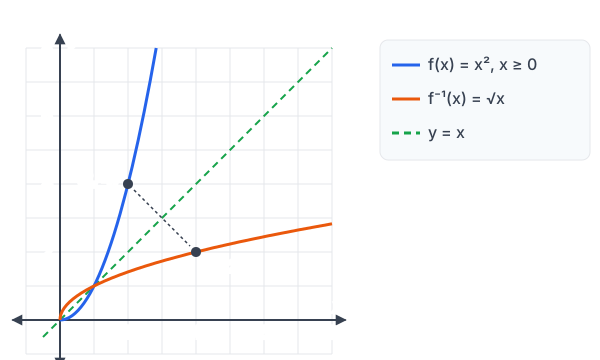
Swapping x and y reflects a point across the line y = x. So the graph of f^{-1} is the mirror image of the graph of f across y = x.
When Does an Inverse Exist?
An inverse is a function only if f is one-to-one: each output comes from exactly one input. Use the horizontal line test. If any horizontal line crosses the graph of f more than once, f has no inverse function.
For example, f(x) = x^2 fails the test, because f(3) = 9 and f(-3) = 9. If you restrict the domain to x \ge 0, the function becomes one-to-one, and its inverse is \sqrt{x}.
How to Find an Inverse
- Replace f(x) with y.
- Swap x and y.
- Solve the new equation for y (see literal equations).
- Replace y with f^{-1}(x).
- Check: f(f^{-1}(x)) and f^{-1}(f(x)) should both simplify to x.
Worked Examples
Example 1: A linear function
Find the inverse of f(x) = 3x - 5.
- Replace f(x) with y: y = 3x - 5
- Swap x and y: x = 3y - 5
- Add 5 to both sides: x + 5 = 3y
- Divide both sides by 3: y = \frac{x + 5}{3}
- Write the inverse: f^{-1}(x) = \frac{x + 5}{3}
- Check: f(f^{-1}(x)) = 3 \cdot \frac{x + 5}{3} - 5 = x + 5 - 5 = x
Answer: f^{-1}(x) = \frac{x + 5}{3}
Example 2: A cubic function
Find the inverse of f(x) = x^3 + 1.
- Replace f(x) with y: y = x^3 + 1
- Swap x and y: x = y^3 + 1
- Subtract 1 from both sides: x - 1 = y^3
- Take the cube root of both sides (see cube roots): y = \sqrt[3]{x - 1}
- Write the inverse: f^{-1}(x) = \sqrt[3]{x - 1}
Answer: f^{-1}(x) = \sqrt[3]{x - 1}. Check with a number: f(2) = 9, and f^{-1}(9) = \sqrt[3]{8} = 2.
Example 3: Verify two inverses
Show that f(x) = 2x + 6 and g(x) = \tfrac{1}{2}x - 3 are inverses.
- Find f(g(x)): 2\left(\tfrac{1}{2}x - 3\right) + 6
- Distribute: x - 6 + 6
- Simplify: f(g(x)) = x
- Find g(f(x)): \tfrac{1}{2}(2x + 6) - 3
- Distribute: x + 3 - 3
- Simplify: g(f(x)) = x
Answer: Both compositions equal x, so f and g are inverses.
Example 4: Restrict the domain
Explain why f(x) = x^2 has no inverse function on all real numbers, then find an inverse for f(x) = x^2 with x \ge 0.
- Test with numbers: f(3) = 9 and f(-3) = 9. The horizontal line y = 9 crosses the graph twice, so f is not one-to-one.
- Restrict to x \ge 0. Now write y = x^2 and swap: x = y^2
- Take the square root. Since y \ge 0, use the positive root: y = \sqrt{x}
- Write the inverse: f^{-1}(x) = \sqrt{x}, with domain [0, \infty)
Answer: On x \ge 0, the inverse is f^{-1}(x) = \sqrt{x}. This is the pair in the graph above.
Example 5: Word problem with temperature
The formula F(C) = \tfrac{9}{5}C + 32 turns Celsius into Fahrenheit. Find the inverse, which turns Fahrenheit into Celsius, and convert 77°F.
- Write the formula with F as the output: F = \tfrac{9}{5}C + 32
- Subtract 32 from both sides: F - 32 = \tfrac{9}{5}C
- Multiply both sides by \tfrac{5}{9}: C = \tfrac{5}{9}(F - 32)
- Substitute 77: C = \tfrac{5}{9}(77 - 32)
- Subtract: C = \tfrac{5}{9}(45)
- Multiply: C = 25
Answer: The inverse is C(F) = \tfrac{5}{9}(F - 32), and 77°F is 25°C. In real-world inverses, we keep the letters F and C instead of swapping them.
Common Mistakes
| Mistake | Example of the error | Fix |
|---|---|---|
| Reading −1 as an exponent | f^{-1}(x) = \frac{1}{3x - 5} | f^{-1} means the inverse function, not the reciprocal. |
| Undoing steps in the wrong order | For 3x - 5, dividing by 3 before adding 5 | Undo in reverse order: add 5 first, then divide by 3. |
| Checking only one composition | Showing f(g(x)) = x only | Check both f(g(x)) and g(f(x)). |
| Forgetting to restrict the domain | Saying the inverse of x^2 is \pm\sqrt{x} | Restrict to x \ge 0; then the inverse is \sqrt{x}. |
| Not swapping x and y | Solving y = 3x - 5 for x and stopping | Swap first, or rename the variables at the end. |
Practice Problems
- Find the inverse of f(x) = x + 7.
- Find the inverse of f(x) = 5x.
- Find the inverse of f(x) = 4x - 1.
- Find the inverse of f(x) = \frac{x}{2} + 3.
- Find the inverse of f(x) = x^3 - 8.
- Show that f(x) = 3x + 4 and g(x) = \frac{x - 4}{3} are inverses.
- A function has the table f(1) = 5, f(2) = 7, f(3) = 9. Write the table for f^{-1} and find f^{-1}(7).
- Is f(x) = x^2 one-to-one on all real numbers? How can you restrict it to get an inverse?
- The point (2, −6) is on the graph of f. Which point must be on the graph of f^{-1}?
- A taxi ride costs C(m) = 2.5m + 3 dollars for m miles. Find the inverse and use it to find how far you can ride for $18.
Show answers
- Swap: x = y + 7
Subtract 7 from both sides: y = x - 7
f^{-1}(x) = x - 7 - Swap: x = 5y
Divide both sides by 5: y = \frac{x}{5}
f^{-1}(x) = \frac{x}{5} - Swap: x = 4y - 1
Add 1 to both sides: x + 1 = 4y
Divide both sides by 4: f^{-1}(x) = \frac{x + 1}{4} - Swap: x = \frac{y}{2} + 3
Subtract 3 from both sides: x - 3 = \frac{y}{2}
Multiply both sides by 2: y = 2(x - 3)
Distribute: f^{-1}(x) = 2x - 6 - Swap: x = y^3 - 8
Add 8 to both sides: x + 8 = y^3
Take the cube root: f^{-1}(x) = \sqrt[3]{x + 8} - f(g(x)) = 3 \cdot \frac{x - 4}{3} + 4 = x - 4 + 4 = x
g(f(x)) = \frac{(3x + 4) - 4}{3} = \frac{3x}{3} = x
Both equal x, so they are inverses. - Swap each pair: f^{-1}(5) = 1, f^{-1}(7) = 2, f^{-1}(9) = 3
So f^{-1}(7) = 2 - No. f(2) = 4 and f(-2) = 4, so a horizontal line crosses the graph twice. Restrict the domain to x \ge 0 (or to x \le 0).
- Swap the coordinates: (−6, 2)
- Write C = 2.5m + 3 and solve for m. Subtract 3 from both sides: C - 3 = 2.5m
Divide both sides by 2.5: m = \frac{C - 3}{2.5}
Substitute 18: m = \frac{18 - 3}{2.5} = \frac{15}{2.5} = 6
You can ride 6 miles.
FAQ
How do you find the inverse of a function?
Write y = f(x), swap x and y, and solve for y. The result is f^{-1}(x).
How do you check if two functions are inverses?
Compose them both ways. If f(g(x)) = x and g(f(x)) = x, they are inverses.
What does the graph of an inverse look like?
It is the reflection of the original graph across the line y = x. Every point (a, b) becomes (b, a).
Does every function have an inverse?
No. Only one-to-one functions have inverse functions. A function that fails the horizontal line test needs a restricted domain first.
Summary
- An inverse function undoes the original: (a, b) on f means (b, a) on f^{-1}.
- To find it, swap x and y, then solve for y.
- Check that f(f^{-1}(x)) = x and f^{-1}(f(x)) = x.
- The graphs are reflections across y = x.
- Only one-to-one functions (horizontal line test) have inverses. Restrict the domain when needed.
Previous lesson: Composition of Functions
Next lesson: Systems of Equations in Three Variables
Back to the Algebra 2 Index