
Area in Polar Coordinates
The area in polar coordinates inside a curve r = f(θ), from θ = α to θ = β, is A = ½∫ r² dθ with limits α and β. The formula adds up thin wedges, each shaped like a sector of a circle with area ½r²Δθ. Choose the limits so the curve is traced exactly once.
Before this lesson: Area of a Sector, Graphing Polar Equations and Derivatives of Polar Functions
The idea: add up thin wedges
In rectangular coordinates, you find area with thin rectangles. In polar coordinates the natural pieces are thin wedges that fan out from the origin, like slices of pizza.
A sector of a circle with radius r and angle Δθ (in radians) has area ½r²Δθ. When r changes with θ, each thin wedge is almost a sector, so its area is about ½(f(θ))²Δθ. Adding the wedges and letting Δθ shrink gives an integral.
Polar area formula
A = \dfrac{1}{2}\int_{\alpha}^{\beta} r^2\,d\theta = \dfrac{1}{2}\int_{\alpha}^{\beta} \big(f(\theta)\big)^2\,d\theta- Sketch the curve, or picture its shape.
- Find limits that trace the region once. Angles where r = 0 often mark where a loop or petal starts and ends.
- Square r, expanding carefully.
- Replace sin² and cos² with the power-reducing identities: cos² u = (1 + cos 2u)/2 and sin² u = (1 − cos 2u)/2.
- Integrate, then multiply by ½.
Symmetry saves work: find the area of one petal or one half and multiply.
Area in polar coordinates examples
Example 1: A circle
Use the formula to find the area inside r = 3.
A = \dfrac{1}{2}\int_0^{2\pi} 3^2\,d\thetaThe circle is traced once for θ from 0 to 2π.
A = \dfrac{9}{2}(2\pi - 0) = 9\piIntegrate the constant 9 and multiply by ½.
Answer: 9π, matching πr² for radius 3.
Example 2: A cardioid
Find the area inside the cardioid r = 1 + cos θ.
A = \dfrac{1}{2}\int_0^{2\pi} (1 + \cos\theta)^2\,d\thetaThe cardioid is traced once for θ from 0 to 2π.
(1 + \cos\theta)^2 = 1 + 2\cos\theta + \cos^2\theta
Expand the square (see special products of binomials).
\cos^2\theta = \dfrac{1 + \cos 2\theta}{2}Use the power-reducing identity (see half-angle formulas).
\int_0^{2\pi} 1\,d\theta = 2\piIntegrate the first term.
\int_0^{2\pi} 2\cos\theta\,d\theta = \left[2\sin\theta\right]_0^{2\pi} = 0Integrate the second term.
\int_0^{2\pi} \dfrac{1 + \cos 2\theta}{2}\,d\theta = \left[\dfrac{\theta}{2} + \dfrac{\sin 2\theta}{4}\right]_0^{2\pi} = \piIntegrate the third term.
A = \dfrac{1}{2}(2\pi + 0 + \pi) = \dfrac{3\pi}{2}Add the three results and multiply by ½.
Answer: 3π/2 ≈ 4.71.
Example 3: A circle that isn’t centered at the origin
Find the area inside r = 4 sin θ.
A = \dfrac{1}{2}\int_0^{\pi} 16\sin^2\theta\,d\thetaThis circle is traced once for θ from 0 to π (r is negative from π to 2π and retraces it).
A = 8\int_0^{\pi} \dfrac{1 - \cos 2\theta}{2}\,d\thetaUse sin² θ = (1 − cos 2θ)/2.
A = 4\left[\theta - \dfrac{\sin 2\theta}{2}\right]_0^{\pi}Integrate.
A = 4(\pi - 0) = 4\pi
Evaluate; sin 2π = sin 0 = 0.
Answer: 4π. The curve is a circle of radius 2, and π(2)² = 4π agrees.
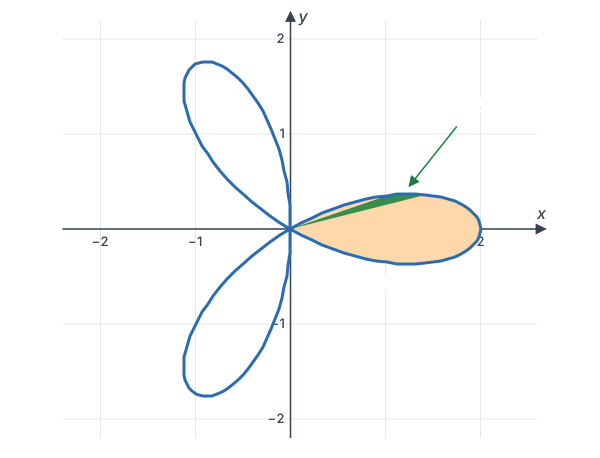
Example 4: One petal of a rose
Find the area of one petal of r = 2 cos 3θ, and the area of the whole rose.
2\cos 3\theta = 0 \Rightarrow \theta = \pm\dfrac{\pi}{6}The right petal starts and ends where r = 0, since 3θ = ±π/2.
A = \dfrac{1}{2}\int_{-\pi/6}^{\pi/6} 4\cos^2 3\theta\,d\thetaSquare r.
A = \int_{-\pi/6}^{\pi/6} (1 + \cos 6\theta)\,d\thetaUse cos² 3θ = (1 + cos 6θ)/2 and simplify 2 · ½.
A = \left[\theta + \dfrac{\sin 6\theta}{6}\right]_{-\pi/6}^{\pi/6}Integrate (u = 6θ).
A = \dfrac{\pi}{6} - \left(-\dfrac{\pi}{6}\right) = \dfrac{\pi}{3}Evaluate; sin(±π) = 0.
3 \cdot \dfrac{\pi}{3} = \piThe rose has 3 equal petals.
Answer: one petal has area π/3 ≈ 1.047, and the whole rose has area π.
Example 5: Area a sprinkler covers (word problem)
A lawn sprinkler waters the region inside r = 4 + 2 sin θ, in meters. How many square meters does it water?
A = \dfrac{1}{2}\int_0^{2\pi} (4 + 2\sin\theta)^2\,d\thetaThe curve is traced once for θ from 0 to 2π (r is always positive).
(4 + 2\sin\theta)^2 = 16 + 16\sin\theta + 4\sin^2\theta
Expand the square.
\int_0^{2\pi} 16\,d\theta = 32\pi, \quad \int_0^{2\pi} 16\sin\theta\,d\theta = 0Integrate the first two terms.
\int_0^{2\pi} 4\sin^2\theta\,d\theta = \int_0^{2\pi} (2 - 2\cos 2\theta)\,d\theta = 4\piUse sin² θ = (1 − cos 2θ)/2 and integrate.
A = \dfrac{1}{2}(32\pi + 0 + 4\pi) = 18\pi \approx 56.55Add and multiply by ½.
Answer: about 56.5 square meters. A full circle with the average radius, 4 m, would be 16π ≈ 50.3 m², so the bulge adds about 6 m².
Common mistakes
| Mistake | Example of the error | Fix |
|---|---|---|
| Forgetting the ½ | \int_0^{2\pi} 9\,d\theta = 18\pi for r = 3 | Each wedge is ½r²Δθ: the area is 9π. |
| Not squaring r | \dfrac{1}{2}\int r\,d\theta | The integrand is r². |
| Tracing the region twice | Using 0 to 2π for r = 4 sin θ and getting 8π | r = 4 sin θ is traced once on [0, π]. Check where the curve repeats. |
| Squaring a sum term by term | (1 + \cos\theta)^2 = 1 + \cos^2\theta | Include the middle term: 1 + 2 cos θ + cos² θ. |
| Integrating cos² θ directly | Writing ∫ cos² θ dθ = (cos³ θ)/3 | Use cos² θ = (1 + cos 2θ)/2 first. |
| Petal limits from the wrong angle | Using 0 to π/3 for a petal of r = 2 cos 3θ | A petal runs between consecutive zeros of r: −π/6 to π/6. |
Related methods
Area between curves
For the region between two polar curves, subtract: ½∫ (R² − r²) dθ. That is the next lesson, Area Between Polar Curves. The rectangular version is area between curves.
Trig integrals
Squared sines and cosines appear in almost every polar area problem. Trigonometric integrals covers higher powers.
Arc length of polar curves
The length of the boundary, rather than the area inside it, uses a different integral. That lesson comes at the end of this unit.
Practice problems
- Use the polar area formula to find the area inside r = 5.
- Find the area inside r = 2 cos θ.
- Find the area inside the cardioid r = 2 + 2 sin θ.
- Find the area of one petal of r = sin 2θ, and of the whole four-petal rose.
- Find the area swept out by the spiral r = θ for 0 ≤ θ ≤ π.
- Find the area inside the limaçon r = 3 + cos θ.
- Find the area swept out by r = e^θ for 0 ≤ θ ≤ 1.
- Find the area inside r = 4 for 0 ≤ θ ≤ π/3. Check it with the sector formula.
- Find the total area inside the lemniscate r² = 4 cos 2θ.
- A garden bed is the region inside r = 2 + cos θ, in meters. Soil costs $8 per square meter. What does it cost to fill the bed?
Show answers
1.
A = \dfrac{1}{2}\int_0^{2\pi} 25\,d\theta = 25\piIntegrate the constant and multiply by ½.
Answer: 25π
2.
A = \dfrac{1}{2}\int_{-\pi/2}^{\pi/2} 4\cos^2\theta\,d\thetaThe circle is traced once for θ from −π/2 to π/2.
A = \int_{-\pi/2}^{\pi/2} (1 + \cos 2\theta)\,d\thetaUse the power-reducing identity.
A = \left[\theta + \tfrac{1}{2}\sin 2\theta\right]_{-\pi/2}^{\pi/2} = \piIntegrate and evaluate.
Answer: π (a circle of radius 1)
3.
(2 + 2\sin\theta)^2 = 4 + 8\sin\theta + 4\sin^2\theta
Expand.
\int_0^{2\pi} (4 + 8\sin\theta + 4\sin^2\theta)\,d\theta = 8\pi + 0 + 4\piIntegrate each term; ∫₀²π sin² θ dθ = π.
A = \dfrac{1}{2}(12\pi) = 6\piMultiply by ½.
Answer: 6π
4.
A = \dfrac{1}{2}\int_0^{\pi/2} \sin^2 2\theta\,d\thetaOne petal runs between the zeros θ = 0 and θ = π/2.
A = \dfrac{1}{4}\int_0^{\pi/2} (1 - \cos 4\theta)\,d\thetaUse sin² 2θ = (1 − cos 4θ)/2.
A = \dfrac{1}{4}\left[\theta - \dfrac{\sin 4\theta}{4}\right]_0^{\pi/2} = \dfrac{\pi}{8}Integrate and evaluate.
4 \cdot \dfrac{\pi}{8} = \dfrac{\pi}{2}Four equal petals.
Answer: π/8 per petal; π/2 for the whole rose
5.
A = \dfrac{1}{2}\int_0^{\pi} \theta^2\,d\theta = \dfrac{1}{2}\cdot\dfrac{\pi^3}{3}Integrate with the power rule.
A = \dfrac{\pi^3}{6} \approx 5.168Simplify.
Answer: π³/6 ≈ 5.17
6.
(3 + \cos\theta)^2 = 9 + 6\cos\theta + \cos^2\theta
Expand.
\int_0^{2\pi} (9 + 6\cos\theta + \cos^2\theta)\,d\theta = 18\pi + 0 + \piIntegrate each term.
A = \dfrac{19\pi}{2} \approx 29.85Multiply by ½.
Answer: 19π/2
7.
A = \dfrac{1}{2}\int_0^{1} e^{2\theta}\,d\thetaSquare r = e^θ.
A = \dfrac{1}{2}\left[\dfrac{e^{2\theta}}{2}\right]_0^1 = \dfrac{e^2 - 1}{4} \approx 1.597Integrate and evaluate.
Answer: (e² − 1)/4 ≈ 1.60
8.
A = \dfrac{1}{2}\int_0^{\pi/3} 16\,d\theta = 8 \cdot \dfrac{\pi}{3} = \dfrac{8\pi}{3}Integrate the constant.
\dfrac{1}{2}(4)^2\left(\dfrac{\pi}{3}\right) = \dfrac{8\pi}{3}Sector formula ½r²θ gives the same value.
Answer: 8π/3 ≈ 8.38
9.
A_{\text{loop}} = \dfrac{1}{2}\int_{-\pi/4}^{\pi/4} 4\cos 2\theta\,d\thetar² = 4 cos 2θ is not negative for θ in [−π/4, π/4], giving the right loop.
A_{\text{loop}} = \left[\sin 2\theta\right]_{-\pi/4}^{\pi/4} = 1 - (-1) = 2Integrate and evaluate.
2 \cdot 2 = 4
The left loop has the same area.
Answer: 4
10.
(2 + \cos\theta)^2 = 4 + 4\cos\theta + \cos^2\theta
Expand.
A = \dfrac{1}{2}(8\pi + 0 + \pi) = \dfrac{9\pi}{2} \approx 14.14Integrate each term over 0 to 2π and multiply by ½.
8 \dfrac{\text{dollars}}{\text{m}^2} \times 14.137\,\text{m}^2 \approx 113.10Multiply by the cost per square meter.
Answer: about $113.10
Polar area FAQ
What is the formula for area in polar coordinates?
A = ½∫ r² dθ, from θ = α to θ = β, where the curve r = f(θ) is traced once on that interval.
Why is there a ½ in the polar area formula?
The pieces are wedges, not rectangles. A wedge with radius r and angle Δθ has area ½r²Δθ, the same as a sector of a circle.
How do you find the limits for a polar area?
Find the angles that trace the region exactly once. For loops and petals, the limits are usually consecutive angles where r = 0.
Why is my polar area twice the right answer?
The interval probably traced the curve twice. For example, r = 4 sin θ and r = 2 cos 3θ are each traced once on an interval of length π, not 2π.
Summary
- Polar area: A = ½∫ r² dθ between the limits α and β.
- The pieces are wedges with area ½r²Δθ.
- Choose limits that trace the region once; petals run between zeros of r.
- Expand r² fully and use power-reducing identities for sin² and cos².
- Use symmetry: find one petal or half, then multiply.
Previous lesson: Derivatives of Polar Functions
Next lesson: Area Between Polar Curves
Back to the Calculus 2 Index