
Area Between Polar Curves
The area between polar curves is A = ½∫ (R² − r²) dθ, where R is the outer curve, r is the inner curve, and the limits are the angles where the curves meet. Find those angles by setting the two equations equal. Square each radius before you subtract.
Before this lesson: Area in Polar Coordinates, Solving Trig Equations and Area Between Curves
The idea: outer wedge minus inner wedge
Each thin wedge of the region starts at the inner curve and ends at the outer curve. Its area is the big wedge, ½R²Δθ, minus the small wedge, ½r²Δθ.
Adding those pieces gives ½∫ (R² − r²) dθ. It works like the washer method: you subtract squares, not the radii first. The limits are where the outer and inner curves cross.
Area between polar curves formula
A = \dfrac{1}{2}\int_{\alpha}^{\beta} \left(R(\theta)^2 - r(\theta)^2\right)d\theta- Sketch both curves and shade the region.
- Find where they meet: set the equations equal and solve for θ. Also check the pole (r = 0), which this can miss.
- On each interval, decide which curve is outer (farther from the origin).
- If the outer and inner curves switch, split the integral at the crossing.
- Square each radius, subtract, integrate, and multiply by ½. Use symmetry to save work.
Area between polar curves examples
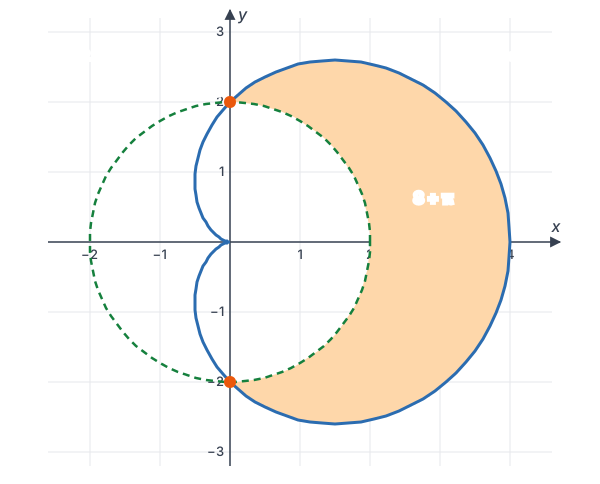
Example 1: Inside a cardioid and outside a circle
Find the area inside r = 2 + 2 cos θ and outside r = 2.
2 + 2\cos\theta = 2
Set the equations equal to find where the curves meet.
\cos\theta = 0 \Rightarrow \theta = \pm\dfrac{\pi}{2}Subtract 2, divide by 2 and solve.
A = \dfrac{1}{2}\int_{-\pi/2}^{\pi/2} \left[(2 + 2\cos\theta)^2 - 2^2\right]d\thetaThe cardioid is outer for θ between −π/2 and π/2.
(2 + 2\cos\theta)^2 - 4 = 8\cos\theta + 4\cos^2\theta
Expand 4 + 8 cos θ + 4 cos² θ and subtract 4.
\int_{-\pi/2}^{\pi/2} 8\cos\theta\,d\theta = \left[8\sin\theta\right]_{-\pi/2}^{\pi/2} = 16Integrate the first term.
\int_{-\pi/2}^{\pi/2} 4\cos^2\theta\,d\theta = \left[2\theta + \sin 2\theta\right]_{-\pi/2}^{\pi/2} = 2\piUse cos² θ = (1 + cos 2θ)/2 (see half-angle formulas) and integrate.
A = \dfrac{1}{2}(16 + 2\pi) = 8 + \piAdd and multiply by ½.
Answer: 8 + π ≈ 11.14.
Example 2: Inside one circle, outside a cardioid
Find the area inside r = 3 sin θ and outside r = 1 + sin θ.
3\sin\theta = 1 + \sin\theta
Set the equations equal.
\sin\theta = \dfrac{1}{2} \Rightarrow \theta = \dfrac{\pi}{6}, \dfrac{5\pi}{6}Subtract sin θ, divide by 2 and solve.
A = \dfrac{1}{2}\int_{\pi/6}^{5\pi/6} \left[9\sin^2\theta - (1 + \sin\theta)^2\right]d\thetaThe circle is outer between these angles.
9\sin^2\theta - (1 + 2\sin\theta + \sin^2\theta) = 8\sin^2\theta - 2\sin\theta - 1
Expand and combine like terms.
8\sin^2\theta - 2\sin\theta - 1 = 3 - 4\cos 2\theta - 2\sin\theta
Use 8 sin² θ = 4 − 4 cos 2θ.
\int_{\pi/6}^{5\pi/6} (3 - 4\cos 2\theta - 2\sin\theta)\,d\theta = \left[3\theta - 2\sin 2\theta + 2\cos\theta\right]_{\pi/6}^{5\pi/6}Integrate.
\left(\dfrac{5\pi}{2} + \sqrt{3} - \sqrt{3}\right) - \left(\dfrac{\pi}{2} - \sqrt{3} + \sqrt{3}\right) = 2\piEvaluate at each limit and subtract.
A = \dfrac{1}{2}(2\pi) = \piMultiply by ½.
Answer: π ≈ 3.14. The square roots cancel, which is a good sign but not something to expect every time.
Example 3: Inside both curves
Find the area inside both r = 3 cos θ and r = 1 + cos θ.
3\cos\theta = 1 + \cos\theta \Rightarrow \cos\theta = \dfrac{1}{2}Set equal and solve: θ = ±π/3.
\int_0^{\pi/3} (1 + \cos\theta)^2\,d\theta = \left[\dfrac{3\theta}{2} + 2\sin\theta + \dfrac{\sin 2\theta}{4}\right]_0^{\pi/3}For θ from 0 to π/3 the cardioid is inner, so it bounds the region. Expand to 1 + 2 cos θ + cos² θ and integrate.
\dfrac{\pi}{2} + \sqrt{3} + \dfrac{\sqrt{3}}{8} = \dfrac{\pi}{2} + \dfrac{9\sqrt{3}}{8}Evaluate; the value at 0 is 0.
\int_{\pi/3}^{\pi/2} 9\cos^2\theta\,d\theta = \left[\dfrac{9\theta}{2} + \dfrac{9\sin 2\theta}{4}\right]_{\pi/3}^{\pi/2}For θ from π/3 to π/2 the circle is inner. It reaches the origin at π/2.
\dfrac{9\pi}{4} - \left(\dfrac{3\pi}{2} + \dfrac{9\sqrt{3}}{8}\right) = \dfrac{3\pi}{4} - \dfrac{9\sqrt{3}}{8}Evaluate at each limit and subtract.
A = 2 \cdot \dfrac{1}{2}\left(\dfrac{\pi}{2} + \dfrac{3\pi}{4}\right)Add the pieces, multiply by ½, and double for the part below the x-axis.
A = \dfrac{5\pi}{4}Simplify.
Answer: 5π/4 ≈ 3.93. When the boundary switches from one curve to the other, split the integral at the crossing.
Example 4: Between the loops of a limaçon
The limaçon r = 1 + 2 cos θ has an inner loop. Find the area between the inner and outer loops.
1 + 2\cos\theta = 0 \Rightarrow \theta = \dfrac{2\pi}{3}, \dfrac{4\pi}{3}The inner loop is traced where r is negative, between these zeros.
\int (1 + 2\cos\theta)^2\,d\theta = 3\theta + 4\sin\theta + \sin 2\theta
Expand 1 + 4 cos θ + 4 cos² θ and integrate (plus C).
A_{\text{inner}} = \dfrac{1}{2}\left[\left(4\pi - 2\sqrt{3} + \tfrac{\sqrt{3}}{2}\right) - \left(2\pi + 2\sqrt{3} - \tfrac{\sqrt{3}}{2}\right)\right]Evaluate the antiderivative at 4π/3 and 2π/3 for the inner loop.
A_{\text{inner}} = \dfrac{1}{2}\left(2\pi - 3\sqrt{3}\right) = \pi - \dfrac{3\sqrt{3}}{2}Subtract and multiply by ½.
A_{\text{outer}} = \dfrac{1}{2}\left[3\theta + 4\sin\theta + \sin 2\theta\right]_{-2\pi/3}^{2\pi/3} = 2\pi + \dfrac{3\sqrt{3}}{2}Evaluate for the outer loop (r positive).
A = A_{\text{outer}} - A_{\text{inner}} = \pi + 3\sqrt{3}Subtract: the region between the loops.
Answer: π + 3√3 ≈ 8.34. The inner loop alone has area π − 3√3/2 ≈ 0.544.
Example 5: A spotlight on a stage (word problem)
A round stage is the region inside r = 6, in meters. A spotlight lights the region inside the cardioid r = 4 + 4 cos θ. How much of the stage is lit?
4 + 4\cos\theta = 6 \Rightarrow \cos\theta = \dfrac{1}{2}The curves cross at θ = ±π/3.
\dfrac{1}{2}\int_0^{\pi/3} 36\,d\theta = 6\piFor θ from 0 to π/3 the stage edge (r = 6) is inner, so it bounds the lit part.
\int_{\pi/3}^{\pi} (4 + 4\cos\theta)^2\,d\theta = \left[24\theta + 32\sin\theta + 4\sin 2\theta\right]_{\pi/3}^{\pi}For θ from π/3 to π the cardioid is inner. Expand 16 + 32 cos θ + 16 cos² θ and integrate.
24\pi - \left(8\pi + 16\sqrt{3} + 2\sqrt{3}\right) = 16\pi - 18\sqrt{3}Evaluate at each limit and subtract.
\dfrac{1}{2}\left(16\pi - 18\sqrt{3}\right) = 8\pi - 9\sqrt{3}Multiply by ½.
A = 2(6\pi + 8\pi - 9\sqrt{3}) = 28\pi - 18\sqrt{3}Double for the half below the x-axis.
A \approx 87.96 - 31.18 = 56.79
Evaluate.
Answer: about 56.8 m² of the 36π ≈ 113.1 m² stage is lit, almost exactly half.
Common mistakes
| Mistake | Example of the error | Fix |
|---|---|---|
| Squaring the difference | \tfrac{1}{2}\int (R - r)^2\,d\theta | Square each radius first: \tfrac{1}{2}\int (R^2 - r^2)\,d\theta. |
| Outer and inner reversed | Getting a negative area in Example 1 | Outer means farther from the origin on that interval. Test an angle between the limits. |
| Missing the pole | Setting sin θ = cos θ and missing that both curves pass through the origin | Check r = 0 for each curve separately. |
| Using one formula when the boundary switches | Using ½∫(1 + cos θ)² dθ alone for “inside both” in Example 3 | Split at the crossing and use the inner curve on each piece. |
| Keeping only one intersection angle | Using 0 to π/2 in Example 1 | Find every solution in the interval; the region runs from −π/2 to π/2. |
| Squaring a sum term by term | (2 + 2\cos\theta)^2 = 4 + 4\cos^2\theta | Include the middle term, 8 cos θ. |
Related methods
Area inside one polar curve
With no inner curve, r = 0 and the formula becomes ½∫ R² dθ from area in polar coordinates.
Rectangular area and washers
Area between curves subtracts heights, top minus bottom. The polar version subtracts squared radii, like the washer method subtracts squared radii for volume.
Arc length of polar curves
To find the length of a polar boundary instead of the area it encloses, use the arc length integral, the next lesson.
Practice problems
- Find the area inside r = 2 and outside r = 1.
- Find the area inside r = 4 cos θ and outside r = 2.
- Find the area inside r = 1 + cos θ and outside r = 1.
- Find the area inside r = 1 and outside r = 1 + cos θ.
- Find all intersection points of r = sin θ and r = cos θ.
- Find the area inside both r = sin θ and r = cos θ.
- Find the area inside r = 2 sin θ and outside r = 1.
- Find the area of the inner loop of r = 1 − 2 cos θ.
- Find the area inside r = 3 + 2 sin θ and outside r = 2.
- A round pond is the region inside r = 4, in meters. A fountain sprays water over the region inside r = 4 + 4 sin θ. How much area does the spray cover outside the pond?
Show answers
1.
A = \dfrac{1}{2}\int_0^{2\pi} (4 - 1)\,d\theta = 3\piThe circles never cross; r = 2 is outer all the way around.
Answer: 3π
2.
4\cos\theta = 2 \Rightarrow \theta = \pm\dfrac{\pi}{3}Find the crossings.
A = \dfrac{1}{2}\int_{-\pi/3}^{\pi/3} (16\cos^2\theta - 4)\,d\thetar = 4 cos θ is outer between them.
A = \dfrac{1}{2}\left[4\theta + 4\sin 2\theta\right]_{-\pi/3}^{\pi/3}16 cos² θ = 8 + 8 cos 2θ; subtract 4 and integrate.
A = \dfrac{4\pi}{3} + 2\sqrt{3} \approx 7.65Evaluate; sin(2π/3) = √3/2.
Answer: 4π/3 + 2√3
3.
A = \dfrac{1}{2}\int_{-\pi/2}^{\pi/2} (2\cos\theta + \cos^2\theta)\,d\thetaCrossings at ±π/2; (1 + cos θ)² − 1 = 2 cos θ + cos² θ.
A = \dfrac{1}{2}\left(4 + \dfrac{\pi}{2}\right) = 2 + \dfrac{\pi}{4}Integrate each term.
Answer: 2 + π/4 ≈ 2.79
4.
A = \dfrac{1}{2}\int_{\pi/2}^{3\pi/2} (-2\cos\theta - \cos^2\theta)\,d\thetaNow r = 1 is outer, for θ from π/2 to 3π/2.
A = \dfrac{1}{2}\left(4 - \dfrac{\pi}{2}\right) = 2 - \dfrac{\pi}{4}Integrate each term.
Answer: 2 − π/4 ≈ 1.21
5.
\sin\theta = \cos\theta \Rightarrow \theta = \dfrac{\pi}{4}Set equal and divide by cos θ.
r = \dfrac{\sqrt{2}}{2} \Rightarrow (x, y) = \left(\tfrac{1}{2}, \tfrac{1}{2}\right)Convert to x and y.
r = 0 \text{ at } \theta = 0 \text{ and } \theta = \dfrac{\pi}{2}Both curves pass through the pole, at different angles.
Answer: (1/2, 1/2) and the origin
6.
A = 2 \cdot \dfrac{1}{2}\int_0^{\pi/4} \sin^2\theta\,d\thetaBy symmetry, double the part bounded by r = sin θ.
A = \left[\dfrac{\theta}{2} - \dfrac{\sin 2\theta}{4}\right]_0^{\pi/4} = \dfrac{\pi}{8} - \dfrac{1}{4}Integrate and evaluate.
Answer: (π − 2)/8 ≈ 0.143
7.
2\sin\theta = 1 \Rightarrow \theta = \dfrac{\pi}{6}, \dfrac{5\pi}{6}Find the crossings.
A = \dfrac{1}{2}\int_{\pi/6}^{5\pi/6} (1 - 2\cos 2\theta)\,d\theta4 sin² θ − 1 = 1 − 2 cos 2θ.
A = \dfrac{1}{2}\left[\theta - \sin 2\theta\right]_{\pi/6}^{5\pi/6} = \dfrac{\pi}{3} + \dfrac{\sqrt{3}}{2}Evaluate.
Answer: π/3 + √3/2 ≈ 1.91
8.
1 - 2\cos\theta = 0 \Rightarrow \theta = \pm\dfrac{\pi}{3}The inner loop is traced for θ between −π/3 and π/3.
A = \dfrac{1}{2}\left[3\theta - 4\sin\theta + \sin 2\theta\right]_{-\pi/3}^{\pi/3}(1 − 2 cos θ)² = 3 − 4 cos θ + 2 cos 2θ; integrate.
A = \pi - \dfrac{3\sqrt{3}}{2} \approx 0.544Evaluate.
Answer: π − 3√3/2
9.
3 + 2\sin\theta = 2 \Rightarrow \theta = -\dfrac{\pi}{6}, \dfrac{7\pi}{6}sin θ = −1/2.
A = \dfrac{1}{2}\int_{-\pi/6}^{7\pi/6} (5 + 12\sin\theta + 4\sin^2\theta)\,d\thetaThe limaçon is outer between them; (3 + 2 sin θ)² − 4.
A = \dfrac{1}{2}\left[7\theta - 12\cos\theta - \sin 2\theta\right]_{-\pi/6}^{7\pi/6}4 sin² θ = 2 − 2 cos 2θ; integrate.
A = \dfrac{14\pi}{3} + \dfrac{11\sqrt{3}}{2} \approx 24.19Evaluate.
Answer: 14π/3 + 11√3/2
10.
4 + 4\sin\theta = 4 \Rightarrow \theta = 0, \pi
Find the crossings.
A = \dfrac{1}{2}\int_0^{\pi} (32\sin\theta + 16\sin^2\theta)\,d\thetaThe spray is outer for θ from 0 to π.
A = \dfrac{1}{2}(64 + 8\pi) = 32 + 4\pi \approx 44.57Integrate each term.
Answer: about 44.6 m²
Area between polar curves FAQ
How do you find the area between two polar curves?
Find where the curves meet, decide which is outer on each interval, and compute ½∫ (R² − r²) dθ between those angles.
How do you find the limits of integration?
Set the two equations equal and solve for θ. Also check whether both curves pass through the pole, because that intersection may not show up when you set them equal.
Why isn’t the formula ½∫ (R − r)² dθ?
Each piece is a big wedge minus a small wedge, ½R²Δθ − ½r²Δθ. Squaring the difference would give the wrong shape.
How do you find the area inside both curves?
Split the region at the crossing points. On each piece, integrate ½r² for whichever curve is closer to the origin, then add.
Summary
- Area between polar curves: A = ½∫ (R² − r²) dθ.
- Limits come from setting the equations equal; check the pole separately.
- R is the outer curve on that interval; split if the curves switch.
- Square each radius, subtract, then integrate.
- Use symmetry to integrate half the region and double.
Previous lesson: Area in Polar Coordinates
Next lesson: Arc Length of Polar Curves
Back to the Calculus 2 Index