
Derivatives of Logarithmic Functions
The derivative of a logarithmic function starts with one rule: the derivative of ln x is \frac{1}{x}, for x \gt 0. For another base, \frac{d}{dx}\log_a x = \frac{1}{x \ln a}. With an inside function u, the chain rule gives \frac{d}{dx}\ln u = \frac{u'}{u}: the derivative of the inside divided by the inside.
Before this lesson: Derivatives of Exponential Functions, Derivatives of Inverse Functions and Properties of Logarithms
Why the derivative of ln x is 1/x
The natural log is the inverse of e^x. If y = \ln x, then e^y = x. Differentiate both sides with respect to x, using implicit differentiation:
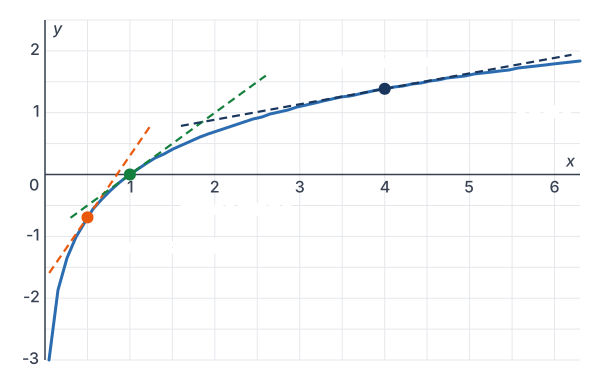
e^y \cdot \frac{dy}{dx} = 1 \quad \Rightarrow \quad \frac{dy}{dx} = \frac{1}{e^y} = \frac{1}{x}You can see it on the graph. Near x = 0 the curve y = \ln x is very steep, and as x grows it flattens out. At x = ½ the slope is 2, at x = 1 it is 1, and at x = 4 it is only ¼.
Logarithmic derivative rules
| Function | Derivative | With an inside function u |
|---|---|---|
| \ln x | \frac{1}{x} | \frac{u'}{u} |
| \ln|x| | \frac{1}{x} | \frac{u'}{u} |
| \log_a x | \frac{1}{x\ln a} | \frac{u'}{u\ln a} |
The rule for \log_a x follows from the change-of-base formula: \log_a x = \frac{\ln x}{\ln a}, and \frac{1}{\ln a} is just a constant.
Use log properties first. Rewriting a log of a product, quotient or power as a sum of simpler logs often makes the derivative much easier (see properties of logarithms).
Derivatives of logarithmic functions examples
Example 1: A sum with ln x
Differentiate y = 3\ln x + x^2.
y' = 3 \cdot \frac{1}{x} + 2xThe derivative of ln x is 1/x; power rule on x².
y' = \frac{3}{x} + 2xMultiply.
Answer: y' = \frac{3}{x} + 2x.
Example 2: Chain rule with ln
Differentiate y = \ln(x^2 + 1).
u = x^2 + 1, \; u' = 2x
The inside function is x² + 1.
y' = \frac{u'}{u} = \frac{2x}{x^2 + 1}Derivative of the inside over the inside (see chain rule).
Answer: y' = \frac{2x}{x^2 + 1}.
Example 3: Product rule with ln x
Differentiate y = x\ln x.
y' = (1)(\ln x) + (x)\left(\frac{1}{x}\right)Product rule (see product rule).
y' = \ln x + 1
Simplify: x · 1/x = 1.
Answer: y' = \ln x + 1.
Example 4: Use log properties first
Differentiate y = \ln\left(x^3\sqrt{x + 1}\right).
y = \ln\left(x^3\right) + \ln\left((x + 1)^{1/2}\right)The log of a product is the sum of the logs.
y = 3\ln x + \frac{1}{2}\ln(x + 1)Bring each exponent down in front (power property).
y' = \frac{3}{x} + \frac{1}{2} \cdot \frac{1}{x + 1}Differentiate each term. The inside x + 1 has derivative 1.
y' = \frac{3}{x} + \frac{1}{2(x + 1)}Multiply.
Answer: y' = \frac{3}{x} + \frac{1}{2(x + 1)}. Without the log properties, you would need the chain rule and the product rule together.
Example 5: Word problem with a growing tree
A young tree’s height is modeled by h(t) = 20\ln(t + 1) feet, t years after planting. How fast is it growing at t = 4 years? At t = 19 years?
h'(t) = 20 \cdot \frac{1}{t + 1} = \frac{20}{t + 1}Chain rule: the inside t + 1 has derivative 1.
h'(4) = \frac{20}{5} = 4Substitute t = 4.
h'(19) = \frac{20}{20} = 1Substitute t = 19.
Answer: the tree grows about 4 feet per year at 4 years and about 1 foot per year at 19 years. A log model always keeps growing, but more and more slowly.
Common mistakes
| Mistake | Example of the error | Fix |
|---|---|---|
| Forgetting the chain rule | \frac{d}{dx}\ln(x^2 + 1) = \frac{1}{x^2 + 1} | Multiply by u′: \frac{2x}{x^2 + 1}. |
| Using 1/x for any log base | \frac{d}{dx}\log_2 x = \frac{1}{x} | Divide by ln a too: \frac{1}{x\ln 2}. |
| Splitting a log of a sum | \ln(x^2 + 1) = \ln x^2 + \ln 1 | Log properties work on products, quotients and powers, not sums. |
| Treating (ln x)² like ln(x²) | \frac{d}{dx}(\ln x)^2 = \frac{2}{x} | Chain rule: 2\ln x \cdot \frac{1}{x}. |
| Differentiating a log constant | \frac{d}{dx}\ln 5 = \frac{1}{5} | ln 5 is a constant, so its derivative is 0. |
Related methods
The derivative of ln|x|
The function \ln|x| is defined for negative x too, and its derivative is still \frac{1}{x}. This version matters later, because it is why the antiderivative of \frac{1}{x} is \ln|x| + C.
Logarithmic differentiation
You can also take the natural log of both sides of an equation before you differentiate. That trick handles messy products and powers like x^x, and it is the next lesson, Logarithmic Differentiation.
Practice problems
- Differentiate y = \ln(5x).
- Differentiate y = \ln(x^2 - 3x).
- Differentiate y = x^2\ln x.
- Differentiate y = (\ln x)^2.
- Differentiate y = \log_{10} x.
- Differentiate y = \ln\sqrt{x}.
- Differentiate y = \ln\left(\frac{x + 1}{x - 1}\right).
- Find the tangent line to y = \ln x at x = 1.
- Find where y = \frac{\ln x}{x} has a horizontal tangent line.
- Find the slope of y = \log_3(x^2 + 2) at x = 1.
Show answers
1.
y' = \frac{5}{5x}Derivative of the inside over the inside.
y' = \frac{1}{x}Simplify. (Or: ln 5x = ln 5 + ln x, and ln 5 is a constant.)
Answer: y' = \frac{1}{x}
2.
y' = \frac{2x - 3}{x^2 - 3x}The inside has derivative 2x − 3.
Answer: y' = \frac{2x - 3}{x^2 - 3x}
3.
y' = 2x\ln x + x^2 \cdot \frac{1}{x}Product rule.
y' = 2x\ln x + x
Simplify x²/x = x.
Answer: y' = 2x\ln x + x
4.
y' = 2\ln x \cdot \frac{1}{x}General power rule: the inside ln x has derivative 1/x.
y' = \frac{2\ln x}{x}Multiply.
Answer: y' = \frac{2\ln x}{x}
5.
y' = \frac{1}{x\ln 10}Rule for log base a with a = 10.
Answer: y' = \frac{1}{x\ln 10}
6.
y = \frac{1}{2}\ln xPower property: √x = x^(1/2).
y' = \frac{1}{2x}Differentiate.
Answer: y' = \frac{1}{2x}
7.
y = \ln(x + 1) - \ln(x - 1)
Quotient property.
y' = \frac{1}{x + 1} - \frac{1}{x - 1}Differentiate each term.
y' = \frac{(x - 1) - (x + 1)}{(x + 1)(x - 1)}Use a common denominator (see adding and subtracting rational expressions).
y' = \frac{-2}{x^2 - 1}Simplify the numerator and multiply out the denominator.
Answer: y' = -\frac{2}{x^2 - 1}
8.
y(1) = \ln 1 = 0
Find the point (1, 0).
y'(1) = \frac{1}{1} = 1The slope is 1/x at x = 1.
y - 0 = 1(x - 1)
Point-slope form (see point-slope form).
Answer: y = x - 1
9.
y' = \frac{\frac{1}{x} \cdot x - \ln x \cdot 1}{x^2}Quotient rule (see quotient rule).
y' = \frac{1 - \ln x}{x^2}Simplify the numerator.
1 - \ln x = 0 \Rightarrow \ln x = 1
Set the numerator equal to 0.
x = e
Rewrite in exponential form.
Answer: x = e, at the point (e, 1/e)
10.
y' = \frac{2x}{(x^2 + 2)\ln 3}Rule for log base 3 with the chain rule.
y'(1) = \frac{2}{3\ln 3}Substitute x = 1.
\frac{2}{3\ln 3} \approx 0.607Use ln 3 ≈ 1.0986.
Answer: about 0.607
Derivatives of logarithmic functions FAQ
What is the derivative of ln x?
\frac{d}{dx}\ln x = \frac{1}{x} for x \gt 0. The same formula holds for ln|x| when x is negative.
What is the derivative of ln(u)?
By the chain rule, \frac{d}{dx}\ln u = \frac{u'}{u}. For example, the derivative of ln(3x + 2) is \frac{3}{3x + 2}.
What is the derivative of log base a of x?
\frac{d}{dx}\log_a x = \frac{1}{x\ln a}. For base 10, that is \frac{1}{x\ln 10} \approx \frac{0.434}{x}.
Why is the derivative of ln(5x) the same as that of ln x?
Because ln 5x = ln 5 + ln x, and ln 5 is a constant with derivative 0. Multiplying the inside by a constant only shifts the log graph up or down.
Summary
- \frac{d}{dx}\ln x = \frac{1}{x} and \frac{d}{dx}\log_a x = \frac{1}{x\ln a}.
- Chain rule: \frac{d}{dx}\ln u = \frac{u'}{u}.
- Simplify with log properties before you differentiate.
- Log properties don’t split a log of a sum.
- The rule comes from ln x being the inverse of eˣ.
Previous lesson: Derivatives of Exponential Functions
Next lesson: Logarithmic Differentiation
Back to the Calculus 1 Index