
Choosing a Convergence Test
To choose a convergence test for a series, look at the form of its terms. Start with the divergence test. Then check for a geometric, p-series or telescoping series. Use the ratio test for factorials, the root test for nth powers, a comparison test for fractions of powers of n, and the alternating series test when signs alternate.
Before this lesson: Divergence Test, p-Series, Limit Comparison Test, Alternating Series Test, Ratio Test and Root Test
Why the form of the terms picks the test
Each convergence test is built for one kind of term. The ratio test is easy when terms have factorials, because they cancel. The root test is easy when the whole term is an nth power. A comparison test is easy when the term is a fraction of powers of n, because it acts like a p-series.
So the skill is not doing a test. It is spotting the pattern in the term, then picking the test that fits it. The flowchart asks the questions in a good order.
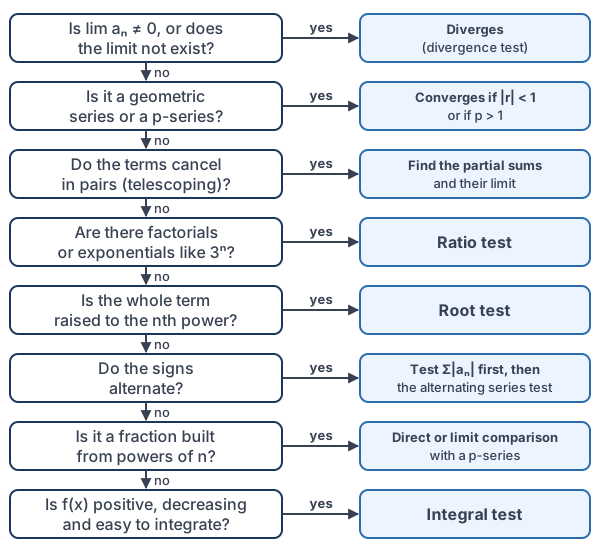
Series convergence tests at a glance
| Test | Use it when | What it tells you |
|---|---|---|
| Divergence test | Always, first | If \lim a_n \ne 0, the series diverges. If the limit is 0, it tells you nothing. |
| Geometric series | \sum ar^n, the variable is in the exponent | Converges when |r| < 1; see infinite geometric series. |
| p-series | \sum \frac{1}{n^p}, the variable is in the base | Converges when p > 1. |
| Telescoping series | Terms split into a difference, like \frac{1}{n} - \frac{1}{n + 1} | Find the partial sums; see telescoping series. |
| Ratio test | Factorials or exponentials | L < 1: converges absolutely. L > 1: diverges. L = 1: no answer. |
| Root test | The whole term is raised to the nth power | Same as the ratio test. |
| Alternating series test | \sum (-1)^n b_n with b_n decreasing to 0 | The series converges (maybe only conditionally). |
| Direct comparison test | Terms are clearly bigger or smaller than a known series | Smaller than convergent: converges. Bigger than divergent: diverges. See direct comparison test. |
| Limit comparison test | Fractions built from powers of n | If \lim \frac{a_n}{b_n} is positive and finite, both series do the same thing. |
| Integral test | f(x) is positive, decreasing and easy to integrate | The series and the improper integral both converge or both diverge; see integral test. |
A step-by-step strategy
- Find \lim a_n. If it is not 0, stop: the series diverges.
- Check for a geometric series, a p-series or a telescoping series. These have direct answers.
- If you see factorials or exponentials, use the ratio test. If the whole term is an nth power, use the root test.
- If the signs alternate, first test \sum |a_n|. If that diverges, use the alternating series test.
- If the term is a fraction of powers of n, compare it with the p-series made from the highest powers.
- If nothing else fits and f(x) is easy to integrate, use the integral test.
Choosing a convergence test: examples
Example 1: Try the divergence test first
Does \sum_{n=1}^{\infty} \dfrac{n^2 + 1}{3n^2 - n} converge?
\lim_{n \to \infty} \dfrac{n^2 + 1}{3n^2 - n} = \lim_{n \to \infty} \dfrac{1 + \frac{1}{n^2}}{3 - \frac{1}{n}}Check the limit of the terms first. Divide the top and bottom by n² (see limits at infinity).
\lim_{n \to \infty} \dfrac{1 + \frac{1}{n^2}}{3 - \frac{1}{n}} = \dfrac{1}{3}1/n² and 1/n go to 0.
\dfrac{1}{3} \ne 0The terms do not approach 0.
Answer: the series diverges by the divergence test. No other test is needed.
Example 2: A fraction of powers of n
Does \sum_{n=1}^{\infty} \dfrac{n + 5}{n^3 + 2} converge?
b_n = \dfrac{n}{n^3} = \dfrac{1}{n^2}The terms go to 0. Keep only the highest power on the top and on the bottom.
\dfrac{a_n}{b_n} = \dfrac{n + 5}{n^3 + 2} \cdot \dfrac{n^2}{1}Divide aₙ by bₙ: multiply by the reciprocal of bₙ.
\dfrac{n + 5}{n^3 + 2} \cdot \dfrac{n^2}{1} = \dfrac{n^3 + 5n^2}{n^3 + 2}Multiply n² into the top (see distributive property).
\lim_{n \to \infty} \dfrac{n^3 + 5n^2}{n^3 + 2} = \lim_{n \to \infty} \dfrac{1 + \frac{5}{n}}{1 + \frac{2}{n^3}} = 1Divide the top and bottom by n³.
0 \lt 1 \lt \infty
The limit is positive and finite, so both series do the same thing.
\sum_{n=1}^{\infty} \dfrac{1}{n^2} \text{ converges}It is a p-series with p = 2 > 1.
Answer: the series converges by the limit comparison test. The ratio test would give L = 1 here, which is no help.
Example 3: A factorial means the ratio test
Does \sum_{n=1}^{\infty} \dfrac{(n + 1)2^n}{n!} converge?
\dfrac{a_{n+1}}{a_n} = \dfrac{(n + 2)2^{n+1}}{(n + 1)!} \cdot \dfrac{n!}{(n + 1)2^n}The term has a factorial, so use the ratio test. Multiply by the reciprocal of aₙ.
\dfrac{(n + 2)2^{n+1}}{(n + 1)!} \cdot \dfrac{n!}{(n + 1)2^n} = 2 \cdot \dfrac{1}{n + 1} \cdot \dfrac{n + 2}{n + 1}2ⁿ⁺¹ ÷ 2ⁿ = 2, and (n + 1)! = (n + 1) · n!.
2 \cdot \dfrac{1}{n + 1} \cdot \dfrac{n + 2}{n + 1} = \dfrac{2n + 4}{(n + 1)^2}Multiply the fractions.
L = \lim_{n \to \infty} \dfrac{2n + 4}{n^2 + 2n + 1} = 0Expand the bottom. It has the higher power of n.
0 \lt 1
Compare L with 1.
Answer: the series converges absolutely by the ratio test.
Example 4: Alternating signs
Does \sum_{n=2}^{\infty} \dfrac{(-1)^n}{\ln n} converge? If so, how?
|a_n| = \dfrac{1}{\ln n}The terms go to 0. Test for absolute convergence first.
\ln n \lt n \text{ for } n \ge 2The natural log grows more slowly than n.
\dfrac{1}{\ln n} \gt \dfrac{1}{n}Take reciprocals of positive numbers; the inequality flips.
\sum_{n=2}^{\infty} \dfrac{1}{n} \text{ diverges}It is the harmonic series, so Σ|aₙ| diverges by direct comparison.
b_n = \dfrac{1}{\ln n} \text{ decreases to } 0ln n increases without bound, so its reciprocal shrinks to 0.
Answer: by the alternating series test the series converges, but not absolutely. It converges conditionally.
Example 5: Energy lost by a fan (word problem)
After a fan is switched off, it loses 40ne^{-n^2} joules of energy in second n. Does the total energy lost over all seconds stay finite? The term is easy to integrate, so use the integral test.
f(x) = 40xe^{-x^2}Match the term with a function of x. It is positive for x > 0.
f'(x) = 40e^{-x^2} + 40x(-2x)e^{-x^2}Use the product rule and the chain rule.
40e^{-x^2} + 40x(-2x)e^{-x^2} = 40e^{-x^2}(1 - 2x^2)Factor out 40e⁻ˣ².
40e^{-x^2}(1 - 2x^2) \lt 0 \text{ for } x \ge 11 − 2x² is negative when x ≥ 1, so f is decreasing.
\int_1^{\infty} 40xe^{-x^2}\,dx = \lim_{b \to \infty} \int_1^{b} 40xe^{-x^2}\,dxWrite the improper integral as a limit.
\int_1^{b} 40xe^{-x^2}\,dx = \left[-20e^{-x^2}\right]_1^{b}Let u = −x², so du = −2x dx (see u-substitution).
\left[-20e^{-x^2}\right]_1^{b} = -20e^{-b^2} + 20e^{-1}Evaluate at b and at 1.
\lim_{b \to \infty} \left(-20e^{-b^2} + 20e^{-1}\right) = \dfrac{20}{e} \approx 7.36e⁻ᵇ² goes to 0.
Answer: the integral is finite, so the series converges by the integral test. The total energy lost is finite: adding the terms gives about 16.2 joules. (The ratio test also works here.)
Common mistakes
| Mistake | Example of the error | Fix |
|---|---|---|
| Thinking terms going to 0 proves convergence | “1/n goes to 0, so \sum \frac{1}{n} converges” | The divergence test can only show divergence. The harmonic series diverges. |
| Using the ratio test on powers of n | Ratio test on \sum \frac{2n + 1}{n^3} gives L = 1 | For fractions of powers of n, use limit comparison with a p-series. |
| Comparing in the wrong direction | “\frac{1}{n + 1} \lt \frac{1}{n} and \sum \frac{1}{n} diverges, so \sum \frac{1}{n + 1} diverges” | Smaller than a divergent series tells you nothing. Use limit comparison instead. |
| Stopping at the alternating series test | Saying \sum \frac{(-1)^n}{n} converges absolutely | That test gives only convergence. Check \sum |a_n| to decide absolute or conditional. |
| Mixing up geometric and p-series | Calling \sum \frac{1}{2^n} a p-series with p = 2 | Variable in the exponent: geometric. Variable in the base: p-series. |
| Ignoring the integral test conditions | Using it on \sum \frac{\cos^2 n}{n^2} | That f is not decreasing. Compare with \frac{1}{n^2} instead. |
Related methods
Which tests show absolute convergence?
The ratio and root tests look at |aₙ|, so when they show convergence, it is absolute. Any test you apply to \sum |a_n| also shows absolute convergence. The alternating series test is the only test here that can show conditional convergence.
After you know a series converges
Many problems then ask for the sum or an estimate. Geometric and telescoping series have exact sums. For other series, you can estimate the sum with a partial sum and bound the error, which Unit 7 covers for alternating series and Taylor series.
Practice problems
For each series, choose a test, then decide whether it converges.
- \sum_{n=1}^{\infty} \dfrac{3^n}{4^n + 1}
- \sum_{n=1}^{\infty} \dfrac{2n^2}{n^2 + 7}
- \sum_{n=1}^{\infty} \dfrac{4}{n\sqrt{n}}
- \sum_{n=1}^{\infty} \dfrac{n^4}{n!}
- \sum_{n=1}^{\infty} \left(\dfrac{5n + 2}{2n + 7}\right)^n
- \sum_{n=1}^{\infty} \dfrac{(-1)^{n+1} n}{n^2 + 4} (absolutely, conditionally or not at all?)
- \sum_{n=1}^{\infty} \dfrac{1}{n(n + 1)} (find the sum if it converges)
- \sum_{n=2}^{\infty} \dfrac{1}{n \ln n}
- \sum_{n=2}^{\infty} \dfrac{\sqrt{n} + 3}{n^2 - 1}
- A model says a website gets \dfrac{900n}{n^2 + 50} new sign-ups on day n. If the model held forever, would the total number of sign-ups stay finite?
Show answers
1.
4^n + 1 \gt 4^n
A geometric-looking term: compare. A bigger bottom makes a smaller fraction.
\dfrac{3^n}{4^n + 1} \lt \dfrac{3^n}{4^n} = \left(\dfrac{3}{4}\right)^nCompare term by term.
\sum_{n=1}^{\infty} \left(\dfrac{3}{4}\right)^n \text{ converges}It is geometric with r = 3/4 < 1.
Answer: converges by direct comparison with a geometric series
2.
\lim_{n \to \infty} \dfrac{2n^2}{n^2 + 7} = \lim_{n \to \infty} \dfrac{2}{1 + \frac{7}{n^2}}Divergence test first. Divide the top and bottom by n².
\lim_{n \to \infty} \dfrac{2}{1 + \frac{7}{n^2}} = 27/n² goes to 0.
2 \ne 0
The terms do not approach 0.
Answer: diverges by the divergence test
3.
\dfrac{4}{n\sqrt{n}} = \dfrac{4}{n^{3/2}}n · n¹ᐟ² = n³ᐟ² (see exponent rules).
p = \dfrac{3}{2} \gt 1It is 4 times a p-series.
Answer: converges (p-series with p = 3/2)
4.
\dfrac{a_{n+1}}{a_n} = \dfrac{(n + 1)^4}{(n + 1)!} \cdot \dfrac{n!}{n^4}Factorial: use the ratio test.
\dfrac{(n + 1)^4}{(n + 1)!} \cdot \dfrac{n!}{n^4} = \dfrac{(n + 1)^3}{n^4}(n + 1)! = (n + 1) · n!, so cancel n! and one factor of n + 1.
L = \lim_{n \to \infty} \dfrac{(n + 1)^3}{n^4} = 0The bottom has the higher power of n.
Answer: L = 0 < 1, so it converges absolutely by the ratio test
5.
\sqrt[n]{\left(\dfrac{5n + 2}{2n + 7}\right)^n} = \dfrac{5n + 2}{2n + 7}The whole term is an nth power: use the root test.
L = \lim_{n \to \infty} \dfrac{5 + \frac{2}{n}}{2 + \frac{7}{n}} = \dfrac{5}{2}Divide the top and bottom by n.
Answer: L = 5/2 > 1, so it diverges by the root test
6.
\lim_{n \to \infty} \dfrac{n}{n^2 + 4} \cdot \dfrac{n}{1} = \lim_{n \to \infty} \dfrac{n^2}{n^2 + 4} = 1Test Σ|aₙ| first, with limit comparison against 1/n.
\sum_{n=1}^{\infty} \dfrac{1}{n} \text{ diverges}So Σ|aₙ| diverges: no absolute convergence.
f'(x) = \dfrac{(x^2 + 4) - x \cdot 2x}{(x^2 + 4)^2}Check that bₙ = n/(n² + 4) decreases. Use the quotient rule.
\dfrac{(x^2 + 4) - x \cdot 2x}{(x^2 + 4)^2} = \dfrac{4 - x^2}{(x^2 + 4)^2}Combine like terms on top.
\dfrac{4 - x^2}{(x^2 + 4)^2} \lt 0 \text{ for } x \gt 2So bₙ decreases from n = 2 on.
\lim_{n \to \infty} \dfrac{n}{n^2 + 4} = 0The bottom has the higher power, so the alternating series test applies.
Answer: converges conditionally
7.
\dfrac{1}{n(n + 1)} = \dfrac{1}{n} - \dfrac{1}{n + 1}Split with partial fraction decomposition.
S_N = 1 - \dfrac{1}{N + 1}The middle terms cancel: the series telescopes.
\lim_{N \to \infty} \left(1 - \dfrac{1}{N + 1}\right) = 11/(N + 1) goes to 0.
Answer: converges; its sum is 1
8.
\int_2^{b} \dfrac{dx}{x \ln x} = \left[\ln(\ln x)\right]_2^{b}f(x) = 1/(x ln x) is positive and decreasing for x ≥ 2. Let u = ln x, du = dx/x.
\left[\ln(\ln x)\right]_2^{b} = \ln(\ln b) - \ln(\ln 2)Evaluate at b and at 2.
\lim_{b \to \infty} \left(\ln(\ln b) - \ln(\ln 2)\right) = \inftyln(ln b) grows without bound.
Answer: diverges by the integral test
9.
b_n = \dfrac{\sqrt{n}}{n^2} = \dfrac{1}{n^{3/2}}Keep the highest powers on the top and bottom.
\dfrac{a_n}{b_n} = \dfrac{\sqrt{n} + 3}{n^2 - 1} \cdot n^{3/2} = \dfrac{n^2 + 3n^{3/2}}{n^2 - 1}Multiply: √n · n³ᐟ² = n².
\lim_{n \to \infty} \dfrac{n^2 + 3n^{3/2}}{n^2 - 1} = \lim_{n \to \infty} \dfrac{1 + \frac{3}{\sqrt{n}}}{1 - \frac{1}{n^2}} = 1Divide the top and bottom by n².
\sum_{n=2}^{\infty} \dfrac{1}{n^{3/2}} \text{ converges}p = 3/2 > 1.
Answer: converges by limit comparison
10.
\dfrac{a_n}{b_n} = \dfrac{900n}{n^2 + 50} \cdot \dfrac{n}{1} = \dfrac{900n^2}{n^2 + 50}A fraction of powers of n: compare with bₙ = n/n² = 1/n.
\lim_{n \to \infty} \dfrac{900n^2}{n^2 + 50} = \lim_{n \to \infty} \dfrac{900}{1 + \frac{50}{n^2}} = 900Divide the top and bottom by n².
\sum_{n=1}^{\infty} \dfrac{1}{n} \text{ diverges}900 is positive and finite, so both series diverge.
Answer: no; in the model the total grows without bound, although very slowly
Convergence tests FAQ
What is the best test for convergence of a series?
No single test works for every series. Start with the divergence test, then match the form of the terms: factorials to the ratio test, nth powers to the root test, fractions of powers of n to limit comparison, and alternating signs to the alternating series test.
What order should I try convergence tests in?
Divergence test; then geometric, p-series and telescoping; then the ratio or root test; then comparison tests; then the alternating series test. Save the integral test for terms you can integrate.
When should I use a comparison test instead of the ratio test?
Use a comparison test when the terms are fractions built from powers of n, like (n + 5)/(n³ + 2). The ratio test gives L = 1 for these, so it gives no answer.
Which convergence tests show absolute convergence?
The ratio and root tests do, when L < 1. So does any test applied to Σ|aₙ|. The alternating series test shows only convergence, so check Σ|aₙ| separately.
Summary
- Always try the divergence test first. It can only prove divergence.
- Geometric, p-series and telescoping series have direct answers.
- Factorials or exponentials: ratio test. Whole term to the nth power: root test.
- Fractions of powers of n: compare with the p-series made from the highest powers.
- Alternating signs: test Σ|aₙ| first, then the alternating series test.
- Use the integral test when f(x) is positive, decreasing and easy to integrate.
Previous lesson: Root Test
Next lesson: Taylor Polynomials
Back to the Calculus 2 Index