
Direct Comparison Test
The direct comparison test compares a series with positive terms to a series you already know, term by term. If 0 \le a_n \le b_n and \sum b_n converges, then \sum a_n converges. If a_n \ge b_n \ge 0 and \sum b_n diverges, then \sum a_n diverges.
Before this lesson: p-Series, Infinite Geometric Series, Integral Test and Comparison Test for Improper Integrals
Why comparing works
When every term is positive, the partial sums only go up. A series like that can do only two things: level off at a finite number, or grow without bound.
Now suppose each term of your series is smaller than the matching term of a series whose total is finite. Your running total stays below that finite total, so it cannot grow without bound. It must level off, so it converges.
It works the other way too. If each term is bigger than the matching term of a series that grows without bound, your running total is pushed up without bound as well.
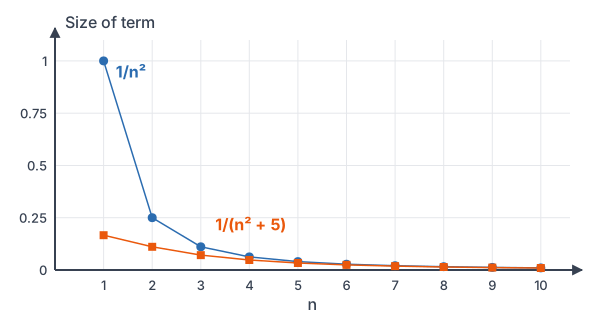
The direct comparison test
Suppose a_n and b_n are both nonnegative for all n (or from some point on).
\text{If } a_n \le b_n \text{ and } \sum b_n \text{ converges, then } \sum a_n \text{ converges.}\text{If } a_n \ge b_n \text{ and } \sum b_n \text{ diverges, then } \sum a_n \text{ diverges.}Two cases give no answer. Being smaller than a divergent series tells you nothing. Being bigger than a convergent series tells you nothing. The inequality has to point the right way.
Good series to compare with. Use a p-series \sum 1/n^p (converges when p > 1) or a geometric series \sum r^n (converges when |r| < 1).
How to use the direct comparison test
- Check that the terms are nonnegative.
- Find the part of the term that matters most for large n. Drop the smaller pieces to guess a p-series or geometric series that behaves the same way.
- Decide whether you expect convergence or divergence, then prove the inequality in the matching direction.
- State the conclusion. If the inequality goes the wrong way, try the limit comparison test instead.
Direct comparison test examples
Example 1: Adding to the denominator
Does \sum_{n=1}^{\infty} \dfrac{1}{n^2 + 5} converge?
\dfrac{1}{n^2 + 5} \gt 0The terms are positive.
n^2 + 5 \gt n^2
Adding 5 makes the denominator bigger.
\dfrac{1}{n^2 + 5} \lt \dfrac{1}{n^2}A bigger denominator makes a smaller fraction.
\sum \dfrac{1}{n^2} \text{ converges}It is a p-series with p = 2.
Answer: the series converges by the direct comparison test, because its terms are smaller than those of a convergent series.
Example 2: Bigger than the harmonic series
Does \sum_{n=3}^{\infty} \dfrac{\ln n}{n} converge?
\ln n \ge \ln 3 \gt 1 \text{ for } n \ge 3ln x is increasing, and ln 3 ≈ 1.10 is greater than 1 (see graphing logarithmic functions).
\dfrac{\ln n}{n} \gt \dfrac{1}{n}Divide both sides by n, which is positive.
\sum_{n=3}^{\infty} \dfrac{1}{n} \text{ diverges}It is the harmonic series missing its first two terms.
Answer: the series diverges by the direct comparison test, because its terms are bigger than those of a divergent series.
Example 3: Comparing with a geometric series
Does \sum_{n=1}^{\infty} \dfrac{3^n}{4^n + 2} converge?
4^n + 2 \gt 4^n
Make the denominator smaller by dropping the 2.
\dfrac{3^n}{4^n + 2} \lt \dfrac{3^n}{4^n}A bigger denominator makes a smaller fraction.
\dfrac{3^n}{4^n} = \left(\dfrac{3}{4}\right)^nUse the power of a quotient rule (see exponent rules).
\sum \left(\dfrac{3}{4}\right)^n \text{ converges}It is geometric with r = 3/4, and |r| is less than 1.
Answer: the series converges by the direct comparison test.
Example 4: A bounded trig factor
Does \sum_{n=1}^{\infty} \dfrac{2 + \sin n}{n^2} converge?
-1 \le \sin n \le 1
Sine is always between −1 and 1.
1 \le 2 + \sin n \le 3
Add 2 to each part.
0 \lt \dfrac{2 + \sin n}{n^2} \le \dfrac{3}{n^2}Divide each part by n², which is positive.
\sum \dfrac{3}{n^2} = 3\sum \dfrac{1}{n^2} \text{ converges}It is 3 times a p-series with p = 2.
Answer: the series converges. The integral test could not handle this series, because its terms go up and down, but a comparison works easily.
Example 5: Coins in a game (word problem)
A phone game gives a daily bonus of \dfrac{100}{n^2 + n + 1} coins on day n. Show that the total bonus stays below a fixed amount forever, and find such an amount.
\dfrac{100}{n^2 + n + 1} \lt \dfrac{100}{n^2}The denominator n² + n + 1 is bigger than n².
\sum_{n=1}^{\infty} \dfrac{100}{n^2} = 100 \cdot \dfrac{\pi^2}{6}The sum of 1/n² is π²/6.
100 \cdot \dfrac{\pi^2}{6} \approx 164.5Multiply.
\sum_{n=1}^{\infty} \dfrac{100}{n^2 + n + 1} \lt 164.5Each term is smaller, so the total is smaller.
Answer: the total bonus converges and is always less than about 164.5 coins, no matter how long you play. (Its actual value is about 79.8 coins.)
Common mistakes
| Mistake | Example of the error | Fix |
|---|---|---|
| Comparing in the wrong direction | “\frac{1}{n+1} \lt \frac{1}{n} and \sum \frac{1}{n} diverges, so \sum \frac{1}{n+1} diverges” | Smaller than divergent proves nothing. Use \frac{1}{n+1} \ge \frac{1}{2n} instead. |
| Being bigger than a convergent series | “\frac{1}{n^2 - 1} \gt \frac{1}{n^2}, so it converges” | Bigger than convergent proves nothing. Use the limit comparison test. |
| Using terms that can be negative | Comparing \frac{\sin n}{n^2} with \frac{1}{n^2} directly | The test needs nonnegative terms. Compare \left|\frac{\sin n}{n^2}\right| instead (absolute convergence, later in this unit). |
| Dropping the wrong piece | Comparing \frac{1}{n^2 + 5} with \frac{1}{5} | Keep the piece that grows fastest, here n². |
| Forgetting to check the benchmark | Comparing with \sum \frac{1}{\sqrt{n}} and calling it convergent | Check the benchmark with the p-series or geometric series rules first. Here p = 1/2, so it diverges. |
| Treating the bound as the sum | “The total is 164.5 coins” in Example 5 | The comparison only gives an upper bound. The real sum is smaller. |
Related methods
When the inequality goes the wrong way
For \sum \frac{1}{n^2 - 1} (starting at n = 2), the terms are a little bigger than 1/n², so a direct comparison with 1/n² fails. The limit comparison test fixes this: it only asks whether the ratio of the terms approaches a positive number.
The same idea for integrals
The comparison test for improper integrals works the same way, with integrals in place of sums.
Practice problems
- Does \sum_{n=1}^{\infty} \dfrac{1}{n^3 + 2} converge?
- Does \sum_{n=1}^{\infty} \dfrac{1}{2^n + 7} converge?
- Does \sum_{n=1}^{\infty} \dfrac{n + 1}{n^2} converge?
- Does \sum_{n=1}^{\infty} \dfrac{\sin^2 n}{n^2} converge?
- Does \sum_{n=1}^{\infty} \dfrac{1}{n + 1} converge?
- Does \sum_{n=1}^{\infty} \dfrac{\ln n}{n^3} converge?
- Does \sum_{n=1}^{\infty} \dfrac{1}{n!} converge?
- Does \sum_{n=2}^{\infty} \dfrac{1}{\ln n} converge?
- Does \sum_{n=1}^{\infty} \dfrac{\sqrt{n}}{n^2 + 1} converge?
- A fundraiser collects \dfrac{50}{n \cdot 2^n} thousand dollars on day n. Show that the total is less than 50 thousand dollars.
Show answers
1.
\dfrac{1}{n^3 + 2} \lt \dfrac{1}{n^3}The denominator is bigger, so the fraction is smaller.
\sum \dfrac{1}{n^3} \text{ converges}p-series with p = 3.
Answer: converges
2.
\dfrac{1}{2^n + 7} \lt \dfrac{1}{2^n} = \left(\tfrac{1}{2}\right)^nDrop the 7 to make the denominator smaller.
\sum \left(\tfrac{1}{2}\right)^n \text{ converges}Geometric with r = 1/2.
Answer: converges
3.
\dfrac{n + 1}{n^2} = \dfrac{1}{n} + \dfrac{1}{n^2}Split the fraction.
\dfrac{1}{n} + \dfrac{1}{n^2} \gt \dfrac{1}{n}1/n² is positive.
\sum \dfrac{1}{n} \text{ diverges}Harmonic series.
Answer: diverges
4.
0 \le \sin^2 n \le 1
A square of a number between −1 and 1 is between 0 and 1.
0 \le \dfrac{\sin^2 n}{n^2} \le \dfrac{1}{n^2}Divide by n².
\sum \dfrac{1}{n^2} \text{ converges}p-series with p = 2.
Answer: converges
5.
n + 1 \le 2n \quad \text{for } n \ge 1Compare the denominators.
\dfrac{1}{n + 1} \ge \dfrac{1}{2n}Take reciprocals of positive numbers; the inequality flips.
\sum \dfrac{1}{2n} = \dfrac{1}{2}\sum \dfrac{1}{n} \text{ diverges}Half the harmonic series.
Answer: diverges
6.
\ln n \lt n \quad \text{for } n \ge 1The log of a number is always smaller than the number.
0 \le \dfrac{\ln n}{n^3} \lt \dfrac{n}{n^3} = \dfrac{1}{n^2}Divide by n³ and simplify; ln n ≥ 0 for n ≥ 1.
\sum \dfrac{1}{n^2} \text{ converges}p-series with p = 2.
Answer: converges
7.
n! = 1 \cdot 2 \cdot 3 \cdots n \ge 1 \cdot 2 \cdot 2 \cdots 2 = 2^{n-1}Each factor from 2 on is at least 2, and there are n − 1 of them.
\dfrac{1}{n!} \le \dfrac{1}{2^{n-1}} = \left(\tfrac{1}{2}\right)^{n-1}Take reciprocals; the inequality flips.
\sum \left(\tfrac{1}{2}\right)^{n-1} = 2Geometric with a = 1 and r = 1/2.
Answer: converges (the sum is e − 1 ≈ 1.718, which is less than 2)
8.
\ln n \lt n \quad \text{for } n \ge 2The log of a number is smaller than the number.
\dfrac{1}{\ln n} \gt \dfrac{1}{n}Take reciprocals of positive numbers; the inequality flips.
\sum_{n=2}^{\infty} \dfrac{1}{n} \text{ diverges}Harmonic series without its first term.
Answer: diverges
9.
n^2 + 1 \gt n^2
Compare the denominators.
\dfrac{\sqrt{n}}{n^2 + 1} \lt \dfrac{\sqrt{n}}{n^2}A bigger denominator makes a smaller fraction.
\dfrac{\sqrt{n}}{n^2} = \dfrac{n^{1/2}}{n^2} = \dfrac{1}{n^{3/2}}Subtract the exponents.
\sum \dfrac{1}{n^{3/2}} \text{ converges}p-series with p = 3/2.
Answer: converges
10.
\dfrac{50}{n \cdot 2^n} \le \dfrac{50}{2^n}n ≥ 1, so dividing by n cannot make the term bigger.
\sum_{n=1}^{\infty} \dfrac{50}{2^n} = \dfrac{25}{1 - \frac{1}{2}} = 50Geometric with a = 25 and r = 1/2.
\dfrac{50}{1 \cdot 2^1} = \dfrac{50}{2^1},\ \dfrac{50}{2 \cdot 2^2} \lt \dfrac{50}{2^2}The terms are equal for n = 1 and smaller for every n ≥ 2.
\sum_{n=1}^{\infty} \dfrac{50}{n \cdot 2^n} \lt 50So the total is strictly less than 50.
Answer: the total is less than $50 thousand (it is about $34.7 thousand)
Direct comparison test FAQ
What is the direct comparison test?
It compares a series with nonnegative terms to a known series, term by term. Smaller than a convergent series means convergent; bigger than a divergent series means divergent.
What series should I compare with?
Use p-series like \sum 1/n^2 or \sum 1/n, and geometric series like \sum (1/2)^n. To choose, keep only the fastest-growing parts of the top and bottom of the term.
What if the inequality goes the wrong way?
Then the direct comparison test gives no answer. Try the limit comparison test, which compares the terms with a limit instead of an inequality.
Does the direct comparison test work for negative terms?
No. The terms must be nonnegative, at least from some point on. For series with mixed signs, look at absolute convergence or the alternating series test.
Summary
- For nonnegative terms: if a_n \le b_n and \sum b_n converges, then \sum a_n converges.
- If a_n \ge b_n and \sum b_n diverges, then \sum a_n diverges.
- Smaller than divergent, or bigger than convergent, tells you nothing.
- Compare with p-series and geometric series, chosen from the fastest-growing parts of the term.
- A comparison gives a bound on the sum, not its exact value.
Previous lesson: p-Series
Next lesson: Limit Comparison Test
Back to the Calculus 2 Index