
p-Series
A p-series is a series of the form \sum_{n=1}^{\infty} \dfrac{1}{n^p}, where p is a constant. The p-series test says it converges when p > 1 and diverges when p ≤ 1. For example, \sum 1/n^2 converges, while the harmonic series \sum 1/n (p = 1) and \sum 1/\sqrt{n} diverge.
Before this lesson: Integral Test, Divergence Test and Rational Exponents
Why the power p decides everything
Every p-series has terms that shrink toward 0 when p > 0. The question is whether they shrink fast enough for the running total to level off.
Compare three series after 20 terms. The partial sums of \sum 1/\sqrt{n} have reached about 7.6 and keep climbing quickly. The harmonic series \sum 1/n has reached about 3.6 and keeps climbing slowly. The partial sums of \sum 1/n^2 have reached about 1.6 and are leveling off.
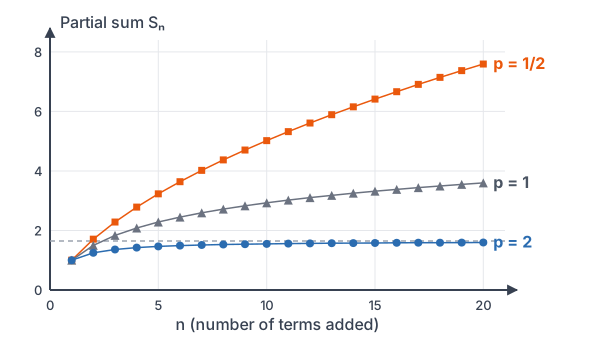
The cutoff is exactly p = 1. Terms like 1/n^{1.01} shrink just fast enough, and terms like 1/n^{0.99} do not.
The p-series test
\sum_{n=1}^{\infty} \dfrac{1}{n^p} \text{ converges if } p \gt 1 \text{ and diverges if } p \le 1Why it works. For p > 0, the function f(x) = x^{-p} is positive, continuous and decreasing, so the integral test applies. For p ≠ 1:
\int_1^{b} x^{-p}\,dx = \dfrac{b^{1-p} - 1}{1 - p}If p > 1, the exponent 1 − p is negative, so b^{1-p} \to 0 and the integral equals \dfrac{1}{p - 1}, a finite number. If p < 1, b^{1-p} \to \infty, so the integral diverges. For p = 1 the integral is ln b, which also diverges. For p ≤ 0 the terms do not go to 0, so the divergence test shows divergence.
Constants and shifts. A constant multiple, like \sum 5/n^2, behaves the same as the p-series. So does a shifted series like \sum 1/(n + 3)^2, which is the p-series with its first three terms missing.
How to use the p-series test
- Simplify the term into the form \dfrac{c}{n^p}, using the exponent rules to combine powers of n.
- Read off p.
- If p > 1, the series converges. If p ≤ 1, it diverges.
p-series examples
Example 1: A large power
Does \sum_{n=1}^{\infty} \dfrac{1}{n^4} converge?
p = 4
The term already has the form 1/nᵖ.
4 \gt 1
Compare p with 1.
Answer: the series converges by the p-series test. Its terms 1, 1/16, 1/81, … shrink very quickly.
Example 2: A square root in the denominator
Does \sum_{n=1}^{\infty} \dfrac{1}{\sqrt{n}} converge?
\dfrac{1}{\sqrt{n}} = \dfrac{1}{n^{1/2}}Write the square root as a power (see rational exponents).
p = \dfrac{1}{2}Read off p.
\dfrac{1}{2} \le 1Compare p with 1.
Answer: the series diverges, even though its terms go to 0.
Example 3: Combining powers first
Does \sum_{n=1}^{\infty} \dfrac{\sqrt[3]{n}}{n^2} converge?
\dfrac{\sqrt[3]{n}}{n^2} = \dfrac{n^{1/3}}{n^2}Write the cube root as a power.
\dfrac{n^{1/3}}{n^2} = n^{1/3 - 2}Use the quotient rule for exponents: subtract the powers.
n^{1/3 - 2} = n^{-5/3}1/3 − 6/3 = −5/3.
n^{-5/3} = \dfrac{1}{n^{5/3}}Rewrite with a positive exponent (see zero and negative exponents).
p = \dfrac{5}{3} \gt 1Read off p and compare it with 1.
Answer: the series converges by the p-series test.
Example 4: A constant multiple and a shift
Decide whether each series converges: (a) \sum_{n=1}^{\infty} \dfrac{5}{n\sqrt{n}} and (b) \sum_{n=1}^{\infty} \dfrac{1}{(n + 3)^2}.
Part (a)
n\sqrt{n} = n^1 \cdot n^{1/2} = n^{3/2}Use the product rule for exponents: add the powers.
\dfrac{5}{n\sqrt{n}} = 5 \cdot \dfrac{1}{n^{3/2}}Factor out the constant 5.
p = \dfrac{3}{2} \gt 1The p-series converges, so 5 times it does too.
Part (b)
k = n + 3
Let k = n + 3; when n = 1, k = 4.
\sum_{n=1}^{\infty} \dfrac{1}{(n + 3)^2} = \sum_{k=4}^{\infty} \dfrac{1}{k^2}This is the p-series with p = 2 missing its first three terms.
p = 2 \gt 1
Dropping a few terms does not change convergence.
Answer: both series converge.
Example 5: Stacking books (word problem)
You stack identical books, each 1 unit long, at the edge of a table. With the best stacking, the book that is nth from the top can stick out \dfrac{1}{2n} units past the book below it. (a) Can the top book stick out as far as you want past the table? (b) How many books does it take for the top book to stick out more than 2 units?
\sum_{n=1}^{\infty} \dfrac{1}{2n} = \dfrac{1}{2}\sum_{n=1}^{\infty} \dfrac{1}{n}(a) The total overhang is half the harmonic series.
p = 1 \le 1
The harmonic series is a p-series with p = 1.
\dfrac{1}{2}\sum_{n=1}^{\infty} \dfrac{1}{n} = \inftyIt diverges, so the overhang grows without bound.
\dfrac{1}{2}\left(1 + \tfrac{1}{2} + \cdots + \tfrac{1}{N}\right) \gt 2(b) The overhang with N books must be more than 2.
1 + \tfrac{1}{2} + \cdots + \tfrac{1}{N} \gt 4Multiply both sides by 2.
1 + \tfrac{1}{2} + \cdots + \tfrac{1}{30} \approx 3.995Add the terms with a calculator: 30 terms are not quite enough.
1 + \tfrac{1}{2} + \cdots + \tfrac{1}{31} \approx 4.02731 terms pass 4.
Answer: (a) yes, because the harmonic series diverges, the overhang can be as large as you like. (b) It takes 31 books to get an overhang of more than 2 book lengths. Each extra unit of overhang takes far more books than the one before.
Common mistakes
| Mistake | Example of the error | Fix |
|---|---|---|
| Mixing up p-series and geometric series | Calling \sum 1/2^n a p-series with p = 2 | In a p-series, n is in the base: 1/n^p. In a geometric series, n is in the exponent: 1/2^n. |
| Thinking the harmonic series converges | “p = 1, so it converges” | The test needs p strictly greater than 1. At p = 1 the series diverges. |
| Not simplifying the powers first | Reading p = 2 from \frac{\sqrt{n}}{n^2} | Simplify first: \frac{n^{1/2}}{n^2} = \frac{1}{n^{3/2}}, so p = 3/2. |
| Using 1/(p − 1) as the sum | “\sum 1/n^2 = \frac{1}{2-1} = 1” | That is the value of the integral, not the series. In fact \sum 1/n^2 = \pi^2/6 \approx 1.645. |
| Applying the test to terms that are not pure powers | Calling \sum \frac{1}{n^2 + 1} a p-series | It is not a p-series, but it can be compared with one. That is the next lesson. |
| Flipping the inequality for p | “p = 1/2 is less than 1, so it converges” | Small p means slowly shrinking terms. The series converges only for p > 1. |
Related methods
p-series as benchmarks
The main use of p-series is as a yardstick. Many series behave like a p-series for large n. For example, \frac{1}{n^2 + 1} is a little smaller than \frac{1}{n^2}, so its series should converge too. The direct comparison test and the limit comparison test make this idea exact.
Known sums
Only a few p-series have known sums. Two famous ones are \sum 1/n^2 = \pi^2/6 and \sum 1/n^4 = \pi^4/90. For most others, estimate the sum with the remainder estimate from the integral test.
Practice problems
- Does \sum_{n=1}^{\infty} \dfrac{1}{n^3} converge?
- Does \sum_{n=1}^{\infty} \dfrac{1}{\sqrt[3]{n}} converge?
- Does \sum_{n=1}^{\infty} \dfrac{1}{n^{0.9}} converge?
- Does \sum_{n=1}^{\infty} \dfrac{7}{n^{2.5}} converge?
- Does \sum_{n=1}^{\infty} \dfrac{\sqrt{n}}{n^2} converge?
- Does \sum_{n=1}^{\infty} \dfrac{n}{\sqrt[3]{n^4}} converge?
- Does \sum_{n=1}^{\infty} \dfrac{1}{(n + 2)^3} converge?
- Does \sum_{n=1}^{\infty} \left(\dfrac{1}{n^2} + \dfrac{1}{2^n}\right) converge?
- For which values of p does \sum_{n=1}^{\infty} \dfrac{1}{n^{2p - 1}} converge?
- A student adds the first 10 terms of \sum_{n=1}^{\infty} \dfrac{1}{n^2} and gets about 1.54977. Use the remainder estimate to trap the full sum between two numbers.
Show answers
1.
p = 3 \gt 1
Read off p and compare it with 1.
Answer: converges
2.
\dfrac{1}{\sqrt[3]{n}} = \dfrac{1}{n^{1/3}}Write the root as a power.
p = \dfrac{1}{3} \le 1Compare p with 1.
Answer: diverges
3.
p = 0.9 \le 1
Read off p and compare it with 1.
Answer: diverges
4.
\dfrac{7}{n^{2.5}} = 7 \cdot \dfrac{1}{n^{2.5}}Factor out the constant.
p = 2.5 \gt 1
Compare p with 1.
Answer: converges
5.
\dfrac{\sqrt{n}}{n^2} = \dfrac{n^{1/2}}{n^2} = n^{1/2 - 2}Write the root as a power and subtract the exponents.
n^{1/2 - 2} = n^{-3/2} = \dfrac{1}{n^{3/2}}1/2 − 2 = −3/2.
p = \dfrac{3}{2} \gt 1Compare p with 1.
Answer: converges
6.
\dfrac{n}{\sqrt[3]{n^4}} = \dfrac{n^1}{n^{4/3}}Write the root as a power.
\dfrac{n^1}{n^{4/3}} = n^{1 - 4/3} = n^{-1/3}Subtract the exponents.
n^{-1/3} = \dfrac{1}{n^{1/3}}Rewrite with a positive exponent.
p = \dfrac{1}{3} \le 1Compare p with 1.
Answer: diverges
7.
\sum_{n=1}^{\infty} \dfrac{1}{(n + 2)^3} = \sum_{k=3}^{\infty} \dfrac{1}{k^3}Let k = n + 2.
p = 3 \gt 1
It is a p-series missing its first two terms.
Answer: converges
8.
\sum \dfrac{1}{n^2} \text{ converges}p-series with p = 2.
\sum \dfrac{1}{2^n} \text{ converges}Geometric series with r = 1/2.
\sum \left(\dfrac{1}{n^2} + \dfrac{1}{2^n}\right) \text{ converges}The sum of two convergent series converges.
Answer: converges (its sum is π²/6 + 1 ≈ 2.645)
9.
2p - 1 \gt 1
The exponent plays the role of p, so it must be greater than 1.
2p \gt 2
Add 1 to both sides.
p \gt 1
Divide both sides by 2.
Answer: it converges when p > 1
10.
\int_{11}^{\infty} \dfrac{dx}{x^2} \le R_{10} \le \int_{10}^{\infty} \dfrac{dx}{x^2}Use the remainder estimate with N = 10.
\dfrac{1}{11} \le R_{10} \le \dfrac{1}{10}Each integral equals 1 divided by its lower limit.
0.09091 \le R_{10} \le 0.1Write as decimals.
1.54977 + 0.09091 \le S \le 1.54977 + 0.1
Add the bounds to S₁₀.
1.64068 \le S \le 1.64977
Simplify.
Answer: the sum is between about 1.6407 and 1.6498 (its exact value is π²/6 ≈ 1.6449)
p-series FAQ
What is a p-series?
A p-series is a series of the form \sum 1/n^p, where p is a fixed number. Examples are \sum 1/n^2, \sum 1/\sqrt{n} and the harmonic series \sum 1/n.
When does a p-series converge?
It converges when p > 1 and diverges when p ≤ 1. The proof uses the integral test on f(x) = 1/x^p.
Is the harmonic series a p-series?
Yes. The harmonic series \sum 1/n is the p-series with p = 1, and it diverges. It is the boundary case of the test.
What is the difference between a p-series and a geometric series?
In a p-series the variable is the base, as in 1/n^2. In a geometric series the variable is the exponent, as in 1/2^n. A geometric series converges when its ratio has size less than 1.
Summary
- A p-series has the form \sum 1/n^p.
- It converges if p > 1 and diverges if p ≤ 1.
- The harmonic series (p = 1) diverges, even though its terms go to 0.
- Simplify roots and powers into c/n^p before reading off p.
- Constant multiples and shifted versions of a p-series behave the same way.
Previous lesson: Integral Test
Next lesson: Direct Comparison Test
Back to the Calculus 2 Index