
Limit Comparison Test
The limit comparison test says that if a_n \gt 0 and b_n \gt 0 and \lim_{n \to \infty} \dfrac{a_n}{b_n} = c, where c is a positive finite number, then \sum a_n and \sum b_n either both converge or both diverge. You pick b_n as a simple series that behaves like a_n for large n.
Before this lesson: Direct Comparison Test, p-Series and Limits at Infinity
Why the ratio of the terms matters
Take a_n = \dfrac{1}{n^2 - 1}. For big n the −1 hardly matters, so a_n is almost \dfrac{1}{n^2}. The trouble is that a_n is slightly bigger than 1/n^2, so the direct comparison test points the wrong way.
The limit comparison test avoids the inequality. It only asks whether the two sets of terms have a steady ratio in the long run. If a_n is about c times b_n for large n, then the two running totals grow or level off together.
The limit comparison test
\text{If } a_n, b_n \gt 0 \text{ and } \lim_{n \to \infty} \dfrac{a_n}{b_n} = c \text{ with } 0 \lt c \lt \infty, \text{ then } \sum a_n \text{ and } \sum b_n \text{ both converge or both diverge.}Two edge cases. If the limit is 0 and \sum b_n converges, then \sum a_n converges (the terms a_n are even smaller). If the limit is ∞ and \sum b_n diverges, then \sum a_n diverges. In the other combinations, a limit of 0 or ∞ tells you nothing, so choose a better b_n.
Choosing bn. Keep only the fastest-growing piece of the top and of the bottom. For a fraction of powers of n, b_n = \dfrac{1}{n^p}, where p is the highest power on the bottom minus the highest power on the top.
How to use the limit comparison test
- Check that the terms are positive, at least from some point on.
- Pick b_n from the fastest-growing pieces, and decide whether \sum b_n converges (p-series or geometric series).
- Find \lim_{n \to \infty} \dfrac{a_n}{b_n}. To divide by b_n, multiply by its reciprocal.
- If the limit is a positive finite number, \sum a_n does what \sum b_n does.
Limit comparison test examples
Example 1: A term slightly bigger than 1/n²
Does \sum_{n=2}^{\infty} \dfrac{1}{n^2 - 1} converge?
b_n = \dfrac{1}{n^2}For large n, n² − 1 behaves like n². The terms are positive for n ≥ 2.
\dfrac{a_n}{b_n} = \dfrac{1}{n^2 - 1} \cdot \dfrac{n^2}{1} = \dfrac{n^2}{n^2 - 1}Divide by multiplying by the reciprocal of bₙ.
\lim_{n \to \infty} \dfrac{n^2}{n^2 - 1} = \lim_{n \to \infty} \dfrac{1}{1 - \frac{1}{n^2}}Divide the top and bottom by n².
\lim_{n \to \infty} \dfrac{1}{1 - \frac{1}{n^2}} = 11/n² goes to 0.
0 \lt 1 \lt \infty \quad \text{and} \quad \sum \dfrac{1}{n^2} \text{ converges}The limit is positive and finite, and the comparison series is a p-series with p = 2.
Answer: the series converges by the limit comparison test. (It is also telescoping, with sum 3/4.)
Example 2: A rational term
Does \sum_{n=1}^{\infty} \dfrac{3n + 5}{2n^3 - n + 4} converge?
b_n = \dfrac{n}{n^3} = \dfrac{1}{n^2}Keep the fastest-growing pieces, 3n and 2n³, and drop the constants 3 and 2. The terms are positive for n ≥ 1.
\dfrac{a_n}{b_n} = \dfrac{3n + 5}{2n^3 - n + 4} \cdot n^2 = \dfrac{3n^3 + 5n^2}{2n^3 - n + 4}Multiply by the reciprocal of bₙ (see multiplying polynomials).
\lim_{n \to \infty} \dfrac{3n^3 + 5n^2}{2n^3 - n + 4} = \lim_{n \to \infty} \dfrac{3 + \frac{5}{n}}{2 - \frac{1}{n^2} + \frac{4}{n^3}}Divide the top and bottom by n³.
\lim_{n \to \infty} \dfrac{3 + \frac{5}{n}}{2 - \frac{1}{n^2} + \frac{4}{n^3}} = \dfrac{3}{2}The small fractions go to 0.
\dfrac{3}{2} \gt 0 \text{ and } \sum \dfrac{1}{n^2} \text{ converges}Positive, finite limit; p-series with p = 2.
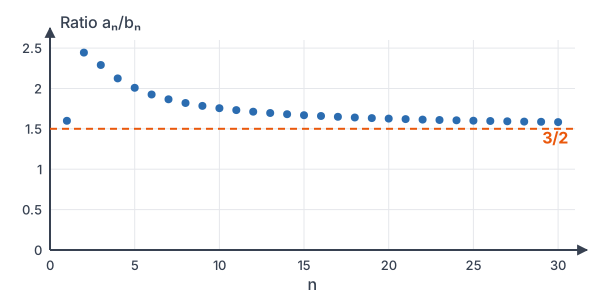
Answer: the series converges. The ratio settles at 3/2, so for large n each term is about 1.5 times 1/n².
Example 3: A square root that acts like n
Does \sum_{n=1}^{\infty} \dfrac{1}{\sqrt{n^2 + 3n}} converge?
b_n = \dfrac{1}{\sqrt{n^2}} = \dfrac{1}{n}Inside the root, n² grows fastest.
\dfrac{a_n}{b_n} = \dfrac{n}{\sqrt{n^2 + 3n}}Multiply by the reciprocal of bₙ.
\dfrac{n}{\sqrt{n^2 + 3n}} = \dfrac{1}{\sqrt{1 + \frac{3}{n}}}Divide the top and bottom by n; inside the root, divide by n².
\lim_{n \to \infty} \dfrac{1}{\sqrt{1 + \frac{3}{n}}} = 13/n goes to 0.
\sum \dfrac{1}{n} \text{ diverges}Harmonic series.
Answer: the series diverges by the limit comparison test.
Example 4: A trig term
Does \sum_{n=1}^{\infty} \sin\left(\dfrac{1}{n}\right) converge?
\sin\left(\dfrac{1}{n}\right) \gt 0For n ≥ 1, 1/n is between 0 and π, so the sine is positive.
b_n = \dfrac{1}{n}For small angles, sin t is close to t.
\lim_{n \to \infty} \dfrac{\sin(1/n)}{1/n} = \lim_{t \to 0^+} \dfrac{\sin t}{t}Let t = 1/n.
\lim_{t \to 0^+} \dfrac{\sin t}{t} = \lim_{t \to 0^+} \dfrac{\cos t}{1} = 1Apply L’Hôpital’s rule.
\sum \dfrac{1}{n} \text{ diverges}Harmonic series.
Answer: the series diverges, even though sin(1/n) goes to 0.
Example 5: Forest loss (word problem)
A model says a forest will lose \dfrac{5n + 2}{n^2 + 1} hectares of trees in year n. If the model holds forever, is the total loss finite?
b_n = \dfrac{n}{n^2} = \dfrac{1}{n}Keep the fastest-growing pieces, 5n and n², and drop the 5.
\dfrac{a_n}{b_n} = \dfrac{5n + 2}{n^2 + 1} \cdot n = \dfrac{5n^2 + 2n}{n^2 + 1}Multiply by the reciprocal of bₙ.
\lim_{n \to \infty} \dfrac{5n^2 + 2n}{n^2 + 1} = \lim_{n \to \infty} \dfrac{5 + \frac{2}{n}}{1 + \frac{1}{n^2}} = 5Divide the top and bottom by n².
\sum \dfrac{1}{n} \text{ diverges}Harmonic series.
\sum_{n=1}^{\infty} \dfrac{5n + 2}{n^2 + 1} \text{ diverges}The limit 5 is positive and finite.
Answer: no. The yearly loss shrinks (3.5 hectares in year 1, about 0.52 in year 10), but the total grows without bound because the losses shrink only like 5/n.
Common mistakes
| Mistake | Example of the error | Fix |
|---|---|---|
| Concluding from a limit of 0 or ∞ | Comparing \frac{1}{n^2} with \frac{1}{n}, getting 0, and saying “diverges” | A limit of 0 with a divergent \sum b_n tells you nothing. Choose b_n with the same growth, here 1/n^2. |
| Choosing bn from the wrong powers | Using b_n = \frac{1}{n} for \frac{3n + 5}{2n^3 - n + 4} | Subtract the top power from the bottom power: 3 − 1 = 2, so b_n = 1/n^2. |
| Forgetting to say what Σbn does | Finding the limit 3/2 and stopping | The test links the two series. State that \sum 1/n^2 converges, so the original series does too. |
| Using it on terms with mixed signs | Comparing \frac{(-1)^n}{n} with \frac{1}{n} | Both sets of terms must be positive. Use the alternating series test instead. |
| Confusing it with the ratio test | Computing \frac{a_{n+1}}{a_n} | The limit comparison test divides by a different series, \frac{a_n}{b_n}. The ratio test is a later lesson. |
| Worrying about which term goes on top | Thinking \frac{b_n}{a_n} gives a different answer | Flipping the ratio turns c into 1/c. Both are positive and finite, so the conclusion is the same. |
Related methods
Direct or limit comparison?
Try the direct comparison test when the inequality is easy, such as \frac{1}{n^2 + 5} \lt \frac{1}{n^2}. Use the limit comparison test when the extra pieces push the inequality the wrong way, such as \frac{1}{n^2 - 1} or \frac{1}{2n - 1}.
Geometric benchmarks
For terms built from powers like 2^n and 3^n, compare with a geometric series. For example, \frac{2^n + n}{3^n} behaves like \left(\tfrac{2}{3}\right)^n, and the ratio of the two goes to 1.
Practice problems
- Does \sum_{n=1}^{\infty} \dfrac{n + 1}{n^3 + 2} converge?
- Does \sum_{n=1}^{\infty} \dfrac{1}{2n - 1} converge?
- Does \sum_{n=2}^{\infty} \dfrac{n^2}{n^4 - 3} converge?
- Does \sum_{n=1}^{\infty} \dfrac{1}{3^n - 2^n} converge?
- Does \sum_{n=1}^{\infty} \dfrac{\sqrt{n}}{n + 4} converge?
- Does \sum_{n=1}^{\infty} \dfrac{2n^2 + 1}{n^{5/2} + n} converge?
- Does \sum_{n=1}^{\infty} \tan\left(\dfrac{1}{n^2}\right) converge?
- Does \sum_{n=1}^{\infty} \left(1 - \cos\dfrac{1}{n}\right) converge?
- Does \sum_{n=1}^{\infty} \dfrac{1}{n^{1 + 1/n}} converge? (Hint: n^{1 + 1/n} = n \cdot n^{1/n} and n^{1/n} \to 1.)
- A ball’s bounce on the nth try reaches \dfrac{4n}{n^3 + 2n + 1} meters. Is the total of all the bounce heights finite?
Show answers
1.
b_n = \dfrac{n}{n^3} = \dfrac{1}{n^2}Keep the fastest-growing pieces.
\dfrac{a_n}{b_n} = \dfrac{(n + 1)n^2}{n^3 + 2} = \dfrac{n^3 + n^2}{n^3 + 2}Multiply by n².
\lim_{n \to \infty} \dfrac{n^3 + n^2}{n^3 + 2} = 1Divide the top and bottom by n³.
Answer: converges, since the limit is 1 and Σ1/n² converges
2.
b_n = \dfrac{1}{n}2n − 1 behaves like 2n; drop the constant 2.
\dfrac{a_n}{b_n} = \dfrac{n}{2n - 1}Multiply by n.
\lim_{n \to \infty} \dfrac{n}{2n - 1} = \dfrac{1}{2}Divide the top and bottom by n.
Answer: diverges, since the limit is 1/2 and the harmonic series diverges
3.
b_n = \dfrac{n^2}{n^4} = \dfrac{1}{n^2}Keep the fastest-growing pieces; the terms are positive for n ≥ 2.
\dfrac{a_n}{b_n} = \dfrac{n^4}{n^4 - 3}Multiply by n².
\lim_{n \to \infty} \dfrac{n^4}{n^4 - 3} = 1Divide the top and bottom by n⁴.
Answer: converges
4.
b_n = \dfrac{1}{3^n}3ⁿ grows much faster than 2ⁿ.
\dfrac{a_n}{b_n} = \dfrac{3^n}{3^n - 2^n} = \dfrac{1}{1 - \left(\tfrac{2}{3}\right)^n}Multiply by 3ⁿ, then divide the top and bottom by 3ⁿ.
\lim_{n \to \infty} \dfrac{1}{1 - \left(\tfrac{2}{3}\right)^n} = 1(2/3)ⁿ goes to 0.
Answer: converges, since Σ(1/3)ⁿ is a convergent geometric series
5.
b_n = \dfrac{\sqrt{n}}{n} = \dfrac{1}{\sqrt{n}}Keep the fastest-growing pieces.
\dfrac{a_n}{b_n} = \dfrac{\sqrt{n} \cdot \sqrt{n}}{n + 4} = \dfrac{n}{n + 4}Multiply by √n.
\lim_{n \to \infty} \dfrac{n}{n + 4} = 1Divide the top and bottom by n.
Answer: diverges, since Σ1/√n is a p-series with p = 1/2
6.
b_n = \dfrac{n^2}{n^{5/2}} = \dfrac{1}{n^{1/2}}Keep the fastest-growing pieces; 5/2 − 2 = 1/2.
\dfrac{a_n}{b_n} = \dfrac{(2n^2 + 1)n^{1/2}}{n^{5/2} + n} = \dfrac{2n^{5/2} + n^{1/2}}{n^{5/2} + n}Multiply by n^(1/2).
\lim_{n \to \infty} \dfrac{2 + n^{-2}}{1 + n^{-3/2}} = 2Divide the top and bottom by n^(5/2).
Answer: diverges, since Σ1/√n diverges
7.
b_n = \dfrac{1}{n^2}For small angles, tan t is close to t.
\lim_{t \to 0^+} \dfrac{\tan t}{t} = \lim_{t \to 0^+} \dfrac{\sec^2 t}{1} = 1Let t = 1/n² and apply L’Hôpital’s rule.
Answer: converges, since Σ1/n² converges
8.
b_n = \dfrac{1}{n^2}For small t, 1 − cos t is close to t²/2.
\lim_{t \to 0^+} \dfrac{1 - \cos t}{t^2} = \lim_{t \to 0^+} \dfrac{\sin t}{2t}Let t = 1/n; the form is 0/0, so apply L’Hôpital’s rule.
\lim_{t \to 0^+} \dfrac{\sin t}{2t} = \lim_{t \to 0^+} \dfrac{\cos t}{2} = \dfrac{1}{2}Apply L’Hôpital’s rule again.
Answer: converges, since the limit is 1/2 and Σ1/n² converges
9.
b_n = \dfrac{1}{n}The extra factor n^(1/n) approaches 1.
\dfrac{a_n}{b_n} = \dfrac{n}{n \cdot n^{1/n}} = \dfrac{1}{n^{1/n}}Multiply by n.
\lim_{n \to \infty} \dfrac{1}{n^{1/n}} = 1Use the hint.
Answer: diverges, since the harmonic series diverges
10.
b_n = \dfrac{n}{n^3} = \dfrac{1}{n^2}Keep the fastest-growing pieces.
\dfrac{a_n}{b_n} = \dfrac{4n \cdot n^2}{n^3 + 2n + 1} = \dfrac{4n^3}{n^3 + 2n + 1}Multiply by n².
\lim_{n \to \infty} \dfrac{4n^3}{n^3 + 2n + 1} = 4Divide the top and bottom by n³.
Answer: yes, the total is finite, since the limit is 4 and Σ1/n² converges
Limit comparison test FAQ
What is the limit comparison test?
It compares two series with positive terms by the limit of the ratio of their terms. If a_n/b_n approaches a positive finite number, both series converge or both diverge.
How do I choose bn for the limit comparison test?
Keep only the fastest-growing piece of the top and of the bottom, and drop constant factors. For \frac{3n + 5}{2n^3 - n + 4}, that gives \frac{n}{n^3} = \frac{1}{n^2}.
What happens if the limit is 0 or infinity?
If the limit is 0 and \sum b_n converges, then \sum a_n converges. If the limit is ∞ and \sum b_n diverges, then \sum a_n diverges. Other cases give no answer.
When should I use limit comparison instead of direct comparison?
Use it when the terms look like a p-series or geometric series but the inequality goes the wrong way, as with \frac{1}{n^2 - 1} compared with \frac{1}{n^2}.
Summary
- If a_n, b_n \gt 0 and a_n/b_n \to c with 0 < c < ∞, the two series both converge or both diverge.
- Choose b_n from the fastest-growing pieces of the term.
- For fractions of powers, b_n = 1/n^p with p = (bottom power) − (top power).
- A limit of 0 or ∞ gives an answer only in the two edge cases.
- No inequality is needed, which makes it easier than direct comparison for many series.
Previous lesson: Direct Comparison Test
Next lesson: Alternating Series Test
Back to the Calculus 2 Index