
Alternating Series Test
The alternating series test says that an alternating series \sum (-1)^{n+1} b_n, with b_n \gt 0, converges if two conditions hold: the sizes b_n decrease (at least from some point on), and \lim_{n \to \infty} b_n = 0. For example, the alternating harmonic series 1 - \tfrac{1}{2} + \tfrac{1}{3} - \tfrac{1}{4} + \cdots converges.
Before this lesson: Infinite Series and Partial Sums, Divergence Test and Convergence of Sequences
Why shrinking back-and-forth steps settle down
An alternating series has terms whose signs switch: +, −, +, −, …. Picture walking along a number line: 1 step forward, 1/2 step back, 1/3 step forward, 1/4 step back, and so on.
Each step undoes part of the one before, but never all of it, because the steps keep getting smaller. So your position zigzags: it overshoots, comes back a little, overshoots by less, and so on. The zigzag gets narrower and narrower, so your position closes in on one point.
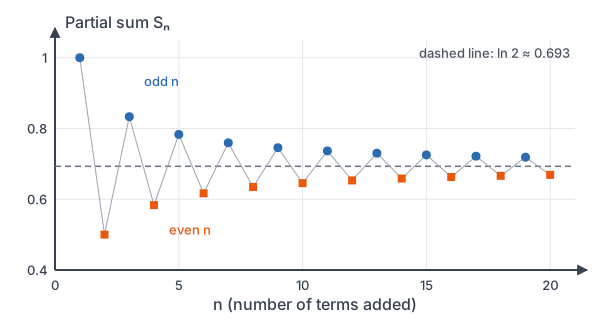
If the steps did not shrink to 0, the zigzag would never close up. That is why both conditions matter.
The alternating series test
Suppose b_n \gt 0 for all n. The series \sum (-1)^{n+1} b_n = b_1 - b_2 + b_3 - \cdots (or the same series starting with a minus sign, \sum (-1)^n b_n) converges if:
\text{(1) } b_{n+1} \le b_n \text{ for all } n \text{ (from some point on)} \qquad \text{(2) } \lim_{n \to \infty} b_n = 0Why it works. The even partial sums S_2, S_4, S_6, \ldots go up, the odd ones S_1, S_3, S_5, \ldots go down, and the gap between neighbors is one term b_n, which shrinks to 0. The two groups are squeezed onto the same number, the sum S.
What the test does not say. If condition (2) fails, the series diverges by the divergence test. If only condition (1) fails, the alternating series test gives no answer.
Error preview. Because the sum sits between any two neighboring partial sums, stopping after n terms makes an error no bigger than the next term, b_{n+1}. A later lesson, the alternating series error bound, uses this.
How to use the alternating series test
- Write the series as \sum (-1)^{n+1} b_n or \sum (-1)^n b_n and identify b_n \gt 0.
- Find \lim b_n. If it is not 0, the series diverges, and you are done.
- Show b_n is decreasing: compare b_{n+1} with b_n, or show that the matching function has a negative derivative.
- If both conditions hold, the series converges.
Alternating series test examples
Example 1: The alternating harmonic series
Does \sum_{n=1}^{\infty} \dfrac{(-1)^{n+1}}{n} = 1 - \tfrac{1}{2} + \tfrac{1}{3} - \tfrac{1}{4} + \cdots converge?
b_n = \dfrac{1}{n}The sizes of the terms, without the signs.
\lim_{n \to \infty} \dfrac{1}{n} = 0Condition (2) holds.
n + 1 \gt n \quad \Rightarrow \quad \dfrac{1}{n + 1} \lt \dfrac{1}{n}A bigger denominator makes a smaller fraction, so bₙ₊₁ < bₙ and condition (1) holds.
Answer: the series converges by the alternating series test. Its sum is ln 2 ≈ 0.693. Compare this with the harmonic series 1 + 1/2 + 1/3 + ⋯, which diverges: the alternating signs make the difference.
Example 2: Decreasing only from some point on
Does \sum_{n=1}^{\infty} \dfrac{(-1)^n n}{n^2 + 4} converge?
b_n = \dfrac{n}{n^2 + 4}The sizes of the terms.
\lim_{n \to \infty} \dfrac{n}{n^2 + 4} = \lim_{n \to \infty} \dfrac{\frac{1}{n}}{1 + \frac{4}{n^2}} = 0Divide the top and bottom by n². Condition (2) holds.
f(x) = \dfrac{x}{x^2 + 4}Use a function to check that bₙ decreases.
f'(x) = \dfrac{(x^2 + 4) - x(2x)}{(x^2 + 4)^2} = \dfrac{4 - x^2}{(x^2 + 4)^2}Use the quotient rule.
4 - x^2 \lt 0 \text{ for } x \gt 2So f is decreasing for x ≥ 2, and condition (1) holds from n = 2 on.
Answer: the series converges. The sizes go 0.2, 0.25, 0.23, 0.2, …: they rise once, then fall for good, which is enough.
Example 3: When the terms do not shrink to 0
Does \sum_{n=1}^{\infty} \dfrac{(-1)^n 2n}{3n + 1} converge?
b_n = \dfrac{2n}{3n + 1}The sizes of the terms.
\lim_{n \to \infty} \dfrac{2n}{3n + 1} = \lim_{n \to \infty} \dfrac{2}{3 + \frac{1}{n}} = \dfrac{2}{3}Divide the top and bottom by n.
\dfrac{2}{3} \neq 0Condition (2) fails, so the terms swing between values near 2/3 and −2/3.
Answer: the series diverges by the divergence test. The alternating series test cannot be used here.
Example 4: A log over n
Does \sum_{n=1}^{\infty} \dfrac{(-1)^{n+1}\ln n}{n} converge?
b_n = \dfrac{\ln n}{n}The sizes (b₁ = 0, and bₙ > 0 for n ≥ 2).
\lim_{x \to \infty} \dfrac{\ln x}{x} = \lim_{x \to \infty} \dfrac{1/x}{1} = 0Apply L’Hôpital’s rule. Condition (2) holds.
f'(x) = \dfrac{x \cdot \frac{1}{x} - \ln x}{x^2} = \dfrac{1 - \ln x}{x^2}Differentiate f(x) = ln x / x with the quotient rule.
1 - \ln x \lt 0 \text{ for } x \gt eSo bₙ decreases for n ≥ 3, and condition (1) holds from n = 3 on.
Answer: the series converges by the alternating series test.
Example 5: A swinging toy (word problem)
A toy on a track moves right \dfrac{1}{\sqrt{n}} meters on its nth move when n is odd, and left by that amount when n is even. (a) Does its position settle at one point? (b) Is the total distance it travels finite?
x = 1 - \dfrac{1}{\sqrt{2}} + \dfrac{1}{\sqrt{3}} - \dfrac{1}{\sqrt{4}} + \cdots(a) The position after all moves is an alternating series with bₙ = 1/√n.
\lim_{n \to \infty} \dfrac{1}{\sqrt{n}} = 0Condition (2) holds.
\sqrt{n + 1} \gt \sqrt{n} \quad \Rightarrow \quad \dfrac{1}{\sqrt{n + 1}} \lt \dfrac{1}{\sqrt{n}}Condition (1) holds.
\sum_{n=1}^{\infty} \dfrac{1}{\sqrt{n}}(b) The distance traveled adds the sizes, without signs.
p = \tfrac{1}{2} \le 1It is a p-series with p = 1/2, so it diverges.
Answer: (a) yes, the position converges; it settles at about 0.60 m right of the start. (b) No, the total distance is infinite. The toy travels forever but ends up near one spot.
Common mistakes
| Mistake | Example of the error | Fix |
|---|---|---|
| Skipping the limit check | Calling \sum (-1)^n \frac{2n}{3n+1} convergent because the signs alternate | Check \lim b_n = 0 first. Here it is 2/3, so the series diverges. |
| Saying the series diverges when bn is not decreasing | “The sizes go up at the start, so it diverges” | The test needs decreasing only from some point on. If it never becomes decreasing, the test simply gives no answer. |
| Including the sign in bn | Taking b_n = \frac{(-1)^n}{n} and checking whether it decreases | b_n is the size of the term, without (-1)^n. Here b_n = 1/n. |
| Using the test on series that do not alternate | Applying it to \sum \frac{\sin n}{n^2} | The signs of sin n do not strictly alternate. Use absolute convergence instead. |
| Missing a hidden alternating sign | Not recognizing \cos(n\pi) as a sign | \cos(n\pi) = (-1)^n, so \sum \frac{\cos(n\pi)}{n} is alternating. |
| Thinking convergence means absolute convergence | “\sum \frac{(-1)^{n+1}}{n} converges, so \sum \frac{1}{n} does too” | Removing the signs can change the answer. The harmonic series diverges. |
Related methods
Absolute and conditional convergence
The alternating harmonic series converges, but the series of its sizes, \sum 1/n, diverges. A series like that is called conditionally convergent. If the series of sizes also converges, as for \sum (-1)^n/n^2, the series is absolutely convergent. That distinction is the next lesson, absolute and conditional convergence.
Estimating the sum
Since the error after n terms is at most b_{n+1}, you can choose how many terms to add. For the alternating harmonic series, 1000 terms give an error less than 0.001, since the next term is 1/1001.
Practice problems
- Does \sum_{n=1}^{\infty} \dfrac{(-1)^{n+1}}{n^2} converge?
- Does \sum_{n=1}^{\infty} \dfrac{(-1)^n}{\sqrt{n}} converge?
- Does \sum_{n=1}^{\infty} \dfrac{(-1)^n (n + 1)}{n} converge?
- Does \sum_{n=0}^{\infty} \dfrac{(-1)^n}{2n + 1} converge?
- Does \sum_{n=1}^{\infty} \dfrac{(-1)^n n}{n^2 + 1} converge?
- Does \sum_{n=1}^{\infty} \dfrac{\cos(n\pi)}{\sqrt[3]{n}} converge?
- Does \sum_{n=1}^{\infty} \dfrac{(-1)^n n}{e^n} converge?
- Does \sum_{n=1}^{\infty} \dfrac{(-1)^{n+1} n^2}{n^2 + 5} converge?
- Does \sum_{n=2}^{\infty} \dfrac{(-1)^n}{\ln n} converge?
- A thermostat makes corrections of +2, −1, +2/3, −1/2, … degrees, so the nth correction is \dfrac{2(-1)^{n+1}}{n}. Does the temperature change settle at one value? If so, what is it? (Use \sum (-1)^{n+1}/n = \ln 2.)
Show answers
1.
b_n = \dfrac{1}{n^2} \to 0Condition (2) holds.
\dfrac{1}{(n + 1)^2} \lt \dfrac{1}{n^2}Condition (1) holds.
Answer: converges
2.
b_n = \dfrac{1}{\sqrt{n}} \to 0Condition (2) holds.
\dfrac{1}{\sqrt{n + 1}} \lt \dfrac{1}{\sqrt{n}}Condition (1) holds.
Answer: converges
3.
b_n = \dfrac{n + 1}{n} = 1 + \dfrac{1}{n}Split the fraction.
\lim_{n \to \infty} \left(1 + \dfrac{1}{n}\right) = 1 \neq 0Condition (2) fails.
Answer: diverges by the divergence test
4.
b_n = \dfrac{1}{2n + 1} \to 0Condition (2) holds.
\dfrac{1}{2n + 3} \lt \dfrac{1}{2n + 1}Condition (1) holds.
Answer: converges (its sum is π/4 ≈ 0.785)
5.
b_n = \dfrac{n}{n^2 + 1} \to 0Divide the top and bottom by n². Condition (2) holds.
f'(x) = \dfrac{(x^2 + 1) - 2x^2}{(x^2 + 1)^2} = \dfrac{1 - x^2}{(x^2 + 1)^2}Quotient rule on f(x) = x/(x² + 1).
1 - x^2 \le 0 \text{ for } x \ge 1bₙ is decreasing, so condition (1) holds.
Answer: converges
6.
\cos(n\pi) = (-1)^n
cos π = −1, cos 2π = 1, and so on.
b_n = \dfrac{1}{\sqrt[3]{n}} \to 0Condition (2) holds.
\dfrac{1}{\sqrt[3]{n + 1}} \lt \dfrac{1}{\sqrt[3]{n}}Condition (1) holds.
Answer: converges
7.
b_n = \dfrac{n}{e^n}The sizes of the terms.
\lim_{x \to \infty} \dfrac{x}{e^x} = \lim_{x \to \infty} \dfrac{1}{e^x} = 0L’Hôpital’s rule. Condition (2) holds.
f'(x) = \dfrac{e^x - xe^x}{e^{2x}} = \dfrac{1 - x}{e^x}Quotient rule on f(x) = x/eˣ, then cancel eˣ.
\dfrac{1 - x}{e^x} \le 0 \text{ for } x \ge 1Condition (1) holds.
Answer: converges
8.
b_n = \dfrac{n^2}{n^2 + 5}The sizes of the terms.
\lim_{n \to \infty} \dfrac{1}{1 + \frac{5}{n^2}} = 1 \neq 0Divide the top and bottom by n². Condition (2) fails.
Answer: diverges by the divergence test
9.
b_n = \dfrac{1}{\ln n} \to 0ln n grows without bound, so condition (2) holds.
\ln(n + 1) \gt \ln n \quad \Rightarrow \quad \dfrac{1}{\ln(n + 1)} \lt \dfrac{1}{\ln n}ln is increasing, so condition (1) holds.
Answer: converges
10.
\sum_{n=1}^{\infty} \dfrac{2(-1)^{n+1}}{n}The total change is this series; bₙ = 2/n decreases to 0, so it converges.
\sum_{n=1}^{\infty} \dfrac{2(-1)^{n+1}}{n} = 2\sum_{n=1}^{\infty} \dfrac{(-1)^{n+1}}{n}Factor out the constant 2.
2\sum_{n=1}^{\infty} \dfrac{(-1)^{n+1}}{n} = 2\ln 2 \approx 1.386Use the given sum.
Answer: yes, the total change settles at 2 ln 2 ≈ 1.39 degrees
Alternating series test FAQ
What are the two conditions of the alternating series test?
The sizes of the terms, b_n, must decrease (at least eventually), and they must approach 0. If both hold, the alternating series converges.
Can the alternating series test prove that a series diverges?
No. It only proves convergence. If the terms do not approach 0, use the divergence test to show divergence. If the terms are not decreasing, the test gives no answer.
Is the alternating series test the same as the Leibniz test?
Yes. The alternating series test is also called the Leibniz test, after Gottfried Leibniz, who used it.
Why does the alternating harmonic series converge when the harmonic series diverges?
The alternating signs make each term cancel part of the one before. The partial sums zigzag in a shrinking range around ln 2 instead of growing without bound.
Summary
- An alternating series \sum (-1)^{n+1} b_n with b_n \gt 0 converges if b_n decreases and b_n \to 0.
- Check the limit first: if b_n does not go to 0, the series diverges.
- Decreasing only has to hold from some point on; a derivative check often shows it.
- The partial sums zigzag around the sum, and the error after n terms is at most b_{n+1}.
- An alternating series can converge even when the series of its sizes diverges.
Previous lesson: Limit Comparison Test
Next lesson: Absolute and Conditional Convergence
Back to the Calculus 2 Index