
Alternating Series Error Bound
The alternating series error bound says that if an alternating series passes the alternating series test, stopping after n terms gives an error no bigger than the first term you left out: |S - S_n| \le b_{n+1}. The true sum S always lies between two consecutive partial sums.
Before this lesson: Alternating Series Test, Infinite Series and Partial Sums and Taylor Polynomials
Why the next term bounds the error
Take an alternating series b_1 - b_2 + b_3 - b_4 + \cdots whose terms b_n shrink to 0. Each partial sum adds or subtracts a smaller amount than the step before. So the partial sums zigzag above and below the true sum S, and the zigzags get smaller.
When you stop at S_n, the next step, b_{n+1}, would jump past S. So S is between S_n and S_{n+1}, and the gap from S_n to S is less than b_{n+1}.
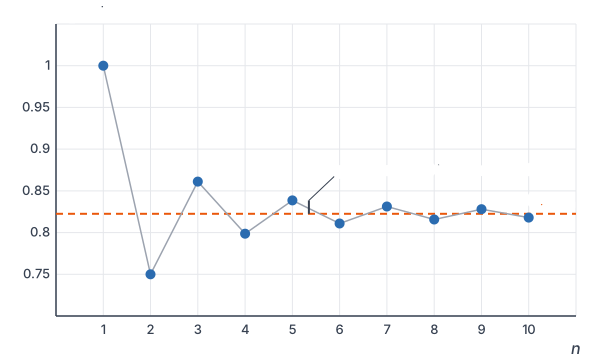
Alternating series error bound
Suppose S = \sum_{n=1}^{\infty} (-1)^{n+1} b_n where every b_n \gt 0, the b_n decrease, and \lim_{n \to \infty} b_n = 0. Then:
|S - S_n| \le b_{n+1}- S_n is the sum of the first n terms, and b_{n+1} is the size of the first term left out.
- The sign of S - S_n matches the sign of the first term left out. If that term is negative, S_n is too big; if it is positive, S_n is too small.
- This result is also called the alternating series estimation theorem.
How to use the error bound
- Check the conditions: the terms alternate, b_n decreases, and b_n \to 0.
- To bound the error of S_n, find the first omitted term, b_{n+1}.
- To reach an error below a target E, find the first b_k with b_k \le E. Then add every term before it.
Alternating series error bound examples
Example 1: Bound the error of a partial sum
Estimate S = \sum_{n=1}^{\infty} \dfrac{(-1)^{n+1}}{n^2} with S_5, and bound the error.
b_n = \dfrac{1}{n^2}bₙ is positive, decreases and goes to 0, so the bound applies.
S_5 = 1 - \dfrac{1}{4} + \dfrac{1}{9} - \dfrac{1}{16} + \dfrac{1}{25}Add the first five terms.
1 - 0.25 + 0.111111 - 0.0625 + 0.04 \approx 0.838611
Convert to decimals and combine.
|S - S_5| \le b_6 = \dfrac{1}{36} \approx 0.0278The first term left out is −1/36.
0.838611 - 0.0278 \le S \le 0.838611
That term is negative, so S₅ is too big.
Answer: S ≈ 0.8386 with error at most 0.0278, and the sum is between about 0.8108 and 0.8386. (The exact sum is π²/12 ≈ 0.8225, which fits.)
Example 2: How many terms are needed?
How many terms of \sum_{n=1}^{\infty} \dfrac{(-1)^{n+1}}{n} guarantee an error of at most 0.01?
b_{n+1} = \dfrac{1}{n + 1} \le 0.01The first omitted term must be at most 0.01.
n + 1 \ge 100
Take reciprocals of both sides; the inequality flips.
n \ge 99
Subtract 1 from both sides.
Answer: 99 terms. This series converges very slowly; its sum is ln 2 ≈ 0.693.
Example 3: A series with factorials
The series \sum_{n=0}^{\infty} \dfrac{(-1)^n}{n!} = 1 - 1 + \dfrac{1}{2!} - \dfrac{1}{3!} + \cdots equals \dfrac{1}{e}. Estimate 1/e with an error less than 0.001.
b_6 = \dfrac{1}{6!} = \dfrac{1}{720} \approx 0.00139Too big: 0.00139 > 0.001.
b_7 = \dfrac{1}{7!} = \dfrac{1}{5040} \approx 0.000198Small enough, so b₇ is the first term to leave out.
1 - 1 + \dfrac{1}{2} - \dfrac{1}{6} + \dfrac{1}{24} - \dfrac{1}{120} + \dfrac{1}{720}Add the terms for n = 0 through 6 (2! = 2, 3! = 6, 4! = 24, 5! = 120, 6! = 720).
\dfrac{1}{2} - \dfrac{1}{6} + \dfrac{1}{24} - \dfrac{1}{120} + \dfrac{1}{720} = \dfrac{265}{720}The first two terms cancel. Use the common denominator 720: 360 − 120 + 30 − 6 + 1 = 265.
\dfrac{265}{720} = \dfrac{53}{144} \approx 0.368056Simplify and divide.
Answer: 1/e ≈ 0.36806 with error less than 0.000198. (The true value is 0.36788.)
Example 4: The error of a Taylor polynomial
In the Taylor polynomials lesson, \sin 0.5 \approx 0.5 - \frac{0.5^3}{3!} + \frac{0.5^5}{5!} \approx 0.4794271. The Maclaurin series of sin x continues - \frac{x^7}{7!} + \frac{x^9}{9!} - \cdots. Bound the error.
\dfrac{0.5^7}{7!} = \dfrac{0.0078125}{5040}At x = 0.5 the series alternates and its terms decrease, so the next term bounds the error. 0.5⁷ = 0.0078125.
\dfrac{0.0078125}{5040} \approx 0.00000155Divide.
Answer: the error is less than 0.00000155, so sin 0.5 ≈ 0.479427 is correct to five decimal places. The next term is negative, so the estimate is a little too big. (The true value is 0.4794255.)
Example 5: A calculator chip (word problem)
A chip computes ln 1.5 with the alternating series 0.5 - \dfrac{0.5^2}{2} + \dfrac{0.5^3}{3} - \cdots, whose terms are b_n = \dfrac{0.5^n}{n}. How many terms does it need for an error of at most 0.0005, and what is the estimate?
b_7 = \dfrac{0.5^7}{7} = \dfrac{0.0078125}{7} \approx 0.00112Compute terms until one is at most 0.0005. This one is too big.
b_8 = \dfrac{0.5^8}{8} = \dfrac{0.00390625}{8} \approx 0.000488Small enough: leave out b₈ and keep the 7 terms before it.
S_7 = 0.5 - 0.125 + 0.0416667 - 0.015625 + 0.00625 - 0.0026042 + 0.0011161
Write the first 7 terms as decimals.
S_7 \approx 0.4058036
Combine.
Answer: 7 terms, giving ln 1.5 ≈ 0.4058 with error at most 0.000488. (The true value is 0.4055.)
Common mistakes
| Mistake | Example of the error | Fix |
|---|---|---|
| Using the last term kept | Bounding the error of S₅ by b₅ = 1/25 | Use the first term left out: b₆ = 1/36. |
| Using it on a series that does not alternate | “The error of S₅ for \sum \frac{1}{n^2} is at most 1/36” | For positive series the error is the whole tail, which is bigger than the next term. Use another method. |
| Skipping the conditions | Using the bound when b_n does not decrease or does not go to 0 | Check all the alternating series test conditions first. |
| Miscounting terms that start at n = 0 | Saying “6 terms” for n = 0 through 6 | n = 0 through 6 is 7 terms. Count carefully. |
| Thinking the error equals the next term | “The error is exactly 1/36” | The next term is an upper bound. The real error is smaller. |
| Rounding the bound down | Calling 0.000198 “about 0.0001” | Round a bound up, or keep enough digits. |
Related methods
Lagrange error bound
When a Taylor series does not alternate, such as the series for e^x at x = 0.5, the next term does not bound the error. Then use the Lagrange error bound, the next lesson.
Bounding the error of a positive series
For a positive series that passes the integral test, the error of S_n is less than \int_n^{\infty} f(x)\,dx. This uses an integral instead of a single term.
Practice problems
- Estimate \sum_{n=1}^{\infty} \dfrac{(-1)^{n+1}}{n^3} with S_4, and bound the error.
- How many terms of \sum_{n=1}^{\infty} \dfrac{(-1)^{n+1}}{n^2} guarantee an error of at most 0.001?
- How many terms of \sum_{n=0}^{\infty} \dfrac{(-1)^n}{2n + 1} guarantee an error of at most 0.005?
- Estimate \sum_{n=1}^{\infty} \dfrac{(-1)^{n+1}}{n \cdot 3^n} with S_3, and bound the error.
- Is S_5 of \sum_{n=1}^{\infty} \dfrac{(-1)^{n+1}}{n^2} larger or smaller than the sum S? Explain.
- Use 1 - \dfrac{x^2}{2} + \dfrac{x^4}{24} to estimate cos 0.4, and bound the error. The series continues - \frac{x^6}{720} + \cdots.
- The series \sum_{n=0}^{\infty} \dfrac{(-0.5)^n}{n!} equals e^{-0.5}. How many terms guarantee an error of at most 0.0001?
- Use S_4 and S_5 to give an interval that contains the sum of \sum_{n=1}^{\infty} \dfrac{(-1)^{n+1}}{n^2}.
- Can you use the error bound on \sum_{n=1}^{\infty} (-1)^{n+1} \dfrac{n}{n + 1}? Explain.
- A student uses 12\left(1 - \frac{1}{4} + \frac{1}{9} - \frac{1}{16} + \frac{1}{25} - \frac{1}{36}\right) to estimate π², since \sum \frac{(-1)^{n+1}}{n^2} = \frac{\pi^2}{12}. Find the estimate and bound its error.
Show answers
1.
S_4 = 1 - \dfrac{1}{8} + \dfrac{1}{27} - \dfrac{1}{64}Add the first four terms; bₙ = 1/n³ decreases to 0.
1 - 0.125 + 0.037037 - 0.015625 \approx 0.896412
Convert to decimals and combine.
|S - S_4| \le b_5 = \dfrac{1}{125} = 0.008The first term left out is 1/125.
Answer: S ≈ 0.8964 with error at most 0.008
2.
\dfrac{1}{(n + 1)^2} \le 0.001The first omitted term must be at most 0.001.
(n + 1)^2 \ge 1000
Take reciprocals; the inequality flips.
n + 1 \ge \sqrt{1000} \approx 31.62Take the square root of both sides.
n + 1 \ge 32
n + 1 is a whole number.
Answer: n = 31 terms
3.
\dfrac{1}{2(N + 1) + 1} = \dfrac{1}{2N + 3} \le 0.005Using terms n = 0 to N, the first omitted term is n = N + 1.
2N + 3 \ge 200
Take reciprocals; the inequality flips.
N \ge 98.5, \text{ so } N = 99Subtract 3, divide by 2, and round up.
Answer: n = 0 through 99, which is 100 terms
4.
S_3 = \dfrac{1}{3} - \dfrac{1}{18} + \dfrac{1}{81}Terms: 1/(1 · 3), 1/(2 · 9), 1/(3 · 27).
0.333333 - 0.055556 + 0.012346 \approx 0.290123
Convert to decimals and combine.
|S - S_3| \le b_4 = \dfrac{1}{4 \cdot 81} = \dfrac{1}{324} \approx 0.00309The first term left out is 1/(4 · 3⁴).
Answer: S ≈ 0.2901 with error at most 0.00309
5.
-\dfrac{1}{36}The first term left out after S₅ is −1/36, which is negative.
S - S_5 \lt 0
S − S₅ has the same sign as that term.
Answer: S₅ is larger than S (it overestimates)
6.
1 - \dfrac{0.16}{2} + \dfrac{0.0256}{24}Substitute x = 0.4: 0.4² = 0.16 and 0.4⁴ = 0.0256.
1 - 0.08 + 0.0010667 \approx 0.9210667
Divide, then combine.
\dfrac{0.4^6}{720} = \dfrac{0.004096}{720} \approx 0.0000057The terms alternate and decrease, so the next term bounds the error.
Answer: cos 0.4 ≈ 0.921067 with error less than 0.0000057
7.
b_5 = \dfrac{0.5^5}{5!} = \dfrac{0.03125}{120} \approx 0.00026Compute terms until one is at most 0.0001. Too big.
b_6 = \dfrac{0.5^6}{6!} = \dfrac{0.015625}{720} \approx 0.0000217Small enough: leave out the n = 6 term.
Answer: keep n = 0 through 5, which is 6 terms
8.
S_4 = 1 - \dfrac{1}{4} + \dfrac{1}{9} - \dfrac{1}{16} \approx 0.798611Add four terms.
S_5 = S_4 + \dfrac{1}{25} \approx 0.838611Add the fifth term.
Answer: 0.7986 < S < 0.8386
9.
\lim_{n \to \infty} \dfrac{n}{n + 1} = 1The terms do not go to 0.
Answer: no. The conditions fail; in fact the series diverges by the divergence test, so there is no sum to estimate
10.
1 - 0.25 + 0.111111 - 0.0625 + 0.04 - 0.027778 \approx 0.810833
Add the six terms as decimals.
12(0.810833) \approx 9.73
Multiply by 12.
12 \cdot \dfrac{1}{49} \approx 0.245The first term left out is 1/49, and the factor of 12 scales the error too.
Answer: π² ≈ 9.73 with error at most 0.245 (the true value is 9.8696)
Alternating series error bound FAQ
What is the alternating series estimation theorem?
If an alternating series passes the alternating series test, the error from stopping after n terms is at most the first term left out: |S - S_n| \le b_{n+1}.
How do you find how many terms you need?
Set the first omitted term less than or equal to the allowed error, b_{n+1} \le E, and solve for n. For factorial terms, list the terms until one is small enough.
Is the partial sum bigger or smaller than the actual sum?
Look at the first term left out. If it is negative, the partial sum is too big. If it is positive, the partial sum is too small.
When can’t you use the alternating series error bound?
You can’t use it when the signs don’t alternate, or when the terms don’t decrease to 0. For a Taylor polynomial that doesn’t alternate, use the Lagrange error bound.
Summary
- For an alternating series with b_n decreasing to 0, |S - S_n| \le b_{n+1}.
- The bound is the first term left out, not the last term kept.
- The sign of the first omitted term tells whether S_n is too big or too small.
- The sum is always between two consecutive partial sums.
- It also bounds the error of alternating Taylor polynomials, like those for sin x and cos x.
Previous lesson: Taylor Polynomials
Next lesson: Lagrange Error Bound
Back to the Calculus 2 Index