
Root Test
The root test decides whether a series converges by taking the nth root of the size of each term. Find L = \lim_{n \to \infty} \sqrt[n]{|a_n|}. If L < 1, the series converges absolutely. If L > 1 (or L = ∞), it diverges. If L = 1, the test gives no answer.
Before this lesson: Ratio Test, Absolute and Conditional Convergence, Rational Exponents and The Number e
Why the nth root of a term matters
In a geometric series with terms r^n, the nth root of each term is just |r|, and the series converges exactly when |r| < 1. The root test asks whether a series acts like a geometric series in the long run.
If the nth roots of the terms settle at a number L below 1, the terms eventually shrink at least as fast as c^n for some c between L and 1. So the series converges. If L is above 1, the terms eventually grow, so they cannot approach 0 and the series diverges.
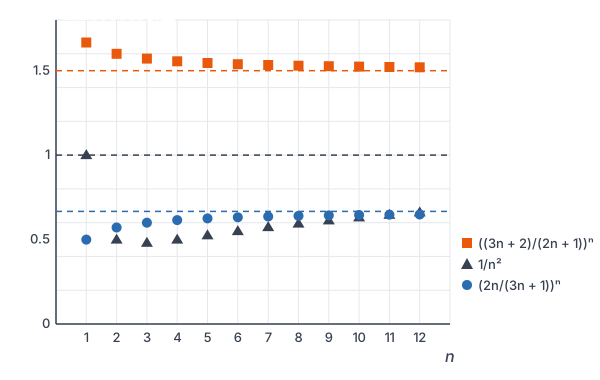
The root test
L = \lim_{n \to \infty} \sqrt[n]{|a_n|} = \lim_{n \to \infty} |a_n|^{1/n}- If L < 1, then \sum a_n converges absolutely (and so it converges).
- If L > 1 or L = ∞, then \sum a_n diverges.
- If L = 1, the test is inconclusive. Use a different test.
The root test works best when the whole term is raised to the nth power, like \left(\frac{2n}{3n + 1}\right)^n, because the nth root undoes that power: \sqrt[n]{b^n} = b for b ≥ 0.
Three limits you will need
- \lim_{n \to \infty} \sqrt[n]{c} = 1 for any constant c > 0.
- \lim_{n \to \infty} \sqrt[n]{n} = 1. Take the natural log: \ln \sqrt[n]{n} = \frac{\ln n}{n}, which goes to 0 by L’Hôpital’s rule, and e^0 = 1.
- \lim_{n \to \infty} \left(1 + \frac{k}{n}\right)^n = e^k. In particular, \left(1 + \frac{1}{n}\right)^n \to e, not 1.
How to use the root test
- Take the absolute value of a_n.
- Take the nth root. A power of n in the exponent cancels with the root.
- Find the limit L, using the three limits above.
- Compare L with 1.
Root test examples
Example 1: A fraction raised to the nth power
Does \sum_{n=1}^{\infty} \left(\dfrac{2n}{3n + 1}\right)^n converge?
\sqrt[n]{|a_n|} = \sqrt[n]{\left(\dfrac{2n}{3n + 1}\right)^n}The terms are positive, so |aₙ| = aₙ.
\sqrt[n]{\left(\dfrac{2n}{3n + 1}\right)^n} = \dfrac{2n}{3n + 1}The nth root undoes the nth power (see rational exponents).
L = \lim_{n \to \infty} \dfrac{2n}{3n + 1} = \lim_{n \to \infty} \dfrac{2}{3 + \frac{1}{n}}Divide the top and bottom by n (see limits at infinity).
\lim_{n \to \infty} \dfrac{2}{3 + \frac{1}{n}} = \dfrac{2}{3}1/n goes to 0.
\dfrac{2}{3} \lt 1Compare L with 1.
Answer: the series converges absolutely. Far out, its terms behave like \left(\frac{2}{3}\right)^n.
Example 2: Using the limit of the nth root of n
Does \sum_{n=1}^{\infty} \dfrac{n^3}{2^n} converge?
\sqrt[n]{\dfrac{n^3}{2^n}} = \dfrac{\sqrt[n]{n^3}}{\sqrt[n]{2^n}}Take the nth root of the top and the bottom.
\dfrac{\sqrt[n]{n^3}}{\sqrt[n]{2^n}} = \dfrac{\left(\sqrt[n]{n}\right)^3}{2}ⁿ√(n³) = (ⁿ√n)³ and ⁿ√(2ⁿ) = 2.
L = \dfrac{1^3}{2} = \dfrac{1}{2}ⁿ√n goes to 1.
\dfrac{1}{2} \lt 1Compare L with 1.
Answer: the series converges absolutely. (Its sum is exactly 26.)
Example 3: A limit that involves e
Does \sum_{n=1}^{\infty} \dfrac{3^n}{\left(1 + \frac{1}{n}\right)^{n^2}} converge?
\sqrt[n]{\dfrac{3^n}{\left(1 + \frac{1}{n}\right)^{n^2}}} = \dfrac{3}{\left(1 + \frac{1}{n}\right)^{n}}Divide each exponent by n: n ÷ n = 1 and n² ÷ n = n.
L = \dfrac{3}{e}(1 + 1/n)ⁿ goes to e (see the number e).
\dfrac{3}{e} \approx 1.10 \gt 1e ≈ 2.718, so 3/e is a bit more than 1.
Answer: the series diverges. Its terms grow without bound (1.5, about 1.78, about 2.03, …), so they cannot approach 0.
Example 4: When the root test fails
Apply the root test to \sum_{n=1}^{\infty} \left(1 - \dfrac{1}{n}\right)^n. Then decide whether the series converges.
\sqrt[n]{\left(1 - \dfrac{1}{n}\right)^n} = 1 - \dfrac{1}{n}The terms are at least 0, and the nth root undoes the nth power.
L = \lim_{n \to \infty} \left(1 - \dfrac{1}{n}\right) = 1The root test is inconclusive.
\lim_{n \to \infty} \left(1 - \dfrac{1}{n}\right)^n = e^{-1}Use the third limit with k = −1.
e^{-1} \approx 0.368 \ne 0The terms do not approach 0, so the series fails the divergence test.
Answer: the root test gives no answer, but the series diverges by the divergence test.
Example 5: Total time for a program (word problem)
A file-compression program makes pass after pass over a file. Pass n takes 60\left(\dfrac{n + 1}{3n}\right)^n seconds. Is the total time over all passes finite?
a_n = 60\left(\dfrac{n + 1}{3n}\right)^nWrite the term. The terms are positive.
\sqrt[n]{a_n} = \sqrt[n]{60} \cdot \dfrac{n + 1}{3n}Take the nth root of each factor.
L = 1 \cdot \lim_{n \to \infty} \dfrac{1 + \frac{1}{n}}{3} = \dfrac{1}{3}ⁿ√60 goes to 1; divide the top and bottom of (n + 1)/(3n) by n.
\dfrac{1}{3} \lt 1Compare L with 1.
Answer: yes, the total time is finite. The first passes take 40, 15 and about 5.3 seconds, and the total levels off at about 63 seconds.
Common mistakes
| Mistake | Example of the error | Fix |
|---|---|---|
| Deciding anything when L = 1 | “L = 1 for \sum 1/n^2, so it diverges” | L = 1 gives no answer. Use another test; here the p-series test shows convergence. |
| Taking the root of only part of the term | \sqrt[n]{\frac{n^3}{2^n}} = \frac{n^3}{2} | Take the root of every factor: \frac{(\sqrt[n]{n})^3}{2}. |
| Thinking ⁿ√n grows without bound | “\sqrt[n]{n} \to \infty, so L = ∞” | \sqrt[n]{n} \to 1, because (ln n)/n goes to 0. |
| Treating (1 + 1/n)ⁿ as 1 | “1^{\infty} = 1, so L = 3 in Example 3” | \left(1 + \frac{1}{n}\right)^n \to e. The form 1^{\infty} is an indeterminate form. |
| Forgetting the absolute value | Taking the nth root of (-1)^n \left(\frac{1}{2}\right)^n as −1/2 | Use |aₙ|. The sign never affects L. |
| Using it on factorials | Trying to find \sqrt[n]{n!} by hand | Use the ratio test when the term has factorials. |
Related methods
Root test or ratio test?
Both tests compare a series with a geometric series, and when both limits exist they give the same L. Use the root test when the whole term is raised to the nth power. Use the ratio test when the term has factorials, since \sqrt[n]{n!} is hard to find directly.
The root test is a little stronger: whenever the ratio test gives an answer, the root test gives the same answer, but not the other way around. In practice, pick whichever is easier to compute.
Geometric series as a special case
For \sum ar^n with a ≠ 0, the root test gives L = \lim \sqrt[n]{|a|} \cdot |r| = |r|. This matches the infinite geometric series rule: converge when |r| < 1, diverge when |r| > 1. When |r| = 1 the root test is silent, but the series diverges because its terms do not go to 0.
Practice problems
- Does \sum_{n=1}^{\infty} \left(\dfrac{n + 4}{2n + 1}\right)^n converge?
- Does \sum_{n=1}^{\infty} \dfrac{7^n}{n^n} converge?
- Does \sum_{n=1}^{\infty} \dfrac{n^2}{5^n} converge?
- Does \sum_{n=1}^{\infty} \left(\dfrac{3n}{n + 2}\right)^n converge?
- Does \sum_{n=1}^{\infty} (-1)^n \left(\dfrac{4n - 1}{5n + 2}\right)^n converge? If so, how?
- Does \sum_{n=1}^{\infty} \left(1 + \dfrac{2}{n}\right)^{-n^2} converge?
- Does \sum_{n=1}^{\infty} \dfrac{n^n}{3^{n^2}} converge?
- Does \sum_{n=1}^{\infty} \left(\dfrac{n}{n + 1}\right)^{n^2} converge?
- What does the root test say about \sum_{n=1}^{\infty} \dfrac{1}{\sqrt{n}}? Does the series converge?
- In a drug study, the amount of a medicine released on day n is 500\left(\dfrac{2n}{5n + 1}\right)^n milligrams. Is the total amount released finite? About how much is it?
Show answers
1.
\sqrt[n]{\left(\dfrac{n + 4}{2n + 1}\right)^n} = \dfrac{n + 4}{2n + 1}The nth root undoes the nth power.
L = \lim_{n \to \infty} \dfrac{1 + \frac{4}{n}}{2 + \frac{1}{n}} = \dfrac{1}{2}Divide the top and bottom by n.
Answer: L = 1/2 < 1, so it converges absolutely
2.
\sqrt[n]{\dfrac{7^n}{n^n}} = \dfrac{7}{n}The top and the bottom are both nth powers.
L = \lim_{n \to \infty} \dfrac{7}{n} = 0Take the limit.
Answer: L = 0 < 1, so it converges absolutely
3.
\sqrt[n]{\dfrac{n^2}{5^n}} = \dfrac{\left(\sqrt[n]{n}\right)^2}{5}Take the nth root of the top and the bottom.
L = \dfrac{1^2}{5} = \dfrac{1}{5}ⁿ√n goes to 1.
Answer: L = 1/5 < 1, so it converges absolutely
4.
\sqrt[n]{\left(\dfrac{3n}{n + 2}\right)^n} = \dfrac{3n}{n + 2}The nth root undoes the nth power.
L = \lim_{n \to \infty} \dfrac{3}{1 + \frac{2}{n}} = 3Divide the top and bottom by n.
Answer: L = 3 > 1, so it diverges
5.
\sqrt[n]{|a_n|} = \dfrac{4n - 1}{5n + 2}Take the absolute value: |(−1)ⁿ| = 1. Then the nth root undoes the nth power.
L = \lim_{n \to \infty} \dfrac{4 - \frac{1}{n}}{5 + \frac{2}{n}} = \dfrac{4}{5}Divide the top and bottom by n.
Answer: L = 4/5 < 1, so it converges absolutely
6.
\sqrt[n]{\left(1 + \dfrac{2}{n}\right)^{-n^2}} = \left(1 + \dfrac{2}{n}\right)^{-n}Divide the exponent by n: −n² ÷ n = −n.
\left(1 + \dfrac{2}{n}\right)^{-n} = \dfrac{1}{\left(1 + \frac{2}{n}\right)^{n}}Rewrite the negative exponent.
L = \dfrac{1}{e^2} \approx 0.135(1 + 2/n)ⁿ goes to e².
Answer: L = 1/e² < 1, so it converges absolutely
7.
\sqrt[n]{\dfrac{n^n}{3^{n^2}}} = \dfrac{n}{3^n}Divide each exponent by n: n² ÷ n = n.
L = \lim_{n \to \infty} \dfrac{n}{3^n} = 0Exponentials grow faster than powers of n.
Answer: L = 0 < 1, so it converges absolutely
8.
\sqrt[n]{\left(\dfrac{n}{n + 1}\right)^{n^2}} = \left(\dfrac{n}{n + 1}\right)^{n}Divide the exponent by n.
\left(\dfrac{n}{n + 1}\right)^{n} = \dfrac{1}{\left(1 + \frac{1}{n}\right)^{n}}Flip the fraction inside: (n + 1)/n = 1 + 1/n.
L = \dfrac{1}{e} \approx 0.368(1 + 1/n)ⁿ goes to e.
Answer: L = 1/e < 1, so it converges absolutely
9.
\sqrt[n]{\dfrac{1}{\sqrt{n}}} = \dfrac{1}{\left(\sqrt[n]{n}\right)^{1/2}}Write 1/√n as n to the power −1/2, then take the nth root.
L = \dfrac{1}{1^{1/2}} = 1ⁿ√n goes to 1, so the root test is inconclusive.
\sum_{n=1}^{\infty} \dfrac{1}{n^{1/2}} \text{ is a p-series with } p = \tfrac{1}{2}p ≤ 1, so the p-series diverges.
Answer: the root test gives no answer; the series diverges as a p-series with p = 1/2
10.
\sqrt[n]{500\left(\dfrac{2n}{5n + 1}\right)^n} = \sqrt[n]{500} \cdot \dfrac{2n}{5n + 1}Take the nth root of each factor.
L = 1 \cdot \dfrac{2}{5} = \dfrac{2}{5}ⁿ√500 goes to 1, and 2n/(5n + 1) goes to 2/5.
\dfrac{2}{5} \lt 1So the total converges.
\sum_{n=1}^{\infty} 500\left(\dfrac{2n}{5n + 1}\right)^n \approx 276.7Add terms with a calculator or computer until they are tiny: 166.7 + 66.1 + 26.4 + 10.5 + ⋯.
Answer: yes, the total is finite: about 277 mg
Root test FAQ
What is the root test for series?
Find L, the limit of the nth root of |aₙ|. If L < 1, the series converges absolutely; if L > 1, it diverges; if L = 1, the test gives no answer.
When should I use the root test instead of the ratio test?
Use the root test when the whole term is raised to the nth power, such as \left(\frac{n}{2n + 1}\right)^n or \frac{5^n}{n^n}. Use the ratio test when the term has factorials.
What is the limit of the nth root of n?
It is 1. The natural log of \sqrt[n]{n} is (ln n)/n, which goes to 0, so \sqrt[n]{n} goes to e^0 = 1.
Can the root test show conditional convergence?
No. It looks at |aₙ|, so when L < 1 it shows absolute convergence. For a conditionally convergent series, L is 1 or the limit does not exist.
Summary
- Find L = lim ⁿ√|aₙ|.
- L < 1: converges absolutely. L > 1 or ∞: diverges. L = 1: no answer.
- Use ⁿ√c → 1, ⁿ√n → 1 and (1 + k/n)ⁿ → eᵏ.
- Best when the whole term is raised to the nth power; use the ratio test for factorials.
- It matches the geometric series rule: for Σarⁿ, L = |r|.
Previous lesson: Ratio Test
Next lesson: Choosing a Convergence Test
Back to the Calculus 2 Index