
Power Series
A power series is an infinite series of the form \sum_{n=0}^{\infty} c_n(x - a)^n = c_0 + c_1(x - a) + c_2(x - a)^2 + \cdots, like a polynomial that never ends. Many functions equal a power series; for example, \frac{1}{1 - x} = 1 + x + x^2 + \cdots when |x| < 1.
Before this lesson: Infinite Geometric Series, Taylor Polynomials and Ratio Test
A polynomial that never ends
A Taylor polynomial stops at some degree. A power series keeps going. Its partial sums are polynomials, and for some values of x those polynomials settle down to a single number. For other x values they grow without bound.
So a power series is really a function of x, but its domain is only the set of x values where the series converges. Inside that set, the series can equal a familiar function exactly.
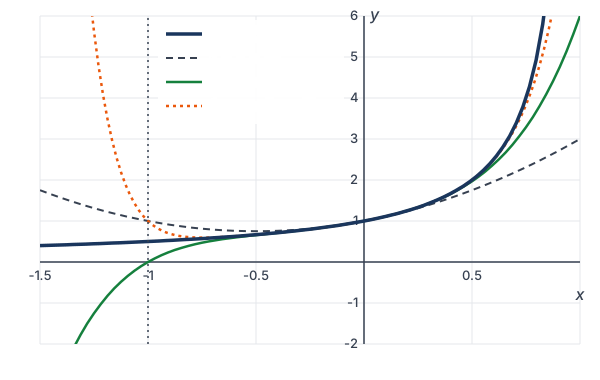
Power series definition
\sum_{n=0}^{\infty} c_n(x - a)^n = c_0 + c_1(x - a) + c_2(x - a)^2 + c_3(x - a)^3 + \cdots- The numbers c_n are the coefficients, and a is the center.
- Every power series converges at its center, x = a, where every term after c_0 is 0.
- A power series centered at a = 0 is \sum c_n x^n.
- The set of x values where it converges is its interval of convergence, the topic of the next lesson.
The key power series: a geometric series
The infinite geometric series rule, with ratio x, gives the most useful power series of all:
\dfrac{1}{1 - x} = \sum_{n=0}^{\infty} x^n = 1 + x + x^2 + x^3 + \cdots, \quad |x| \lt 1You can build many more power series from this one. Replace x with another expression, such as −x, x² or x/3, or multiply the whole series by x. The interval changes to match.
How to write a function as a power series
- Rewrite the function in the form \dfrac{\text{constant}}{1 - (\text{something})}.
- Replace x in \sum x^n with that something, and multiply by the constant.
- Simplify the general term.
- Find where |something| < 1. That is where the series is valid.
Power series examples
Example 1: Find the sum of a power series
Where does \sum_{n=0}^{\infty} \dfrac{x^n}{2^n} converge, and what function does it equal there?
\sum_{n=0}^{\infty} \dfrac{x^n}{2^n} = \sum_{n=0}^{\infty} \left(\dfrac{x}{2}\right)^nWrite the term as one power (see exponent rules). It is geometric with ratio x/2.
\left|\dfrac{x}{2}\right| \lt 1A geometric series converges when |ratio| < 1.
|x| \lt 2
Multiply both sides by 2.
\sum_{n=0}^{\infty} \left(\dfrac{x}{2}\right)^n = \dfrac{1}{1 - \frac{x}{2}}Use first term ÷ (1 − ratio), with first term 1.
\dfrac{1}{1 - \frac{x}{2}} = \dfrac{2}{2 - x}Multiply the top and bottom by 2.
Answer: it converges for −2 < x < 2, where it equals \frac{2}{2 - x}. For example, at x = 1 the series is 1 + 1/2 + 1/4 + ⋯ = 2.
Example 2: Replace x with −x
Find a power series for \dfrac{1}{1 + x}.
\dfrac{1}{1 + x} = \dfrac{1}{1 - (-x)}Write it in the form 1/(1 − something).
\dfrac{1}{1 - (-x)} = \sum_{n=0}^{\infty} (-x)^nReplace x with −x in the geometric series.
\sum_{n=0}^{\infty} (-x)^n = \sum_{n=0}^{\infty} (-1)^n x^n(−x)ⁿ = (−1)ⁿxⁿ.
|-x| \lt 1 \quad \Leftrightarrow \quad |x| \lt 1
Find where |something| < 1.
Answer: \frac{1}{1 + x} = 1 - x + x^2 - x^3 + \cdots for −1 < x < 1.
Example 3: Replace x with a power of x
Find a power series for \dfrac{1}{1 + x^2}.
\dfrac{1}{1 + x^2} = \dfrac{1}{1 - (-x^2)}Write it in the form 1/(1 − something).
\dfrac{1}{1 - (-x^2)} = \sum_{n=0}^{\infty} (-x^2)^nReplace x with −x².
\sum_{n=0}^{\infty} (-x^2)^n = \sum_{n=0}^{\infty} (-1)^n x^{2n}(x²)ⁿ = x²ⁿ.
|-x^2| \lt 1 \quad \Leftrightarrow \quad |x| \lt 1
x² < 1 exactly when |x| < 1.
Answer: \frac{1}{1 + x^2} = 1 - x^2 + x^4 - x^6 + \cdots for −1 < x < 1. Integrating this series term by term later gives a series for arctan x.
Example 4: Factor out a constant first
Find a power series for \dfrac{x}{3 - x}.
\dfrac{1}{3 - x} = \dfrac{1}{3\left(1 - \frac{x}{3}\right)}Factor 3 out of the bottom so it starts with 1 (see factoring out the GCF).
\dfrac{1}{3} \cdot \dfrac{1}{1 - \frac{x}{3}} = \dfrac{1}{3}\sum_{n=0}^{\infty} \left(\dfrac{x}{3}\right)^nReplace x with x/3.
\dfrac{1}{3}\sum_{n=0}^{\infty} \dfrac{x^n}{3^n} = \sum_{n=0}^{\infty} \dfrac{x^n}{3^{n+1}}Move 1/3 inside: 3 · 3ⁿ = 3ⁿ⁺¹.
\dfrac{x}{3 - x} = \sum_{n=0}^{\infty} \dfrac{x^{n+1}}{3^{n+1}}Multiply every term by x.
\left|\dfrac{x}{3}\right| \lt 1 \quad \Leftrightarrow \quad |x| \lt 3Multiplying by x does not change where it converges.
Answer: \frac{x}{3 - x} = \frac{x}{3} + \frac{x^2}{9} + \frac{x^3}{27} + \cdots for −3 < x < 3.
Example 5: Present value of payments (word problem)
A contract pays $1,000 at the end of every year forever. With an interest rate r, a payment n years away is worth 1000x^n today, where x = \frac{1}{1 + r}. So the total value today is 1000(x + x^2 + x^3 + \cdots). Find a closed form, and find the value when r = 5%.
x + x^2 + x^3 + \cdots = x(1 + x + x^2 + \cdots)
Factor out x.
x(1 + x + x^2 + \cdots) = \dfrac{x}{1 - x}Use the geometric series; 0 < x < 1 because r > 0.
x = \dfrac{1}{1.05}, \; 1 - x = \dfrac{0.05}{1.05}Put in r = 0.05.
\dfrac{x}{1 - x} = \dfrac{1}{1.05} \cdot \dfrac{1.05}{0.05} = 20Dividing by a fraction means multiplying by its reciprocal.
1000 \cdot 20 = 20{,}000Multiply by the payment.
Answer: the value today is \frac{1000x}{1 - x}, which equals $20,000 at 5% interest.
Common mistakes
| Mistake | Example of the error | Fix |
|---|---|---|
| Forgetting where the series is valid | “\frac{1}{1 - x} = 1 + x + x^2 + \cdots for every x” | It holds only for |x| < 1. At x = 2 the left side is −1 but the series diverges. |
| Losing the minus sign | Writing \frac{1}{1 + x} = \sum x^n | Write 1 + x as 1 − (−x): the series is \sum (-1)^n x^n. |
| Not factoring out the constant | Writing \frac{1}{3 - x} = \sum \left(\frac{x}{3}\right)^n | First write \frac{1}{3 - x} = \frac{1}{3} \cdot \frac{1}{1 - x/3}, so the series is \sum \frac{x^n}{3^{n+1}}. |
| Shifting the power wrong | x \sum x^n = \sum x^{2n} | Multiplying by x adds 1 to each exponent: \sum x^{n+1}. |
| Thinking the interval changes when you multiply by x | Saying x \sum x^n converges for a different set of x | Multiplying every term by x does not change where it converges. |
| Squaring the ratio wrong | For \frac{1}{1 - 4x^2}, using |x| < 4 | Solve 4x² < 1 to get |x| < 1/2. |
Related methods
Taylor series
The geometric series trick works only for functions that can be written as \frac{c}{1 - (\text{something})}. For other functions, like e^x or \sin x, you build the power series from derivatives, as in the Taylor polynomials lesson but with no last term. That is a Taylor series, coming up in this unit.
Finding the interval with the ratio test
When a power series is not geometric, use the ratio test with x left as a variable. Setting the limit less than 1 gives the interval where the series converges. The next lesson shows how.
Practice problems
- Find a power series for \dfrac{1}{1 - 2x} and where it is valid.
- Find a power series for \dfrac{1}{1 + 4x^2} and where it is valid.
- Find a power series for \dfrac{1}{5 - x} and where it is valid.
- Find a power series for \dfrac{x^2}{1 - x}.
- Find a power series for \dfrac{3}{2 + x} and where it is valid.
- Find the sum of \sum_{n=0}^{\infty} \dfrac{(x - 1)^n}{4^n} and the x values where it converges.
- Write \dfrac{1}{x} as a power series centered at a = 1.
- Use the series for \frac{1}{1 + x} to find the sum of 1 - 0.1 + 0.01 - 0.001 + \cdots.
- Write the first four terms of \sum_{n=0}^{\infty} \dfrac{(n + 1)x^n}{2^n}.
- A patient takes 50 mg of a drug every day. Each day, a fraction x of the drug in the body remains. After many days, the amount just after a dose is 50(1 + x + x^2 + \cdots). Write this in closed form and find it when x = 0.2.
Show answers
1.
\dfrac{1}{1 - 2x} = \sum_{n=0}^{\infty} (2x)^nReplace x with 2x.
\sum_{n=0}^{\infty} (2x)^n = \sum_{n=0}^{\infty} 2^n x^n(2x)ⁿ = 2ⁿxⁿ.
|2x| \lt 1 \quad \Leftrightarrow \quad |x| \lt \dfrac{1}{2}Divide both sides by 2.
Answer: \sum 2^n x^n for −1/2 < x < 1/2
2.
\dfrac{1}{1 + 4x^2} = \sum_{n=0}^{\infty} (-4x^2)^nReplace x with −4x².
\sum_{n=0}^{\infty} (-4x^2)^n = \sum_{n=0}^{\infty} (-1)^n 4^n x^{2n}(−4x²)ⁿ = (−1)ⁿ4ⁿx²ⁿ.
4x^2 \lt 1 \quad \Leftrightarrow \quad |x| \lt \dfrac{1}{2}x² < 1/4.
Answer: \sum (-1)^n 4^n x^{2n} for −1/2 < x < 1/2
3.
\dfrac{1}{5 - x} = \dfrac{1}{5} \cdot \dfrac{1}{1 - \frac{x}{5}}Factor 5 out of the bottom.
\dfrac{1}{5}\sum_{n=0}^{\infty} \left(\dfrac{x}{5}\right)^n = \sum_{n=0}^{\infty} \dfrac{x^n}{5^{n+1}}Replace x with x/5 and move 1/5 inside.
Answer: \sum \dfrac{x^n}{5^{n+1}} for −5 < x < 5
4.
\dfrac{x^2}{1 - x} = x^2\sum_{n=0}^{\infty} x^nFactor out x².
x^2\sum_{n=0}^{\infty} x^n = \sum_{n=0}^{\infty} x^{n+2}Add 2 to each exponent.
Answer: x^2 + x^3 + x^4 + \cdots for −1 < x < 1
5.
\dfrac{3}{2 + x} = \dfrac{3}{2} \cdot \dfrac{1}{1 - \left(-\frac{x}{2}\right)}Factor 2 out of the bottom; 1 + x/2 = 1 − (−x/2).
\dfrac{3}{2}\sum_{n=0}^{\infty} \left(-\dfrac{x}{2}\right)^n = \sum_{n=0}^{\infty} \dfrac{3(-1)^n x^n}{2^{n+1}}Replace x with −x/2 and move 3/2 inside.
Answer: \sum \dfrac{3(-1)^n x^n}{2^{n+1}} for −2 < x < 2
6.
\sum_{n=0}^{\infty} \left(\dfrac{x - 1}{4}\right)^n = \dfrac{1}{1 - \frac{x - 1}{4}}Geometric with ratio (x − 1)/4.
\dfrac{1}{1 - \frac{x - 1}{4}} = \dfrac{4}{4 - (x - 1)} = \dfrac{4}{5 - x}Multiply the top and bottom by 4.
|x - 1| \lt 4 \quad \Leftrightarrow \quad -3 \lt x \lt 5
Solve the absolute value inequality.
Answer: the sum is 4/(5 − x) for −3 < x < 5
7.
\dfrac{1}{x} = \dfrac{1}{1 + (x - 1)} = \dfrac{1}{1 - (-(x - 1))}Write x as 1 + (x − 1).
\dfrac{1}{1 - (-(x - 1))} = \sum_{n=0}^{\infty} (-1)^n (x - 1)^nReplace x with −(x − 1).
|x - 1| \lt 1 \quad \Leftrightarrow \quad 0 \lt x \lt 2
Solve the inequality.
Answer: \sum (-1)^n (x - 1)^n for 0 < x < 2
8.
1 - 0.1 + 0.01 - 0.001 + \cdots = \sum_{n=0}^{\infty} (-1)^n (0.1)^nThis is the series for 1/(1 + x) with x = 0.1, inside |x| < 1.
\dfrac{1}{1 + 0.1} = \dfrac{1}{1.1} = \dfrac{10}{11}Use the closed form.
Answer: 10/11 ≈ 0.90909
9.
n = 0, 1, 2, 3: \quad \dfrac{1}{1}, \; \dfrac{2x}{2}, \; \dfrac{3x^2}{4}, \; \dfrac{4x^3}{8}Put n = 0, 1, 2, 3 into the general term.
Answer: 1 + x + \dfrac{3}{4}x^2 + \dfrac{1}{2}x^3 + \cdots
10.
50(1 + x + x^2 + \cdots) = \dfrac{50}{1 - x}Geometric series; 0 < x < 1.
\dfrac{50}{1 - 0.2} = \dfrac{50}{0.8} = 62.5Put in x = 0.2.
Answer: 50/(1 − x), which is 62.5 mg when x = 0.2
Power series FAQ
What is a power series?
It is a series of the form \sum c_n (x - a)^n, like a polynomial with infinitely many terms. It defines a function on the x values where it converges.
What is the center of a power series?
The center is the number a in the powers (x - a)^n. Every power series converges at its center, and it usually converges on an interval around it.
Does a power series converge for every x?
Not always. Some converge for every x, some only at the center, and most on an interval around the center. The next lesson shows how to find that interval.
How do you write a function as a power series?
If the function looks like \frac{c}{1 - (\text{something})}, use the geometric series. Otherwise, build a Taylor series from the function’s derivatives.
Summary
- A power series is \sum c_n (x - a)^n, with coefficients c_n and center a.
- \frac{1}{1 - x} = \sum x^n for |x| < 1 is the starting point for many other series.
- Substitute −x, x² or x/c for x, or multiply by a power of x, to get new series.
- Factor the constant out first so the bottom starts with 1.
- Always state the x values where the series is valid.
Previous lesson: Lagrange Error Bound
Next lesson: Radius and Interval of Convergence
Back to the Calculus 2 Index