
Method of Frobenius
The method of Frobenius finds series solutions near a regular singular point, where an ordinary power series fails. Try y = xʳ Σ aₙxⁿ with a₀ ≠ 0. The lowest power of x gives the indicial equation for r, and the remaining powers give a recurrence relation for the coefficients. Each suitable root r gives one solution.
Before this lesson: Power Series Solutions, Cauchy-Euler Equations and Reduction of Order
Why a new method is needed
Near an ordinary point, y = Σ aₙxⁿ always works, as in power series solutions. At a singular point it can fail. For example, the Cauchy-Euler equation 2x²y″ + 3xy′ − y = 0 has the solutions x^(1/2) and x⁻¹, and neither one is a power series.
The fix is to allow a factor xʳ, where r can be a fraction or a negative number. Frobenius showed that this works whenever the singular point is not too badly behaved. Throughout, take x > 0 so that xʳ is defined.
Regular singular points and the indicial equation
Write the equation as y″ + P(x)y′ + Q(x)y = 0. A singular point x₀ is regular if (x − x₀)P(x) and (x − x₀)²Q(x) are both analytic at x₀. For rational functions, that means no factor of x − x₀ is left in their denominators. Otherwise the point is irregular, and the method may fail.
At a regular singular point x = 0, multiply through so the equation reads x²y″ + xp(x)y′ + q(x)y = 0, where p(x) = xP(x) and q(x) = x²Q(x). Let p₀ = p(0) and q₀ = q(0). Substituting the Frobenius series and keeping the lowest power of x gives:
y = x^r\sum_{n=0}^{\infty} a_nx^n = \sum_{n=0}^{\infty} a_nx^{n+r},\qquad r(r-1) + p_0r + q_0 = 0The roots r₁ ≥ r₂ of the indicial equation (real roots, in this lesson) decide what the second solution looks like:
| Indicial roots | Two independent solutions |
|---|---|
| r_1 - r_2 not an integer | Two Frobenius series, one for each root |
| r_1 = r_2 | y_1 = x^{r_1}\sum a_nx^n and y_2 = y_1\ln x + x^{r_1}\sum b_nx^n |
| r_1 - r_2 a positive integer | y_1 from r_1; y_2 = Cy_1\ln x + x^{r_2}\sum b_nx^n, where C may be 0 |
The ln x forms come from reduction of order. Each series converges at least out to the nearest other singular point.
How to use the method of Frobenius
- Check that x = 0 is a regular singular point, and find p₀ and q₀.
- Solve the indicial equation r(r − 1) + p₀r + q₀ = 0.
- Substitute y = Σ aₙxⁿ⁺ʳ, shift indices so every sum has xⁿ⁺ʳ, and write the recurrence relation.
- For the larger root r₁, compute the coefficients from a₀ = 1.
- If r₁ − r₂ is not an integer, repeat with r₂. Otherwise check the table: the second solution may need ln x.
Method of Frobenius examples
Example 1: Classifying singular points
Classify the singular points of x(x − 1)²y″ + y′ + y = 0.
P(x) = Q(x) = \dfrac{1}{x(x-1)^2}Divide by x(x − 1)²; the singular points are x = 0 and x = 1.
xP(x) = \dfrac{1}{(x-1)^2},\quad x^2Q(x) = \dfrac{x}{(x-1)^2}For x = 0, multiply P by x and Q by x².
\text{both are finite at } x = 0Their denominators are 1 at x = 0, so they are analytic there.
(x-1)P(x) = \dfrac{1}{x(x-1)}For x = 1, multiply P by x − 1.
\text{not finite at } x = 1A factor of x − 1 is still in the denominator.
Answer: x = 0 is a regular singular point, so the method of Frobenius works there. x = 1 is an irregular singular point.
Example 2: Roots that do not differ by an integer
Find two Frobenius series solutions of 2x²y″ − xy′ + (1 + x)y = 0 about x = 0, through the x³ term inside each series.
y' = \sum (n+r)a_nx^{n+r-1},\quad y'' = \sum (n+r)(n+r-1)a_nx^{n+r-2}Differentiate y = Σ aₙxⁿ⁺ʳ term by term; every sum starts at n = 0.
\sum \left[2(n+r)(n+r-1) - (n+r) + 1\right]a_nx^{n+r} + \sum a_nx^{n+r+1} = 0Substitute; 2x²y″, −xy′ and y all give xⁿ⁺ʳ.
\sum_{n=0}^{\infty} a_nx^{n+r+1} = \sum_{n=1}^{\infty} a_{n-1}x^{n+r}Shift the last sum: replace n by n − 1.
(2r - 1)(r - 1)a_0 = 0
The n = 0 coefficient: 2r² − 3r + 1, factored.
r_1 = 1,\quad r_2 = \dfrac{1}{2}a₀ ≠ 0; the roots differ by 1/2, not an integer.
(2s - 1)(s - 1)a_n = -a_{n-1},\quad s = n + rMatch the coefficients of xⁿ⁺ʳ for n ≥ 1.
r = 1:\quad a_n = -\dfrac{a_{n-1}}{n(2n+1)}With s = n + 1, (2s − 1)(s − 1) = (2n + 1)n.
a_1 = -\dfrac{1}{3},\quad a_2 = \dfrac{1}{30},\quad a_3 = -\dfrac{1}{630}Start from a₀ = 1: a₂ = −a₁/10 and a₃ = −a₂/21.
r = \dfrac{1}{2}:\quad a_n = -\dfrac{a_{n-1}}{n(2n-1)}With s = n + 1/2, (2s − 1)(s − 1) = (2n)(n − 1/2) = n(2n − 1).
a_1 = -1,\quad a_2 = \dfrac{1}{6},\quad a_3 = -\dfrac{1}{90}Start from a₀ = 1: a₂ = −a₁/6 and a₃ = −a₂/15.
Answer: y₁ = x(1 − x/3 + x²/30 − x³/630 + ⋯) and y₂ = x^(1/2)(1 − x + x²/6 − x³/90 + ⋯). The general solution is y = c₁y₁ + c₂y₂ for x > 0.
Example 3: A repeated root (Bessel’s equation of order 0)
Find one Frobenius solution of x²y″ + xy′ + x²y = 0 about x = 0, and describe the second solution.
p(x) = 1,\quad q(x) = x^2 \Rightarrow p_0 = 1,\ q_0 = 0
Compare with x²y″ + xp(x)y′ + q(x)y = 0.
r(r-1) + r = r^2 = 0 \Rightarrow r = 0
The indicial equation has a double root.
\sum (n+r)^2a_nx^{n+r} + \sum_{n=2}^{\infty} a_{n-2}x^{n+r} = 0(n + r)(n + r − 1) + (n + r) = (n + r)²; the x²y sum shifts by 2.
1^2a_1 = 0 \Rightarrow a_1 = 0
With r = 0, the x¹ term comes only from the first sum.
a_n = -\dfrac{a_{n-2}}{n^2},\quad n \ge 2Match the coefficients of xⁿ.
a_2 = -\dfrac{1}{4},\quad a_4 = -\dfrac{a_2}{16} = \dfrac{1}{64},\quad a_6 = -\dfrac{a_4}{36} = -\dfrac{1}{2304}Start from a₀ = 1; every odd coefficient is 0.
Answer: y₁ = 1 − x²/4 + x⁴/64 − x⁶/2304 + ⋯, the Bessel function J₀(x). Because the root repeats, the second solution has the form y₂ = J₀(x) ln x + Σ bₙxⁿ, which grows without bound as x → 0⁺.
Example 4: A hanging chain (word problem)
A chain hangs from a hook and swings slowly. With x measured in meters up from the loose bottom end, the sideways shape u(x) of one swing mode satisfies xu″ + u′ + 2u = 0, and u(0) = 1 at the loose end. Find the series solution through x⁴ and estimate u(0.5).
x^2u'' + xu' + 2xu = 0
Multiply by x; now p(x) = 1 and q(x) = 2x.
r(r-1) + r = r^2 = 0 \Rightarrow r = 0
p₀ = 1 and q₀ = 0: a double root.
n^2a_n + 2a_{n-1} = 0 \Rightarrow a_n = -\dfrac{2a_{n-1}}{n^2}Substitute u = Σ aₙxⁿ; the 2xu sum shifts by 1.
a_1 = -2,\quad a_2 = -\dfrac{2(-2)}{4} = 1Start from a₀ = u(0) = 1.
a_3 = -\dfrac{2(1)}{9} = -\dfrac{2}{9},\quad a_4 = -\dfrac{2(-2/9)}{16} = \dfrac{1}{36}Use n = 3 and n = 4.
u \approx 1 - 2x + x^2 - \dfrac{2}{9}x^3 + \dfrac{1}{36}x^4Write the series through x⁴.
u(0.5) \approx 1 - 1 + 0.25 - 0.027778 + 0.001736 = 0.223958
Substitute x = 0.5.
Answer: u(0.5) ≈ 0.224, so half a meter above the loose end the chain swings about 22% as far as the end does. The second solution contains ln x and is unbounded at x = 0, but a real chain has a finite loose end, so only this series fits. The exact solution is J₀(2√(2x)), and J₀(2) ≈ 0.22389.
Example 5: Roots that differ by an integer
Solve x²y″ + xy′ + (x² − 1/4)y = 0 (Bessel’s equation of order 1/2) by the method of Frobenius.
r(r-1) + r - \dfrac{1}{4} = r^2 - \dfrac{1}{4} = 0 \Rightarrow r = \pm\dfrac{1}{2}p₀ = 1 and q₀ = −1/4; the roots differ by 1, an integer.
\left[(n+r)^2 - \dfrac{1}{4}\right]a_n = -a_{n-2}Substitute; the x²y sum shifts by 2. For n = 1 the right side is 0.
r = \dfrac{1}{2}:\quad \left(n + \dfrac{1}{2}\right)^2 - \dfrac{1}{4} = n(n+1)Expand: n² + n + 1/4 − 1/4.
a_1 = 0,\quad a_2 = -\dfrac{1}{6},\quad a_4 = -\dfrac{a_2}{20} = \dfrac{1}{120}n = 1 gives 2a₁ = 0; then aₙ = −aₙ₋₂/(n(n + 1)) from a₀ = 1.
y_1 = x^{1/2}\left(1 - \dfrac{x^2}{3!} + \dfrac{x^4}{5!} - \cdots\right) = \dfrac{\sin x}{\sqrt{x}}The series in parentheses is (sin x)/x, from the Maclaurin series of sin x.
r = -\dfrac{1}{2}:\quad \left(n - \dfrac{1}{2}\right)^2 - \dfrac{1}{4} = n(n-1)Expand: n² − n + 1/4 − 1/4.
0 \cdot a_1 = 0
n = 1: any a₁ works, so the smaller root does not fail. Choose a₁ = 0.
a_2 = -\dfrac{1}{2},\quad a_4 = -\dfrac{a_2}{12} = \dfrac{1}{24}aₙ = −aₙ₋₂/(n(n − 1)) from a₀ = 1.
y_2 = x^{-1/2}\left(1 - \dfrac{x^2}{2!} + \dfrac{x^4}{4!} - \cdots\right) = \dfrac{\cos x}{\sqrt{x}}Recognize the series for cos x.
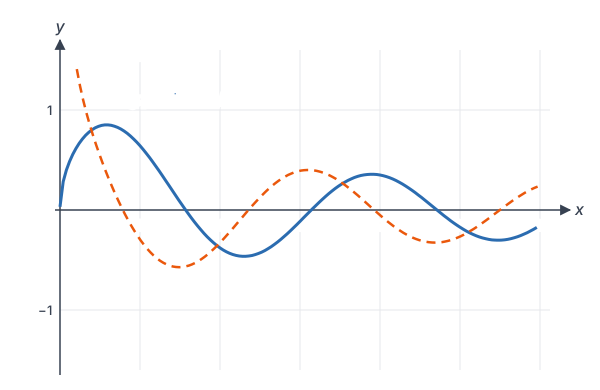
Answer: y = c₁ sin x/√x + c₂ cos x/√x for x > 0. Here the roots differ by an integer, but the n = 1 equation is 0 = 0, so no ln x term is needed (C = 0 in the table). The graph shows that y₁ stays bounded at x = 0 while y₂ blows up.
Common mistakes
| Mistake | Example of the error | Fix |
|---|---|---|
| Using an ordinary power series at a singular point | Trying y = Σ aₙxⁿ for 2x²y″ − xy′ + (1 + x)y = 0 | Use y = Σ aₙxⁿ⁺ʳ with a₀ ≠ 0. |
| Reading p₀ and q₀ before dividing | Taking p₀ = −1 and q₀ = 1 in Example 2 | Divide by 2 first: p₀ = −1/2 and q₀ = 1/2. |
| Assuming two Frobenius series for a double root | Expecting a second series from r = 0 in Example 3 | A double root gives only one; the second solution has ln x. |
| Shifting the power but not the starting index | Writing Σ from n = 0 of aₙ₋₁xⁿ⁺ʳ | After replacing n by n − 1, the sum starts at n = 1. |
| Calling a point regular too quickly | Calling x = 1 regular in Example 1 | Check (x − 1)P and (x − 1)²Q; here (x − 1)P still has x − 1 below. |
| Assuming the smaller root always fails | Adding ln x in Example 5 | Check the n = r₁ − r₂ equation; if it reads 0 = 0, a second series exists. |
Related ideas
Cauchy-Euler equations as a special case
If p(x) and q(x) are constants, the equation is a Cauchy-Euler equation. Every coefficient after a₀ is then 0, so the Frobenius series is just xʳ, and the indicial equation is the same equation for r used there.
Bessel functions
Bessel’s equation x²y″ + xy′ + (x² − ν²)y = 0 appears in heat flow and vibrations in round regions. Its indicial roots are ±ν, and the Frobenius solutions define the Bessel functions Jν(x), as in Examples 3 and 5.
Practice problems
- Classify x = 0 for x²y″ + 5xy′ + (3 − x)y = 0.
- Find the indicial roots for the equation in Problem 1, and say which case of the table applies.
- Classify x = 0 for x³y″ + y′ + y = 0.
- Find the indicial roots of 2x²y″ + 3xy′ − (1 + x)y = 0.
- For the equation in Problem 4, find a₁ and a₂ for the larger root (a₀ = 1).
- For the equation in Problem 4, find a₁ and a₂ for the smaller root (a₀ = 1).
- Find the first four terms of the Frobenius solution of xy″ + y′ − y = 0 with a₀ = 1.
- Explain why the second solution in Problem 7 must contain ln x.
- For x²y″ + xy′ + (x² − 1/9)y = 0, find the indicial roots and a₂ for r = 1/3 (a₀ = 1).
- A chain satisfies xu″ + u′ + 3u = 0 with u(0) = 1. Find its series solution through x³.
Show answers
1.
p(x) = 5,\quad q(x) = 3 - x
The equation already has the form x²y″ + xp(x)y′ + q(x)y = 0.
Answer: both are polynomials, so x = 0 is a regular singular point
2.
r(r-1) + 5r + 3 = r^2 + 4r + 3
Use p₀ = 5 and q₀ = 3.
(r + 1)(r + 3) = 0 \Rightarrow r = -1,\ -3
Answer: r₁ = −1 and r₂ = −3 differ by 2, an integer; y₁ comes from r = −1, and y₂ may contain ln x
3.
P(x) = \dfrac{1}{x^3} \Rightarrow xP(x) = \dfrac{1}{x^2}Divide by x³, then multiply P by x.
Answer: xP(x) is not finite at x = 0, so x = 0 is an irregular singular point
4.
p_0 = \dfrac{3}{2},\quad q_0 = -\dfrac{1}{2}Divide by 2: x²y″ + (3/2)xy′ − (1/2)(1 + x)y = 0.
r(r-1) + \dfrac{3}{2}r - \dfrac{1}{2} = 0 \Rightarrow 2r^2 + r - 1 = 0Multiply by 2 and combine like terms.
(2r - 1)(r + 1) = 0
Factor.
Answer: r = 1/2 and r = −1; they differ by 3/2, so there are two Frobenius series
5.
(2s - 1)(s + 1)a_n = a_{n-1},\quad s = n + rSubstitute; 2s(s − 1) + 3s − 1 = 2s² + s − 1, and −xy shifts by 1.
a_n = \dfrac{a_{n-1}}{n(2n+3)}With s = n + 1/2: (2n)(n + 3/2) = n(2n + 3).
Answer: a₁ = 1/5 and a₂ = a₁/14 = 1/70
6.
a_n = \dfrac{a_{n-1}}{n(2n-3)}With s = n − 1: (2n − 3)(n).
a_1 = \dfrac{1}{1(-1)} = -1,\quad a_2 = \dfrac{-1}{2(1)} = -\dfrac{1}{2}Use n = 1 and n = 2.
Answer: a₁ = −1 and a₂ = −1/2, so y₂ = x⁻¹(1 − x − x²/2 + ⋯)
7.
x^2y'' + xy' - xy = 0 \Rightarrow r^2 = 0
Multiply by x; p₀ = 1 and q₀ = 0.
n^2a_n = a_{n-1} \Rightarrow a_1 = 1,\ a_2 = \dfrac{1}{4},\ a_3 = \dfrac{1}{36}a₂ = a₁/4 and a₃ = a₂/9.
Answer: y₁ = 1 + x + x²/4 + x³/36 + ⋯
8.
r_1 = r_2 = 0
The indicial equation r² = 0 has a double root.
Answer: a double root gives only one Frobenius series, so the second solution is y₁ ln x + Σ bₙxⁿ
9.
r^2 - \dfrac{1}{9} = 0 \Rightarrow r = \pm\dfrac{1}{3}p₀ = 1 and q₀ = −1/9; the difference 2/3 is not an integer.
\left(n + \dfrac{1}{3}\right)^2 - \dfrac{1}{9} = \dfrac{n(3n+2)}{3}Expand: n² + 2n/3.
a_2 = -\dfrac{3a_0}{2(8)} = -\dfrac{3}{16}aₙ = −3aₙ₋₂/(n(3n + 2)) with n = 2.
Answer: r = ±1/3 (two Frobenius series); a₂ = −3/16
10.
a_n = -\dfrac{3a_{n-1}}{n^2}Same steps as Example 4 with 3u.
a_1 = -3,\quad a_2 = \dfrac{9}{4},\quad a_3 = -\dfrac{3(9/4)}{9} = -\dfrac{3}{4}Start from a₀ = 1.
Answer: u = 1 − 3x + (9/4)x² − (3/4)x³ + ⋯
Method of Frobenius FAQ
What is the method of Frobenius?
It finds series solutions of the form y = xʳ Σ aₙxⁿ near a regular singular point. The exponent r comes from the indicial equation, and the coefficients come from a recurrence relation.
What is a regular singular point?
It is a singular point x₀ where (x − x₀)P(x) and (x − x₀)²Q(x) are still analytic, for the equation y″ + Py′ + Qy = 0. At a regular singular point, at least one Frobenius solution always exists.
What is the indicial equation?
It is r(r − 1) + p₀r + q₀ = 0, the equation from the lowest power of x after substituting the Frobenius series. Its roots are the possible exponents r.
When does the second Frobenius solution contain ln x?
Always when the indicial roots are equal. When they differ by a positive integer it may or may not; you find out by checking whether the recurrence breaks down at n = r₁ − r₂.
Summary
- At a regular singular point, try y = Σ aₙxⁿ⁺ʳ with a₀ ≠ 0 and x > 0.
- Write the equation as x²y″ + xp(x)y′ + q(x)y = 0; the indicial equation is r(r − 1) + p₀r + q₀ = 0.
- Roots not differing by an integer give two Frobenius series.
- A double root forces ln x in the second solution; roots differing by an integer may or may not.
- Bessel and Cauchy-Euler equations are important examples of the method.
Previous lesson: Power Series Solutions
Next lesson: Boundary Value Problems
Back to the Differential Equations Index