
Cauchy-Euler Equations
A Cauchy-Euler equation has the form ax²y″ + bxy′ + cy = 0, where each power of x matches the order of its derivative. For positive x, try y = x^m. This gives the indicial equation am(m − 1) + bm + c = 0, and its roots give the solutions, much like a characteristic equation.
Before this lesson: Second-Order Homogeneous Linear Equations, Repeated Roots of the Characteristic Equation and Complex Roots of the Characteristic Equation
Why y = x^m works
In ax²y″ + bxy′ + cy = 0, the coefficients are not constants, so e^(rx) will not work. But look at the powers. Each derivative of x^m lowers the power by 1, and the matching factor x or x² raises it back. So every term is a constant times x^m.
With y = x^m, y′ = mx^(m−1) and y″ = m(m − 1)x^(m−2). Then x²y″ = m(m − 1)x^m and xy′ = mx^m. Substituting and dividing by x^m, which is not 0 for positive x, leaves the indicial equation am(m − 1) + bm + c = 0. It is also called the auxiliary equation.
The equation is singular at x = 0, where the coefficient of y″ is 0. Solutions are found for positive x (or for negative x, by replacing x with |x|).
Cauchy-Euler formula
ax^2y'' + bxy' + cy = 0 \quad\Longrightarrow\quad am(m - 1) + bm + c = 0
| Roots of the indicial equation | General solution for positive x |
|---|---|
| Real and different, m₁ and m₂ | y = C₁x^(m₁) + C₂x^(m₂) |
| Repeated, m | y = (C₁ + C₂ ln x)x^m |
| Complex, α ± βi | y = x^α(C₁ cos(β ln x) + C₂ sin(β ln x)) |
The three cases match the three cases of a characteristic equation, with ln x in place of x. The reason is the substitution x = e^t, explained under Related ideas.
How to solve a Cauchy-Euler equation
- Check the form: x² multiplies y″, x multiplies y′, and a constant multiplies y.
- Write the indicial equation am(m − 1) + bm + c = 0. Expand it to am² + (b − a)m + c = 0.
- Solve for m.
- Write the general solution from the table.
- For an initial-value problem, use conditions at a positive x, such as x = 1.
Cauchy-Euler examples
Example 1: Two different real roots
Solve x²y″ − 2xy′ − 4y = 0 for positive x.
m(m - 1) - 2m - 4 = 0
Write the indicial equation with a = 1, b = −2, c = −4.
m^2 - 3m - 4 = 0
Distribute and combine like terms.
(m - 4)(m + 1) = 0
m = 4,\quad m = -1
Set each factor equal to 0.
y = C_1x^4 + C_2x^{-1}Use the different-roots case.
Answer: y = C₁x⁴ + C₂/x. Check y = x⁴: x²(12x²) − 2x(4x³) − 4x⁴ = 12x⁴ − 8x⁴ − 4x⁴ = 0.
Example 2: A repeated root
Solve x²y″ − 3xy′ + 4y = 0 for positive x.
m(m - 1) - 3m + 4 = 0
Write the indicial equation.
m^2 - 4m + 4 = 0
Distribute and combine like terms.
(m - 2)^2 = 0 \Rightarrow m = 2
Factor the perfect square; the root repeats.
y = \left(C_1 + C_2\ln x\right)x^2
Use the repeated-root case.
Answer: y = C₁x² + C₂x² ln x. The second solution has ln x where a constant-coefficient equation would have x.
Example 3: Complex roots
Solve x²y″ + xy′ + 9y = 0 for positive x.
m(m - 1) + m + 9 = 0
Write the indicial equation.
m^2 + 9 = 0
Distribute; the m terms cancel.
m = \pm 3i
Take square roots: α = 0, β = 3.
y = C_1\cos(3\ln x) + C_2\sin(3\ln x)
Use the complex case; x^0 = 1.
Answer: y = C₁ cos(3 ln x) + C₂ sin(3 ln x). These solutions oscillate, but more and more slowly as x grows, because ln x grows slowly.
Example 4: An initial-value problem
Solve x²y″ + 3xy′ − 3y = 0 with y(1) = 2 and y′(1) = −2.
m^2 + 2m - 3 = (m + 3)(m - 1) = 0
The indicial equation m(m − 1) + 3m − 3 = 0 simplifies and factors.
y = C_1x + C_2x^{-3}Use the roots 1 and −3.
y' = C_1 - 3C_2x^{-4}Differentiate with the power rule.
C_1 + C_2 = 2
Substitute x = 1 into y.
C_1 - 3C_2 = -2
Substitute x = 1 into y′.
4C_2 = 4 \Rightarrow C_2 = 1
Subtract the second equation from the first (see elimination method).
C_1 = 1
Substitute C₂ = 1 into C₁ + C₂ = 2.
y = x + x^{-3}Substitute both constants.
Answer: y = x + 1/x³. Check: y(1) = 2 and y′(1) = 1 − 3 = −2.
Example 5: Temperature in a spherical shell (word problem)
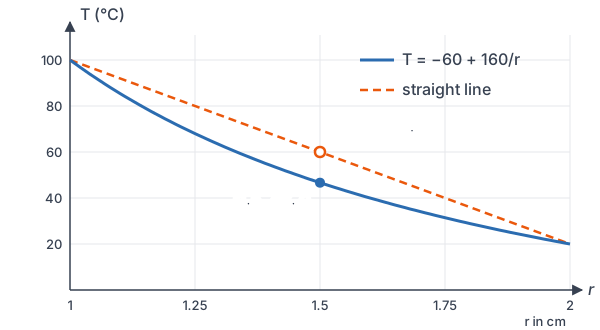
A hollow ball has inner radius 1 cm and outer radius 2 cm. The inside surface is held at 100°C and the outside at 20°C. In steady state, the temperature T at distance r from the center satisfies r²T″ + 2rT′ = 0. Find T(r) and the temperature halfway through the wall, at r = 1.5 cm.
m(m - 1) + 2m = m^2 + m = 0
Write the indicial equation with a = 1, b = 2, c = 0.
m(m + 1) = 0 \Rightarrow m = 0,\ m = -1
Factor out m and solve.
T = C_1 + \dfrac{C_2}{r}Use the different-roots case; r^0 = 1.
C_1 + C_2 = 100
Use T(1) = 100.
C_1 + \tfrac{1}{2}C_2 = 20Use T(2) = 20.
\tfrac{1}{2}C_2 = 80 \Rightarrow C_2 = 160Subtract the second equation from the first, then multiply by 2.
C_1 = -60
Substitute C₂ = 160 into C₁ + C₂ = 100.
T = -60 + \dfrac{160}{r}Write the temperature.
T(1.5) = -60 + \dfrac{160}{1.5} \approx 46.7Substitute r = 1.5.
Answer: T(r) = −60 + 160/r, and T(1.5) ≈ 46.7°C. That is below the 60°C you might guess from a straight line, because the outer half of the wall has more area to lose heat through.
Common mistakes
| Mistake | Example of the error | Fix |
|---|---|---|
| Using the characteristic equation | Writing m² − 2m − 4 = 0 for x²y″ − 2xy′ − 4y = 0 | Use m(m − 1) + bm + c: m² − 3m − 4 = 0. |
| Trying exponentials | y = C₁e^(4x) + C₂e^(−x) | The solutions are powers: y = C₁x⁴ + C₂x^(−1). |
| Repeated root with x instead of ln x | y = (C₁ + C₂x)x² | Use ln x: y = (C₁ + C₂ ln x)x². |
| Complex root with βx inside cosine | cos 3x for m = ±3i | Use cos(3 ln x) and sin(3 ln x). |
| Using initial conditions at x = 0 | y(0) = 1 | The equation is singular at 0. Use a positive x, such as x = 1. |
| Applying the method to the wrong form | Using y = x^m on x²y″ + y′ + y = 0 | Each power of x must match the derivative’s order; here it does not. |
Related ideas
The substitution x = e^t
Let x = e^t, so t = ln x. By the chain rule, xy′ = dy/dt and x²y″ = d²y/dt² − dy/dt. The Cauchy-Euler equation becomes a(d²y/dt²) + (b − a)(dy/dt) + cy = 0, which has constant coefficients. Its characteristic equation am² + (b − a)m + c = 0 is the indicial equation, and e^(mt) = x^m. That is why ln x shows up wherever x appeared before.
Nonhomogeneous Cauchy-Euler equations
For ax²y″ + bxy′ + cy = f(x), find y₁ and y₂ here, divide by ax² for standard form, and use Variation of Parameters. Practice problem 9 does this.
Negative x
For negative x, replace x with |x| in every solution, for example y = C₁|x|⁴ + C₂|x|^(−1). Each interval, positive x or negative x, gets its own solution.
Practice problems
- Solve x²y″ − 6y = 0 for positive x.
- Solve x²y″ + 4xy′ + 2y = 0 for positive x.
- Solve x²y″ − xy′ + y = 0 for positive x.
- Solve x²y″ + 5xy′ + 4y = 0 for positive x.
- Solve x²y″ + xy′ + 4y = 0 for positive x.
- Solve x²y″ − xy′ + 5y = 0 for positive x.
- Solve 2x²y″ + 3xy′ − y = 0 for positive x.
- Solve x²y″ − 2y = 0 with y(1) = 3 and y′(1) = 0.
- Find a particular solution of x²y″ − 2y = x³ for positive x.
- In a long pipe with inner radius 1 cm at 80°C and outer radius 2 cm at 30°C, the steady temperature satisfies r²T″ + rT′ = 0. Find T(r) and T(1.5).
Show answers
1.
m(m - 1) - 6 = m^2 - m - 6 = 0
Write and expand the indicial equation.
(m - 3)(m + 2) = 0
Factor.
Answer: y = C₁x³ + C₂x^(−2)
2.
m(m - 1) + 4m + 2 = m^2 + 3m + 2 = 0
Write and expand the indicial equation.
(m + 1)(m + 2) = 0
Factor.
Answer: y = C₁x^(−1) + C₂x^(−2)
3.
m(m - 1) - m + 1 = m^2 - 2m + 1 = 0
Write and expand the indicial equation.
(m - 1)^2 = 0 \Rightarrow m = 1
Factor; the root repeats.
Answer: y = (C₁ + C₂ ln x)x
4.
m(m - 1) + 5m + 4 = m^2 + 4m + 4 = 0
Write and expand the indicial equation.
(m + 2)^2 = 0 \Rightarrow m = -2
Factor; the root repeats.
Answer: y = (C₁ + C₂ ln x)x^(−2)
5.
m(m - 1) + m + 4 = m^2 + 4 = 0
Write and expand the indicial equation.
m = \pm 2i
Take square roots: α = 0, β = 2.
Answer: y = C₁ cos(2 ln x) + C₂ sin(2 ln x)
6.
m(m - 1) - m + 5 = m^2 - 2m + 5 = 0
Write and expand the indicial equation.
m = \dfrac{2 \pm \sqrt{4 - 20}}{2} = 1 \pm 2iUse the quadratic formula; √−16 = 4i.
Answer: y = x(C₁ cos(2 ln x) + C₂ sin(2 ln x))
7.
2m(m - 1) + 3m - 1 = 2m^2 + m - 1 = 0
Write and expand the indicial equation with a = 2.
(2m - 1)(m + 1) = 0
Factor.
m = \tfrac{1}{2},\quad m = -1Set each factor equal to 0.
Answer: y = C₁√x + C₂x^(−1)
8.
m^2 - m - 2 = (m - 2)(m + 1) = 0
The indicial equation is m(m − 1) − 2 = 0.
y = C_1x^2 + C_2x^{-1},\quad y' = 2C_1x - C_2x^{-2}Write the general solution and differentiate.
C_1 + C_2 = 3,\quad 2C_1 - C_2 = 0
Substitute x = 1 into y and y′.
3C_1 = 3 \Rightarrow C_1 = 1,\ C_2 = 2
Add the equations, then substitute back.
Answer: y = x² + 2/x
9.
y_1 = x^2,\quad y_2 = x^{-1},\quad g = xUse Practice 8’s roots; divide by x² for standard form.
W = x^2(-x^{-2}) - x^{-1}(2x) = -3Compute the Wronskian.
u_1' = -\dfrac{x^{-1}\cdot x}{-3} = \tfrac{1}{3} \Rightarrow u_1 = \tfrac{x}{3}Use u₁′ = −y₂g/W and integrate.
u_2' = \dfrac{x^2\cdot x}{-3} = -\tfrac{x^3}{3} \Rightarrow u_2 = -\tfrac{x^4}{12}Use u₂′ = y₁g/W and integrate.
y_p = \tfrac{x}{3}x^2 - \tfrac{x^4}{12}x^{-1} = \tfrac{x^3}{3} - \tfrac{x^3}{12} = \tfrac{x^3}{4}Form u₁y₁ + u₂y₂ and combine like terms.
Answer: yₚ = x³/4
10.
m(m - 1) + m = m^2 = 0
Write the indicial equation; m = 0 repeats.
T = C_1 + C_2\ln r
Use the repeated-root case; r^0 = 1.
C_1 = 80,\quad 80 + C_2\ln 2 = 30
Use T(1) = 80 (ln 1 = 0) and T(2) = 30.
C_2 = -\dfrac{50}{\ln 2} \approx -72.13Subtract 80 and divide by ln 2.
T(1.5) = 80 - \dfrac{50\ln 1.5}{\ln 2} \approx 50.8Substitute r = 1.5.
Answer: T(r) = 80 − (50/ln 2) ln r, and T(1.5) ≈ 50.8°C
Cauchy-Euler FAQ
What is a Cauchy-Euler equation?
It is a linear equation ax²y″ + bxy′ + cy = 0 in which the power of x on each term equals the order of the derivative. It is also called an Euler equation or an equidimensional equation.
How do you solve a Cauchy-Euler equation?
Substitute y = x^m to get the indicial equation am(m − 1) + bm + c = 0. Solve it, then use the table: powers for different real roots, a ln x factor for a repeated root, and cos(β ln x) and sin(β ln x) for complex roots.
Why does ln x appear in the solutions?
The substitution x = e^t turns the equation into one with constant coefficients in t = ln x. The usual solutions in t, like te^(mt) and cos βt, become ln x · x^m and cos(β ln x).
What is the indicial equation?
It is am(m − 1) + bm + c = 0, the equation you get by substituting y = x^m. Its roots are the powers in the solution.
Summary
- A Cauchy-Euler equation is ax²y″ + bxy′ + cy = 0.
- Try y = x^m to get the indicial equation am(m − 1) + bm + c = 0.
- Different real roots: y = C₁x^(m₁) + C₂x^(m₂).
- Repeated root: y = (C₁ + C₂ ln x)x^m. Complex roots: y = x^α(C₁ cos(β ln x) + C₂ sin(β ln x)).
- Solve for positive x, and use initial conditions at a positive x.
Previous lesson: Variation of Parameters
Next lesson: Spring-Mass Systems
Back to the Differential Equations Index