
Second-Order Homogeneous Linear Equations
A second-order homogeneous differential equation with constant coefficients has the form ay″ + by′ + cy = 0. Trying y = e^(rx) turns it into the characteristic equation ar² + br + c = 0. When that equation has two different real roots r₁ and r₂, the general solution is y = C₁e^(r₁x) + C₂e^(r₂x).
Before this lesson: Classifying Differential Equations, Derivatives of Exponential Functions and Quadratic Formula
The idea: guess an exponential
In ay″ + by′ + cy = 0, the function and its first two derivatives must cancel. Exponentials are the natural guess, because the derivative of e^(rx) is just r times itself.
Substitute y = e^(rx), y′ = re^(rx) and y″ = r²e^(rx). Every term has a factor of e^(rx), which is never 0, so you can divide it out. What is left is an ordinary quadratic in r, called the characteristic equation (or auxiliary equation).
Each real root r gives a solution e^(rx). Because the equation is linear and homogeneous, any combination C₁y₁ + C₂y₂ of solutions is also a solution. This is the superposition principle. Two solutions that are not constant multiples of each other give every solution.
Second-order homogeneous differential equation: the rule
ay'' + by' + cy = 0 \;\longrightarrow\; ar^2 + br + c = 0
r_1 \ne r_2 \text{ real} \;\Longrightarrow\; y = C_1e^{r_1x} + C_2e^{r_2x}The roots are real and different exactly when the discriminant b² − 4ac is positive. The other two cases have their own lessons.
| Discriminant b² − 4ac | Roots | General solution |
|---|---|---|
| Positive | Two different real roots | y = C_1e^{r_1x} + C_2e^{r_2x} |
| Negative | Complex roots \alpha \pm \beta i | y = e^{\alpha x}(C_1\cos\beta x + C_2\sin\beta x) |
| Zero | One repeated root r | y = (C_1 + C_2x)e^{rx} |
How to solve
- Replace y″ with r², y′ with r and y with 1 to write the characteristic equation.
- Solve it by factoring or with the quadratic formula.
- Write y = C₁e^(r₁x) + C₂e^(r₂x).
- For an initial-value problem, find y′, substitute the initial values into y and y′, and solve the two equations for C₁ and C₂.
Second-order homogeneous differential equation examples
Example 1: Factor the characteristic equation
Find the general solution of y″ − 5y′ + 6y = 0.
r^2 - 5r + 6 = 0
Write the characteristic equation: y″ → r², y′ → r, y → 1.
(r - 2)(r - 3) = 0
Factor the trinomial (see factoring trinomials).
r_1 = 2,\quad r_2 = 3
Set each factor equal to 0. The roots are real and different.
y = C_1e^{2x} + C_2e^{3x}Write one exponential for each root.
Answer: y = C₁e^(2x) + C₂e^(3x).
Example 2: An initial-value problem
Solve y″ − y′ − 6y = 0 with y(0) = 3 and y′(0) = −1.
r^2 - r - 6 = 0
Write the characteristic equation.
(r - 3)(r + 2) = 0
Factor.
r_1 = 3,\quad r_2 = -2
Set each factor equal to 0.
y = C_1e^{3x} + C_2e^{-2x}Write the general solution.
y' = 3C_1e^{3x} - 2C_2e^{-2x}Differentiate each term (see derivatives of exponential functions).
C_1 + C_2 = 3
Substitute x = 0 into y; e⁰ = 1.
3C_1 - 2C_2 = -1
Substitute x = 0 into y′.
3C_1 - 2(3 - C_1) = -1
Solve the first equation for C₂ = 3 − C₁ and substitute (see substitution method).
5C_1 - 6 = -1
Distribute and combine like terms.
C_1 = 1
Add 6 to both sides, then divide by 5.
C_2 = 3 - 1 = 2
Substitute C₁ = 1 into C₂ = 3 − C₁.
y = e^{3x} + 2e^{-2x}Write the solution.
Answer: y = e^(3x) + 2e^(−2x). Check: y(0) = 1 + 2 = 3 and y′(0) = 3 − 4 = −1.
Example 3: A leading coefficient that isn’t 1
Find the general solution of 2y″ + 5y′ − 3y = 0.
2r^2 + 5r - 3 = 0
Write the characteristic equation; keep the 2.
(2r - 1)(r + 3) = 0
Factor (see factoring trinomials when a is not 1).
r_1 = \tfrac{1}{2},\quad r_2 = -3Set each factor equal to 0.
y = C_1e^{x/2} + C_2e^{-3x}Write one exponential for each root.
Answer: y = C₁e^(x/2) + C₂e^(−3x).
Example 4: Irrational roots
Find the general solution of y″ + 4y′ + y = 0.
r^2 + 4r + 1 = 0
Write the characteristic equation. It doesn’t factor over the integers.
r = \dfrac{-4 \pm \sqrt{16 - 4}}{2}Use the quadratic formula with a = 1, b = 4, c = 1.
r = \dfrac{-4 \pm 2\sqrt{3}}{2}Simplify √12 = 2√3 (see simplifying square roots).
r = -2 \pm \sqrt{3}Divide each term by 2.
y = C_1e^{(-2 + \sqrt{3})x} + C_2e^{(-2 - \sqrt{3})x}Write one exponential for each root.
Answer: y = C₁e^((−2 + √3)x) + C₂e^((−2 − √3)x). Both roots are negative (−2 + √3 ≈ −0.27), so every solution decays to 0.
Example 5: A door closer (word problem)
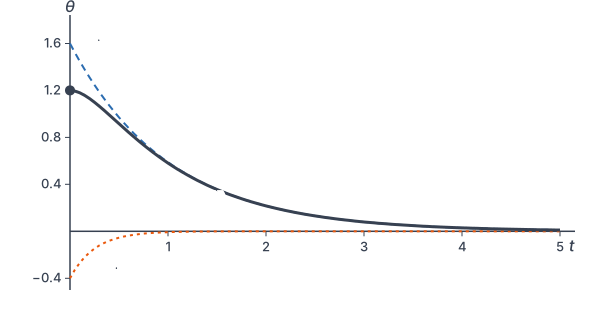
A heavily damped door closer makes the door’s angle θ (in radians) satisfy θ″ + 5θ′ + 4θ = 0, with t in seconds. The door is let go from rest at θ(0) = 1.2. Find θ(t) and the angle after 1 second.
r^2 + 5r + 4 = 0
Write the characteristic equation.
(r + 1)(r + 4) = 0
Factor.
r_1 = -1,\quad r_2 = -4
Set each factor equal to 0.
\theta = C_1e^{-t} + C_2e^{-4t}Write the general solution.
\theta' = -C_1e^{-t} - 4C_2e^{-4t}Differentiate.
C_1 + C_2 = 1.2
Substitute t = 0 into θ.
-C_1 - 4C_2 = 0
“From rest” means θ′(0) = 0.
-3C_2 = 1.2
Add the two equations to eliminate C₁ (see elimination method).
C_2 = -0.4
Divide both sides by −3.
C_1 = 1.2 - (-0.4) = 1.6
Substitute into C₁ + C₂ = 1.2.
\theta = 1.6e^{-t} - 0.4e^{-4t}Write the solution.
\theta(1) = 1.6e^{-1} - 0.4e^{-4} \approx 0.5886 - 0.0073 = 0.5813Substitute t = 1 and evaluate.
Answer: θ(t) = 1.6e^(−t) − 0.4e^(−4t), and after 1 second the angle is about 0.58 radians (about 33°). Since 1.6e^(−t) is always larger than 0.4e^(−4t) for positive t, the door never swings past closed: it is overdamped.
Common mistakes
| Mistake | Example of the error | Fix |
|---|---|---|
| Dropping a missing term the wrong way | Writing r² − 4 = 0 for y″ − 4y′ = 0 | The y′ term gives −4r: r² − 4r = 0, so r = 0 or 4. |
| Sign errors in the roots | (r − 2)(r − 3) = 0 gives r = −2, −3 | Set each factor equal to 0: r = 2 and r = 3. |
| Leaving x out of the exponent | y = C_1e^{2} + C_2e^{3} | Each solution is e^(rx): y = C₁e^(2x) + C₂e^(3x). |
| Using one constant | y = C(e^{2x} + e^{3x}) | A second-order equation needs two independent constants. |
| Putting y′(0) into y | Using C₁ + C₂ = −1 for y′(0) = −1 | Differentiate first, then substitute into y′. |
| Using the method on nonconstant coefficients | Trying e^(rx) in y″ + xy = 0 | The characteristic equation works only when a, b and c are constants. |
Related ideas
Why two solutions are enough
A second-order initial-value problem needs two numbers, y(x₀) and y′(x₀). Two solutions that are not multiples of each other let you match any two such numbers, so C₁y₁ + C₂y₂ covers every solution. The Wronskian turns “not multiples” into a test.
Connection to first-order equations
The first-order equation y′ + ky = 0 has characteristic equation r + k = 0 and solution Ce^(−kx), the same exponential model used in exponential models with differential equations.
Connection to eigenvalues
Writing ay″ + by′ + cy = 0 as a system for (y, y′) gives a 2 × 2 matrix whose characteristic polynomial is the same quadratic, so the roots r are its eigenvalues.
Practice problems
- Find the general solution of y″ − 7y′ + 10y = 0.
- Find the general solution of y″ − 9y = 0.
- Find the general solution of y″ − 4y′ = 0.
- Find the general solution of 3y″ + 2y′ − y = 0.
- Find the general solution of y″ + 2y′ − 2y = 0.
- Solve y″ + y′ − 2y = 0 with y(0) = 4 and y′(0) = −5.
- Solve y″ − 4y = 0 with y(0) = 0 and y′(0) = 8.
- Find a second-order equation whose general solution is y = C₁e^(−x) + C₂e^(5x).
- Show by substitution that y = e^(−3x) solves y″ + 2y′ − 3y = 0.
- A shock absorber’s displacement x (in meters) satisfies x″ + 6x′ + 8x = 0, with x(0) = 0.1 and x′(0) = 0. Find x(t) and x(1).
Show answers
1.
r^2 - 7r + 10 = 0
Write the characteristic equation.
(r - 2)(r - 5) = 0
Factor.
r = 2,\ 5
Set each factor equal to 0.
Answer: y = C₁e^(2x) + C₂e^(5x)
2.
r^2 - 9 = 0
Write the characteristic equation; there is no y′ term.
(r - 3)(r + 3) = 0
Factor the difference of squares (see factoring difference of squares).
r = 3,\ -3
Set each factor equal to 0.
Answer: y = C₁e^(3x) + C₂e^(−3x)
3.
r^2 - 4r = 0
Write the characteristic equation; there is no y term.
r(r - 4) = 0
Factor out r (see factoring out the GCF).
r = 0,\ 4
Set each factor equal to 0.
Answer: y = C₁ + C₂e^(4x), since e^(0x) = 1
4.
3r^2 + 2r - 1 = 0
Write the characteristic equation.
(3r - 1)(r + 1) = 0
Factor.
r = \tfrac{1}{3},\ -1Set each factor equal to 0.
Answer: y = C₁e^(x/3) + C₂e^(−x)
5.
r^2 + 2r - 2 = 0
Write the characteristic equation.
r = \dfrac{-2 \pm \sqrt{4 + 8}}{2}Use the quadratic formula with a = 1, b = 2, c = −2.
r = \dfrac{-2 \pm 2\sqrt{3}}{2} = -1 \pm \sqrt{3}Simplify √12 = 2√3 and divide each term by 2.
Answer: y = C₁e^((−1 + √3)x) + C₂e^((−1 − √3)x)
6.
(r - 1)(r + 2) = 0
Factor r² + r − 2 = 0: r = 1, −2.
y = C_1e^{x} + C_2e^{-2x},\quad y' = C_1e^{x} - 2C_2e^{-2x}Write y and differentiate.
C_1 + C_2 = 4,\quad C_1 - 2C_2 = -5
Substitute x = 0 into y and y′.
3C_2 = 9
Subtract the second equation from the first.
C_2 = 3,\quad C_1 = 1
Divide by 3, then use C₁ = 4 − C₂.
Answer: y = e^x + 3e^(−2x)
7.
r = 2,\ -2
Solve r² − 4 = 0.
y = C_1e^{2x} + C_2e^{-2x},\quad y' = 2C_1e^{2x} - 2C_2e^{-2x}Write y and differentiate.
C_1 + C_2 = 0,\quad 2C_1 - 2C_2 = 8
Substitute x = 0.
C_2 = -C_1 \Rightarrow 4C_1 = 8
Substitute C₂ = −C₁ into the second equation.
C_1 = 2,\quad C_2 = -2
Divide by 4.
Answer: y = 2e^(2x) − 2e^(−2x)
8.
(r + 1)(r - 5) = 0
The roots must be −1 and 5.
r^2 - 4r - 5 = 0
Multiply out the factors (see multiplying binomials).
Answer: y″ − 4y′ − 5y = 0 (or any nonzero multiple of it)
9.
y' = -3e^{-3x},\quad y'' = 9e^{-3x}Differentiate twice.
9e^{-3x} + 2(-3e^{-3x}) - 3e^{-3x}Substitute into the left side.
(9 - 6 - 3)e^{-3x} = 0Factor out e^(−3x) and combine.
Answer: the left side is 0, so y = e^(−3x) is a solution (r = −3 is a root of r² + 2r − 3 = 0)
10.
(r + 2)(r + 4) = 0
Factor r² + 6r + 8 = 0: r = −2, −4.
x = C_1e^{-2t} + C_2e^{-4t},\quad x' = -2C_1e^{-2t} - 4C_2e^{-4t}Write x and differentiate.
C_1 + C_2 = 0.1,\quad -2C_1 - 4C_2 = 0
Substitute t = 0.
C_1 = -2C_2 \Rightarrow -C_2 = 0.1
Solve the second equation for C₁ and substitute into the first.
C_2 = -0.1,\quad C_1 = 0.2
Multiply by −1, then C₁ = −2C₂.
x(1) = 0.2e^{-2} - 0.1e^{-4} \approx 0.02707 - 0.00183 = 0.02524Substitute t = 1 and evaluate.
Answer: x(t) = 0.2e^(−2t) − 0.1e^(−4t), and x(1) ≈ 0.0252 m
Second-order homogeneous differential equations FAQ
What is a second-order homogeneous linear differential equation?
It is an equation a(x)y″ + b(x)y′ + c(x)y = 0, where every term contains y or one of its derivatives and the right side is 0. This lesson covers the constant-coefficient case ay″ + by′ + cy = 0.
What is the characteristic equation?
It is the quadratic ar² + br + c = 0 that you get by substituting y = e^(rx) into ay″ + by′ + cy = 0 and dividing by e^(rx). Its roots tell you which exponentials solve the equation.
What is the general solution when the roots are real and distinct?
If r₁ and r₂ are different real numbers, the general solution is y = C₁e^(r₁x) + C₂e^(r₂x), where C₁ and C₂ are any constants.
Why does a second-order equation have two constants?
Solving it undoes two derivatives, and an initial-value problem gives two conditions, y(x₀) and y′(x₀). Two arbitrary constants are needed to match both.
Summary
- For ay″ + by′ + cy = 0, try y = e^(rx) to get the characteristic equation ar² + br + c = 0.
- If b² − 4ac is positive, there are two different real roots r₁ and r₂.
- The general solution is y = C₁e^(r₁x) + C₂e^(r₂x), by superposition.
- For an initial-value problem, differentiate, substitute x₀ into y and y′, and solve for C₁ and C₂.
- Negative roots mean every solution decays to 0; a positive root means most solutions grow.
Previous lesson: Runge-Kutta Method
Next lesson: The Wronskian
Back to the Differential Equations Index