
The Wronskian
The Wronskian of two functions y₁ and y₂ is the determinant W = y₁y₂′ − y₂y₁′. For two solutions of a second-order linear homogeneous equation, W ≠ 0 means they form a fundamental set, so every solution is C₁y₁ + C₂y₂. W = 0 means one solution is a constant multiple of the other.
Before this lesson: Second-Order Homogeneous Linear Equations, Determinant of a Matrix and Linear Independence
The idea: can two solutions match any starting values?
A second-order initial-value problem gives two numbers at a point x₀: a value y(x₀) and a slope y′(x₀). To match them with y = C₁y₁ + C₂y₂, you solve two linear equations for C₁ and C₂.
That system has exactly one answer for every pair of starting values when its coefficient matrix has a nonzero determinant. That determinant is the Wronskian. When it is 0, the two solutions are really the same solution scaled, so they can only reach some starting values.
Two solutions with a nonzero Wronskian are called a fundamental set of solutions. They are linearly independent: neither is a constant multiple of the other.
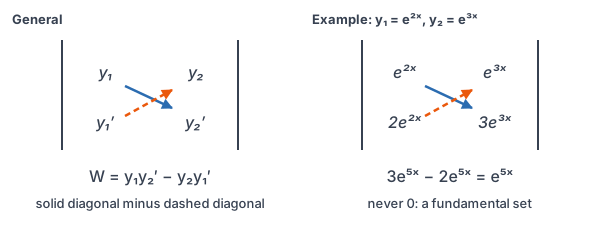
Wronskian formula and test
W(y_1, y_2)(x) = \begin{vmatrix} y_1 & y_2 \\ y_1' & y_2' \end{vmatrix} = y_1y_2' - y_2y_1'Wronskian test. Suppose y₁ and y₂ solve y″ + p(x)y′ + q(x)y = 0 on an interval I where p and q are continuous. Then exactly one of these is true:
- W(x) ≠ 0 for every x in I. Then y₁ and y₂ form a fundamental set, and y = C₁y₁ + C₂y₂ is the general solution.
- W(x) = 0 for every x in I. Then one solution is a constant multiple of the other.
So for solutions, checking W at one convenient point is enough.
How to use it
- Check that y₁ and y₂ both solve the equation.
- Find y₁′ and y₂′.
- Compute W = y₁y₂′ − y₂y₁′ and simplify.
- If W is not 0 on the interval, the solutions form a fundamental set.
Wronskian examples
Example 1: Two exponentials
Find W(e^(2x), e^(3x)). Do these functions form a fundamental set for y″ − 5y′ + 6y = 0?
y_1 = e^{2x},\quad y_1' = 2e^{2x}Differentiate y₁ (see derivatives of exponential functions).
y_2 = e^{3x},\quad y_2' = 3e^{3x}Differentiate y₂.
W = e^{2x}(3e^{3x}) - e^{3x}(2e^{2x})Compute y₁y₂′ − y₂y₁′ (see determinant of a matrix).
W = 3e^{5x} - 2e^{5x}Multiply by adding exponents (see exponent rules).
W = e^{5x}Combine like terms.
Answer: W = e^(5x), which is never 0. Both functions solve y″ − 5y′ + 6y = 0 (its characteristic roots are 2 and 3, as in second-order homogeneous linear equations), so they form a fundamental set on the whole real line.
Example 2: Sine and cosine
Show that y₁ = cos 3x and y₂ = sin 3x form a fundamental set for y″ + 9y = 0.
y_1'' = -9\cos 3x
Differentiate cos 3x twice with the chain rule.
-9\cos 3x + 9\cos 3x = 0
Substitute into y″ + 9y: y₁ is a solution. The same steps work for sin 3x.
y_1' = -3\sin 3x,\quad y_2' = 3\cos 3x
Find the first derivatives (see derivatives of trig functions).
W = \cos 3x(3\cos 3x) - \sin 3x(-3\sin 3x)
Compute y₁y₂′ − y₂y₁′.
W = 3\cos^2 3x + 3\sin^2 3x
Multiply; subtracting a negative gives a plus.
W = 3(\cos^2 3x + \sin^2 3x) = 3
Factor out 3 and use sin² + cos² = 1 (see fundamental trig identities).
Answer: W = 3, which is never 0, so cos 3x and sin 3x form a fundamental set. The general solution is y = C₁ cos 3x + C₂ sin 3x.
Example 3: Solutions that are not independent
Is {e^(2x), 5e^(2x)} a fundamental set for y″ − 5y′ + 6y = 0?
y_1' = 2e^{2x},\quad y_2' = 10e^{2x}Differentiate both functions.
W = e^{2x}(10e^{2x}) - 5e^{2x}(2e^{2x})Compute y₁y₂′ − y₂y₁′.
W = 10e^{4x} - 10e^{4x} = 0Multiply and combine like terms.
Answer: W = 0, so this is not a fundamental set: 5e^(2x) is just 5 times e^(2x). These two can never produce e^(3x), which is also a solution.
Example 4: Variable coefficients and an initial-value problem
The functions y₁ = x and y₂ = x² solve x²y″ − 2xy′ + 2y = 0 for positive x. Check that they form a fundamental set, then solve with y(1) = 3, y′(1) = 4.
x^2(0) - 2x(1) + 2x = 0
Check y₁ = x: y₁′ = 1 and y₁″ = 0.
x^2(2) - 2x(2x) + 2x^2 = 0
Check y₂ = x²: y₂′ = 2x and y₂″ = 2 (see power rule).
W = x(2x) - x^2(1) = x^2
Compute y₁y₂′ − y₂y₁′ and combine like terms.
y = C_1x + C_2x^2,\quad y' = C_1 + 2C_2x
W = x² is positive for positive x, so this is the general solution there.
C_1 + C_2 = 3,\quad C_1 + 2C_2 = 4
Substitute x = 1 into y and y′.
C_2 = 1
Subtract the first equation from the second (see elimination method).
C_1 = 2
Substitute C₂ = 1 into C₁ + C₂ = 3.
Answer: W = x² is not 0 for positive x, so {x, x²} is a fundamental set there, and y = 2x + x². Notice that the determinant of the system for C₁ and C₂ is W(1) = 1. At x = 0, where W = 0, the equation’s leading coefficient x² is also 0, so the test does not apply.
Example 5: Two measured spring motions (word problem)
A spring’s position x (in meters) satisfies x″ + 4x = 0. Two test runs give the solutions x₁ = sin 2t and x₂ = sin 2t + √3 cos 2t. Can every motion of this spring be written as C₁x₁ + C₂x₂? If so, write the motion that starts at x(0) = 1 with x′(0) = 0.
x_1' = 2\cos 2t,\quad x_2' = 2\cos 2t - 2\sqrt{3}\sin 2tDifferentiate with the chain rule.
W = \sin 2t(2\cos 2t - 2\sqrt{3}\sin 2t) - (\sin 2t + \sqrt{3}\cos 2t)(2\cos 2t)Compute x₁x₂′ − x₂x₁′.
W = 2\sin 2t\cos 2t - 2\sqrt{3}\sin^2 2t - 2\sin 2t\cos 2t - 2\sqrt{3}\cos^2 2tDistribute both products (see distributive property).
W = -2\sqrt{3}(\sin^2 2t + \cos^2 2t) = -2\sqrt{3}The sin 2t cos 2t terms cancel; factor and use sin² + cos² = 1.
x(0) = C_1(0) + C_2(\sqrt{3}) = 1 \Rightarrow C_2 = \tfrac{1}{\sqrt{3}}W ≠ 0, so the set is fundamental. Substitute t = 0 into x = C₁x₁ + C₂x₂.
x'(0) = 2C_1 + 2C_2 = 0 \Rightarrow C_1 = -\tfrac{1}{\sqrt{3}}Substitute t = 0 into x′ and solve for C₁.
x = -\tfrac{1}{\sqrt{3}}\sin 2t + \tfrac{1}{\sqrt{3}}(\sin 2t + \sqrt{3}\cos 2t) = \cos 2tSubstitute the constants and simplify: the sine terms cancel.
Answer: yes. W = −2√3 is never 0, so the two runs form a fundamental set, and the motion starting at 1 m from rest is x = cos 2t.
Common mistakes
| Mistake | Example of the error | Fix |
|---|---|---|
| Subtracting in the wrong order | Writing W = y₁′y₂ − y₁y₂′ | W = y₁y₂′ − y₂y₁′. The wrong order gives −W, which matters in later formulas. |
| Forgetting the chain rule | (sin 3x)′ = cos 3x | (sin 3x)′ = 3 cos 3x. |
| Testing functions that are not solutions | Calling {e^x, e^(2x)} a fundamental set for y″ + 9y = 0 | First check that both functions solve the equation. |
| Using W = 0 to prove dependence for any functions | x³ and |x|³ have W = 0 everywhere | They are independent. The “W = 0 means dependent” rule needs two solutions of the same equation. |
| Ignoring the interval | Calling {x, x²} fundamental at x = 0 | The test applies on an interval where p and q are continuous; here x must stay positive or negative. |
| Forgetting a negative sign when subtracting | −sin 3x(−3 sin 3x) written as −3 sin² 3x | Subtracting a negative gives +3 sin² 3x. |
Related ideas
Abel’s formula
If y₁ and y₂ solve y″ + p(x)y′ + q(x)y = 0, then W(x) = Ce^(−∫p(x) dx) for some constant C. You can find W without knowing the solutions. In Example 4, dividing by x² gives p(x) = −2/x, so W = Ce^(2 ln x) = Cx², matching the direct answer.
Linear independence of vectors
The Wronskian is the function version of the test for linear independence of vectors: two vectors in the plane are independent exactly when the 2 × 2 determinant with those columns is not 0. Here the columns are (y₁, y₁′) and (y₂, y₂′).
Higher order
For an nth-order equation, the Wronskian is the n × n determinant with rows y, y′, …, y^(n−1). It is also used in Variation of Parameters to build particular solutions.
Practice problems
- Find W(e^x, e^(−x)).
- Find W(1, x).
- Find W(e^(4x), xe^(4x)).
- Find W(cos x, sin x).
- Find W(sin 2x, 3 sin 2x). Are the functions independent?
- Find W(x, x ln x) for positive x.
- Is {e^(3x), e^(−3x)} a fundamental set for y″ − 9y = 0?
- Use Abel’s formula to find the Wronskian of any two solutions of y″ + 3y′ − y = 0, up to a constant.
- y₁ = e^x and y₂ = e^(2x) solve y″ − 3y′ + 2y = 0. Find W(0), then solve with y(0) = 1, y′(0) = 4.
- A pendulum with small swings satisfies x″ + x = 0. Do x₁ = cos t and x₂ = cos t + sin t form a fundamental set?
Show answers
1.
W = e^x(-e^{-x}) - e^{-x}(e^x)Use y₁′ = e^x and y₂′ = −e^(−x).
W = -1 - 1 = -2
Simplify each product: e^x e^(−x) = 1.
Answer: W = −2
2.
W = 1(1) - x(0)
Use y₁′ = 0 and y₂′ = 1.
Answer: W = 1
3.
y_2' = e^{4x} + 4xe^{4x}Differentiate xe^(4x) with the product rule.
W = e^{4x}(e^{4x} + 4xe^{4x}) - xe^{4x}(4e^{4x})Compute y₁y₂′ − y₂y₁′.
W = e^{8x} + 4xe^{8x} - 4xe^{8x} = e^{8x}Distribute and combine like terms.
Answer: W = e^(8x)
4.
W = \cos x(\cos x) - \sin x(-\sin x)
Use y₁′ = −sin x and y₂′ = cos x.
W = \cos^2 x + \sin^2 x = 1
Simplify and use the Pythagorean identity.
Answer: W = 1
5.
W = \sin 2x(6\cos 2x) - 3\sin 2x(2\cos 2x)
Use y₁′ = 2 cos 2x and y₂′ = 6 cos 2x.
W = 6\sin 2x\cos 2x - 6\sin 2x\cos 2x = 0
Multiply and combine.
Answer: W = 0; the functions are dependent, since y₂ = 3y₁
6.
y_2' = \ln x + 1
Differentiate x ln x with the product rule (see derivatives of logarithmic functions).
W = x(\ln x + 1) - x\ln x(1)
Compute y₁y₂′ − y₂y₁′.
W = x\ln x + x - x\ln x = x
Distribute and combine like terms.
Answer: W = x, which is positive for positive x
7.
W = e^{3x}(-3e^{-3x}) - e^{-3x}(3e^{3x})Compute y₁y₂′ − y₂y₁′.
W = -3 - 3 = -6
Simplify each product.
Answer: yes; both are solutions (roots ±3) and W = −6 is never 0
8.
p(x) = 3
The equation is already in the form y″ + p(x)y′ + q(x)y = 0.
W = Ce^{-\int 3\,dx} = Ce^{-3x}Apply Abel’s formula.
Answer: W = Ce^(−3x)
9.
W = e^x(2e^{2x}) - e^{2x}(e^x) = e^{3x}Compute y₁y₂′ − y₂y₁′.
W(0) = 1
Substitute x = 0. It is not 0, so a unique solution exists.
C_1 + C_2 = 1,\quad C_1 + 2C_2 = 4
Substitute x = 0 into y = C₁e^x + C₂e^(2x) and y′ = C₁e^x + 2C₂e^(2x).
C_2 = 3,\quad C_1 = -2
Subtract the first equation from the second, then substitute back.
Answer: W(0) = 1 and y = −2e^x + 3e^(2x)
10.
x_2' = -\sin t + \cos t
Differentiate x₂.
W = \cos t(-\sin t + \cos t) - (\cos t + \sin t)(-\sin t)
Compute x₁x₂′ − x₂x₁′ with x₁′ = −sin t.
W = -\sin t\cos t + \cos^2 t + \sin t\cos t + \sin^2 t
Distribute.
W = \cos^2 t + \sin^2 t = 1
Combine like terms and use the Pythagorean identity.
Answer: yes; W = 1 is never 0, so they form a fundamental set
Wronskian FAQ
What is the Wronskian used for?
It tests whether two solutions of a linear homogeneous differential equation are independent. If the Wronskian is not 0, the solutions form a fundamental set and C₁y₁ + C₂y₂ is the general solution.
How do you calculate the Wronskian?
Write y₁ and y₂ in the top row of a 2 × 2 matrix and their derivatives in the bottom row, then take the determinant: W = y₁y₂′ − y₂y₁′.
What does it mean if the Wronskian is zero?
For two solutions of the same linear equation on an interval where its coefficients are continuous, W = 0 means one solution is a constant multiple of the other. For functions that are not solutions, W = 0 alone does not prove dependence.
What is a fundamental set of solutions?
It is a set of n linearly independent solutions of an nth-order linear homogeneous equation. For a second-order equation, that is two solutions with a nonzero Wronskian.
Summary
- The Wronskian of y₁ and y₂ is W = y₁y₂′ − y₂y₁′, a 2 × 2 determinant.
- For two solutions, W is either never 0 or always 0 on an interval where the coefficients are continuous.
- W ≠ 0: the solutions form a fundamental set, and y = C₁y₁ + C₂y₂ is the general solution.
- W = 0: one solution is a constant multiple of the other.
- Abel’s formula: W = Ce^(−∫p dx) for y″ + py′ + qy = 0.
Previous lesson: Second-Order Homogeneous Linear Equations
Next lesson: Reduction of Order
Back to the Differential Equations Index