
Variation of Parameters
Variation of parameters finds a particular solution of y″ + p(x)y′ + q(x)y = g(x) from two homogeneous solutions y₁ and y₂. Write yₚ = u₁y₁ + u₂y₂, where u₁′ = −y₂g/W and u₂′ = y₁g/W and W is the Wronskian. It works for right sides like tan x or e^x/x, where undetermined coefficients fails.
Before this lesson: The Wronskian, Method of Undetermined Coefficients and Choosing an Integration Technique
The idea: let the constants vary
The complementary solution y_c = C₁y₁ + C₂y₂ solves the equation with 0 on the right. To get the right side g(x), replace the constants with functions and try yₚ = u₁(x)y₁ + u₂(x)y₂. The constants (parameters) now vary, which gives the method its name.
Two unknown functions need two conditions. The first is a choice that keeps the algebra simple: u₁′y₁ + u₂′y₂ = 0. Substituting yₚ into the equation then gives the second: u₁′y₁′ + u₂′y₂′ = g. Solving this 2 × 2 system with Cramer’s rule gives u₁′ and u₂′, and the denominator is the Wronskian W = y₁y₂′ − y₂y₁′.
Unlike undetermined coefficients, this method works for any continuous g(x), and even when p and q depend on x, as long as you know y₁ and y₂. The cost is two integrals, which can be hard.
Variation of parameters formula
For y″ + p(x)y′ + q(x)y = g(x) in standard form, with homogeneous solutions y₁ and y₂,
u_1' = -\dfrac{y_2\,g}{W}, \qquad u_2' = \dfrac{y_1\,g}{W}, \qquad W = y_1y_2' - y_2y_1'y_p = -y_1\displaystyle\int \dfrac{y_2\,g}{W}\,dx + y_2\displaystyle\int \dfrac{y_1\,g}{W}\,dxThe coefficient of y″ must be 1. For ay″ + by′ + cy = f(x), divide by a first, so g = f/a.
How to use variation of parameters
- Put the equation in standard form and read off g(x).
- Solve the homogeneous equation for y₁ and y₂, and compute W.
- Compute u₁′ = −y₂g/W and u₂′ = y₁g/W.
- Integrate to get u₁ and u₂. You can drop the constants of integration.
- Write yₚ = u₁y₁ + u₂y₂, drop any terms that are already in y_c, and write y = y_c + yₚ.
Variation of parameters examples
Example 1: A tangent right side
Solve y″ + y = tan x for x between −π/2 and π/2.
y_1 = \cos x,\quad y_2 = \sin x
The roots of r² + 1 = 0 are ±i.
W = \cos x\cos x - \sin x(-\sin x) = 1
Compute the Wronskian and use cos²x + sin²x = 1.
u_1' = -\sin x\tan x = -\dfrac{\sin^2 x}{\cos x}Use u₁′ = −y₂g/W.
u_1' = -\dfrac{1 - \cos^2 x}{\cos x} = \cos x - \sec xReplace sin²x with 1 − cos²x (see fundamental trig identities) and split the fraction.
u_1 = \sin x - \ln(\sec x + \tan x)
Integrate; ∫sec x dx = ln|sec x + tan x|, and sec x + tan x is positive here (see trigonometric integrals).
u_2' = \cos x\tan x = \sin x
Use u₂′ = y₁g/W.
u_2 = -\cos x
Integrate.
y_p = \cos x\left[\sin x - \ln(\sec x + \tan x)\right] + \sin x(-\cos x)
Form u₁y₁ + u₂y₂.
y_p = -\cos x\ln(\sec x + \tan x)
Distribute; the sin x cos x terms cancel.
Answer: y = C₁ cos x + C₂ sin x − cos x ln(sec x + tan x).
Example 2: A repeated root and e^x/x
Solve y″ − 2y′ + y = e^x/x for positive x.
y_1 = e^{x},\quad y_2 = xe^{x}The characteristic equation (r − 1)² = 0 has a repeated root.
W = e^{x}(1 + x)e^{x} - xe^{x}e^{x} = e^{2x}Compute the Wronskian and combine like terms.
u_1' = -\dfrac{xe^{x}\cdot e^{x}/x}{e^{2x}} = -1Use u₁′ = −y₂g/W and cancel.
u_1 = -x
Integrate.
u_2' = \dfrac{e^{x}\cdot e^{x}/x}{e^{2x}} = \dfrac{1}{x}Use u₂′ = y₁g/W and cancel.
u_2 = \ln x
Integrate (see integrals that give natural logarithms).
y_p = -xe^{x} + xe^{x}\ln xForm u₁y₁ + u₂y₂.
y_p = xe^{x}\ln xDrop −xe^x, which is already in y_c.
Answer: y = (C₁ + C₂x)e^x + xe^x ln x. Undetermined coefficients has no trial form for e^x/x, so this method is the way to go.
Example 3: Checking against undetermined coefficients
Solve y″ − 3y′ + 2y = e^(3x) with variation of parameters, then check with undetermined coefficients.
y_1 = e^{x},\quad y_2 = e^{2x}The characteristic equation (r − 1)(r − 2) = 0 has roots 1 and 2.
W = e^{x}\cdot 2e^{2x} - e^{2x}\cdot e^{x} = e^{3x}Compute the Wronskian.
u_1' = -\dfrac{e^{2x}e^{3x}}{e^{3x}} = -e^{2x} \Rightarrow u_1 = -\tfrac{1}{2}e^{2x}Use u₁′ = −y₂g/W, cancel and integrate.
u_2' = \dfrac{e^{x}e^{3x}}{e^{3x}} = e^{x} \Rightarrow u_2 = e^{x}Use u₂′ = y₁g/W, cancel and integrate.
y_p = -\tfrac{1}{2}e^{3x} + e^{3x} = \tfrac{1}{2}e^{3x}Form u₁y₁ + u₂y₂ and combine like terms.
9A - 9A + 2A = 1 \Rightarrow A = \tfrac{1}{2}Check: substitute Ae^(3x) and divide by e^(3x).
Answer: y = C₁e^x + C₂e^(2x) + ½e^(3x). Both methods agree, but undetermined coefficients is faster when it applies.
Example 4: Variable coefficients
For positive x, y₁ = x and y₂ = x² solve x²y″ − 2xy′ + 2y = 0. Find a particular solution of x²y″ − 2xy′ + 2y = x³.
y'' - \dfrac{2}{x}y' + \dfrac{2}{x^2}y = xDivide by x² for standard form, so g = x.
W = x(2x) - x^2(1) = x^2
Compute the Wronskian.
u_1' = -\dfrac{x^2\cdot x}{x^2} = -x \Rightarrow u_1 = -\dfrac{x^2}{2}Use u₁′ = −y₂g/W and integrate.
u_2' = \dfrac{x\cdot x}{x^2} = 1 \Rightarrow u_2 = xUse u₂′ = y₁g/W and integrate.
y_p = -\dfrac{x^2}{2}\cdot x + x\cdot x^2 = \dfrac{x^3}{2}Form u₁y₁ + u₂y₂ and combine like terms.
Answer: y = C₁x + C₂x² + x³/2. Check: yₚ′ = 3x²/2 and yₚ″ = 3x, so x²(3x) − 2x(3x²/2) + 2(x³/2) = 3x³ − 3x³ + x³ = x³. Forgetting to divide by x² would give g = x³ and a wrong answer.
Example 5: A spring pushed by a growing force (word problem)
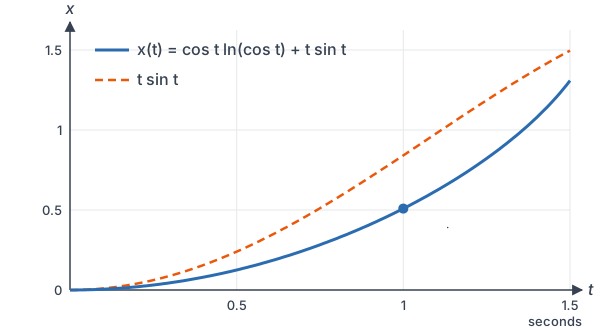
An undamped spring starts at rest at its rest position. A motor pushes it with a force that grows as time goes on, and its position x (in meters, t in seconds) satisfies x″ + x = sec t for t between 0 and π/2, with x(0) = 0 and x′(0) = 0. Find x(t) and the position at t = 1.
u_1' = -\sin t\sec t = -\tan t
With x₁ = cos t, x₂ = sin t and W = 1, use u₁′ = −x₂g/W.
u_1 = \ln(\cos t)
Integrate; cos t is positive here.
u_2' = \cos t\sec t = 1 \Rightarrow u_2 = t
Use u₂′ = x₁g/W and integrate.
x_p = \cos t\ln(\cos t) + t\sin t
Form u₁x₁ + u₂x₂.
x = C_1\cos t + C_2\sin t + \cos t\ln(\cos t) + t\sin t
Add x_c.
C_1 = 0
Substitute t = 0: ln(cos 0) = ln 1 = 0.
x_p' = -\sin t\ln(\cos t) - \sin t + \sin t + t\cos t
Differentiate xₚ with the product rule and the chain rule.
x' = C_2\cos t - \sin t\ln(\cos t) + t\cos t
Combine like terms and add the derivative of C₂ sin t.
C_2 = 0
Substitute t = 0 into x′.
x(1) = \cos 1\ln(\cos 1) + \sin 1 \approx -0.3326 + 0.8415
Substitute t = 1 with a calculator in radian mode.
x(1) \approx 0.509
Add.
Answer: x(t) = cos t ln(cos t) + t sin t, and x(1) ≈ 0.509 m. Here the particular solution already matches both initial conditions, so x_c drops out.
Common mistakes
| Mistake | Example of the error | Fix |
|---|---|---|
| Skipping standard form | Using g = x³ for x²y″ − 2xy′ + 2y = x³ | Divide by x² first: g = x. |
| Mixing up the signs | u₁′ = y₂g/W | The minus sign goes on u₁′ = −y₂g/W. |
| Pairing the wrong functions | u₁′ = −y₁g/W | u₁′ uses y₂ and u₂′ uses y₁. |
| Forgetting W | u₂′ = y₁g | Divide by W, even when it is not 1. |
| Stopping at u₁ and u₂ | Giving u₂ = ln x as the answer | The answer is yₚ = u₁y₁ + u₂y₂, plus y_c. |
| Sign error integrating tan x | Writing ∫tan x dx = ln(cos x) | ∫tan x dx = −ln|cos x|, so ∫(−tan x) dx = ln|cos x|. |
Related ideas
Variation of parameters vs. undetermined coefficients
| Undetermined coefficients | Variation of parameters | |
|---|---|---|
| Right side g(x) | Polynomials, exponentials, sines, cosines and their products | Any continuous g(x) |
| Coefficients | Constants only | Can depend on x, if y₁ and y₂ are known |
| Work | Algebra (match coefficients) | Two integrals |
When g(x) fits the table in Method of Undetermined Coefficients, that method is usually faster. Example 3 shows the two agree.
Where the formula comes from
The two conditions u₁′y₁ + u₂′y₂ = 0 and u₁′y₁′ + u₂′y₂′ = g form a linear system in u₁′ and u₂′. Its coefficient determinant is the Wronskian from The Wronskian lesson, which is not 0 for a fundamental set, so the system always has one solution.
Equations with variable coefficients
Variation of parameters needs y₁ and y₂ first. For equations like x²y″ + bxy′ + cy = 0, Cauchy-Euler Equations shows how to find them, and Reduction of Order finds y₂ from y₁.
Practice problems
- Find a particular solution of y″ + y = sec x for x between −π/2 and π/2.
- Find a particular solution of y″ + y = csc x for x between 0 and π.
- Find a particular solution of y″ + 4y = sec 2x for x between −π/4 and π/4.
- Use variation of parameters to find a particular solution of y″ − y = e^x.
- Find a particular solution of y″ + 2y′ + y = e^(−x)/x² for positive x.
- Find a particular solution of y″ − 4y′ + 4y = e^(2x)/(1 + x²).
- Use variation of parameters to find a particular solution of y″ + y = sin x.
- For positive x, y₁ = x² and y₂ = x² ln x solve x²y″ − 3xy′ + 4y = 0. Find a particular solution of x²y″ − 3xy′ + 4y = x².
- For positive x, y₁ = e^x and y₂ = x + 1 solve xy″ − (x + 1)y′ + y = 0. Find a particular solution of xy″ − (x + 1)y′ + y = x².
- Solve y″ + y = tan x with y(0) = 1 and y′(0) = 0, for x between −π/2 and π/2.
Show answers
1.
u_1' = -\sin x\sec x = -\tan x \Rightarrow u_1 = \ln(\cos x)
y₁ = cos x, y₂ = sin x, W = 1; cos x is positive here.
u_2' = \cos x\sec x = 1 \Rightarrow u_2 = x
Use u₂′ = y₁g/W and integrate.
Answer: yₚ = cos x ln(cos x) + x sin x
2.
u_1' = -\sin x\csc x = -1 \Rightarrow u_1 = -x
y₁ = cos x, y₂ = sin x, W = 1.
u_2' = \cos x\csc x = \cot x \Rightarrow u_2 = \ln(\sin x)
Integrate; sin x is positive here.
Answer: yₚ = −x cos x + sin x ln(sin x)
3.
W = \cos 2x(2\cos 2x) - \sin 2x(-2\sin 2x) = 2
y₁ = cos 2x, y₂ = sin 2x.
u_1' = -\dfrac{\sin 2x\sec 2x}{2} = -\tfrac{1}{2}\tan 2x \Rightarrow u_1 = \tfrac{1}{4}\ln(\cos 2x)Use u₁′ = −y₂g/W and integrate with u = 2x.
u_2' = \dfrac{\cos 2x\sec 2x}{2} = \tfrac{1}{2} \Rightarrow u_2 = \tfrac{x}{2}Use u₂′ = y₁g/W and integrate.
Answer: yₚ = ¼ cos 2x ln(cos 2x) + ½ x sin 2x
4.
W = e^{x}(-e^{-x}) - e^{-x}e^{x} = -2y₁ = e^x, y₂ = e^(−x).
u_1' = -\dfrac{e^{-x}e^{x}}{-2} = \tfrac{1}{2} \Rightarrow u_1 = \tfrac{x}{2}Use u₁′ = −y₂g/W and integrate.
u_2' = \dfrac{e^{x}e^{x}}{-2} = -\tfrac{1}{2}e^{2x} \Rightarrow u_2 = -\tfrac{1}{4}e^{2x}Use u₂′ = y₁g/W and integrate.
y_p = \tfrac{x}{2}e^{x} - \tfrac{1}{4}e^{x}Form u₁y₁ + u₂y₂.
Answer: yₚ = ½xe^x (dropping −¼e^x, which is in y_c)
5.
W = e^{-x}(1 - x)e^{-x} - xe^{-x}(-e^{-x}) = e^{-2x}y₁ = e^(−x), y₂ = xe^(−x).
u_1' = -\dfrac{1}{x} \Rightarrow u_1 = -\ln x−y₂g/W = −xe^(−x)·e^(−x)/(x²e^(−2x)).
u_2' = \dfrac{1}{x^2} \Rightarrow u_2 = -\dfrac{1}{x}y₁g/W = e^(−x)·e^(−x)/(x²e^(−2x)).
y_p = -e^{-x}\ln x - e^{-x}Form u₁y₁ + u₂y₂.
Answer: yₚ = −e^(−x) ln x (dropping −e^(−x))
6.
u_1' = -\dfrac{x}{1 + x^2} \Rightarrow u_1 = -\tfrac{1}{2}\ln(1 + x^2)y₁ = e^(2x), y₂ = xe^(2x), W = e^(4x); integrate with u = 1 + x².
u_2' = \dfrac{1}{1 + x^2} \Rightarrow u_2 = \arctan xIntegrate (see integrals that give inverse trig functions).
Answer: yₚ = e^(2x)(x arctan x − ½ ln(1 + x²))
7.
u_1' = -\sin^2 x = -\tfrac{1}{2} + \tfrac{1}{2}\cos 2xW = 1; use the identity sin²x = (1 − cos 2x)/2.
u_1 = -\tfrac{x}{2} + \tfrac{1}{4}\sin 2xIntegrate.
u_2' = \sin x\cos x \Rightarrow u_2 = \tfrac{1}{2}\sin^2 xIntegrate with u = sin x.
y_p = -\tfrac{x}{2}\cos x + \tfrac{1}{2}\sin x\cos^2 x + \tfrac{1}{2}\sin^3 xForm u₁y₁ + u₂y₂, using sin 2x = 2 sin x cos x.
y_p = -\tfrac{x}{2}\cos x + \tfrac{1}{2}\sin xFactor ½ sin x and use cos²x + sin²x = 1.
Answer: yₚ = −½x cos x (dropping ½ sin x)
8.
y'' - \dfrac{3}{x}y' + \dfrac{4}{x^2}y = 1Divide by x², so g = 1.
W = x^2(2x\ln x + x) - x^2\ln x(2x) = x^3
Compute the Wronskian.
u_1' = -\dfrac{\ln x}{x} \Rightarrow u_1 = -\tfrac{1}{2}(\ln x)^2−y₂g/W = −x² ln x/x³; integrate with u = ln x.
u_2' = \dfrac{1}{x} \Rightarrow u_2 = \ln xy₁g/W = x²/x³.
y_p = -\tfrac{1}{2}x^2(\ln x)^2 + x^2(\ln x)^2Form u₁y₁ + u₂y₂.
Answer: yₚ = ½x²(ln x)²
9.
y'' - \dfrac{x + 1}{x}y' + \dfrac{1}{x}y = xDivide by x, so g = x.
W = e^{x}(1) - (x + 1)e^{x} = -xe^{x}Compute the Wronskian.
u_1' = (x + 1)e^{-x} \Rightarrow u_1 = -(x + 2)e^{-x}−y₂g/W = (x + 1)x/(xe^x); integrate by parts.
u_2' = -1 \Rightarrow u_2 = -x
y₁g/W = e^x·x/(−xe^x).
y_p = -(x + 2) - x(x + 1) = -x^2 - 2x - 2
Form u₁y₁ + u₂y₂ and distribute.
y_p = -x^2
Drop −2x − 2 = −2(x + 1), a multiple of y₂.
Answer: yₚ = −x²
10.
y = C_1\cos x + C_2\sin x - \cos x\ln(\sec x + \tan x)
Use Example 1.
C_1 = 1
Substitute x = 0; ln(1 + 0) = 0.
y' = -C_1\sin x + C_2\cos x + \sin x\ln(\sec x + \tan x) - 1
Differentiate; the derivative of ln(sec x + tan x) is sec x, and cos x sec x = 1.
C_2 - 1 = 0 \Rightarrow C_2 = 1
Substitute x = 0 into y′.
Answer: y = cos x + sin x − cos x ln(sec x + tan x)
Variation of parameters FAQ
What is variation of parameters?
It is a method for finding a particular solution of a linear nonhomogeneous differential equation. You replace the constants in y_c = C₁y₁ + C₂y₂ with functions u₁ and u₂ and solve for their derivatives.
What is the variation of parameters formula?
For y″ + py′ + qy = g, use yₚ = u₁y₁ + u₂y₂ with u₁′ = −y₂g/W and u₂′ = y₁g/W, where W = y₁y₂′ − y₂y₁′.
When should I use variation of parameters instead of undetermined coefficients?
Use it when g(x) is not a polynomial, exponential, sine, cosine or a product of these, such as tan x, sec x, ln x or 1/x, or when the coefficients depend on x.
Do I need the constants of integration for u₁ and u₂?
No. Constants of integration only add multiples of y₁ and y₂, which are already in y_c.
Summary
- Write the equation in standard form y″ + py′ + qy = g.
- Find y₁, y₂ and the Wronskian W = y₁y₂′ − y₂y₁′.
- u₁′ = −y₂g/W and u₂′ = y₁g/W; integrate both.
- yₚ = u₁y₁ + u₂y₂, and y = y_c + yₚ.
- It works for any continuous g(x), but the integrals can be hard.
Previous lesson: Method of Undetermined Coefficients
Next lesson: Cauchy-Euler Equations
Back to the Differential Equations Index