
Classifying Differential Equations
Classifying differential equations means sorting them by the features that decide how to solve them: whether the equation is ordinary or partial, its order (the highest derivative), whether it is linear or nonlinear, and, for a linear equation, whether it is homogeneous. Each label points to a different solution method.
Before this lesson: Verifying Solutions to Differential Equations, Separable Differential Equations and Partial Derivatives
The idea: labels that point to a method
A differential equation is an equation that links an unknown function to one or more of its derivatives. Before you try to solve one, you name its type, the same way you would check whether a polynomial equation is linear or quadratic before choosing a method.
Four questions do most of the work. Does the unknown function depend on one variable or several? What is the highest derivative? Do the unknown function and its derivatives appear only in a simple, first-power way? Is there a term with no unknown function in it at all?
Linear equations matter most because they behave like the systems in linear algebra. If you write the left side as L[y], then L is a linear operator, much like a linear transformation: L[c₁y₁ + c₂y₂] = c₁L[y₁] + c₂L[y₂]. That property, called superposition, lets you build new solutions by adding old ones, and it is why linear equations have complete solution methods.
Classifying differential equations: the rules
Ordinary or partial
An ordinary differential equation (ODE) has an unknown function of one independent variable, so every derivative is an ordinary derivative like dy/dx. A partial differential equation (PDE) has an unknown function of two or more variables, so it uses partial derivatives like ∂u/∂t.
Order
The order is the order of the highest derivative in the equation. A power on a derivative does not change the order: (y′)³ + y = 0 is first order, because y′ is the highest derivative that appears. (Some books also define the degree, the power of that highest derivative, when the equation is a polynomial in the derivatives.)
Linear or nonlinear
An nth-order ODE is linear if it can be written in this form, where the coefficients a₀(x), …, aₙ(x) and the right side g(x) depend only on the independent variable x:
a_n(x)\,y^{(n)} + a_{n-1}(x)\,y^{(n-1)} + \cdots + a_1(x)\,y' + a_0(x)\,y = g(x)So y and its derivatives may only appear to the first power, may not multiply each other, and may not sit inside another function such as sin y or eʸ. The coefficients themselves can be any functions of x. Any equation that does not fit this form is nonlinear.
| Term | Linear or nonlinear? | Why |
|---|---|---|
| x^2 y'' | Linear | The coefficient x^2 depends only on x. |
| (\sin x)\,y' | Linear | The sine is of x, not of y. |
| e^x | Linear | No y at all, so it belongs to g(x). |
| y^2 | Nonlinear | y is raised to the second power. |
| y\,y' | Nonlinear | y multiplies its own derivative. |
| (y')^2 | Nonlinear | The derivative is squared. |
| \sin y or e^y | Nonlinear | y is inside another function. |
Homogeneous or nonhomogeneous
A linear equation is homogeneous if g(x) = 0 once every term containing y is on the left side. Otherwise it is nonhomogeneous. If every coefficient aₖ is a constant, the equation has constant coefficients; otherwise it has variable coefficients.
| Label | Question to ask | Example |
|---|---|---|
| Ordinary (ODE) | Does the unknown depend on one variable only? | y' = 2xy |
| Partial (PDE) | Does it depend on two or more variables? | u_t = 3u_{xx} |
| Order n | What is the highest derivative? | y''' + y = 0 has order 3 |
| Linear | Does it fit the linear form above? | x^2y'' + y = \sin x |
| Nonlinear | Is there a term like y^2, yy', (y')^2 or \sin y? | y'' + \sin y = 0 |
| Homogeneous | Linear, and is g(x) = 0? | y'' + 4y = 0 |
| Nonhomogeneous | Linear, and is g(x) ≠ 0? | y'' + 4y = e^x |
| Constant coefficients | Is every aₖ a number? | y'' - 3y' + 2y = 0 |
Classifying differential equations examples
Example 1: Constant coefficients
Classify y″ + 4y′ − 5y = 0.
y'' + 4y' - 5y = 0
Start with the equation. The unknown y is a function of x alone.
\text{ordinary}Only one independent variable, so every derivative is ordinary: this is an ODE.
y'' \;\Rightarrow\; \text{order } 2The highest derivative is y″, so the order is 2.
1\cdot y'' + 4\cdot y' + (-5)\cdot y
y″, y′ and y each appear to the first power, times a constant, so the equation is linear with constant coefficients.
g(x) = 0
The right side is 0, so the equation is homogeneous.
Answer: a second-order linear homogeneous ODE with constant coefficients.
Example 2: Variable coefficients
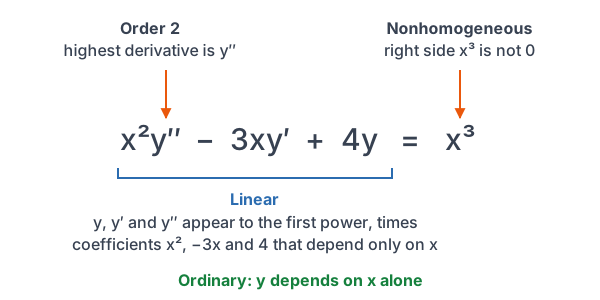
Classify x²y″ − 3xy′ + 4y = x³.
x^2y'' - 3xy' + 4y = x^3
Start with the equation. The unknown y is a function of x alone, so it is an ODE.
y'' \;\Rightarrow\; \text{order } 2The highest derivative is y″.
a_2 = x^2,\; a_1 = -3x,\; a_0 = 4
Read off the coefficients. Each depends only on x, and y″, y′ and y appear to the first power, so the equation is linear.
g(x) = x^3
The right side is not 0, so the equation is nonhomogeneous.
Answer: a second-order linear nonhomogeneous ODE with variable coefficients.
Example 3: Rewrite before you classify
Classify xy′ = x + y.
xy' = x + y
Start with the equation.
xy' - y = x
Subtract y from both sides, so every term with y is on the left.
y' - \dfrac{1}{x}\,y = 1Divide every term by x (for x ≠ 0) to get standard form.
y' \;\Rightarrow\; \text{order } 1The highest derivative is y′, and y depends on x alone, so it is a first-order ODE.
a_0(x) = -\dfrac{1}{x}y′ and y appear to the first power, and the coefficient −1/x depends only on x, so the equation is linear.
g(x) = 1
The right side is not 0, so the equation is nonhomogeneous.
Answer: a first-order linear nonhomogeneous ODE. Notice that y′ = 1 + y/x is also a function of y/x alone. Some books call that kind of equation “homogeneous” in a second, unrelated sense; Substitution for Homogeneous Equations covers it.
Example 4: Partial differential equations
Classify the heat equation u_t = 3u_xx and the equation u_t + u·u_x = 0, where u = u(x, t).
u_t = 3u_{xx}Start with the heat equation. The unknown u depends on two variables, x and t.
\dfrac{\partial u}{\partial t} = 3\,\dfrac{\partial^2 u}{\partial x^2}Write the subscripts as partial derivatives. So this is a PDE.
\dfrac{\partial^2 u}{\partial x^2} \;\Rightarrow\; \text{order } 2The highest derivative is second order.
u_t - 3u_{xx} = 0Subtract 3u_xx from both sides. Each term is a constant times a derivative of u, and the right side is 0, so it is linear and homogeneous.
u_t + u\,u_x = 0
Now the second equation. u still depends on x and t, so it is also a PDE.
u\,u_x \;\Rightarrow\; \text{nonlinear}u multiplies its own derivative u_x, so the equation is nonlinear. Its highest derivative is first order.
Answer: the heat equation is a second-order linear homogeneous PDE. The equation u_t + u·u_x = 0 is a first-order nonlinear PDE.
Example 5: A spring pushed by a motor (word problem)
A 2-kilogram mass hangs on a spring with spring constant 50 N/m. A damper with constant 0.4 N·s/m slows it down, and a motor pushes it with a force of 10 cos 3t newtons. Newton’s second law gives 2x″ + 0.4x′ + 50x = 10 cos 3t, where x(t) is the displacement in meters after t seconds. Classify the equation and write it in standard form.
2x'' + 0.4x' + 50x = 10\cos 3t
Start with the model. The unknown x depends on time t alone, so it is an ODE.
x'' \;\Rightarrow\; \text{order } 2The highest derivative is x″, the acceleration.
x'' + 0.2x' + 25x = 5\cos 3t
Divide every term by 2 to get standard form, with leading coefficient 1.
1,\; 0.2,\; 25
x″, x′ and x appear to the first power, times constants, so the equation is linear with constant coefficients.
g(t) = 5\cos 3t
The right side is not 0, so the equation is nonhomogeneous. The cosine is of t, not of x, so it does not make the equation nonlinear.
Answer: a second-order linear nonhomogeneous ODE with constant coefficients. Without the motor, the right side is 0 and the equation becomes homogeneous. Unit 2 solves both kinds, in Method of Undetermined Coefficients and Spring-Mass Systems.
Common mistakes
| Mistake | Example of the error | Fix |
|---|---|---|
| Calling an equation nonlinear because a coefficient has x in it | Saying x^2y'' + y = 0 is nonlinear because of x^2 | Only powers and products of y and its derivatives matter. Coefficients may be any functions of x. |
| Calling an equation linear because x appears to the first power | Saying y' = x + y^2 is linear | Look at y, not x. The y^2 term makes it nonlinear. |
| Confusing order with a power | Saying (y')^3 + y = 0 is third order | Order is the highest derivative, here y′. It is first order (and nonlinear). |
| Judging homogeneous before moving terms | Calling y'' + y - x = 0 homogeneous because the right side is 0 | Move the term without y to the right: y'' + y = x, so it is nonhomogeneous. |
| Thinking any sine makes an equation nonlinear | Calling (\sin x)y' + y = 0 nonlinear | \sin x is just a coefficient. Only \sin y (or sine of a derivative) is nonlinear. |
| Calling a PDE an ODE because only one derivative is written | Saying u_t = 3u_{xx} is an ODE | u depends on x and t, so its derivatives are partial: it is a PDE. |
Related methods: which type goes with which lesson
| Type of equation | Where it is solved |
|---|---|
| First-order separable, dy/dx = g(x)h(y) | Separable Differential Equations |
| First-order linear, y′ + p(x)y = q(x) | First-Order Linear Differential Equations |
| First-order nonlinear, special forms | Exact Differential Equations and Bernoulli Equations |
| Second-order linear, constant coefficients | Second-Order Homogeneous Linear Equations |
| Any first-order equation, numerically | Euler’s Method and the Runge-Kutta Method |
| Linear PDEs such as the heat equation | Unit 6 of the Differential Equations course |
Many first-order models from calculus fit these labels too: the logistic differential equation is first-order and nonlinear, and a slope field can show the shape of solutions to any first-order ODE, linear or not.
Practice problems
- Classify y‴ − 2y′ = x.
- Classify t²y″ + ty′ + (t² − 4)y = 0.
- Classify dy/dx = xy².
- Classify y″ + yy′ = 0.
- Classify y⁽⁴⁾ + y = cos x.
- Classify Laplace’s equation u_xx + u_yy = 0, where u = u(x, y).
- Classify y′ + eʸ = x.
- Rewrite x²y′ = 3xy + x⁴ in standard form and classify it.
- A fish population P (in thousands) after t years follows dP/dt = 0.2P(1 − P/800). Classify the equation.
- The charge q (in coulombs) on a capacitor in a circuit follows 0.5q″ + 10q′ + 50q = 12 sin 60t. Write it in standard form and classify it.
Show answers
1.
y''' - 2y' = x
y depends on x alone, so it is an ODE.
y''' \;\Rightarrow\; \text{order } 3The highest derivative is y‴.
1\cdot y''' + (-2)\cdot y'
The derivatives appear to the first power, times constants: linear with constant coefficients.
g(x) = x
The right side is not 0: nonhomogeneous.
Answer: a third-order linear nonhomogeneous ODE with constant coefficients
2.
t^2y'' + ty' + (t^2 - 4)y = 0
y depends on t alone, so it is an ODE.
y'' \;\Rightarrow\; \text{order } 2The highest derivative is y″.
a_2 = t^2,\; a_1 = t,\; a_0 = t^2 - 4
The coefficients depend only on t, and y, y′, y″ appear to the first power: linear with variable coefficients.
g(t) = 0
The right side is 0: homogeneous.
Answer: a second-order linear homogeneous ODE with variable coefficients
3.
\dfrac{dy}{dx} = xy^2y depends on x alone, so it is an ODE of order 1.
xy^2
y is squared, so the equation is nonlinear. (It is separable.)
Answer: a first-order nonlinear ODE
4.
y'' + yy' = 0
y depends on x alone, and the highest derivative is y″: a second-order ODE.
y\,y'
y multiplies its own derivative, so the equation is nonlinear.
Answer: a second-order nonlinear ODE
5.
y^{(4)} + y = \cos xy depends on x alone, so it is an ODE.
y^{(4)} \;\Rightarrow\; \text{order } 4The highest derivative is the fourth derivative.
1\cdot y^{(4)} + 1\cdot yFirst powers times constants: linear with constant coefficients.
g(x) = \cos x
The cosine is of x, so it belongs to g(x), which is not 0: nonhomogeneous.
Answer: a fourth-order linear nonhomogeneous ODE with constant coefficients
6.
u_{xx} + u_{yy} = 0u depends on x and y, so the derivatives are partial: a PDE.
u_{xx} \;\Rightarrow\; \text{order } 2The highest derivatives are second order.
1\cdot u_{xx} + 1\cdot u_{yy} = 0Each term is a constant times a derivative of u, and the right side is 0: linear and homogeneous.
Answer: a second-order linear homogeneous PDE
7.
y' + e^y = x
y depends on x alone, and the highest derivative is y′: a first-order ODE.
e^y
y is inside the exponential function, so the equation is nonlinear.
Answer: a first-order nonlinear ODE
8.
x^2y' = 3xy + x^4
Start with the equation.
x^2y' - 3xy = x^4
Subtract 3xy from both sides.
y' - \dfrac{3}{x}\,y = x^2Divide every term by x² (for x ≠ 0).
a_0(x) = -\dfrac{3}{x},\; g(x) = x^2First order, y′ and y to the first power, coefficient depends only on x: linear. g(x) is not 0: nonhomogeneous.
Answer: y′ − (3/x)y = x², a first-order linear nonhomogeneous ODE
9.
\dfrac{dP}{dt} = 0.2P\left(1 - \dfrac{P}{800}\right)P depends on t alone, and the highest derivative is dP/dt: a first-order ODE.
\dfrac{dP}{dt} = 0.2P - \dfrac{0.2}{800}P^2Multiply out with the distributive property.
\dfrac{dP}{dt} = 0.2P - 0.00025P^2Divide 0.2 by 800.
P^2
The P² term makes the equation nonlinear.
Answer: a first-order nonlinear ODE (a logistic equation)
10.
0.5q'' + 10q' + 50q = 12\sin 60t
q depends on t alone, so it is an ODE.
q'' + 20q' + 100q = 24\sin 60t
Divide every term by 0.5 to get standard form.
q'' \;\Rightarrow\; \text{order } 2The highest derivative is q″.
1,\; 20,\; 100
q″, q′ and q appear to the first power, times constants: linear with constant coefficients.
g(t) = 24\sin 60t
The right side is not 0: nonhomogeneous.
Answer: q″ + 20q′ + 100q = 24 sin 60t, a second-order linear nonhomogeneous ODE with constant coefficients
Classifying differential equations FAQ
What is the order of a differential equation?
The order is the order of the highest derivative that appears. For example, y″ + 3y′ = x is second order. A power on a derivative, as in (y′)², does not raise the order.
How do you tell if a differential equation is linear?
Move every term with y to the left side. The equation is linear if y and its derivatives appear only to the first power, never multiplied together or inside another function, and every coefficient depends only on the independent variable.
What is the difference between an ordinary and a partial differential equation?
In an ordinary differential equation the unknown function depends on one variable, so it has ordinary derivatives. In a partial differential equation the unknown depends on two or more variables, so it has partial derivatives.
What does homogeneous mean for a differential equation?
For a linear equation, homogeneous means the right side g(x) is 0 once all the y terms are on the left. For a first-order equation, some books also use the word for dy/dx = F(y/x), which is a different idea solved with the substitution y = vx.
Summary
- An ODE has an unknown function of one variable; a PDE has an unknown function of two or more variables.
- The order is the highest derivative, not the highest power.
- A linear equation has the form aₙ(x)y⁽ⁿ⁾ + … + a₁(x)y′ + a₀(x)y = g(x).
- Terms like y², yy′, (y′)², sin y and eʸ make an equation nonlinear; coefficients in x do not.
- A linear equation is homogeneous when g(x) = 0 after all y terms are on the left.
- The labels tell you which solution method to use.
Previous course: Linear Algebra Index
Next lesson: First-Order Linear Differential Equations
Back to the Differential Equations Index