
Bernoulli Equations
A Bernoulli equation is a first-order differential equation of the form y′ + p(x)y = q(x)yⁿ, where n is any real number other than 0 or 1. The substitution v = y^(1−n) turns it into a linear equation in v, which you solve with an integrating factor before converting back to y.
Before this lesson: First-Order Linear Differential Equations, Chain Rule and Logistic Differential Equations
The idea: a substitution that removes the power
The term yⁿ makes a Bernoulli equation nonlinear, so the integrating factor can’t be used directly. But divide every term by yⁿ and look at what is left: y⁻ⁿy′ + p(x)y¹⁻ⁿ = q(x).
The two y-terms are related. By the chain rule, the derivative of y¹⁻ⁿ is (1 − n)y⁻ⁿy′, which is just a constant times the first term. So if you name v = y¹⁻ⁿ, the whole equation becomes linear in v.
That is the pattern for many first-order equations: a good substitution turns an equation you can’t solve into one you can.
Bernoulli equations: the substitution
y' + p(x)\,y = q(x)\,y^n, \qquad n \ne 0,\ 1
Here is why v = y¹⁻ⁿ works.
y^{-n}y' + p(x)\,y^{1-n} = q(x)Divide every term by yⁿ (for y ≠ 0).
v = y^{1-n}Name the new unknown.
v' = (1 - n)\,y^{-n}y'Differentiate with the chain rule.
y^{-n}y' = \dfrac{v'}{1 - n}Divide both sides by 1 − n.
\dfrac{v'}{1 - n} + p(x)\,v = q(x)Substitute into the first line.
v' + (1 - n)\,p(x)\,v = (1 - n)\,q(x)
Multiply every term by 1 − n. This equation is linear in v.
How to solve a Bernoulli equation
- Write the equation as y′ + p(x)y = q(x)yⁿ and identify p, q and n.
- Divide every term by yⁿ.
- Let v = y¹⁻ⁿ, so that y⁻ⁿy′ = v′/(1 − n). Substitute.
- Solve the linear equation in v with an integrating factor.
- Replace v with y¹⁻ⁿ and solve for y. Use an initial condition, if given.
- If n is positive, note that y = 0 is also a solution. It was lost when you divided by yⁿ.
| n | Substitution | Linear equation in v |
|---|---|---|
| 2 | v = y^{-1} | v' - pv = -q |
| 3 | v = y^{-2} | v' - 2pv = -2q |
| \tfrac{1}{2} | v = y^{1/2} | v' + \tfrac{1}{2}pv = \tfrac{1}{2}q |
| −1 | v = y^{2} | v' + 2pv = 2q |
If n = 0 or n = 1, the equation is already linear, so no substitution is needed.
Bernoulli equation examples
Example 1: n = 2
Solve y′ + y = y².
y^{-2}y' + y^{-1} = 1Here p = 1, q = 1 and n = 2. Divide every term by y².
v = y^{-1},\; v' = -y^{-2}y'Let v = y^(1−2) = y^(−1) and differentiate with the chain rule.
-v' + v = 1
Substitute y^(−2)y′ = −v′ and y^(−1) = v.
v' - v = -1
Multiply every term by −1.
\mu = e^{\int -1\,dx} = e^{-x}Find the integrating factor (see first-order linear differential equations).
(e^{-x}v)' = -e^{-x}Multiply every term by e^(−x) and rewrite the left side.
e^{-x}v = e^{-x} + CIntegrate both sides.
v = 1 + Ce^{x}Multiply every term by eˣ.
y = \dfrac{1}{1 + Ce^{x}}Replace v with 1/y and take the reciprocal of both sides.
Answer: y = 1/(1 + Ceˣ), plus the constant solution y = 0, which was lost when we divided by y².
Example 2: Standard form first
Solve xy′ + y = x²y² for positive x, with y(1) = 1.
y' + \dfrac{1}{x}\,y = xy^2Divide every term by x. Now p = 1/x, q = x and n = 2.
y^{-2}y' + \dfrac{1}{x}\,y^{-1} = xDivide every term by y².
-v' + \dfrac{1}{x}\,v = xLet v = y^(−1), so y^(−2)y′ = −v′.
v' - \dfrac{1}{x}\,v = -xMultiply every term by −1.
\mu = e^{-\ln x} = \dfrac{1}{x}Find the integrating factor.
\left(\dfrac{v}{x}\right)' = -1Multiply every term by 1/x and rewrite the left side.
\dfrac{v}{x} = -x + CIntegrate both sides.
v = Cx - x^2
Multiply both sides by x.
y = \dfrac{1}{Cx - x^2}Replace v with 1/y and take reciprocals.
1 = \dfrac{1}{C - 1}Substitute x = 1 and y = 1.
C = 2
So C − 1 = 1.
Answer: y = 1/(2x − x²), valid for x between 0 and 2.
Example 3: n = 3
Solve y′ + 2y = eˣy³ with y(0) = 1.
y^{-3}y' + 2y^{-2} = e^{x}Here n = 3. Divide every term by y³.
v = y^{-2},\; v' = -2y^{-3}y'Let v = y^(1−3) = y^(−2) and differentiate.
-\tfrac{1}{2}v' + 2v = e^{x}Substitute y^(−3)y′ = −v′/2.
v' - 4v = -2e^{x}Multiply every term by −2.
(e^{-4x}v)' = -2e^{-3x}Multiply by μ = e^(−4x), rewrite the left side, and add exponents on the right.
e^{-4x}v = \tfrac{2}{3}e^{-3x} + CIntegrate: −2 ÷ (−3) = 2/3.
v = \tfrac{2}{3}e^{x} + Ce^{4x}Multiply every term by e^(4x).
1 = \tfrac{2}{3} + CAt x = 0, v = y^(−2) = 1.
C = \tfrac{1}{3}Subtract 2/3 from both sides.
y^{-2} = \dfrac{2e^{x} + e^{4x}}{3}Replace v with y^(−2) and write the right side over 3.
y^2 = \dfrac{3}{2e^{x} + e^{4x}}Take the reciprocal of both sides.
y = \sqrt{\dfrac{3}{2e^{x} + e^{4x}}}Take the positive square root, since y(0) = 1 is positive.
Answer: y = √(3/(2eˣ + e^(4x))).
Example 4: A fractional power
Solve y′ + y = √y with y(0) = 9.
y^{-1/2}y' + y^{1/2} = 1Write √y as y^(1/2), so n = 1/2 (see rational exponents). Divide every term by y^(1/2).
v = y^{1/2},\; v' = \tfrac{1}{2}y^{-1/2}y'Let v = y^(1−1/2) = y^(1/2) and differentiate.
2v' + v = 1
Substitute y^(−1/2)y′ = 2v′.
v' + \tfrac{1}{2}v = \tfrac{1}{2}Divide every term by 2.
(e^{x/2}v)' = \tfrac{1}{2}e^{x/2}Multiply by μ = e^(x/2) and rewrite the left side.
e^{x/2}v = e^{x/2} + CIntegrate both sides.
v = 1 + Ce^{-x/2}Divide every term by e^(x/2).
3 = 1 + C
At x = 0, v = √9 = 3.
C = 2
Subtract 1 from both sides.
y = \left(1 + 2e^{-x/2}\right)^2Replace v with √y and square both sides.
Answer: y = (1 + 2e^(−x/2))². As x grows, y approaches 1.
Example 5: Fish in a pond (word problem)
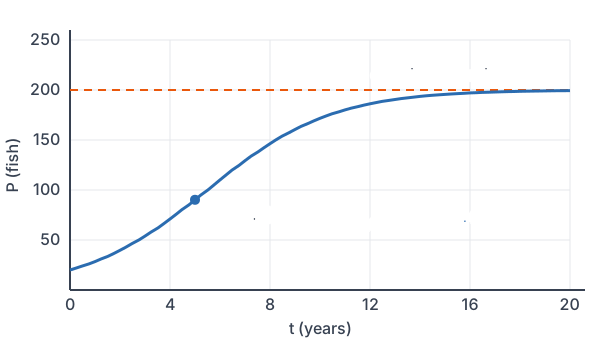
The number of fish P in a pond after t years follows dP/dt = 0.4P − 0.002P². The pond starts with 20 fish. Find P(t), the population after 5 years and the long-run population.
P' - 0.4P = -0.002P^2
Subtract 0.4P from both sides. This is a Bernoulli equation with n = 2.
P^{-2}P' - 0.4P^{-1} = -0.002Divide every term by P².
-v' - 0.4v = -0.002
Let v = P^(−1), so P^(−2)P′ = −v′.
v' + 0.4v = 0.002
Multiply every term by −1.
(e^{0.4t}v)' = 0.002e^{0.4t}Multiply by μ = e^(0.4t) and rewrite the left side.
e^{0.4t}v = 0.005e^{0.4t} + CIntegrate: 0.002 ÷ 0.4 = 0.005.
v = 0.005 + Ce^{-0.4t}Divide every term by e^(0.4t).
0.05 = 0.005 + C
At t = 0, v = 1/20 = 0.05.
C = 0.045
Subtract 0.005 from both sides.
P = \dfrac{1}{0.005 + 0.045e^{-0.4t}}Replace v with 1/P and take reciprocals.
P = \dfrac{200}{1 + 9e^{-0.4t}}Multiply the top and bottom by 200.
P(5) = \dfrac{200}{1 + 9e^{-2}} \approx 90.2Substitute t = 5 and use a calculator.
Answer: P = 200/(1 + 9e^(−0.4t)). After 5 years there are about 90 fish. As t grows, e^(−0.4t) approaches 0, so the population levels off at 200, the carrying capacity.
Common mistakes
| Mistake | Example of the error | Fix |
|---|---|---|
| Using the wrong power for v | For n = 3, letting v = y^2 | Use v = y^{1-n}, so v = y^{-2}. |
| Forgetting the factor 1 − n | Turning y^{-3}y' + 2y^{-2} = e^x into v' + 2v = e^x | Since y^{-3}y' = -\tfrac{1}{2}v', the equation is v' - 4v = -2e^x. |
| Substituting before dividing by yⁿ | Putting v into y' + y = y^2 directly | Divide every term by y^n first, then substitute. |
| Stopping at v | Giving v = 1 + Ce^x as the answer | Replace v with y^{1-n} and solve for y. |
| Losing y = 0 | Listing only y = \frac{1}{1 + Ce^x} | When n is positive, y = 0 is also a solution. |
| Substituting when n = 0 or 1 | Using v = y^{0} for y' + y = xy | With n = 1 the equation is already linear: y' + (1 - x)y = 0. |
Related methods
Logistic growth
The logistic equation dP/dt = kP(1 − P/M) is a Bernoulli equation with n = 2. It is also separable, and logistic differential equations solves it that way with partial fractions. The Bernoulli substitution reaches the same formula without partial fractions, as Example 5 shows.
Other substitutions
Equations of the form dy/dx = F(y/x) use a different substitution, v = y/x. That is the next lesson, Substitution for Homogeneous Equations. An equation like y′ = 1 + y + y², with an extra constant term, is a Riccati equation, not a Bernoulli equation.
Checking the type first
Classifying differential equations helps you spot the form: a Bernoulli equation is first order, nonlinear only because of the single yⁿ term, and linear in every other way.
Practice problems
- Solve y′ − y = −y².
- For y′ + (3/x)y = x²y⁴, identify n, the substitution v and the linear equation in v. (Don’t solve it.)
- Solve y′ + 2y = 2y³.
- Solve y′ + (1/x)y = y² for positive x.
- Solve y′ − y = eˣy² with y(0) = 2.
- Solve y′ + 2y = 2√y with y(0) = 4.
- Solve y′ − 3y = −3y^(1/3).
- Which are Bernoulli equations? (a) y′ + xy = xy³ (b) y′ + y = y² + 1 (c) y′ − y = x√y (d) y′ + y = x
- A deer population P after t years follows dP/dt = 0.5P − 0.001P², with P(0) = 50. Find P(t), the population after 4 years and the carrying capacity.
- A coasting boat slows down with velocity v (in m/s) after t seconds following dv/dt = −0.1v − 0.02v², with v(0) = 10. Find v(t) and the speed after 10 seconds.
Show answers
1.
y^{-2}y' - y^{-1} = -1Here n = 2. Divide every term by y².
-v' - v = -1
Let v = y^(−1), so y^(−2)y′ = −v′.
v' + v = 1
Multiply every term by −1.
(e^{x}v)' = e^{x}Multiply by μ = eˣ and rewrite the left side.
v = 1 + Ce^{-x}Integrate to get eˣv = eˣ + C, then divide by eˣ.
y = \dfrac{1}{1 + Ce^{-x}}Replace v with 1/y and take reciprocals.
Answer: y = 1/(1 + Ce^(−x)), and also y = 0
2.
n = 4
The power on the right side is y⁴.
v = y^{1-4} = y^{-3}Use v = y^(1−n).
v' + (1 - 4)\cdot\dfrac{3}{x}\,v = (1 - 4)\,x^2Use v′ + (1 − n)pv = (1 − n)q with p = 3/x and q = x².
v' - \dfrac{9}{x}\,v = -3x^2Simplify each coefficient.
Answer: n = 4, v = y^(−3), and v′ − (9/x)v = −3x²
3.
y^{-3}y' + 2y^{-2} = 2Here n = 3. Divide every term by y³.
-\tfrac{1}{2}v' + 2v = 2Let v = y^(−2), so y^(−3)y′ = −v′/2.
v' - 4v = -4
Multiply every term by −2.
(e^{-4x}v)' = -4e^{-4x}Multiply by μ = e^(−4x) and rewrite the left side.
e^{-4x}v = e^{-4x} + CIntegrate both sides.
v = 1 + Ce^{4x}Multiply every term by e^(4x).
y^2 = \dfrac{1}{1 + Ce^{4x}}Replace v with y^(−2) and take reciprocals.
Answer: y² = 1/(1 + Ce^(4x)), and also y = 0
4.
y^{-2}y' + \dfrac{1}{x}\,y^{-1} = 1Here n = 2. Divide every term by y².
v' - \dfrac{1}{x}\,v = -1Let v = y^(−1), substitute −v′, and multiply every term by −1.
\left(\dfrac{v}{x}\right)' = -\dfrac{1}{x}Multiply by μ = 1/x and rewrite the left side.
\dfrac{v}{x} = -\ln x + CIntegrate both sides (x is positive).
v = x(C - \ln x)
Multiply both sides by x.
Answer: y = 1/(x(C − ln x)), and also y = 0
5.
y^{-2}y' - y^{-1} = e^{x}Here n = 2. Divide every term by y².
v' + v = -e^{x}Let v = y^(−1), substitute −v′, and multiply every term by −1.
(e^{x}v)' = -e^{2x}Multiply by μ = eˣ and rewrite the left side.
e^{x}v = -\tfrac{1}{2}e^{2x} + CIntegrate both sides.
v = -\tfrac{1}{2}e^{x} + Ce^{-x}Divide every term by eˣ.
\tfrac{1}{2} = -\tfrac{1}{2} + CAt x = 0, v = 1/y = 1/2.
C = 1
Add 1/2 to both sides.
Answer: y = 1/(e^(−x) − ½eˣ)
6.
y^{-1/2}y' + 2y^{1/2} = 2Here n = 1/2. Divide every term by y^(1/2).
2v' + 2v = 2
Let v = y^(1/2), so y^(−1/2)y′ = 2v′.
v' + v = 1
Divide every term by 2.
v = 1 + Ce^{-x}Multiply by μ = eˣ, integrate, and divide by eˣ, as in Problem 1.
2 = 1 + C
At x = 0, v = √4 = 2.
C = 1
Subtract 1 from both sides.
Answer: y = (1 + e^(−x))²
7.
y^{-1/3}y' - 3y^{2/3} = -3Here n = 1/3. Divide every term by y^(1/3).
\tfrac{3}{2}v' - 3v = -3Let v = y^(2/3), so v′ = (2/3)y^(−1/3)y′ and y^(−1/3)y′ = (3/2)v′.
v' - 2v = -2
Multiply every term by 2/3.
(e^{-2x}v)' = -2e^{-2x}Multiply by μ = e^(−2x) and rewrite the left side.
v = 1 + Ce^{2x}Integrate to get e^(−2x)v = e^(−2x) + C, then multiply by e^(2x).
y = \left(1 + Ce^{2x}\right)^{3/2}Replace v with y^(2/3) and raise both sides to the 3/2 power.
Answer: y = (1 + Ce^(2x))^(3/2), and also y = 0
8.
y' + xy = xy^3
(a) One power term, y³: Bernoulli with n = 3.
y' + y = y^2 + 1
(b) The extra constant 1 doesn’t fit the form: not Bernoulli (it is a Riccati equation).
y' - y = xy^{1/2}(c) Bernoulli with n = 1/2.
y' + y = x
(d) Here n = 0, so the equation is already linear.
Answer: (a) and (c) are Bernoulli; (d) is linear; (b) is neither
9.
v' + 0.5v = 0.001
Write P′ − 0.5P = −0.001P², divide by P², let v = P^(−1), and multiply by −1.
(e^{0.5t}v)' = 0.001e^{0.5t}Multiply by μ = e^(0.5t) and rewrite the left side.
v = 0.002 + Ce^{-0.5t}Integrate (0.001 ÷ 0.5 = 0.002) and divide by e^(0.5t).
0.02 = 0.002 + C
At t = 0, v = 1/50 = 0.02.
C = 0.018
Subtract 0.002 from both sides.
P = \dfrac{1}{0.002 + 0.018e^{-0.5t}} = \dfrac{500}{1 + 9e^{-0.5t}}Take reciprocals, then multiply the top and bottom by 500.
P(4) = \dfrac{500}{1 + 9e^{-2}} \approx 225.4Substitute t = 4.
Answer: P = 500/(1 + 9e^(−0.5t)), about 225 deer after 4 years, carrying capacity 500
10.
v^{-2}v' + 0.1v^{-1} = -0.02Add 0.1v to both sides: v′ + 0.1v = −0.02v², so n = 2. Divide every term by v².
-w' + 0.1w = -0.02
Let w = v^(−1), so v^(−2)v′ = −w′.
w' - 0.1w = 0.02
Multiply every term by −1.
(e^{-0.1t}w)' = 0.02e^{-0.1t}Multiply by μ = e^(−0.1t) and rewrite the left side.
e^{-0.1t}w = -0.2e^{-0.1t} + CIntegrate: 0.02 ÷ (−0.1) = −0.2.
w = -0.2 + Ce^{0.1t}Multiply every term by e^(0.1t).
0.1 = -0.2 + C
At t = 0, w = 1/10 = 0.1.
C = 0.3
Add 0.2 to both sides.
v(10) = \dfrac{1}{0.3e - 0.2} \approx 1.62Use v = 1/w = 1/(0.3e^(0.1t) − 0.2) with t = 10.
Answer: v = 1/(0.3e^(0.1t) − 0.2), about 1.6 m/s after 10 seconds
Bernoulli equations FAQ
What is a Bernoulli differential equation?
It is a first-order equation y′ + p(x)y = q(x)yⁿ with n not equal to 0 or 1. The yⁿ term makes it nonlinear, but a substitution makes it linear.
What substitution do you use for a Bernoulli equation?
Divide by yⁿ and let v = y^(1−n). The equation becomes v′ + (1 − n)p(x)v = (1 − n)q(x), which is linear in v.
Why is y = 0 a solution of a Bernoulli equation?
When n is positive, putting y = 0 makes both sides 0, so the constant function y = 0 works. The method misses it because it divides by yⁿ, so list it separately.
Is the logistic equation a Bernoulli equation?
Yes. dP/dt = kP − (k/M)P² has the form P′ − kP = −(k/M)P², a Bernoulli equation with n = 2. It is also separable.
Summary
- A Bernoulli equation has the form y′ + p(x)y = q(x)yⁿ, with n ≠ 0, 1.
- Divide by yⁿ and substitute v = y^(1−n).
- The new equation v′ + (1 − n)pv = (1 − n)q is linear; solve it with an integrating factor.
- Convert back with y = v^(1/(1−n)) and use the initial condition.
- For positive n, y = 0 is an extra solution.
- The logistic equation is a Bernoulli equation with n = 2.
Previous lesson: Exact Differential Equations
Next lesson: Substitution for Homogeneous Equations
Back to the Differential Equations Index