
Exact Differential Equations
An exact differential equation has the form M(x, y) dx + N(x, y) dy = 0 with ∂M/∂y = ∂N/∂x. Then there is a potential function ψ(x, y) with ψₓ = M and ψᵧ = N, and the solutions are the curves ψ(x, y) = C. You find ψ by integrating M with respect to x and matching N.
Before this lesson: First-Order Linear Differential Equations, Partial Derivatives and Conservative Vector Fields
The idea: solutions are level curves
Suppose a function ψ(x, y) stays constant along a solution curve, so ψ(x, y) = C. Differentiating both sides with respect to x, with y a function of x, gives ψₓ + ψᵧ · dy/dx = 0 by the multivariable chain rule. In differential form, that is ψₓ dx + ψᵧ dy = 0.
So an equation M dx + N dy = 0 is easy to solve whenever M and N are the two partial derivatives of one function ψ. The solutions are simply the level curves ψ(x, y) = C. Such an equation is called exact, and ψ is called a potential function.
How can you tell without knowing ψ? If M = ψₓ and N = ψᵧ, then Mᵧ = ψₓᵧ and Nₓ = ψᵧₓ, and those mixed partials are equal for smooth functions. This is the same test that tells whether the vector field ⟨M, N⟩ is conservative.
Exact differential equations: the test and the method
M(x, y)\,dx + N(x, y)\,dy = 0 \text{ is exact } \iff \dfrac{\partial M}{\partial y} = \dfrac{\partial N}{\partial x}The test holds on a rectangle (or any region without holes) where M, N and their first partial derivatives are continuous.
- Write the equation as M dx + N dy = 0. If it is given as dy/dx = f(x, y), multiply through by dx and move every term to one side.
- Test for exactness: compute Mᵧ and Nₓ and check that they are equal.
- Integrate M with respect to x, treating y as a constant: ψ = ∫M dx + h(y). The constant of integration can depend on y, so write it as h(y).
- Differentiate that ψ with respect to y and set it equal to N. Solve for h′(y). It must not contain x.
- Integrate h′(y) to get h(y). No constant is needed here.
- Write the general solution ψ(x, y) = C, and use an initial condition to find C.
You can also start by integrating N with respect to y and matching M. Pick whichever integral is easier.
Exact differential equations examples
Example 1: Test and solve
Solve (2xy + 3) dx + (x² + 4y) dy = 0.
M = 2xy + 3,\; N = x^2 + 4y
Identify M and N.
M_y = 2x
Differentiate M with respect to y, holding x fixed (see partial derivatives).
N_x = 2x
Differentiate N with respect to x, holding y fixed.
M_y = N_x
They match, so the equation is exact.
\psi = \int (2xy + 3)\,dx = x^2y + 3x + h(y)
Integrate M with respect to x. The constant can depend on y, so call it h(y).
\psi_y = x^2 + h'(y)
Differentiate ψ with respect to y.
x^2 + h'(y) = x^2 + 4y
Set ψᵧ equal to N.
h'(y) = 4y
Subtract x² from both sides.
h(y) = 2y^2
Integrate with respect to y.
x^2y + 3x + 2y^2 = C
Write ψ(x, y) = C.
Answer: x²y + 3x + 2y² = C. This is an implicit solution; implicit differentiation of it gives back the original equation.
Example 2: An initial-value problem
Solve (y cos x + 2x) dx + (sin x + 3y²) dy = 0 with y(0) = 2.
M_y = \cos x,\; N_x = \cos x
M = y cos x + 2x and N = sin x + 3y². The partials match, so the equation is exact.
\psi = \int (y\cos x + 2x)\,dx = y\sin x + x^2 + h(y)
Integrate M with respect to x.
\psi_y = \sin x + h'(y)
Differentiate with respect to y.
h'(y) = 3y^2
Set ψᵧ equal to N = sin x + 3y² and subtract sin x.
h(y) = y^3
Integrate with respect to y.
y\sin x + x^2 + y^3 = C
Write the general solution.
2\sin 0 + 0^2 + 2^3 = C
Substitute x = 0 and y = 2.
C = 8
Since sin 0 = 0 and 2³ = 8.
Answer: y sin x + x² + y³ = 8.
Example 3: Not exact? Use an integrating factor
Solve (3xy + y²) dx + (x² + xy) dy = 0 for positive x.
M_y = 3x + 2y,\; N_x = 2x + y
Compute both partials. They are different, so the equation is not exact.
\dfrac{M_y - N_x}{N} = \dfrac{x + y}{x(x + y)}Subtract the partials and factor x out of N (see factoring out the GCF).
\dfrac{M_y - N_x}{N} = \dfrac{1}{x}Cancel x + y. The result depends on x alone, so an integrating factor μ(x) exists.
\mu = e^{\int (1/x)\,dx} = xFind the integrating factor, as in first-order linear equations.
(3x^2y + xy^2)\,dx + (x^3 + x^2y)\,dy = 0
Multiply every term by x.
M_y = 3x^2 + 2xy = N_x
Test again: now the equation is exact.
\psi = x^3y + \tfrac{1}{2}x^2y^2 + h(y)Integrate the new M with respect to x.
\psi_y = x^3 + x^2y + h'(y)
Differentiate with respect to y.
h'(y) = 0
Set ψᵧ equal to the new N = x³ + x²y and subtract.
x^3y + \tfrac{1}{2}x^2y^2 = Ch is a constant, so it joins C.
Answer: x³y + ½x²y² = C. The rule used here: if (Mᵧ − Nₓ)/N depends only on x, then μ(x) = e^(∫(Mᵧ − Nₓ)/N dx) makes the equation exact.
Example 4: Starting from dy/dx
Solve dy/dx = −(2x + ye^(xy))/(2y + xe^(xy)).
(2x + ye^{xy})\,dx + (2y + xe^{xy})\,dy = 0Multiply both sides by (2y + xe^(xy)) dx and move every term to the left.
M_y = e^{xy} + xye^{xy}Differentiate ye^(xy) with respect to y using the product rule.
N_x = e^{xy} + xye^{xy}Differentiate xe^(xy) with respect to x the same way. The partials match: exact.
\psi = x^2 + e^{xy} + h(y)Integrate M with respect to x. With y held fixed, the integral of ye^(xy) dx is e^(xy).
\psi_y = xe^{xy} + h'(y)Differentiate with respect to y.
h'(y) = 2y
Set ψᵧ equal to N = 2y + xe^(xy) and subtract xe^(xy).
h(y) = y^2
Integrate with respect to y.
x^2 + y^2 + e^{xy} = CWrite ψ(x, y) = C.
Answer: x² + y² + e^(xy) = C.
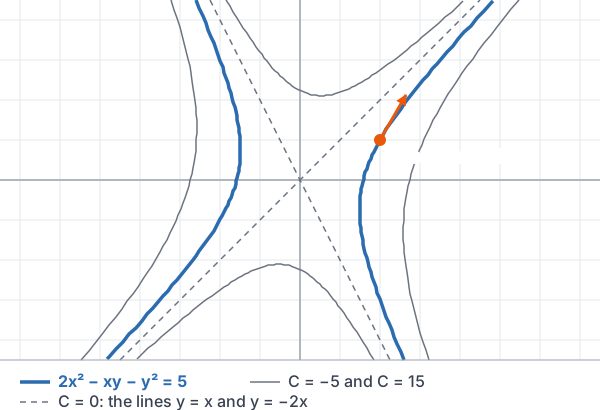
Example 5: Streamlines of a water flow (word problem)
Water flows across a shallow pool. At the point (x, y), in meters, its velocity has components u = x + 2y and v = 4x − y (in cm/s). A drop of dye placed at (2, 1) drifts along a streamline, a curve whose slope at each point is dy/dx = v/u. Find the equation of the dye’s path.
\dfrac{dy}{dx} = \dfrac{4x - y}{x + 2y}Write the slope of a streamline, v/u.
(4x - y)\,dx - (x + 2y)\,dy = 0
Cross-multiply and move every term to the left.
M_y = -1,\; N_x = -1
M = 4x − y and N = −x − 2y. The partials match: exact.
\psi = 2x^2 - xy + h(y)
Integrate M with respect to x.
\psi_y = -x + h'(y)
Differentiate with respect to y.
h'(y) = -2y
Set ψᵧ equal to N = −x − 2y and add x to both sides.
h(y) = -y^2
Integrate with respect to y.
2x^2 - xy - y^2 = C
The streamlines are the level curves of ψ.
2(2)^2 - (2)(1) - (1)^2 = C
Substitute the starting point (2, 1).
C = 5
Simplify: 8 − 2 − 1 = 5.
Answer: the dye follows 2x² − xy − y² = 5. The equation came out exact because this flow neither compresses nor expands: uₓ + vᵧ = 1 + (−1) = 0.
Common mistakes
| Mistake | Example of the error | Fix |
|---|---|---|
| Testing the wrong partials | Comparing M_x with N_y | Compare M_y (M with respect to y) with N_x (N with respect to x). |
| Using a plain constant instead of h(y) | Writing \psi = x^2y + 3x + C after integrating M | When you integrate with respect to x, the constant can depend on y: write h(y). |
| Adding both integrals | \psi = (x^2y + 3x) + (x^2y + 2y^2) | Shared terms like x^2y appear in both integrals. Count each term once. |
| Losing a sign when rewriting dy/dx | From \frac{dy}{dx} = \frac{4x - y}{x + 2y}, taking N = x + 2y | Move every term to one side: N = −(x + 2y). |
| Keeping an x in h′(y) | Getting h'(y) = 4y + x and integrating anyway | h′ can’t depend on x. Recheck the test or the algebra. |
| Stopping at ψ | Giving x^2y + 3x + 2y^2 as the answer | The solution is the equation ψ(x, y) = C. |
Related methods
Conservative vector fields
The test Mᵧ = Nₓ is the same test used for conservative vector fields, and ψ is the potential function of the field ⟨M, N⟩. Finding ψ works exactly the same way in both settings.
Integrating factors for equations that aren’t exact
| If this depends on one variable | Use this integrating factor |
|---|---|
| \dfrac{M_y - N_x}{N} depends on x only | \mu(x) = e^{\int \frac{M_y - N_x}{N}\,dx} |
| \dfrac{N_x - M_y}{M} depends on y only | \mu(y) = e^{\int \frac{N_x - M_y}{M}\,dy} |
Every first-order linear equation y′ + p(x)y = q(x) becomes exact after you multiply by e^(∫p dx), which is why the integrating factor method works.
Separable equations
A separable differential equation dy/dx = g(x)h(y) can be written g(x) dx − (1/h(y)) dy = 0. Here Mᵧ = 0 and Nₓ = 0, so every separable equation is exact.
Practice problems
- Show that (2x + y) dx + (x + 6y) dy = 0 is exact and solve it.
- Solve (3x² + 2y) dx + (2x − 4y³) dy = 0.
- Is x²y dx + xy² dy = 0 exact?
- Solve (eˣ + y) dx + (x + 2y) dy = 0 with y(0) = 1.
- Solve (2xy³ + cos x) dx + (3x²y² − 1) dy = 0.
- Solve (y/x + 6x) dx + (ln x − 2) dy = 0 for positive x.
- Solve dy/dx = −(2xy + 1)/(x² + 3y²).
- Solve (4x³ + 2y) dx + (2x + 2y) dy = 0 with y(1) = 2.
- Find an integrating factor that makes (2y² + 3x) dx + 2xy dy = 0 exact (for positive x), then solve it.
- A flow has velocity components u = 2x + y and v = 3x − 2y. Find the streamline through (1, 1), using dy/dx = v/u.
Show answers
1.
M_y = 1,\; N_x = 1
M = 2x + y and N = x + 6y. The partials match: exact.
\psi = x^2 + xy + h(y)
Integrate M with respect to x.
x + h'(y) = x + 6y
Set ψᵧ equal to N.
h'(y) = 6y
Subtract x from both sides.
h(y) = 3y^2
Integrate with respect to y.
Answer: x² + xy + 3y² = C
2.
M_y = 2,\; N_x = 2
M = 3x² + 2y and N = 2x − 4y³: exact.
\psi = x^3 + 2xy + h(y)
Integrate M with respect to x.
2x + h'(y) = 2x - 4y^3
Set ψᵧ equal to N.
h'(y) = -4y^3
Subtract 2x from both sides.
h(y) = -y^4
Integrate with respect to y.
Answer: x³ + 2xy − y⁴ = C
3.
M_y = x^2
M = x²y, so its partial with respect to y is x².
N_x = y^2
N = xy², so its partial with respect to x is y².
x^2 \ne y^2
The partials are different functions.
Answer: not exact
4.
M_y = 1,\; N_x = 1
M = eˣ + y and N = x + 2y: exact.
\psi = e^x + xy + h(y)
Integrate M with respect to x.
h'(y) = 2y
Set x + h′(y) equal to N and subtract x.
e^x + xy + y^2 = C
Integrate h′ to get h = y² and write ψ = C.
e^0 + 0 + 1^2 = C
Substitute x = 0 and y = 1.
C = 2
Simplify: 1 + 0 + 1.
Answer: eˣ + xy + y² = 2
5.
M_y = 6xy^2,\; N_x = 6xy^2
Differentiate 2xy³ + cos x with respect to y and 3x²y² − 1 with respect to x: exact.
\psi = x^2y^3 + \sin x + h(y)
Integrate M with respect to x.
3x^2y^2 + h'(y) = 3x^2y^2 - 1
Set ψᵧ equal to N.
h'(y) = -1
Subtract 3x²y² from both sides.
h(y) = -y
Integrate with respect to y.
Answer: x²y³ + sin x − y = C
6.
M_y = \dfrac{1}{x},\; N_x = \dfrac{1}{x}M = y/x + 6x and N = ln x − 2: exact.
\psi = y\ln x + 3x^2 + h(y)
Integrate M with respect to x (x is positive).
\ln x + h'(y) = \ln x - 2
Set ψᵧ equal to N.
h'(y) = -2
Subtract ln x from both sides.
h(y) = -2y
Integrate with respect to y.
Answer: y ln x + 3x² − 2y = C
7.
(2xy + 1)\,dx + (x^2 + 3y^2)\,dy = 0
Multiply by (x² + 3y²) dx and move every term to the left.
M_y = 2x,\; N_x = 2x
The partials match: exact.
\psi = x^2y + x + h(y)
Integrate M with respect to x.
h'(y) = 3y^2
Set x² + h′(y) equal to N and subtract x².
h(y) = y^3
Integrate with respect to y.
Answer: x²y + x + y³ = C
8.
M_y = 2,\; N_x = 2
M = 4x³ + 2y and N = 2x + 2y: exact.
\psi = x^4 + 2xy + h(y)
Integrate M with respect to x.
h'(y) = 2y
Set 2x + h′(y) equal to N and subtract 2x.
x^4 + 2xy + y^2 = C
Integrate h′ to get h = y² and write ψ = C.
1 + 2(1)(2) + 2^2 = C
Substitute x = 1 and y = 2.
C = 9
Simplify: 1 + 4 + 4.
Answer: x⁴ + 2xy + y² = 9
9.
M_y = 4y,\; N_x = 2y
M = 2y² + 3x and N = 2xy. Different, so not exact.
\dfrac{M_y - N_x}{N} = \dfrac{2y}{2xy} = \dfrac{1}{x}Depends on x only.
\mu = e^{\int (1/x)\,dx} = xFind the integrating factor.
(2xy^2 + 3x^2)\,dx + 2x^2y\,dy = 0
Multiply every term by x.
M_y = 4xy = N_x
Now exact.
\psi = x^2y^2 + x^3 + h(y)
Integrate the new M with respect to x.
h'(y) = 0
ψᵧ = 2x²y + h′(y) must equal N = 2x²y.
Answer: μ = x, and x²y² + x³ = C
10.
(3x - 2y)\,dx - (2x + y)\,dy = 0
Write dy/dx = (3x − 2y)/(2x + y), cross-multiply and move every term to the left.
M_y = -2,\; N_x = -2
M = 3x − 2y and N = −2x − y: exact.
\psi = \tfrac{3}{2}x^2 - 2xy + h(y)Integrate M with respect to x.
h'(y) = -y
Set −2x + h′(y) equal to N and add 2x.
\tfrac{3}{2}x^2 - 2xy - \tfrac{1}{2}y^2 = CIntegrate h′ to get h = −y²/2.
3x^2 - 4xy - y^2 = K
Multiply both sides by 2 and call 2C = K.
3 - 4 - 1 = K
Substitute x = 1 and y = 1.
Answer: 3x² − 4xy − y² = −2
Exact differential equations FAQ
What makes a differential equation exact?
An equation M dx + N dy = 0 is exact when M and N are the partial derivatives ψₓ and ψᵧ of one function ψ. You test it by checking that ∂M/∂y = ∂N/∂x.
How do you find the potential function?
Integrate M with respect to x and add an unknown h(y). Differentiate the result with respect to y, set it equal to N, solve for h′(y), and integrate. The solution is ψ(x, y) = C.
What if the equation is not exact?
Look for an integrating factor. If (Mᵧ − Nₓ)/N depends only on x, or (Nₓ − Mᵧ)/M depends only on y, the formulas above give one. Otherwise try another method, such as a substitution.
Is every separable equation exact?
Yes. Written as g(x) dx − (1/h(y)) dy = 0, it has Mᵧ = 0 and Nₓ = 0. Both methods give the same solution.
Summary
- M dx + N dy = 0 is exact when Mᵧ = Nₓ.
- Then M = ψₓ and N = ψᵧ for a potential function ψ.
- Find ψ: integrate M with respect to x, add h(y), and match ψᵧ to N.
- The general solution is ψ(x, y) = C, usually in implicit form.
- If the test fails, an integrating factor μ(x) or μ(y) may make the equation exact.
Previous lesson: First-Order Linear Differential Equations
Next lesson: Bernoulli Equations
Back to the Differential Equations Index