
Spring-Mass Systems
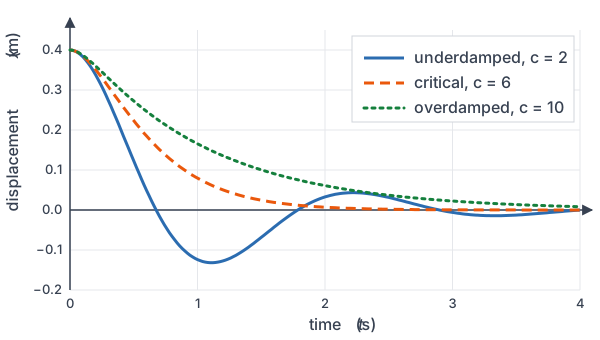
A spring-mass system is a mass hanging on a spring. Its displacement x(t) satisfies mx″ + cx′ + kx = 0, where m is the mass, c is the damping constant and k is the spring constant. The roots of mr² + cr + k = 0 show whether it keeps bouncing, bounces less and less, or settles without bouncing.
Before this lesson: Second-Order Homogeneous Linear Equations, Complex Roots of the Characteristic Equation and Repeated Roots of the Characteristic Equation
Where the equation comes from
Hang a mass m on a spring. The spring stretches a distance L and the mass comes to rest at the equilibrium position. There, the spring’s pull kL balances the weight mg. This is Hooke’s law: a spring stretched or squeezed a distance s pushes back with force ks.
Now measure x(t) from equilibrium, with down as positive. If the mass moves to x, the spring’s extra force is −kx, because it always pulls back toward equilibrium. Gravity and the stretch kL cancel, so they drop out.
Air, oil or a shock absorber adds a damping force −cx′. It opposes the velocity and grows with speed. Newton’s second law, mass times acceleration equals total force, gives mx″ = −kx − cx′. Move everything to one side to get the spring-mass equation.
Spring-mass system equation
mx'' + cx' + kx = 0, \qquad x(0) = x_0,\quad x'(0) = v_0
Here m and k are positive and c ≥ 0. The characteristic equation is mr² + cr + k = 0. With no damping, the natural frequency is ω₀ = √(k/m) radians per second, and the period is T = 2π/ω₀.
| Case | Test | Roots | Motion |
|---|---|---|---|
| Undamped | c = 0 | r = ±ω₀i | x = C₁ cos ω₀t + C₂ sin ω₀t, keeps oscillating |
| Underdamped | c² − 4mk is negative | r = α ± βi, α negative | x = e^(αt)(C₁ cos βt + C₂ sin βt), oscillates while dying out |
| Critically damped | c² − 4mk = 0 | r = −c/(2m), repeated | x = (C₁ + C₂t)e^(rt), returns fastest without oscillating |
| Overdamped | c² − 4mk is positive | two negative real roots | x = C₁e^(r₁t) + C₂e^(r₂t), returns slowly without oscillating |
In the underdamped case, β is the quasi-frequency and 2π/β is the quasi-period, the time between one high point and the next. The size of the swings shrinks like e^(αt).
Amplitude-phase form
Undamped motion C₁ cos ω₀t + C₂ sin ω₀t is one cosine wave. Write it as A cos(ω₀t − φ), where the amplitude is A = √(C₁² + C₂²), and the phase angle φ satisfies cos φ = C₁/A and sin φ = C₂/A. This is the same idea as a phase shift of a sine graph.
How to solve a spring-mass problem
- Find m, c and k in matching units. In US units, mass is weight divided by g = 32 ft/s², and k is weight divided by the stretch.
- Write mx″ + cx′ + kx = 0 and the initial conditions, with down as positive.
- Solve the characteristic equation mr² + cr + k = 0 and name the case.
- Write the general solution for that case.
- Use x(0) and x′(0) to find C₁ and C₂.
- Answer the question: amplitude, period, quasi-period or the largest displacement.
Spring-mass system examples
Example 1: Undamped motion
A 2-kg mass hangs on a spring with k = 50 N/m. It is pulled 0.1 m below equilibrium and released from rest. Ignore damping. Find x(t), the natural frequency and the period.
2x'' + 50x = 0
Write mx″ + kx = 0 with m = 2 and k = 50.
x'' + 25x = 0
Divide both sides by 2.
r^2 + 25 = 0
Write the characteristic equation.
r = \pm 5i
Take square roots (see complex numbers); ω₀ = 5.
x = C_1\cos 5t + C_2\sin 5t
Use the undamped form.
C_1 = 0.1
Substitute x(0) = 0.1.
x' = -5C_1\sin 5t + 5C_2\cos 5t
Differentiate (see derivatives of trig functions).
5C_2 = 0
Substitute x′(0) = 0.
C_2 = 0
Divide both sides by 5.
x = 0.1\cos 5t
Substitute both constants.
T = \dfrac{2\pi}{5} \approx 1.257Use T = 2π/ω₀.
Answer: x(t) = 0.1 cos 5t meters. The natural frequency is 5 rad/s and the period is about 1.257 s. The mass swings between 0.1 m below and 0.1 m above equilibrium forever.
Example 2: Finding k and the amplitude-phase form
An 8-lb weight stretches a spring 6 inches. The weight starts 0.3 ft below equilibrium and is given an upward velocity of 3.2 ft/s. Ignore damping. Find x(t) in amplitude-phase form, the amplitude and the period.
6\text{ in} = 0.5\text{ ft}Convert inches to feet.
k = \dfrac{8}{0.5} = 16At equilibrium, weight = kL, so k = 16 lb/ft.
m = \dfrac{8}{32} = 0.25Divide the weight by g = 32 ft/s²; m = 0.25 slug.
0.25x'' + 16x = 0
Write mx″ + kx = 0.
x'' + 64x = 0
Multiply both sides by 4.
r = \pm 8i
Solve r² + 64 = 0; ω₀ = 8.
x = C_1\cos 8t + C_2\sin 8t
Use the undamped form.
C_1 = 0.3
Substitute x(0) = 0.3 (below is positive).
8C_2 = -3.2
Substitute x′(0) = −3.2 into x′ = −8C₁ sin 8t + 8C₂ cos 8t (up is negative).
C_2 = -0.4
Divide both sides by 8.
A = \sqrt{0.3^2 + (-0.4)^2} = \sqrt{0.25}Use A = √(C₁² + C₂²).
A = 0.5
Take the square root.
\cos\varphi = 0.6,\quad \sin\varphi = -0.8
Divide C₁ and C₂ by A.
\varphi = -\cos^{-1}(0.6) \approx -0.927sin φ is negative, so φ is in Quadrant IV (see inverse trig functions).
x = 0.5\cos(8t + 0.927)
Write A cos(ω₀t − φ).
Answer: x(t) = 0.5 cos(8t + 0.927) ft. The amplitude is 0.5 ft and the period is 2π/8 = π/4 ≈ 0.785 s.
Example 3: Underdamped motion
A 1-kg mass on a spring with k = 26 N/m moves through air with damping constant c = 2 N·s/m. It starts 0.5 m below equilibrium at rest. Find x(t) and the quasi-period.
x'' + 2x' + 26x = 0
Write mx″ + cx′ + kx = 0.
c^2 - 4mk = 4 - 104 = -100
The test value is negative, so the motion is underdamped.
r = \dfrac{-2 \pm \sqrt{-100}}{2}Use the quadratic formula on r² + 2r + 26 = 0.
r = -1 \pm 5i
Simplify; √−100 = 10i.
x = e^{-t}(C_1\cos 5t + C_2\sin 5t)Use the underdamped form with α = −1, β = 5.
C_1 = 0.5
Substitute x(0) = 0.5.
x' = e^{-t}\big((5C_2 - C_1)\cos 5t - (C_2 + 5C_1)\sin 5t\big)Differentiate with the product rule and collect terms.
5C_2 - C_1 = 0
Substitute x′(0) = 0.
5C_2 = 0.5
Substitute C₁ = 0.5 and add 0.5 to both sides.
C_2 = 0.1
Divide both sides by 5.
x = e^{-t}(0.5\cos 5t + 0.1\sin 5t)Substitute both constants.
\dfrac{2\pi}{5} \approx 1.257The quasi-period is 2π/β.
Answer: x(t) = e^(−t)(0.5 cos 5t + 0.1 sin 5t) m, with quasi-period about 1.257 s. The swings stay inside ±√0.26 e^(−t) ≈ ±0.51e^(−t), so after 3 seconds they are under 0.026 m.
Example 4: Critical damping
A 1-kg mass hangs on a spring with k = 9 N/m. What damping constant makes the system critically damped? With that damping, find x(t) if the mass starts 0.4 m below equilibrium at rest.
c^2 = 4mk = 36
Set c² − 4mk = 0.
c = 6
Take the positive square root; c = 6 N·s/m.
r^2 + 6r + 9 = 0
Write the characteristic equation.
(r + 3)^2 = 0
Factor the perfect square (see perfect square trinomials).
r = -3
The root repeats.
x = (C_1 + C_2t)e^{-3t}Use the critically damped form.
C_1 = 0.4
Substitute x(0) = 0.4.
x' = C_2e^{-3t} - 3(C_1 + C_2t)e^{-3t}Differentiate with the product rule.
C_2 - 3C_1 = 0
Substitute x′(0) = 0.
C_2 = 1.2
Substitute C₁ = 0.4 and add 1.2 to both sides.
x = (0.4 + 1.2t)e^{-3t}Substitute both constants.
Answer: c = 6 N·s/m and x(t) = (0.4 + 1.2t)e^(−3t) m. The mass moves straight back toward equilibrium and never passes it, because 0.4 + 1.2t stays positive.
Example 5: A mass in thick oil (word problem)
A 2-kg mass hangs from a spring with k = 8 N/m inside a tank of thick oil, which gives damping c = 10 N·s/m. The mass starts 0.2 m below equilibrium and is pushed downward at 1 m/s. How far below equilibrium does it get, and does it ever pass equilibrium?
2x'' + 10x' + 8x = 0
Write mx″ + cx′ + kx = 0.
c^2 - 4mk = 100 - 64 = 36
The test value is positive, so the motion is overdamped.
r^2 + 5r + 4 = 0
Write the characteristic equation and divide by 2.
(r + 1)(r + 4) = 0
r = -1,\quad r = -4
Set each factor equal to 0.
x = C_1e^{-t} + C_2e^{-4t}Use the overdamped form.
C_1 + C_2 = 0.2
Substitute x(0) = 0.2.
-C_1 - 4C_2 = 1
Substitute x′(0) = 1 into x′ = −C₁e^(−t) − 4C₂e^(−4t).
-3C_2 = 1.2
Add the two equations (see elimination method).
C_2 = -0.4
Divide both sides by −3.
C_1 = 0.6
Substitute C₂ = −0.4 into C₁ + C₂ = 0.2.
x = 0.6e^{-t} - 0.4e^{-4t}Substitute both constants.
-0.6e^{-t} + 1.6e^{-4t} = 0Set x′ = 0 to find the lowest point.
e^{3t} = \dfrac{1.6}{0.6} = \dfrac{8}{3}Move a term, then multiply both sides by e^(4t)/0.6.
t = \dfrac{1}{3}\ln\dfrac{8}{3} \approx 0.327Take the natural log and divide by 3 (see solving exponential equations).
x(0.327) \approx 0.6(0.7211) - 0.4(0.2704) \approx 0.325
Substitute t ≈ 0.327.
Answer: the mass gets about 0.325 m below equilibrium at t ≈ 0.327 s. It never passes equilibrium: x = 0 needs 0.6e^(−t) = 0.4e^(−4t), or e^(3t) = 2/3, which gives a negative t. Overdamped motion crosses equilibrium at most once.
Common mistakes
| Mistake | Example of the error | Fix |
|---|---|---|
| Using weight as mass | m = 16 for a 16-lb weight | Divide by g: m = 16/32 = 0.5 slug. |
| Mixing units when finding k | k = 8/6 for an 8-lb weight that stretches 6 in | Convert to feet first: k = 8/0.5 = 16 lb/ft. |
| Wrong sign on the initial velocity | x′(0) = 2 for “pushed upward at 2 ft/s” with down positive | Up is negative here: x′(0) = −2. |
| Testing with c² − 4k | Calling m = 2, c = 5, k = 4 overdamped because 25 − 16 is positive | Use c² − 4mk: 25 − 32 = −7, so it is underdamped. |
| Adding constants for the amplitude | A = 0.3 + 0.4 = 0.7 | A = √(0.3² + 0.4²) = 0.5. |
| Using ω₀ for damped motion | Quasi-period 2π/√26 for x″ + 2x′ + 26x = 0 | Use β from r = −1 ± 5i: quasi-period 2π/5. |
Related ideas
Circuits use the same equation
In an RLC circuit with no battery, the charge q on the capacitor satisfies Lq″ + Rq′ + q/C = 0. Inductance L plays the role of mass, resistance R plays damping, and 1/C plays the spring constant. Every case on this page carries over.
Energy in undamped motion
With c = 0, the energy ½m(x′)² + ½kx² stays constant, so the mass trades speed for stretch and back. Damping turns some of that energy into heat, which is why the swings shrink.
Adding an outside force
If a motor or a road bump pushes the mass with force F(t), the equation becomes mx″ + cx′ + kx = F(t). You solve it with the method of undetermined coefficients. When the push matches the natural frequency, the swings can grow without bound. Forced Oscillations and Resonance covers this.
Practice problems
- A 0.5-kg mass hangs on a spring with k = 32 N/m and no damping. Find the natural frequency and the period.
- A 4-lb weight stretches a spring 3 inches. Find k, m and the natural frequency.
- Solve x″ + 16x = 0 with x(0) = 0 and x′(0) = 2. What is the amplitude?
- Write x = 0.5 cos 3t + 1.2 sin 3t in amplitude-phase form.
- A system has m = 2, c = 8 and k = 8. Classify the damping.
- A system has m = 1, c = 3 and k = 4. Classify the damping and find the quasi-period.
- Solve x″ + 4x′ + 13x = 0 with x(0) = 1 and x′(0) = 0.
- A 0.5-kg mass hangs on a spring with k = 18 N/m. Find the damping constant for critical damping.
- Solve x″ + 5x′ + 6x = 0 with x(0) = 0 and x′(0) = 2, and find the largest displacement.
- A 1-kg mass on a spring with k = 16 N/m has damping c = 2 N·s/m. It is released at rest 0.3 m below equilibrium. Find x(t) and the quasi-period.
Show answers
1.
\omega_0 = \sqrt{\dfrac{32}{0.5}} = \sqrt{64}Use ω₀ = √(k/m).
\omega_0 = 8
Take the square root.
T = \dfrac{2\pi}{8} = \dfrac{\pi}{4} \approx 0.785Use T = 2π/ω₀.
Answer: ω₀ = 8 rad/s and T ≈ 0.785 s
2.
3\text{ in} = 0.25\text{ ft}Convert inches to feet.
k = \dfrac{4}{0.25} = 16Divide the weight by the stretch; k = 16 lb/ft.
m = \dfrac{4}{32} = 0.125Divide the weight by g = 32; m = 0.125 slug.
\omega_0 = \sqrt{\dfrac{16}{0.125}} = \sqrt{128} \approx 11.31Use ω₀ = √(k/m).
Answer: k = 16 lb/ft, m = 0.125 slug, ω₀ = √128 ≈ 11.31 rad/s
3.
r = \pm 4i
Solve r² + 16 = 0.
x = C_1\cos 4t + C_2\sin 4t
Use the undamped form.
C_1 = 0
Substitute x(0) = 0.
4C_2 = 2
Substitute x′(0) = 2 into x′ = −4C₁ sin 4t + 4C₂ cos 4t.
C_2 = 0.5
Divide both sides by 4.
Answer: x = 0.5 sin 4t, amplitude 0.5
4.
A = \sqrt{0.5^2 + 1.2^2} = \sqrt{1.69}Use A = √(C₁² + C₂²).
A = 1.3
Take the square root.
\tan\varphi = \dfrac{1.2}{0.5} = 2.4Divide sin φ = 1.2/1.3 by cos φ = 0.5/1.3.
\varphi = \tan^{-1}(2.4) \approx 1.176Both C₁ and C₂ are positive, so φ is in Quadrant I.
Answer: x = 1.3 cos(3t − 1.176)
5.
c^2 - 4mk = 64 - 64 = 0
Compute the test value.
Answer: critically damped (repeated root r = −2)
6.
c^2 - 4mk = 9 - 16 = -7
The test value is negative, so it is underdamped.
r = \dfrac{-3 \pm i\sqrt{7}}{2}Use the quadratic formula on r² + 3r + 4 = 0.
\beta = \dfrac{\sqrt{7}}{2} \approx 1.323Read the imaginary part.
\dfrac{2\pi}{\beta} = \dfrac{4\pi}{\sqrt{7}} \approx 4.75Use quasi-period 2π/β.
Answer: underdamped, quasi-period ≈ 4.75
7.
r = \dfrac{-4 \pm \sqrt{16 - 52}}{2} = -2 \pm 3iUse the quadratic formula; √−36 = 6i.
x = e^{-2t}(C_1\cos 3t + C_2\sin 3t)Use the underdamped form.
C_1 = 1
Substitute x(0) = 1.
-2C_1 + 3C_2 = 0
Substitute x′(0) = 0; x′(0) = αC₁ + βC₂.
C_2 = \tfrac{2}{3}Substitute C₁ = 1 and solve.
Answer: x = e^(−2t)(cos 3t + (2/3) sin 3t)
8.
c^2 = 4mk = 4(0.5)(18) = 36
Set c² − 4mk = 0.
c = 6
Take the positive square root.
Answer: c = 6 N·s/m
9.
(r + 2)(r + 3) = 0
Factor r² + 5r + 6.
x = C_1e^{-2t} + C_2e^{-3t}Use the overdamped form with r = −2, −3.
C_1 + C_2 = 0,\quad -2C_1 - 3C_2 = 2
Substitute x(0) = 0 and x′(0) = 2.
C_2 = -2,\quad C_1 = 2
Substitute C₁ = −C₂ into the second equation: −C₂ = 2.
x' = -4e^{-2t} + 6e^{-3t} = 0 \Rightarrow e^{t} = 1.5Set x′ = 0 and multiply by e^(3t)/4.
x(\ln 1.5) = 2\left(\tfrac{4}{9}\right) - 2\left(\tfrac{8}{27}\right) = \tfrac{8}{27}e^(−2t) = 4/9 and e^(−3t) = 8/27.
Answer: x = 2e^(−2t) − 2e^(−3t); largest displacement 8/27 ≈ 0.296 at t = ln 1.5 ≈ 0.405
10.
r = \dfrac{-2 \pm \sqrt{4 - 64}}{2} = -1 \pm i\sqrt{15}Use the quadratic formula on r² + 2r + 16 = 0.
x = e^{-t}(C_1\cos\sqrt{15}\,t + C_2\sin\sqrt{15}\,t)Use the underdamped form.
C_1 = 0.3
Substitute x(0) = 0.3.
-C_1 + \sqrt{15}\,C_2 = 0Substitute x′(0) = 0; x′(0) = αC₁ + βC₂.
C_2 = \dfrac{0.3}{\sqrt{15}} \approx 0.0775Solve for C₂.
\dfrac{2\pi}{\sqrt{15}} \approx 1.622Use quasi-period 2π/β.
Answer: x = e^(−t)(0.3 cos √15 t + 0.0775 sin √15 t) m; quasi-period ≈ 1.622 s
Spring-mass system FAQ
What is the differential equation for a spring-mass system?
It is mx″ + cx′ + kx = 0, where x is the displacement from equilibrium, m is the mass, c is the damping constant and k is the spring constant. With no damping it is mx″ + kx = 0.
What is the difference between underdamped, critically damped and overdamped?
Compare c² with 4mk. If c² is smaller, the mass oscillates with shrinking swings (underdamped). If they are equal, it returns as fast as possible without oscillating (critically damped). If c² is larger, it returns more slowly without oscillating (overdamped).
How do you find the spring constant k?
Use Hooke’s law at equilibrium: k equals the weight divided by the stretch. An 8-lb weight that stretches a spring 0.5 ft gives k = 16 lb/ft.
What is the natural frequency of a spring-mass system?
It is ω₀ = √(k/m) radians per second, the frequency of the motion with no damping. The period is 2π/ω₀.
Summary
- A spring-mass system satisfies mx″ + cx′ + kx = 0, with x measured from equilibrium.
- Undamped motion (c = 0) is x = A cos(ω₀t − φ), with ω₀ = √(k/m) and A = √(C₁² + C₂²).
- The sign of c² − 4mk decides the case: negative is underdamped, zero is critically damped, positive is overdamped.
- Underdamped motion oscillates with quasi-period 2π/β inside an envelope that shrinks like e^(αt).
- In US units, divide weight by 32 to get mass, and convert inches to feet before finding k.
Previous lesson: Cauchy-Euler Equations
Next lesson: Forced Oscillations and Resonance
Back to the Differential Equations Index