
Repeated Roots of the Characteristic Equation
When the characteristic equation ar² + br + c = 0 has a repeated root r (because b² − 4ac = 0), the equation ay″ + by′ + cy = 0 has only one exponential solution, e^(rx). The second solution is xe^(rx), so the general solution is y = (C₁ + C₂x)e^(rx), with r = −b/(2a).
Before this lesson: Second-Order Homogeneous Linear Equations, Reduction of Order and Complex Roots of the Characteristic Equation
Why a repeated root needs a second solution
A second-order linear equation needs two solutions that are not constant multiples of each other. When the characteristic equation has two different roots, e^(r₁x) and e^(r₂x) do the job. When the discriminant b² − 4ac is 0, both roots are the same number r, and the trial y = e^(rx) gives only one function.
Writing C₁e^(rx) + C₂e^(rx) does not help, because that is just (C₁ + C₂)e^(rx), a single constant times one function. It cannot match two initial conditions in general.
Reduction of order fixes this. Substituting y = ve^(rx) makes every v and v′ term cancel and leaves v″ = 0, so v = x works. The second solution is xe^(rx). The Wronskian of e^(rx) and xe^(rx) is e^(2rx), which is never 0, so the two form a fundamental set.
Repeated roots formula
If ar² + br + c = 0 has the repeated root r, then
y = \left(C_1 + C_2x\right)e^{rx}, \qquad r = -\dfrac{b}{2a}The repeated root happens exactly when b² = 4ac. Then ar² + br + c is a constant times a perfect square, a(r − r₀)², which is often the fastest way to find the root.
How to solve an equation with a repeated root
- Write the characteristic equation ar² + br + c = 0 and check that b² − 4ac = 0.
- Find the root r = −b/(2a), or factor the perfect square.
- Write y = (C₁ + C₂x)e^(rx).
- For an initial-value problem, find y′ with the product rule, then use y(0) and y′(0) to find C₁ and C₂.
Repeated roots examples
Example 1: Factoring a perfect square
Solve y″ + 6y′ + 9y = 0.
r^2 + 6r + 9 = 0
Write the characteristic equation.
6^2 - 4(1)(9) = 36 - 36 = 0
Check the discriminant: it is 0, so the root repeats.
(r + 3)^2 = 0
Factor the perfect square trinomial.
r = -3
Set r + 3 = 0 and subtract 3.
y = \left(C_1 + C_2x\right)e^{-3x}Use the repeated-root formula.
Answer: y = (C₁ + C₂x)e^(−3x), or y = C₁e^(−3x) + C₂xe^(−3x).
Example 2: A positive repeated root
Solve y″ − 10y′ + 25y = 0.
r^2 - 10r + 25 = 0
Write the characteristic equation.
(-10)^2 - 4(1)(25) = 100 - 100 = 0
Check the discriminant.
r = -\dfrac{-10}{2(1)} = 5Use r = −b/(2a).
y = \left(C_1 + C_2x\right)e^{5x}Use the repeated-root formula.
Answer: y = (C₁ + C₂x)e^(5x).
Example 3: An initial-value problem
Solve y″ − 4y′ + 4y = 0 with y(0) = 3 and y′(0) = 4.
(r - 2)^2 = 0 \Rightarrow r = 2
Factor r² − 4r + 4 and solve.
y = \left(C_1 + C_2x\right)e^{2x}Write the general solution.
y(0) = C_1 = 3
Substitute x = 0; e^0 = 1.
y' = C_2e^{2x} + 2\left(C_1 + C_2x\right)e^{2x}Differentiate with the product rule.
y'(0) = C_2 + 2C_1 = 4
Substitute x = 0.
C_2 + 6 = 4
Substitute C₁ = 3.
C_2 = -2
Subtract 6 from both sides.
y = \left(3 - 2x\right)e^{2x}Substitute both constants.
Answer: y = (3 − 2x)e^(2x). Check: y(0) = 3 and y′(0) = −2 + 2(3) = 4.
Example 4: A leading coefficient other than 1
Solve 9y″ + 12y′ + 4y = 0.
9r^2 + 12r + 4 = 0
Write the characteristic equation.
12^2 - 4(9)(4) = 144 - 144 = 0
Check the discriminant.
(3r + 2)^2 = 0
Factor: (3r)² + 2(3r)(2) + 2².
3r + 2 = 0
Take the square root of both sides.
r = -\tfrac{2}{3}Subtract 2 and divide by 3.
y = \left(C_1 + C_2x\right)e^{-2x/3}Use the repeated-root formula.
Answer: y = (C₁ + C₂x)e^(−2x/3). The shortcut r = −b/(2a) = −12/18 = −2/3 gives the same root.
Example 5: A critically damped spring (word problem)
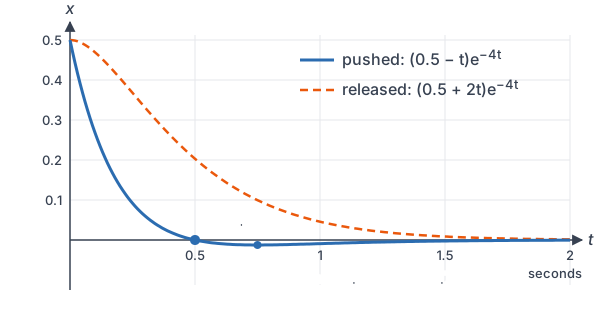
A 1 kg mass hangs on a spring with spring constant 16 N/m and damping constant 8 N·s/m, so its position x (in meters, t in seconds) satisfies x″ + 8x′ + 16x = 0. It starts 0.5 m from rest position and is pushed toward rest at 3 m/s, so x(0) = 0.5 and x′(0) = −3. Find x(t), when the mass passes rest position, and how far past rest it goes.
r^2 + 8r + 16 = (r + 4)^2 = 0
Write the characteristic equation and factor.
r = -4
Solve; the root repeats.
x = \left(C_1 + C_2t\right)e^{-4t}Write the general solution.
C_1 = 0.5
Substitute t = 0 into x.
x' = C_2e^{-4t} - 4\left(C_1 + C_2t\right)e^{-4t}Differentiate with the product rule.
C_2 - 4(0.5) = -3
Substitute t = 0 into x′.
C_2 = -1
Simplify to C₂ − 2 = −3, then add 2 to both sides.
x = \left(0.5 - t\right)e^{-4t}Write the motion.
0.5 - t = 0 \Rightarrow t = 0.5
Set x = 0; e^(−4t) is never 0.
x' = e^{-4t}\left[-1 - 4(0.5 - t)\right] = (4t - 3)e^{-4t}Substitute the constants into x′ and simplify.
4t - 3 = 0 \Rightarrow t = 0.75
Set x′ = 0 to find the farthest point past rest.
x(0.75) = -0.25e^{-3} \approx -0.0124Substitute t = 0.75 into x.
Answer: x(t) = (0.5 − t)e^(−4t). The mass passes rest position at t = 0.5 s, goes about 0.012 m (1.2 cm) past it at t = 0.75 s, then returns toward rest without crossing again. A critically damped system crosses rest at most once.
Common mistakes
| Mistake | Example of the error | Fix |
|---|---|---|
| Using the same exponential twice | y = C₁e^(−3x) + C₂e^(−3x) | That is one function. The second solution is xe^(−3x). |
| Multiplying the wrong term by x | y = C₁xe^(rx) + C₂x²e^(rx) | Only one term gets an x: y = C₁e^(rx) + C₂xe^(rx). |
| Putting x in the exponent | y = C₁e^(rx) + C₂e^(rx²) | The x multiplies the exponential: xe^(rx). |
| Sign error in the root | (r + 3)² = 0 so r = 3 | r + 3 = 0 gives r = −3. |
| Forgetting the product rule | Derivative of C₂xe^(2x) written as 2C₂xe^(2x) | It is C₂e^(2x) + 2C₂xe^(2x). |
| Not checking the discriminant | Treating r² + 6r + 8 as a repeated root | Here b² − 4ac = 4, so the roots −2 and −4 are different. |
Related ideas
The three cases of the characteristic equation
| Discriminant b² − 4ac | Roots | General solution |
|---|---|---|
| Positive | Real and different, r₁ and r₂ | y = C₁e^(r₁x) + C₂e^(r₂x) |
| Zero | Repeated, r | y = (C₁ + C₂x)e^(rx) |
| Negative | Complex, α ± βi | y = e^(αx)(C₁ cos βx + C₂ sin βx) |
The first case is in Second-Order Homogeneous Linear Equations and the third is in Complex Roots of the Characteristic Equation.
Why xe^(rx) works
With a repeated root r, the characteristic polynomial is a(r − r₀)², so b = −2ar₀ and c = ar₀². Substituting y = xe^(r₀x) gives y′ = (1 + r₀x)e^(r₀x) and y″ = (2r₀ + r₀²x)e^(r₀x). Then ay″ + by′ + cy = a(2r₀ + r₀²x − 2r₀ − 2r₀²x + r₀²x)e^(r₀x) = 0.
Roots that repeat more than twice
For higher-order equations, a root r that appears k times gives the solutions e^(rx), xe^(rx), x²e^(rx), up to x^(k−1)e^(rx). For example, y‴ − 6y″ + 12y′ − 8y = 0 has the characteristic equation (r − 2)³ = 0, so y = (C₁ + C₂x + C₃x²)e^(2x).
Critical damping
For a spring mx″ + cx′ + kx = 0, a repeated root happens when c² = 4mk. This is called critical damping: the smallest damping that stops the mass from oscillating. Spring-Mass Systems compares it with underdamped and overdamped motion.
Practice problems
- Solve y″ + 2y′ + y = 0.
- Solve y″ − 8y′ + 16y = 0.
- Solve 4y″ − 4y′ + y = 0.
- Solve y″ + 14y′ + 49y = 0.
- Solve 16y″ + 24y′ + 9y = 0.
- Solve y″ + 4y′ + 4y = 0 with y(0) = 1 and y′(0) = 1.
- Solve y″ − 6y′ + 9y = 0 with y(0) = 2 and y′(0) = 5.
- Find an equation y″ + by′ + cy = 0 that has the solution y = xe^(5x).
- For what values of k does y″ + ky′ + 9y = 0 have a repeated root? Give the general solution for the positive k.
- A spring satisfies x″ + 10x′ + 25x = 0 with x(0) = 0 and x′(0) = 2 (x in meters, t in seconds). Find x(t), the time of the largest displacement and that displacement.
Show answers
1.
(r + 1)^2 = 0 \Rightarrow r = -1
Factor r² + 2r + 1 and solve.
Answer: y = (C₁ + C₂x)e^(−x)
2.
(r - 4)^2 = 0 \Rightarrow r = 4
Factor r² − 8r + 16 and solve.
Answer: y = (C₁ + C₂x)e^(4x)
3.
(2r - 1)^2 = 0
Factor 4r² − 4r + 1.
r = \tfrac{1}{2}Set 2r − 1 = 0, add 1 and divide by 2.
Answer: y = (C₁ + C₂x)e^(x/2)
4.
(r + 7)^2 = 0 \Rightarrow r = -7
Factor r² + 14r + 49 and solve.
Answer: y = (C₁ + C₂x)e^(−7x)
5.
(4r + 3)^2 = 0
Factor 16r² + 24r + 9.
r = -\tfrac{3}{4}Set 4r + 3 = 0, subtract 3 and divide by 4.
Answer: y = (C₁ + C₂x)e^(−3x/4)
6.
y = \left(C_1 + C_2x\right)e^{-2x},\quad C_1 = 1The root of (r + 2)² = 0 is −2; substitute x = 0.
y' = C_2e^{-2x} - 2\left(C_1 + C_2x\right)e^{-2x}Differentiate with the product rule.
C_2 - 2 = 1 \Rightarrow C_2 = 3
Substitute x = 0 and C₁ = 1, then add 2.
Answer: y = (1 + 3x)e^(−2x)
7.
y = \left(C_1 + C_2x\right)e^{3x},\quad C_1 = 2The root of (r − 3)² = 0 is 3; substitute x = 0.
y' = C_2e^{3x} + 3\left(C_1 + C_2x\right)e^{3x}Differentiate with the product rule.
C_2 + 6 = 5 \Rightarrow C_2 = -1
Substitute x = 0 and C₁ = 2, then subtract 6.
Answer: y = (2 − x)e^(3x)
8.
(r - 5)^2 = 0
The solution xe^(5x) needs 5 as a repeated root.
r^2 - 10r + 25 = 0
Expand the square.
Answer: y″ − 10y′ + 25y = 0
9.
k^2 - 4(1)(9) = 0
Set the discriminant of r² + kr + 9 equal to 0.
k^2 = 36 \Rightarrow k = \pm 6
Add 36 and take square roots.
(r + 3)^2 = 0 \Rightarrow r = -3
For k = 6, factor r² + 6r + 9.
Answer: k = 6 or k = −6; for k = 6, y = (C₁ + C₂x)e^(−3x)
10.
x = \left(C_1 + C_2t\right)e^{-5t},\quad C_1 = 0The root of (r + 5)² = 0 is −5; substitute t = 0.
x = C_2te^{-5t},\quad x' = C_2(1 - 5t)e^{-5t}Drop the C₁ term and differentiate with the product rule.
C_2 = 2
Substitute t = 0 into x′.
1 - 5t = 0 \Rightarrow t = 0.2
Set x′ = 0.
x(0.2) = 2(0.2)e^{-1} = 0.4e^{-1} \approx 0.147Substitute t = 0.2 into x.
Answer: x(t) = 2te^(−5t); the largest displacement is about 0.147 m at t = 0.2 s
Repeated roots FAQ
What is the solution when the characteristic equation has a repeated root?
If the root r repeats, the general solution is y = (C₁ + C₂x)e^(rx). The extra factor x makes the second solution independent of the first.
Why do you multiply by x for a repeated root?
With only one root, e^(rx) is the only exponential solution. Reduction of order shows that xe^(rx) also solves the equation, and it is not a constant multiple of e^(rx).
How do you know the root is repeated?
Check the discriminant: the root repeats exactly when b² − 4ac = 0. The characteristic polynomial is then a perfect square times a.
What does a repeated root mean for a spring?
It means critical damping. The mass returns to rest as fast as possible without oscillating, and it crosses rest position at most once.
Summary
- A repeated root happens when b² − 4ac = 0; the root is r = −b/(2a).
- The general solution is y = (C₁ + C₂x)e^(rx).
- The second solution xe^(rx) comes from reduction of order.
- Use the product rule on (C₁ + C₂x)e^(rx) for initial conditions.
- A root repeated k times gives e^(rx), xe^(rx), up to x^(k−1)e^(rx).
Previous lesson: Complex Roots of the Characteristic Equation
Next lesson: Method of Undetermined Coefficients
Back to the Differential Equations Index