
Forced Oscillations and Resonance
Forced oscillations happen when an outside force F(t) pushes a spring-mass system, so mx″ + cx′ + kx = F(t). With a periodic push F₀ cos ωt, the motion is a transient part that dies out plus a steady-state part. Resonance happens when ω matches the natural frequency, and undamped swings then grow without bound.
Before this lesson: Spring-Mass Systems and Method of Undetermined Coefficients
What an outside force does
In spring-mass systems, nothing pushes the mass after it starts, so it oscillates at its own natural frequency ω₀ = √(k/m). Now let a motor, a wave or an engine push it with a force F(t). The equation becomes nonhomogeneous.
Its solution is x = x_c + x_p. The complementary part x_c solves the unforced equation, and the particular part x_p is any one solution of the forced equation. With damping, x_c shrinks to 0, so it is called the transient. What remains, x_p, is the steady-state motion.
The most common push is F(t) = F₀ cos ωt. The mass is then pulled toward two rhythms: its own ω₀ and the driving frequency ω. How those two compare decides what happens.
Forced oscillation formulas
mx'' + cx' + kx = F_0\cos\omega t, \qquad \omega_0 = \sqrt{k/m}| Case | Particular solution xₚ | Long-run motion |
|---|---|---|
| No damping, ω ≠ ω₀ | xₚ = F₀ cos ωt / (m(ω₀² − ω²)) | Bounded; beats when ω is close to ω₀ |
| No damping, ω = ω₀ | xₚ = (F₀/(2mω₀)) t sin ω₀t | Pure resonance: swings grow without bound |
| Damping, c positive | xₚ = a cos ωt + b sin ωt | Steady state with amplitude A(ω) below |
A(\omega) = \dfrac{F_0}{\sqrt{(k - m\omega^2)^2 + (c\omega)^2}}With damping, the amplitude is largest at the practical resonance frequency ω = √(k/m − c²/(2m²)), when the number under the root is positive. Small damping gives a tall, narrow peak near ω₀.
Beats
Start an undamped system at rest with ω close to ω₀. Then x = (F₀/(m(ω₀² − ω²)))(cos ωt − cos ω₀t). A product-to-sum identity turns this into a fast wave inside a slow envelope that swells and fades. Those swells are called beats, and one full swell lasts 2π/|ω₀ − ω|.
How to solve a forced oscillation problem
- Write mx″ + cx′ + kx = F₀ cos ωt and find ω₀ = √(k/m).
- Solve the unforced equation for x_c.
- Choose the trial xₚ. Use t(a cos ωt + b sin ωt) if c = 0 and ω = ω₀; otherwise use a cos ωt + b sin ωt.
- Substitute xₚ and match the cos ωt and sin ωt coefficients.
- Add x = x_c + xₚ, then use the initial conditions on the full x.
- Answer the question: steady-state amplitude, beat period or the time when swings reach a size.
Forced oscillation examples
Example 1: Forcing away from resonance
Solve x″ + 16x = 6 cos 2t with x(0) = 0 and x′(0) = 0. Find the largest displacement.
r = \pm 4i
Solve r² + 16 = 0, so ω₀ = 4.
x_c = C_1\cos 4t + C_2\sin 4t
Write the complementary solution.
x_p = a\cos 2t
Choose the trial; ω = 2 is not ω₀, and there is no x′ term, so no sine is needed.
-4a\cos 2t + 16a\cos 2t = 6\cos 2t
Substitute xₚ″ = −4a cos 2t (see derivatives of trig functions).
12a = 6
Combine like terms and match coefficients.
a = 0.5
Divide both sides by 12.
x = C_1\cos 4t + C_2\sin 4t + 0.5\cos 2t
Add x_c and xₚ.
C_1 + 0.5 = 0
Substitute x(0) = 0.
C_1 = -0.5
Subtract 0.5 from both sides.
4C_2 = 0
Substitute x′(0) = 0; the derivative of 0.5 cos 2t is 0 at t = 0.
C_2 = 0
Divide both sides by 4.
x = 0.5(\cos 2t - \cos 4t)
Substitute the constants and factor out 0.5.
\cos 2t - \cos 4t = -2u^2 + u + 1
Let u = cos 2t and use cos 4t = 2u² − 1 (see double-angle formulas).
u = \tfrac{1}{4}The parabola’s vertex is at u = −b/(2a) = −1/(−4).
x_{\max} = 0.5\left(-\tfrac{1}{8} + \tfrac{1}{4} + 1\right) = 0.5625Substitute u = 1/4.
Answer: x(t) = 0.5(cos 2t − cos 4t), and the largest displacement is 0.5625. The motion mixes the two frequencies but stays bounded.
Example 2: Pure resonance
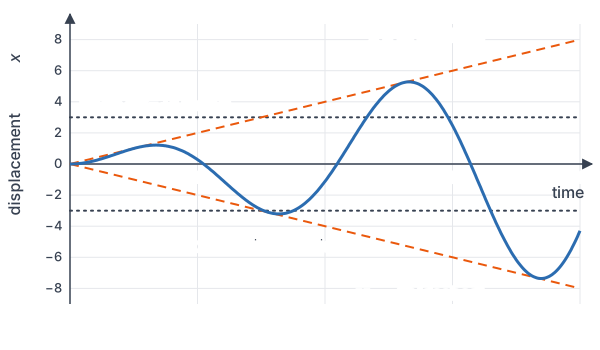
Solve x″ + 9x = 12 cos 3t with x(0) = 0 and x′(0) = 0. If the spring breaks when the swings reach 3 m, when does it break?
x_c = C_1\cos 3t + C_2\sin 3t
Solve r² + 9 = 0: r = ±3i, so ω₀ = 3.
x_p = t(a\cos 3t + b\sin 3t)
ω = ω₀ = 3, so multiply the trial by t.
x_p' = a\cos 3t + b\sin 3t + t(-3a\sin 3t + 3b\cos 3t)
Differentiate with the product rule.
x_p'' = -6a\sin 3t + 6b\cos 3t - 9t(a\cos 3t + b\sin 3t)
Differentiate again and collect terms.
x_p'' + 9x_p = -6a\sin 3t + 6b\cos 3t
Add 9xₚ; the t terms cancel.
6b = 12,\quad -6a = 0
Match with 12 cos 3t.
b = 2,\quad a = 0
Divide both equations by 6 and by −6.
x = C_1\cos 3t + C_2\sin 3t + 2t\sin 3t
Add x_c and xₚ.
C_1 = 0
Substitute x(0) = 0.
3C_2 = 0
Substitute x′(0) = 0; xₚ′(0) = 0.
x = 2t\sin 3t
Substitute C₂ = 0.
2t = 3
The swings have size 2t; set it equal to 3.
t = 1.5
Divide both sides by 2.
Answer: x(t) = 2t sin 3t, which matches F₀/(2mω₀) = 12/6 = 2. The swings grow in a straight line, and the spring breaks at about t = 1.5 s.
Example 3: Damping and the steady state
Find the steady-state solution of x″ + 2x′ + 5x = 10 cos t and its amplitude.
r = -1 \pm 2i
Solve r² + 2r + 5 = 0 with the quadratic formula; x_c has the factor e^(−t), so it dies out.
x_p = a\cos t + b\sin t
Choose the trial with both cosine and sine.
x_p' = -a\sin t + b\cos t
Differentiate.
x_p'' = -a\cos t - b\sin t
Differentiate again.
(4a + 2b)\cos t + (4b - 2a)\sin t = 10\cos t
Substitute into x″ + 2x′ + 5x and collect terms.
4a + 2b = 10,\quad 4b - 2a = 0
Match the cos t and sin t coefficients.
a = 2b
Solve the second equation for a.
10b = 10
Substitute a = 2b into the first equation (see substitution method).
b = 1,\quad a = 2
Divide by 10, then use a = 2b.
x_p = 2\cos t + \sin t
Write the steady state.
A = \sqrt{2^2 + 1^2} = \sqrt{5} \approx 2.236Find the amplitude.
Answer: the steady state is 2 cos t + sin t, with amplitude √5 ≈ 2.236. The formula agrees: 10/√((5 − 1)² + 2²) = 10/√20 = √5.
Example 4: Beats in a machine (word problem)
A 1-kg part on a spring with k = 100 N/m starts at rest. A motor pushes it with F(t) = 1.9 cos 9t newtons. Ignore damping. Find x(t), the largest swing and the time from one loud swell to the next.
\omega_0 = \sqrt{100} = 10Find the natural frequency.
x_p = \dfrac{1.9}{100 - 81}\cos 9t = 0.1\cos 9tUse F₀ cos ωt / (m(ω₀² − ω²)).
x = C_1\cos 10t + C_2\sin 10t + 0.1\cos 9t
Add x_c.
C_1 = -0.1,\quad C_2 = 0
Use x(0) = 0 and x′(0) = 0 as in Example 1.
x = 0.1(\cos 9t - \cos 10t)
Substitute the constants.
x = 0.2\sin(0.5t)\sin(9.5t)
Use cos A − cos B = −2 sin((A + B)/2) sin((A − B)/2) (see sum and difference formulas).
\dfrac{2\pi}{10 - 9} = 2\pi \approx 6.28Beat period 2π/|ω₀ − ω|.
Answer: x(t) = 0.2 sin(0.5t) sin(9.5t) m. The part shakes about 9.5 radians per second inside the slow envelope 0.2 sin(0.5t). The swings peak at 0.2 m (first at t = π ≈ 3.14 s), and the swells repeat every 2π ≈ 6.28 s.
Example 5: Practical resonance (word problem)
A machine part has m = 1 kg, k = 25 N/m and c = 2 N·s/m. A motor shakes it with F(t) = 10 cos ωt. Which ω gives the largest steady-state amplitude, and how large is it?
A(\omega) = \dfrac{10}{\sqrt{(25 - \omega^2)^2 + 4\omega^2}}Substitute into the amplitude formula.
g(u) = (25 - u)^2 + 4u
A is largest where the expression under the root is smallest; let u = ω².
g'(u) = -2(25 - u) + 4
Differentiate with the chain rule.
-50 + 2u + 4 = 0
Set g′(u) = 0 (see critical points) and distribute.
u = 23
Add 46 to both sides and divide by 2.
\omega = \sqrt{23} \approx 4.796Take the positive square root.
g(23) = 2^2 + 4(23) = 96
Substitute u = 23.
A = \dfrac{10}{\sqrt{96}} \approx 1.021Substitute into A.
Answer: ω = √23 ≈ 4.796 rad/s gives the largest amplitude, about 1.021 m. That is a little below ω₀ = 5, as the formula √(k/m − c²/(2m²)) = √(25 − 2) predicts. At ω = 5 the amplitude is 10/√100 = 1, and for a very slow push it is only 10/25 = 0.4.
Common mistakes
| Mistake | Example of the error | Fix |
|---|---|---|
| No t factor at resonance | Trying xₚ = a cos 3t for x″ + 9x = 12 cos 3t | a cos 3t solves the unforced equation; use t(a cos 3t + b sin 3t). |
| Dropping the sine term with damping | xₚ = a cos t for x″ + 2x′ + 5x = 10 cos t | The x′ term makes sine appear; use a cos t + b sin t. |
| Initial conditions on x_c alone | Setting C₁ = 0 from x(0) = 0 in Example 1 | Apply them to x_c + xₚ: C₁ + 0.5 = 0. |
| Swapping ω and ω₀ | Writing m(ω² − ω₀²) in the denominator | It is m(ω₀² − ω²); the sign shows whether xₚ is in step with the push. |
| Keeping the transient in the steady state | Steady state e^(−t)cos 2t + 2 cos t + sin t | Drop the part that dies out: 2 cos t + sin t. |
| Expecting unbounded growth with damping | “Damped resonance blows up” | With positive c, the amplitude A(ω) is finite; only the undamped case grows without bound. |
Related ideas
RLC circuits
A circuit with a voltage source E(t) satisfies Lq″ + Rq′ + q/C = E(t). Tuning a radio means changing C until the circuit’s natural frequency 1/√(LC) matches the station’s frequency, so that one signal resonates.
Other forcing functions
For forcing that is not a sine or cosine, like a sudden push or a square wave, use Variation of Parameters or the Laplace transform. The Laplace Transform starts the next unit.
Phase lag
With damping, the steady state lags behind the push by an angle δ with tan δ = cω/(k − mω²). Below resonance the mass moves almost in step with the force, and far above resonance it moves almost opposite to it.
Practice problems
- Find a particular solution of x″ + 25x = 21 cos 2t.
- Find a particular solution of x″ + 4x = 8 cos 2t.
- Solve x″ + 9x = 5 cos 2t with x(0) = 0 and x′(0) = 0.
- Find the steady-state solution of x″ + 2x′ + 2x = 4 cos 2t and its amplitude.
- Use the amplitude formula for m = 2, c = 3, k = 50, F₀ = 12 and ω = 4.
- A 1-kg mass on a spring with k = 36 N/m starts at rest and is pushed by 2.2 cos 5t. Find x(t), the largest swing and the beat period.
- For 4x″ + 100x = F₀ cos ωt, which ω causes pure resonance?
- Find the practical resonance frequency for m = 1, c = 4 and k = 40.
- Solve x″ + 16x = 4 cos 4t from rest. When do the swings reach 2 m?
- Solve x″ + 2x′ + 5x = 10 cos t (Example 3) with x(0) = 0 and x′(0) = 0.
Show answers
1.
x_p = a\cos 2t
ω = 2 is not ω₀ = 5.
-4a + 25a = 21
Substitute and match the cos 2t coefficients.
21a = 21 \Rightarrow a = 1
Combine like terms and divide by 21.
Answer: xₚ = cos 2t
2.
x_p = t(a\cos 2t + b\sin 2t)
ω = ω₀ = 2, so multiply by t.
x_p'' + 4x_p = -4a\sin 2t + 4b\cos 2t
Substitute; the t terms cancel.
4b = 8,\quad a = 0
Match with 8 cos 2t.
Answer: xₚ = 2t sin 2t
3.
-4a + 9a = 5 \Rightarrow a = 1
Use xₚ = a cos 2t and match coefficients.
x = C_1\cos 3t + C_2\sin 3t + \cos 2t
Add x_c.
C_1 = -1,\quad C_2 = 0
Use x(0) = 0 and x′(0) = 0.
Answer: x = cos 2t − cos 3t
4.
(-2a + 4b)\cos 2t + (-4a - 2b)\sin 2t = 4\cos 2t
Substitute xₚ = a cos 2t + b sin 2t and collect terms.
-2a + 4b = 4,\quad -4a - 2b = 0
Match coefficients.
b = -2a
Solve the second equation for b.
-10a = 4 \Rightarrow a = -0.4,\ b = 0.8
Substitute into the first equation and solve.
A = \sqrt{0.16 + 0.64} = \sqrt{0.8} \approx 0.894Find the amplitude.
Answer: xₚ = −0.4 cos 2t + 0.8 sin 2t, amplitude ≈ 0.894
5.
A = \dfrac{12}{\sqrt{(50 - 32)^2 + 12^2}}Substitute; mω² = 32 and cω = 12.
A = \dfrac{12}{\sqrt{468}} \approx 0.555Add 324 + 144 and divide.
Answer: A ≈ 0.555
6.
x_p = \dfrac{2.2}{36 - 25}\cos 5t = 0.2\cos 5tUse the undamped formula with ω₀ = 6.
x = 0.2(\cos 5t - \cos 6t)
Apply x(0) = 0 and x′(0) = 0.
x = 0.4\sin(0.5t)\sin(5.5t)
Use the product-to-sum identity.
\dfrac{2\pi}{6 - 5} = 2\piBeat period.
Answer: x = 0.4 sin(0.5t) sin(5.5t); largest swing 0.4; beat period 2π ≈ 6.28
7.
\omega_0 = \sqrt{\dfrac{100}{4}} = 5Pure resonance happens at ω = ω₀.
Answer: ω = 5
8.
\omega = \sqrt{40 - \dfrac{16}{2}} = \sqrt{32}Use √(k/m − c²/(2m²)).
\omega \approx 5.657
Evaluate.
Answer: ω = √32 ≈ 5.657
9.
x_p = \dfrac{4}{2(1)(4)}\,t\sin 4t = 0.5t\sin 4tUse F₀/(2mω₀).
x = 0.5t\sin 4t
From rest, C₁ = 0 and C₂ = 0.
0.5t = 2 \Rightarrow t = 4
Set the swing size equal to 2.
Answer: x = 0.5t sin 4t; the swings reach 2 m at t = 4 s
10.
x = e^{-t}(C_1\cos 2t + C_2\sin 2t) + 2\cos t + \sin tAdd x_c to Example 3’s xₚ.
C_1 + 2 = 0 \Rightarrow C_1 = -2
Substitute x(0) = 0.
-C_1 + 2C_2 + 1 = 0
Substitute x′(0) = 0; x′(0) = −C₁ + 2C₂ + 1.
2C_2 = -3 \Rightarrow C_2 = -1.5
Substitute C₁ = −2 and solve.
Answer: x = e^(−t)(−2 cos 2t − 1.5 sin 2t) + 2 cos t + sin t
Forced oscillations FAQ
What is resonance in differential equations?
Resonance happens when the driving frequency ω equals the natural frequency ω₀ = √(k/m) of an undamped system. The particular solution then has a factor t, like 2t sin 3t, so the swings grow without bound.
What is the difference between transient and steady-state solutions?
With damping, x = x_c + xₚ. The transient x_c has a decaying exponential factor and fades away. The steady state xₚ keeps oscillating at the driving frequency for as long as the force acts.
What causes beats?
Beats happen in an undamped system pushed at a frequency close to, but not equal to, its natural frequency. The motion is a fast oscillation inside a slow envelope, with one swell every 2π/|ω₀ − ω|.
Can damped systems resonate?
Yes, but the swings stay bounded. The steady-state amplitude A(ω) peaks at the practical resonance frequency √(k/m − c²/(2m²)), and the peak is taller when the damping is small.
Summary
- Forced motion satisfies mx″ + cx′ + kx = F(t), with x = x_c + xₚ.
- Undamped with ω ≠ ω₀: xₚ = F₀ cos ωt / (m(ω₀² − ω²)); ω near ω₀ gives beats.
- Undamped with ω = ω₀: xₚ = (F₀/(2mω₀)) t sin ω₀t, pure resonance.
- Damped: the transient dies out and the steady state has amplitude F₀/√((k − mω²)² + (cω)²).
- Use the initial conditions on the full solution x_c + xₚ.
Previous lesson: Spring-Mass Systems
Next lesson: Laplace Transform
Back to the Differential Equations Index