
Laplace Transform
The Laplace transform turns a function f(t), defined for t ≥ 0, into a function of s: F(s) = ∫₀^∞ e^(−st) f(t) dt. It changes derivatives into multiplication by s, so differential equations become algebra. Three common results are L{1} = 1/s, L{e^(at)} = 1/(s − a) and L{sin bt} = b/(s² + b²).
Before this lesson: Improper Integrals and Integration by Parts
What the Laplace transform does
Multiply f(t) by the decaying weight e^(−st) and add up the area from 0 to infinity. The answer depends on s, so the transform is a new function F(s). Large s makes the weight die out fast, which is why the integral usually exists once s is large enough.
The payoff comes from derivatives. Integration by parts shows that the transform of y′ is sY(s) − y(0). So a differential equation in t becomes an algebra equation in s, with the initial conditions already built in. You solve for Y(s), then turn it back into y(t) with the inverse transform.
We write L{f(t)} = F(s), with a capital letter for the transform. A function has a transform when it is piecewise continuous and of exponential order: |f(t)| is at most Me^(ct) for some constants M and c once t is large. Then F(s) exists for every s greater than c.
Laplace transform definition and table
\mathcal{L}\{f(t)\} = F(s) = \int_0^{\infty} e^{-st} f(t)\, dt| f(t) | F(s) = L{f(t)} | Valid for |
|---|---|---|
| 1 | 1/s | s greater than 0 |
| tⁿ (n = 1, 2, 3, …) | n!/sⁿ⁺¹ | s greater than 0 |
| e^(at) | 1/(s − a) | s greater than a |
| sin bt | b/(s² + b²) | s greater than 0 |
| cos bt | s/(s² + b²) | s greater than 0 |
| tⁿe^(at) | n!/(s − a)ⁿ⁺¹ | s greater than a |
| e^(at) sin bt | b/((s − a)² + b²) | s greater than a |
| e^(at) cos bt | (s − a)/((s − a)² + b²) | s greater than a |
Three key properties
\mathcal{L}\{af + bg\} = aF(s) + bG(s)\mathcal{L}\{e^{at}f(t)\} = F(s - a)\mathcal{L}\{y'\} = sY(s) - y(0), \qquad \mathcal{L}\{y''\} = s^2Y(s) - sy(0) - y'(0)The first is linearity: transform term by term and keep the constants. The second is the first shifting theorem: multiplying by e^(at) replaces s with s − a. The third is the derivative rule, which is what makes the transform useful for differential equations.
How to find a Laplace transform
- Split the function into terms and pull out constants (linearity).
- Match each term to a row of the table. If a term has a factor e^(at), find the transform without it and replace s with s − a.
- If no row fits, use the definition: set up the improper integral and evaluate it as a limit.
- Add the results and state where they are valid.
Laplace transform examples
Example 1: The transform of 1 from the definition
Use the definition to find L{1}.
\mathcal{L}\{1\} = \int_0^{\infty} e^{-st}\, dtSubstitute f(t) = 1 into the definition.
= \lim_{b \to \infty} \int_0^{b} e^{-st}\, dtWrite the improper integral as a limit.
= \lim_{b \to \infty} \left[-\dfrac{e^{-st}}{s}\right]_0^{b}Integrate; s is a positive constant.
= \lim_{b \to \infty} \left(-\dfrac{e^{-sb}}{s} + \dfrac{1}{s}\right)Evaluate at b and at 0.
= \dfrac{1}{s}For positive s, e^(−sb) goes to 0 (see limits at infinity).
Answer: L{1} = 1/s for s greater than 0. For s ≤ 0 the integral diverges, so the transform exists only for positive s.
Example 2: An exponential from the definition
Use the definition to find L{e^(3t)}.
\mathcal{L}\{e^{3t}\} = \int_0^{\infty} e^{-st}e^{3t}\, dtSubstitute f(t) = e^(3t).
= \int_0^{\infty} e^{-(s - 3)t}\, dtAdd the exponents (see exponent rules).
= \lim_{b \to \infty} \left[-\dfrac{e^{-(s - 3)t}}{s - 3}\right]_0^{b}Integrate, with s − 3 in place of s.
= 0 + \dfrac{1}{s - 3}For s greater than 3, e^(−(s − 3)b) goes to 0.
Answer: L{e^(3t)} = 1/(s − 3) for s greater than 3. The same steps give L{e^(at)} = 1/(s − a).
Example 3: The transform of t
Use the definition to find L{t}.
\mathcal{L}\{t\} = \int_0^{\infty} te^{-st}\, dtSubstitute f(t) = t.
u = t,\quad dv = e^{-st}\,dtChoose the parts for integration by parts.
du = dt,\quad v = -\dfrac{e^{-st}}{s}Differentiate u and integrate dv.
= \left[-\dfrac{te^{-st}}{s}\right]_0^{\infty} + \dfrac{1}{s}\int_0^{\infty} e^{-st}\, dtUse uv − ∫ v du.
= 0 + \dfrac{1}{s}\int_0^{\infty} e^{-st}\, dtte^(−st) goes to 0 as t grows (see L’Hôpital’s rule), and it is 0 at t = 0.
= \dfrac{1}{s}\cdot\dfrac{1}{s} = \dfrac{1}{s^2}Use Example 1.
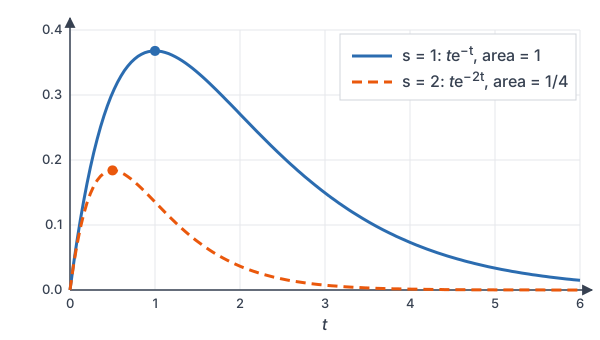
Answer: L{t} = 1/s² for s greater than 0. Repeating the step gives L{tⁿ} = n!/sⁿ⁺¹.
Example 4: Using the table, linearity and shifting
Find L{2t³ − 5 cos 4t + 6e^(−2t) sin 3t}.
\mathcal{L}\{2t^3\} = 2\cdot\dfrac{3!}{s^4} = \dfrac{12}{s^4}Use the tⁿ row with n = 3.
\mathcal{L}\{-5\cos 4t\} = -\dfrac{5s}{s^2 + 16}Use the cos bt row with b = 4.
\mathcal{L}\{\sin 3t\} = \dfrac{3}{s^2 + 9}Find the transform without the e^(−2t) factor.
\mathcal{L}\{6e^{-2t}\sin 3t\} = \dfrac{18}{(s + 2)^2 + 9}Shift: replace s with s + 2, then multiply by 6.
F(s) = \dfrac{12}{s^4} - \dfrac{5s}{s^2 + 16} + \dfrac{18}{(s + 2)^2 + 9}Add the three transforms (linearity).
Answer: F(s) = 12/s⁴ − 5s/(s² + 16) + 18/((s + 2)² + 9), valid for s greater than 0.
Example 5: Transforming a drug-level model (word problem)
The amount y(t) of a drug in the blood, in milligrams, satisfies y′ + 2y = e^(−t) with y(0) = 3, where t is in hours. Transform the equation and solve for Y(s). Then check that the solution y = e^(−t) + 2e^(−2t) has this transform.
sY - 3 + 2Y = \dfrac{1}{s + 1}Transform both sides: L{y′} = sY − y(0) and L{e^(−t)} = 1/(s + 1).
(s + 2)Y = 3 + \dfrac{1}{s + 1}Add 3 to both sides and factor out Y.
Y = \dfrac{3}{s + 2} + \dfrac{1}{(s + 1)(s + 2)}Divide both sides by s + 2.
Y = \dfrac{3(s + 1) + 1}{(s + 1)(s + 2)} = \dfrac{3s + 4}{(s + 1)(s + 2)}Use a common denominator (see adding rational expressions).
\mathcal{L}\{e^{-t} + 2e^{-2t}\} = \dfrac{1}{s + 1} + \dfrac{2}{s + 2}Transform the proposed solution with the table.
= \dfrac{(s + 2) + 2(s + 1)}{(s + 1)(s + 2)} = \dfrac{3s + 4}{(s + 1)(s + 2)}Use a common denominator and combine like terms.
Answer: Y(s) = (3s + 4)/((s + 1)(s + 2)), and the transform of e^(−t) + 2e^(−2t) matches it, so y = e^(−t) + 2e^(−2t) mg. Going from Y(s) back to y(t) on your own is the job of the inverse transform, the next lesson.
Common mistakes
| Mistake | Example of the error | Fix |
|---|---|---|
| Forgetting the factorial | L{t²} = 1/s³ | L{t²} = 2!/s³ = 2/s³. |
| Mixing up sine and cosine | L{sin 3t} = s/(s² + 9) | Sine has b on top: 3/(s² + 9). |
| Shifting the wrong way | L{e^(2t) cos t} = (s + 2)/((s + 2)² + 1) | e^(at) gives s − a: (s − 2)/((s − 2)² + 1). |
| Transforming a product as a product | L{t sin t} = (1/s²) · 1/(s² + 1) | The transform of a product is not the product of transforms; use a rule that fits, or the definition. |
| Dropping the initial value | L{y′} = sY | L{y′} = sY − y(0). |
| Ignoring where it exists | Using L{e^(3t)} = 1/(s − 3) at s = 2 | The integral diverges there; it is valid only for s greater than 3. |
Related ideas
Why the derivative rule works
Integrate by parts with u = e^(−st) and dv = y′ dt: ∫₀^∞ e^(−st) y′ dt = [e^(−st) y]₀^∞ + s∫₀^∞ e^(−st) y dt = −y(0) + sY(s). Apply it twice to get the y″ rule.
Hyperbolic functions
Since cosh bt = (e^(bt) + e^(−bt))/2, linearity gives L{cosh bt} = s/(s² − b²), and similarly L{sinh bt} = b/(s² − b²), for s greater than |b|. See hyperbolic functions. Practice problem 8 works this out.
Where this leads
The transform solves linear equations with initial values, like first-order linear equations and the forced oscillations of the last lesson. Turning Y(s) back into y(t) usually takes partial fraction decomposition, which the next lesson uses.
Practice problems
- Use the definition to find L{e^(−5t)}.
- Find L{7}.
- Find L{t³}.
- Find L{3 sin 2t − 4 cos 2t}.
- Find L{e^(4t) sin 5t}.
- Find L{te^(−3t)}.
- Find L{(t + 1)²}.
- Find L{cosh 2t} from the exponential form of cosh.
- Transform y″ − 3y′ + 2y = 0 with y(0) = 1 and y′(0) = 0, and solve for Y(s).
- Find L{sin² t}.
Show answers
1.
\int_0^{\infty} e^{-st}e^{-5t}\, dt = \int_0^{\infty} e^{-(s + 5)t}\, dtSubstitute and add the exponents.
= \lim_{b \to \infty}\left[-\dfrac{e^{-(s + 5)t}}{s + 5}\right]_0^{b} = \dfrac{1}{s + 5}Integrate and take the limit, for s greater than −5.
Answer: 1/(s + 5), for s greater than −5
2.
\mathcal{L}\{7\} = 7\cdot\dfrac{1}{s}Use linearity and L{1} = 1/s.
Answer: 7/s
3.
\mathcal{L}\{t^3\} = \dfrac{3!}{s^4} = \dfrac{6}{s^4}Use the tⁿ row with n = 3.
Answer: 6/s⁴
4.
3\cdot\dfrac{2}{s^2 + 4} - 4\cdot\dfrac{s}{s^2 + 4}Use the sine and cosine rows with b = 2.
= \dfrac{6 - 4s}{s^2 + 4}Combine over the common denominator.
Answer: (6 − 4s)/(s² + 4)
5.
\mathcal{L}\{\sin 5t\} = \dfrac{5}{s^2 + 25}Find the transform without e^(4t).
\dfrac{5}{(s - 4)^2 + 25}Shift: replace s with s − 4.
Answer: 5/((s − 4)² + 25)
6.
\mathcal{L}\{t\} = \dfrac{1}{s^2}Find the transform without e^(−3t).
\dfrac{1}{(s + 3)^2}Shift: replace s with s + 3.
Answer: 1/(s + 3)²
7.
(t + 1)^2 = t^2 + 2t + 1
Expand the square (see special products of binomials).
\dfrac{2}{s^3} + \dfrac{2}{s^2} + \dfrac{1}{s}Transform each term with the table.
Answer: 2/s³ + 2/s² + 1/s
8.
\cosh 2t = \tfrac{1}{2}e^{2t} + \tfrac{1}{2}e^{-2t}Write cosh as exponentials.
\tfrac{1}{2}\left(\dfrac{1}{s - 2} + \dfrac{1}{s + 2}\right)Transform each term.
= \tfrac{1}{2}\cdot\dfrac{2s}{s^2 - 4} = \dfrac{s}{s^2 - 4}Use a common denominator and simplify.
Answer: s/(s² − 4), for s greater than 2
9.
s^2Y - s - 3(sY - 1) + 2Y = 0
Transform each term with y(0) = 1 and y′(0) = 0.
(s^2 - 3s + 2)Y - s + 3 = 0
Distribute and collect the Y terms.
Y = \dfrac{s - 3}{s^2 - 3s + 2}Add s − 3 to both sides and divide.
Answer: Y = (s − 3)/(s² − 3s + 2) = (s − 3)/((s − 1)(s − 2))
10.
\sin^2 t = \tfrac{1}{2} - \tfrac{1}{2}\cos 2tUse the power-reducing form of the double-angle formula.
\dfrac{1}{2s} - \dfrac{s}{2(s^2 + 4)}Transform each term.
= \dfrac{(s^2 + 4) - s^2}{2s(s^2 + 4)} = \dfrac{2}{s(s^2 + 4)}Use a common denominator and simplify.
Answer: 2/(s(s² + 4))
Laplace transform FAQ
What is the Laplace transform used for?
It turns linear differential equations with initial values into algebra problems in s. It is used to solve circuit, spring and control problems, especially ones with switches or sudden pushes.
What is the Laplace transform of tⁿ?
L{tⁿ} = n!/sⁿ⁺¹ for s greater than 0. For example, L{t} = 1/s² and L{t³} = 6/s⁴.
Does every function have a Laplace transform?
No. The integral must converge. Piecewise continuous functions of exponential order, like polynomials, sines and e^(at), have transforms; e^(t²) grows too fast and does not.
What is the first shifting theorem?
It says L{e^(at) f(t)} = F(s − a). To transform e^(at) times a function, transform the function alone and replace every s with s − a.
Summary
- The Laplace transform is F(s) = ∫₀^∞ e^(−st) f(t) dt, an improper integral that depends on s.
- Key results: L{1} = 1/s, L{tⁿ} = n!/sⁿ⁺¹, L{e^(at)} = 1/(s − a), L{sin bt} = b/(s² + b²), L{cos bt} = s/(s² + b²).
- The transform is linear, and multiplying by e^(at) shifts s to s − a.
- Derivatives become algebra: L{y′} = sY − y(0) and L{y″} = s²Y − sy(0) − y′(0).
- Each result holds only for the values of s where the integral converges.
Previous lesson: Forced Oscillations and Resonance
Next lesson: Inverse Laplace Transform
Back to the Differential Equations Index