
Inverse Laplace Transform
The inverse Laplace transform recovers f(t) from its transform F(s), written f(t) = L⁻¹{F(s)}. In practice you rewrite F(s) so that each piece matches a row of the transform table. The main tools are linearity, completing the square for shifted sines and cosines, and partial fractions for rational functions.
Before this lesson: Laplace Transform and Partial Fraction Decomposition
Reading the table backwards
The Laplace transform sends f(t) to F(s). The inverse goes the other way. If L{e^(3t)} = 1/(s − 3), then L⁻¹{1/(s − 3)} = e^(3t).
Two continuous functions with the same transform are equal, so the answer is unique. That means any method that gets F(s) into table form gives the right f(t).
The inverse is linear too: L⁻¹{aF + bG} = af + bg. So you can split F(s) into simple pieces, invert each one and add. Most of the work is algebra in s that makes the pieces match the table exactly, including the constants.
Inverse Laplace transform table
| F(s) | f(t) = L⁻¹{F(s)} |
|---|---|
| 1/s | 1 |
| 1/sⁿ⁺¹ | tⁿ/n! |
| 1/(s − a) | e^(at) |
| 1/(s − a)ⁿ⁺¹ | tⁿe^(at)/n! |
| s/(s² + b²) | cos bt |
| b/(s² + b²) | sin bt |
| (s − a)/((s − a)² + b²) | e^(at) cos bt |
| b/((s − a)² + b²) | e^(at) sin bt |
\mathcal{L}^{-1}\{F(s - a)\} = e^{at}f(t)The last line is the first shifting theorem read backwards. If every s in F appears as s − a, invert as if the shift were not there, then multiply by e^(at).
How to find an inverse Laplace transform
- Split F(s) into a sum of simple fractions. If the denominator factors, use partial fractions.
- If a quadratic denominator does not factor, complete the square to get (s − a)² + b².
- Rewrite each numerator to match the table: write it as a multiple of (s − a) plus a multiple of b.
- Fix constants so each fraction is a number times an exact table entry.
- Invert each piece and add.
Inverse Laplace transform examples
Example 1: Using linearity
Find L⁻¹{3/s − 4/s³ + 5/(s + 2)}.
\mathcal{L}^{-1}\left\{\dfrac{3}{s}\right\} = 3Use the 1/s row.
\dfrac{4}{s^3} = 2\cdot\dfrac{2!}{s^3}Rewrite to match t² ↔ 2!/s³.
\mathcal{L}^{-1}\left\{\dfrac{4}{s^3}\right\} = 2t^2Invert.
\mathcal{L}^{-1}\left\{\dfrac{5}{s + 2}\right\} = 5e^{-2t}Use the 1/(s − a) row with a = −2.
f(t) = 3 - 2t^2 + 5e^{-2t}Combine the pieces.
Answer: f(t) = 3 − 2t² + 5e^(−2t).
Example 2: Matching sine and cosine
Find L⁻¹{(2s + 7)/(s² + 9)}.
\dfrac{2s + 7}{s^2 + 9} = 2\cdot\dfrac{s}{s^2 + 9} + 7\cdot\dfrac{1}{s^2 + 9}Split the numerator.
\dfrac{1}{s^2 + 9} = \dfrac{1}{3}\cdot\dfrac{3}{s^2 + 9}Sine needs b = 3 on top, so multiply and divide by 3.
f(t) = 2\cos 3t + \tfrac{7}{3}\sin 3tInvert each piece with b = 3.
Answer: f(t) = 2 cos 3t + (7/3) sin 3t.
Example 3: Completing the square
Find L⁻¹{(s + 5)/(s² + 4s + 13)}.
s^2 + 4s + 13 = (s + 2)^2 + 9
Complete the square: s² + 4s + 4 = (s + 2)², and 13 − 4 = 9.
s + 5 = (s + 2) + 3
Rewrite the numerator using s + 2.
\dfrac{s + 5}{(s + 2)^2 + 9} = \dfrac{s + 2}{(s + 2)^2 + 9} + \dfrac{3}{(s + 2)^2 + 9}Split the fraction.
f(t) = e^{-2t}\cos 3t + e^{-2t}\sin 3tUse the shifted rows with a = −2 and b = 3.
Answer: f(t) = e^(−2t)(cos 3t + sin 3t). The e^(−2t) comes from the shift s + 2, so it has a minus sign.
Example 4: Finishing the drug-level model (word problem)
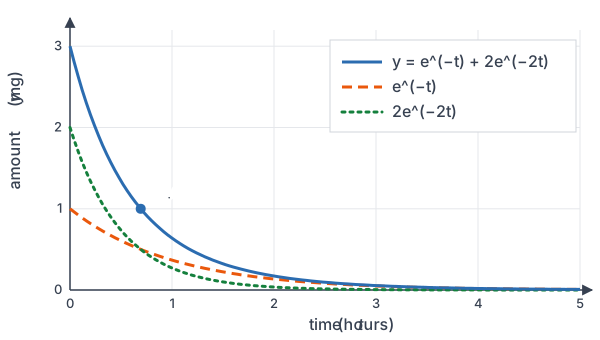
In the Laplace Transform lesson, the drug amount y(t), in milligrams after t hours, had transform Y(s) = (3s + 4)/((s + 1)(s + 2)). Find y(t), and find when the amount drops to 1 mg.
\dfrac{3s + 4}{(s + 1)(s + 2)} = \dfrac{A}{s + 1} + \dfrac{B}{s + 2}Set up partial fractions.
3s + 4 = A(s + 2) + B(s + 1)
Multiply both sides by (s + 1)(s + 2).
1 = A
Substitute s = −1.
-2 = -B \Rightarrow B = 2
Substitute s = −2.
y(t) = e^{-t} + 2e^{-2t}Invert each fraction.
2u^2 + u - 1 = 0,\quad u = e^{-t}Set y = 1 and let u = e^(−t), so e^(−2t) = u².
(2u - 1)(u + 1) = 0 \Rightarrow u = \tfrac{1}{2}Factor the trinomial; u = e^(−t) must be positive.
t = \ln 2 \approx 0.693
Solve e^(−t) = 1/2 (see solving exponential equations).
Answer: y(t) = e^(−t) + 2e^(−2t) mg, and the amount drops to 1 mg at t = ln 2 ≈ 0.693 hours, about 42 minutes.
Example 5: A linear factor and a quadratic factor
Find L⁻¹{(2s² + 3s + 9)/(s(s² + 9))}.
\dfrac{2s^2 + 3s + 9}{s(s^2 + 9)} = \dfrac{A}{s} + \dfrac{Bs + C}{s^2 + 9}A quadratic factor that does not factor needs a linear numerator Bs + C.
2s^2 + 3s + 9 = A(s^2 + 9) + (Bs + C)s
Multiply both sides by s(s² + 9).
9 = 9A \Rightarrow A = 1
Substitute s = 0.
2s^2 + 3s + 9 = (1 + B)s^2 + Cs + 9
Substitute A = 1 and expand.
B = 1,\quad C = 3
Match the s² and s coefficients.
\dfrac{1}{s} + \dfrac{s}{s^2 + 9} + \dfrac{3}{s^2 + 9}Write the pieces.
f(t) = 1 + \cos 3t + \sin 3t
Invert each piece.
Answer: f(t) = 1 + cos 3t + sin 3t.
Common mistakes
| Mistake | Example of the error | Fix |
|---|---|---|
| Forgetting the factorial | L⁻¹{1/s³} = t² | 1/s³ = (1/2)(2!/s³), so the answer is t²/2. |
| Missing b for sine | L⁻¹{1/(s² + 9)} = sin 3t | Multiply and divide by 3: (1/3) sin 3t. |
| Wrong sign in the exponential | L⁻¹{1/(s + 2)} = e^(2t) | s + 2 = s − (−2), so it is e^(−2t). |
| Not fixing the numerator after completing the square | (s + 5)/((s + 2)² + 9) → e^(−2t) cos 3t | Write s + 5 = (s + 2) + 3; there is also an e^(−2t) sin 3t term. |
| Inverting a product as a product | L⁻¹{1/(s(s − 1))} = 1 · e^t | Use partial fractions: −1/s + 1/(s − 1) gives e^t − 1. |
| Wrong partial-fraction form | A/s + B/(s² + 9) | A quadratic factor needs Bs + C on top. |
Related ideas
Repeated factors
For a repeated factor like (s − 1)², either use partial fractions with A/(s − 1) + B/(s − 1)², or write the numerator in powers of s − 1. The term 1/(s − a)² inverts to te^(at). Practice problem 9 uses this.
Products of transforms
The inverse of a product F(s)G(s) is not f(t)g(t). Partial fractions usually avoid the problem. When they do not, the Convolution Theorem gives the answer as an integral.
Solving equations
Inverting is the last step when you solve an initial-value problem with transforms. Transform the equation, solve for Y(s), then use the methods on this page. That is the next lesson, Solving Differential Equations with Laplace Transforms.
Practice problems
- Find L⁻¹{6/s⁴}.
- Find L⁻¹{1/(s − 7)}.
- Find L⁻¹{(4s − 10)/(s² + 25)}.
- Find L⁻¹{3/(s + 4)²}.
- Find L⁻¹{2/((s − 1)² + 16)}.
- Find L⁻¹{(s − 1)/(s² − 2s + 5)}.
- Find L⁻¹{(s + 1)/(s² + 6s + 10)}.
- Find L⁻¹{(s − 3)/((s − 1)(s − 2))}.
- Find L⁻¹{(s + 3)/(s − 1)²}.
- Find L⁻¹{8/(s(s² + 4))}.
Show answers
1.
\dfrac{6}{s^4} = \dfrac{3!}{s^4}Note 3! = 6.
Answer: t³
2.
\mathcal{L}^{-1}\left\{\dfrac{1}{s - 7}\right\} = e^{7t}Use the 1/(s − a) row.
Answer: e^(7t)
3.
4\cdot\dfrac{s}{s^2 + 25} - 2\cdot\dfrac{5}{s^2 + 25}Split, and write −10 as −2 · 5 for sine with b = 5.
Answer: 4 cos 5t − 2 sin 5t
4.
3\cdot\dfrac{1!}{(s + 4)^2}Match t e^(at) with n = 1 and a = −4.
Answer: 3te^(−4t)
5.
\dfrac{2}{(s - 1)^2 + 16} = \dfrac{1}{2}\cdot\dfrac{4}{(s - 1)^2 + 16}Sine needs b = 4 on top.
Answer: (1/2)e^t sin 4t
6.
s^2 - 2s + 5 = (s - 1)^2 + 4
Complete the square.
\dfrac{s - 1}{(s - 1)^2 + 4}The numerator already matches.
Answer: e^t cos 2t
7.
s^2 + 6s + 10 = (s + 3)^2 + 1
Complete the square.
s + 1 = (s + 3) - 2
Rewrite the numerator.
\dfrac{s + 3}{(s + 3)^2 + 1} - 2\cdot\dfrac{1}{(s + 3)^2 + 1}Split with b = 1.
Answer: e^(−3t)cos t − 2e^(−3t)sin t
8.
s - 3 = A(s - 2) + B(s - 1)
Clear denominators.
-2 = -A \Rightarrow A = 2;\quad -1 = B
Substitute s = 1, then s = 2.
\dfrac{2}{s - 1} - \dfrac{1}{s - 2}Write the pieces.
Answer: 2e^t − e^(2t)
9.
s + 3 = (s - 1) + 4
Write the numerator in terms of s − 1.
\dfrac{1}{s - 1} + \dfrac{4}{(s - 1)^2}Split the fraction.
Answer: e^t + 4te^t
10.
8 = A(s^2 + 4) + (Bs + C)s
Use A/s + (Bs + C)/(s² + 4) and clear denominators.
A = 2
Substitute s = 0: 8 = 4A.
0 = (2 + B)s^2 + Cs \Rightarrow B = -2,\ C = 0
Subtract 8 and match coefficients.
\dfrac{2}{s} - \dfrac{2s}{s^2 + 4}Write the pieces.
Answer: 2 − 2 cos 2t
Inverse Laplace transform FAQ
How do you find the inverse Laplace transform?
Break F(s) into pieces that match the transform table, using partial fractions and completing the square, then invert each piece and add. Adjust constants so each piece matches a table entry exactly.
What is the inverse Laplace transform of 1/s²?
It is t, because L{t} = 1!/s² = 1/s². In general, L⁻¹{1/sⁿ⁺¹} = tⁿ/n!.
Is the inverse Laplace transform unique?
Yes, for continuous functions. Two continuous functions with the same transform are equal for every t ≥ 0, so any correct method gives the same answer.
What is the inverse Laplace transform of 1/(s² + a²)?
It is (1/a) sin at. The sine row needs a in the numerator, so multiply and divide by a.
Summary
- The inverse Laplace transform reads the table backwards: L⁻¹{F(s)} = f(t).
- It is linear, so split F(s) into simple pieces and invert each one.
- Use partial fractions for factored denominators and completing the square for quadratics that do not factor.
- Adjust constants: tⁿ needs n!, and sin bt needs b in the numerator.
- A shift s − a in F(s) means a factor e^(at) in f(t).
Previous lesson: Laplace Transform
Next lesson: Solving Differential Equations with Laplace Transforms
Back to the Differential Equations Index