
Convolution Theorem
The convolution theorem says the Laplace transform of a convolution is the product of the transforms: L{f * g} = F(s)G(s). Read backwards, it finds the inverse transform of a product F(s)G(s) as the integral of f(τ)g(t − τ) from 0 to t. It also writes the solution for any forcing in one formula.
Before this lesson: Inverse Laplace Transform and Dirac Delta Function
What convolution means
The inverse of a product is not the product of the inverses: L⁻¹{F(s)G(s)} is not f(t)g(t). Partial fractions often get around this, but not always. Convolution is the operation in t that matches multiplication in s.
(f * g)(t) = \int_{0}^{t} f(\tau)\,g(t - \tau)\,d\tauThink of g as how a system responds to a single push, and f as a stream of small pushes. The push at time τ has size f(τ) dτ, and by time t it has had t − τ to act, so it adds f(τ)g(t − τ) dτ. The convolution adds up all of these effects from 0 to t.
Inside the integral, τ is the variable and t is a constant. Convolution is commutative, f * g = g * f, so you can put the shift t − τ on whichever function makes the integral easier.
The convolution theorem
\mathcal{L}\{(f * g)(t)\} = F(s)\,G(s)\mathcal{L}^{-1}\{F(s)\,G(s)\} = \int_{0}^{t} f(\tau)\,g(t - \tau)\,d\tauThe second line is the one you use most. Split the transform into two factors you can invert, F(s) and G(s), find f(t) and g(t), and then evaluate the convolution integral.
How to invert a product with the convolution theorem
- Write the transform as a product F(s)G(s) of two factors from the table.
- Invert each factor to get f(t) and g(t).
- Write the integral of f(τ)g(t − τ) from 0 to t, choosing which function gets t − τ.
- Evaluate the integral in τ, treating t as a constant.
Convolution theorem examples
Example 1: Checking the theorem against partial fractions
Compute e^t * e^(2t), and check it with L⁻¹{1/((s − 1)(s − 2))}.
(e^{t} * e^{2t})(t) = \int_{0}^{t} e^{\tau}e^{2(t - \tau)}\,d\tauWrite the convolution integral with f(τ) = e^τ and g(t − τ) = e^(2(t − τ)).
\int_{0}^{t} e^{\tau}e^{2t - 2\tau}\,d\tau = e^{2t}\int_{0}^{t} e^{-\tau}\,d\tauCombine exponents and pull out e^(2t), a constant in τ.
e^{2t}\int_{0}^{t} e^{-\tau}\,d\tau = e^{2t}\left(1 - e^{-t}\right)Integrate: the antiderivative of e^(−τ) is −e^(−τ).
e^{2t}\left(1 - e^{-t}\right) = e^{2t} - e^{t}Distribute e^(2t).
\dfrac{1}{(s - 1)(s - 2)} = \dfrac{1}{s - 2} - \dfrac{1}{s - 1}Check with partial fractions.
\mathcal{L}^{-1}\left\{\dfrac{1}{s - 2} - \dfrac{1}{s - 1}\right\} = e^{2t} - e^{t}Invert; the two methods agree.
Answer: e^t * e^(2t) = e^(2t) − e^t, which matches L⁻¹{1/((s − 1)(s − 2))}, the product of the transforms 1/(s − 1) and 1/(s − 2).
Example 2: An inverse transform with a factor of 1/s
Find L⁻¹{1/(s(s² + 4))} with the convolution theorem.
F(s) = \dfrac{1}{s},\quad G(s) = \dfrac{1}{s^2 + 4}Split into two table factors.
f(t) = 1,\quad g(t) = \tfrac{1}{2}\sin 2tInvert each factor; the sine row needs b = 2 on top.
\mathcal{L}^{-1}\{F(s)G(s)\} = \int_{0}^{t} 1\cdot\tfrac{1}{2}\sin 2\tau\,d\tauPut the shift on f = 1, which does not change it, so g keeps the variable τ.
\int_{0}^{t} \tfrac{1}{2}\sin 2\tau\,d\tau = \left[-\tfrac{1}{4}\cos 2\tau\right]_{0}^{t}Integrate.
\left[-\tfrac{1}{4}\cos 2\tau\right]_{0}^{t} = -\tfrac{1}{4}\cos 2t + \tfrac{1}{4}Evaluate at t and 0.
Answer: L⁻¹{1/(s(s² + 4))} = (1/4)(1 − cos 2t). In general, dividing a transform by s integrates its inverse from 0 to t.
Example 3: A repeated quadratic factor
Find L⁻¹{1/(s² + 1)²}.
\dfrac{1}{(s^2 + 1)^2} = \dfrac{1}{s^2 + 1}\cdot\dfrac{1}{s^2 + 1}Split into two equal factors.
\mathcal{L}^{-1}\left\{\dfrac{1}{(s^2 + 1)^2}\right\} = \int_{0}^{t} \sin\tau\,\sin(t - \tau)\,d\tauEach factor inverts to sin t.
\sin\tau\,\sin(t - \tau) = \tfrac{1}{2}\big[\cos(2\tau - t) - \cos t\big]Use the product-to-sum identity sin A sin B = (1/2)[cos(A − B) − cos(A + B)], from the sum and difference formulas.
\tfrac{1}{2}\int_{0}^{t} \cos(2\tau - t)\,d\tau = \tfrac{1}{4}\big[\sin(2\tau - t)\big]_{0}^{t}Integrate the first term; t is a constant.
\tfrac{1}{4}\big[\sin t - \sin(-t)\big] = \tfrac{1}{2}\sin tEvaluate, using sin(−t) = −sin t.
\tfrac{1}{2}\int_{0}^{t} \cos t\,d\tau = \tfrac{1}{2}t\cos tIntegrate the second term; cos t is a constant in τ.
\mathcal{L}^{-1}\left\{\dfrac{1}{(s^2 + 1)^2}\right\} = \tfrac{1}{2}\sin t - \tfrac{1}{2}t\cos tSubtract the second term from the first.
Answer: L⁻¹{1/(s² + 1)²} = (1/2)(sin t − t cos t). The t cos t term grows without bound, which is the resonance seen in forced oscillations and resonance.
Example 4: A spring pushed by a growing force (word problem)
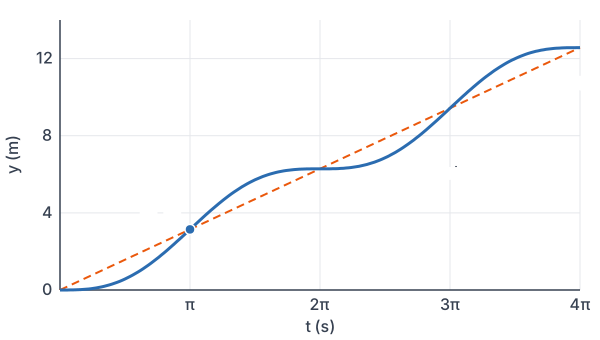
A 1 kg mass on a spring with spring constant 1 N/m starts at rest at equilibrium. A force of t newtons, growing steadily, pushes it, so y″ + y = t with y(0) = 0 and y′(0) = 0. Write y as a convolution, evaluate it, and find y(π).
s^2Y + Y = \dfrac{1}{s^2}Transform both sides with zero initial values.
Y = \dfrac{1}{s^2}\cdot\dfrac{1}{s^2 + 1}Divide by s² + 1 and write Y as a product.
y(t) = \int_{0}^{t} (t - \tau)\sin\tau\,d\tauInvert each factor (t and sin t) and put the shift on t, which is easier to integrate.
y(t) = t\int_{0}^{t}\sin\tau\,d\tau - \int_{0}^{t}\tau\sin\tau\,d\tauSplit the integral; t is a constant in τ.
t\int_{0}^{t}\sin\tau\,d\tau = t(1 - \cos t)Integrate sin τ.
\int_{0}^{t}\tau\sin\tau\,d\tau = \sin t - t\cos tIntegrate by parts with u = τ and dv = sin τ dτ.
y(t) = t - t\cos t - \sin t + t\cos t
Subtract the two results.
y(t) = t - \sin t
Combine like terms.
y(\pi) = \pi - \sin\pi = \pi \approx 3.14
Substitute t = π.
Answer: y(t) = t − sin t, so y(π) = π ≈ 3.14 meters. The mass follows the slowly moving balance point y = t but wobbles behind it by sin t. The same convolution with sin(t − τ) gives the response to any force, as in spring-mass systems.
Example 5: An integral equation
Solve y(t) = 2 − ∫₀ᵗ (t − τ)y(τ) dτ for y(t).
y(t) = 2 - (t * y)(t)
The integral is the convolution of t with y.
Y = \dfrac{2}{s} - \dfrac{1}{s^2}\,YTransform both sides with the convolution theorem.
Y + \dfrac{1}{s^2}Y = \dfrac{2}{s}Add Y/s² to both sides.
\dfrac{s^2 + 1}{s^2}\,Y = \dfrac{2}{s}Factor out Y.
Y = \dfrac{2}{s}\cdot\dfrac{s^2}{s^2 + 1} = \dfrac{2s}{s^2 + 1}Multiply by s²/(s² + 1) and simplify.
y(t) = 2\cos t
Invert with the cosine row.
\int_{0}^{t}(t - \tau)\,2\cos\tau\,d\tau = 2 - 2\cos tCheck: compute the integral as in Example 4.
2 - (2 - 2\cos t) = 2\cos t
Substitute into the right side; it matches.
Answer: y(t) = 2 cos t. Equations like this, with the unknown inside a convolution integral, are called Volterra integral equations, and the convolution theorem turns them into algebra.
Common mistakes
| Mistake | Example of the error | Fix |
|---|---|---|
| Inverting a product as a product | L⁻¹{1/(s(s² + 4))} = 1 · (1/2) sin 2t | Use the convolution integral: (1/4)(1 − cos 2t). |
| Forgetting the shift t − τ | integral of f(τ)g(τ) from 0 to t | One factor must be g(t − τ). |
| Using the wrong limits | integral from 0 to ∞ | Convolution runs from 0 to t. |
| Treating t as the variable of integration | integrating t − τ as (t − τ)²/2 in t | Integrate in τ; t is a constant until the end. |
| Thinking f * 1 = f | t * 1 = t | f * 1 is the integral of f from 0 to t, so t * 1 = t²/2. |
| Transforming a product of functions as a product | L{t · sin t} = (1/s²) · 1/(s² + 1) | That product rule is for convolutions: L{t * sin t} = 1/(s²(s² + 1)). |
Related ideas
Impulse response and transfer functions
For ay″ + by′ + cy = g(t) with zero initial values, Y(s) = H(s)G(s), where H(s) = 1/(as² + bs + c) is the transfer function. Its inverse h(t) is the response to a unit Dirac delta impulse. By the convolution theorem, y = h * g for every forcing g.
Nonzero initial values
If the initial values are not zero, add the response caused by the initial values alone to h * g. For y″ + y = g(t), y(0) = a and y′(0) = b, the solution is y = a cos t + b sin t plus the integral of sin(t − τ)g(τ) from 0 to t. This is an alternative to variation of parameters when the coefficients are constant.
Practice problems
- Compute 1 * 1.
- Compute t * t.
- Compute 1 * e^(3t).
- Find L{∫₀ᵗ e^τ cos(t − τ) dτ}.
- Find L{t * sin t}.
- Use convolution to find L⁻¹{1/(s(s + 3))}.
- Use convolution to find L⁻¹{1/((s − 1)(s + 1))}.
- Use convolution to find L⁻¹{1/(s²(s² + 1))}.
- Solve y″ + 4y = g(t) with y(0) = 0 and y′(0) = 0 as a convolution, then evaluate it for g(t) = 1.
- Solve the integral equation y(t) = 1 + ∫₀ᵗ y(τ) dτ.
Show answers
1.
(1 * 1)(t) = \int_{0}^{t} 1\cdot 1\,d\tauWrite the convolution integral.
\int_{0}^{t} 1\,d\tau = tIntegrate.
Answer: t (check: 1/s · 1/s = 1/s², whose inverse is t)
2.
(t * t)(t) = \int_{0}^{t} \tau(t - \tau)\,d\tauWrite the convolution integral.
\int_{0}^{t} (t\tau - \tau^2)\,d\tau = \dfrac{t\cdot t^2}{2} - \dfrac{t^3}{3}Distribute and integrate in τ.
\dfrac{t^3}{2} - \dfrac{t^3}{3} = \dfrac{t^3}{6}Subtract the fractions.
Answer: t³/6 (check: 1/s² · 1/s² = 1/s⁴ = (1/6) · 3!/s⁴)
3.
(1 * e^{3t})(t) = \int_{0}^{t} e^{3\tau}\,d\tauPut the shift on 1.
\int_{0}^{t} e^{3\tau}\,d\tau = \tfrac{1}{3}\left(e^{3t} - 1\right)Integrate and evaluate.
Answer: (e^(3t) − 1)/3
4.
\int_{0}^{t} e^{\tau}\cos(t - \tau)\,d\tau = (e^{t} * \cos t)(t)Recognize a convolution.
\mathcal{L}\{e^{t} * \cos t\} = \dfrac{1}{s - 1}\cdot\dfrac{s}{s^2 + 1}Apply the convolution theorem.
Answer: s/((s − 1)(s² + 1))
5.
\mathcal{L}\{t * \sin t\} = \dfrac{1}{s^2}\cdot\dfrac{1}{s^2 + 1}Apply the convolution theorem.
Answer: 1/(s²(s² + 1))
6.
\dfrac{1}{s}\cdot\dfrac{1}{s + 3} \to 1 * e^{-3t}Split and invert each factor.
\int_{0}^{t} e^{-3\tau}\,d\tau = \tfrac{1}{3}\left(1 - e^{-3t}\right)Integrate and evaluate.
Answer: (1 − e^(−3t))/3
7.
\int_{0}^{t} e^{\tau}e^{-(t - \tau)}\,d\tau = e^{-t}\int_{0}^{t} e^{2\tau}\,d\tauWrite e^t * e^(−t) and pull out e^(−t).
e^{-t}\int_{0}^{t} e^{2\tau}\,d\tau = e^{-t}\cdot\tfrac{1}{2}\left(e^{2t} - 1\right)Integrate and evaluate.
e^{-t}\cdot\tfrac{1}{2}\left(e^{2t} - 1\right) = \tfrac{1}{2}\left(e^{t} - e^{-t}\right)Distribute e^(−t).
Answer: (e^t − e^(−t))/2, which is sinh t
8.
\int_{0}^{t} (t - \tau)\sin\tau\,d\tauWrite t * sin t with the shift on t.
t(1 - \cos t) - (\sin t - t\cos t)
Split and integrate, as in Example 4.
Answer: t − sin t
9.
Y = \dfrac{1}{s^2 + 4}\,G(s)Transform with zero initial values and divide by s² + 4.
y(t) = \int_{0}^{t} \tfrac{1}{2}\sin\big(2(t - \tau)\big)\,g(\tau)\,d\tau1/(s² + 4) inverts to (1/2) sin 2t; apply the convolution theorem.
y(t) = \int_{0}^{t} \tfrac{1}{2}\sin 2\tau\,d\tauFor g = 1, use commutativity to move the shift onto g.
y(t) = \tfrac{1}{4}(1 - \cos 2t)Integrate and evaluate, as in Example 2.
Answer: y = (1/2) ∫₀ᵗ sin(2(t − τ)) g(τ) dτ; for g = 1, y = (1 − cos 2t)/4
10.
Y = \dfrac{1}{s} + \dfrac{1}{s}\,YThe integral is 1 * y; transform both sides.
\left(1 - \dfrac{1}{s}\right)Y = \dfrac{1}{s}Subtract Y/s and factor out Y.
\dfrac{s - 1}{s}\,Y = \dfrac{1}{s} \Rightarrow Y = \dfrac{1}{s - 1}Multiply both sides by s/(s − 1).
Answer: y = e^t (check: 1 + (e^t − 1) = e^t)
Convolution theorem FAQ
What is the convolution theorem for Laplace transforms?
It states that L{f * g} = F(s)G(s), where f * g is the integral of f(τ)g(t − τ) from 0 to t. So the inverse transform of a product of transforms is the convolution of their inverses.
Is the Laplace transform of a product equal to the product of the transforms?
No. L{f(t)g(t)} is not F(s)G(s) in general. The product F(s)G(s) is the transform of the convolution f * g, not of the ordinary product.
When should I use convolution instead of partial fractions?
Use it when the forcing g(t) is not a specific function, when a repeated quadratic factor makes partial fractions long, or when the unknown appears inside an integral. For simple factored denominators, partial fractions are usually faster.
Is convolution commutative?
Yes, f * g = g * f. Substituting u = t − τ in the integral swaps the roles of f and g, so you can put the shift on whichever function is easier to integrate.
Summary
- The convolution of f and g is the integral of f(τ)g(t − τ) from 0 to t.
- Convolution theorem: L{f * g} = F(s)G(s), so L⁻¹{F(s)G(s)} = f * g.
- In the integral, τ is the variable and t is a constant; convolution is commutative.
- Dividing a transform by s integrates its inverse from 0 to t.
- With zero initial values, the solution is the impulse response h(t) convolved with the forcing g(t).
Previous lesson: Dirac Delta Function
Next lesson: Systems of Differential Equations
Back to the Differential Equations Index