
Dirac Delta Function
The Dirac delta function δ(t − c) models an impulse: a force so strong and so brief that it delivers a set total push in an instant. It is zero except at t = c, the total area under it is 1, and its Laplace transform is e^(−cs). It lets you solve problems like a hammer striking a spring.
Before this lesson: Unit Step Functions and Solving Differential Equations with Laplace Transforms
What the Dirac delta function means
Picture a rectangular pulse that starts at time c, lasts for a short time ε, and has height 1/ε. Its area is ε · (1/ε) = 1, no matter how small ε is. Written with unit step functions, the pulse is:
d_\varepsilon(t) = \dfrac{1}{\varepsilon}\big[u(t - c) - u(t - c - \varepsilon)\big]As ε shrinks, the pulse gets narrower and taller but keeps area 1. The Dirac delta δ(t − c) is the limit: zero everywhere except at t = c, with total area 1. It is not an ordinary function, because no ordinary function is zero almost everywhere and still has area 1. Mathematicians call it a generalized function.
In a model, Aδ(t − c) means a total impulse of A delivered at time c: a hammer strike, an injection of a drug, a sudden deposit into an account. You never need its value at c; you only use how it acts inside integrals.
Dirac delta function rules
For c ≥ 0 and any function f that is continuous at c:
\int_{a}^{b} \delta(t - c)\,dt = 1 \quad \text{if } a \lt c \lt b\int_{0}^{\infty} f(t)\,\delta(t - c)\,dt = f(c)\mathcal{L}\{\delta(t - c)\} = e^{-cs}, \qquad \mathcal{L}\{\delta(t)\} = 1The second line is the sifting property: the delta picks out the value of f at c. The Laplace transform follows from it with f(t) = e^(−st). It also gives L{f(t)δ(t − c)} = f(c)e^(−cs).
What an impulse does to a solution
In a second-order equation y″ + by′ + ky = Aδ(t − c), the position y stays continuous, but the velocity y′ jumps by A at t = c. In a first-order equation y′ + ay = Aδ(t − c), the solution y itself jumps by A. The Laplace method handles these jumps for you.
Dirac delta function examples
Example 1: The delta as a limit of pulses
Find the Laplace transform of the pulse d_ε(t), and show that it approaches e^(−cs) as ε → 0.
\mathcal{L}\{d_\varepsilon\} = \dfrac{1}{\varepsilon}\left(\dfrac{e^{-cs}}{s} - \dfrac{e^{-(c + \varepsilon)s}}{s}\right)Transform each step with L{u(t − c)} = e^(−cs)/s.
\mathcal{L}\{d_\varepsilon\} = e^{-cs}\cdot\dfrac{1 - e^{-\varepsilon s}}{\varepsilon s}Factor out e^(−cs)/s.
\lim_{\varepsilon \to 0}\dfrac{1 - e^{-\varepsilon s}}{\varepsilon s} = \lim_{\varepsilon \to 0}\dfrac{s e^{-\varepsilon s}}{s}The limit has the form 0/0, so use L’Hôpital’s rule in ε.
\lim_{\varepsilon \to 0} e^{-\varepsilon s} = 1Cancel s and substitute ε = 0.
\mathcal{L}\{\delta(t - c)\} = e^{-cs}\cdot 1 = e^{-cs}Multiply by e^(−cs).
Answer: L{d_ε} = e^(−cs)(1 − e^(−εs))/(εs), which approaches e^(−cs). For c = 0 the transform of δ(t) is 1.
Example 2: Using the sifting property
Evaluate (a) the integral of (t² + 1)δ(t − 3) from 0 to 5, and (b) L{t²δ(t − 2)}.
\int_{0}^{5} (t^2 + 1)\,\delta(t - 3)\,dt = 3^2 + 1(a) The spike at 3 is inside [0, 5], so the integral picks out f(3).
3^2 + 1 = 10
Evaluate.
\mathcal{L}\{t^2\delta(t - 2)\} = \int_{0}^{\infty} e^{-st}t^2\,\delta(t - 2)\,dt(b) Write the definition of the transform.
\int_{0}^{\infty} e^{-st}t^2\,\delta(t - 2)\,dt = e^{-2s}\cdot 2^2Sift: replace t with 2 in e^(−st)t².
\mathcal{L}\{t^2\delta(t - 2)\} = 4e^{-2s}Simplify.
Answer: (a) 10; (b) 4e^(−2s). The t² only matters at t = 2, so it becomes the constant 4.
Example 3: A drug injection (word problem)
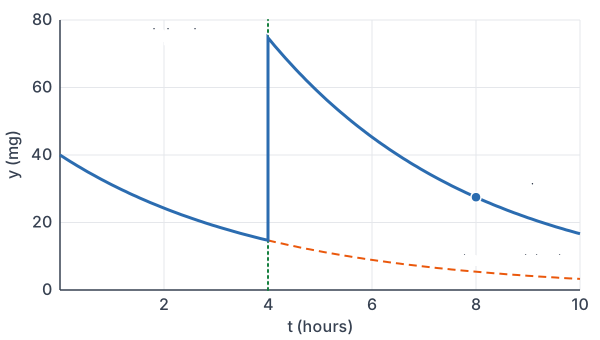
A patient has 40 mg of a drug in the blood at t = 0, and the body removes it at a rate of 1/4 of the amount per hour. At t = 4 hours a nurse injects another 60 mg all at once. The amount y(t), in mg, satisfies y′ + (1/4)y = 60δ(t − 4), y(0) = 40. Find y(t), the amounts just before and just after the injection, and the amount at t = 8 hours.
sY - 40 + \tfrac{1}{4}Y = 60e^{-4s}Transform both sides and substitute y(0) = 40.
\left(s + \tfrac{1}{4}\right)Y = 40 + 60e^{-4s}Factor out Y and add 40 to both sides.
Y = \dfrac{40}{s + \frac{1}{4}} + e^{-4s}\cdot\dfrac{60}{s + \frac{1}{4}}Divide both sides by s + 1/4.
y(t) = 40e^{-t/4} + 60\,u(t - 4)\,e^{-(t - 4)/4}Invert; the e^(−4s) term shifts by 4 and switches on at t = 4.
y(4^-) = 40e^{-1} \approx 14.72Just before the injection the step is still 0.
y(4^+) = 40e^{-1} + 60 \approx 74.72Just after, the step is 1 and e^0 = 1: the amount jumps by 60.
y(8) = 40e^{-2} + 60e^{-1}Substitute t = 8.
y(8) \approx 5.41 + 22.07 = 27.49
Evaluate each term and add.
Answer: y(t) = 40e^(−t/4) + 60u(t − 4)e^(−(t − 4)/4). The amount falls to about 14.72 mg, jumps to about 74.72 mg at the injection, and is about 27.49 mg at t = 8 hours. Without the impulse this is plain exponential decay.
Example 4: A hammer strikes a moving spring
A mass on a spring satisfies y″ + 4y = 3δ(t − π) with y(0) = 1 and y′(0) = 0: it starts stretched 1 unit, and a hammer gives it an impulse of 3 at t = π. Find y(t) and the amplitude after the strike.
s^2Y - s - 0 + 4Y = 3e^{-\pi s}Transform both sides and substitute y(0) = 1 and y′(0) = 0.
(s^2 + 4)Y = s + 3e^{-\pi s}Factor out Y and add s to both sides.
Y = \dfrac{s}{s^2 + 4} + e^{-\pi s}\cdot\dfrac{3}{2}\cdot\dfrac{2}{s^2 + 4}Divide by s² + 4; the sine row needs b = 2 on top.
y(t) = \cos 2t + \tfrac{3}{2}u(t - \pi)\sin\big(2(t - \pi)\big)Invert; the e^(−πs) term shifts by π.
\sin(2t - 2\pi) = \sin 2t
Sine has period 2π (see amplitude and period).
y(t) = \cos 2t + \tfrac{3}{2}\sin 2t \quad (t \ge \pi)Write the motion after the strike.
A = \sqrt{1^2 + \left(\tfrac{3}{2}\right)^2} = \sqrt{\tfrac{13}{4}}The amplitude of a cos ωt + b sin ωt is √(a² + b²).
A = \tfrac{\sqrt{13}}{2} \approx 1.80Simplify and evaluate.
Answer: y(t) = cos 2t for t before π, and y(t) = cos 2t + (3/2) sin 2t after. The strike raises the amplitude from 1 to about 1.80. Check: at t = π the velocity jumps from −2 sin 2π = 0 to 0 + 3 = 3, a jump equal to the impulse. See spring-mass systems for the amplitude form.
Example 5: An impulse that stops the motion
A mass satisfies y″ + y = Aδ(t − π) with y(0) = 0 and y′(0) = 1. Find y(t), and find the impulse A that leaves the mass at rest after t = π.
s^2Y - 0 - 1 + Y = Ae^{-\pi s}Transform both sides and substitute the initial values.
Y = \dfrac{1}{s^2 + 1} + Ae^{-\pi s}\cdot\dfrac{1}{s^2 + 1}Add 1, factor out Y and divide by s² + 1.
y(t) = \sin t + A\,u(t - \pi)\sin(t - \pi)
Invert each piece and apply the shift.
\sin(t - \pi) = -\sin t
Use the difference formula: sin t cos π − cos t sin π.
y(t) = \big(1 - A\,u(t - \pi)\big)\sin t
Factor out sin t.
y(t) = (1 - A)\sin t \quad (t \ge \pi)
For t ≥ π the step equals 1.
1 - A = 0 \Rightarrow A = 1
The motion stops for every t after π only if 1 − A = 0.
Answer: y(t) = sin t before π and (1 − A) sin t after, so an impulse of A = 1 stops the mass. At t = π the mass is at y = 0 moving with velocity cos π = −1, and an impulse of +1 cancels that velocity exactly.
Common mistakes
| Mistake | Example of the error | Fix |
|---|---|---|
| Treating δ like an ordinary function | δ(t − 3) = 1 at t = 3 | δ has no usable value at c; use it only through integrals and transforms. |
| Mixing up the delta and step transforms | L{δ(t − 2)} = e^(−2s)/s | L{δ(t − 2)} = e^(−2s); the /s belongs to u(t − 2). |
| Transforming f instead of sifting | L{t²δ(t − 2)} = (2/s³)e^(−2s) | Sift: L{f(t)δ(t − c)} = f(c)e^(−cs) = 4e^(−2s). |
| Sifting outside the interval | integral of f(t)δ(t − 6) from 0 to 4 = f(6) | The spike at 6 is not in [0, 4], so the integral is 0. |
| Dropping the shift when inverting | L⁻¹{e^(−πs)/(s² + 4)} = (1/2) sin 2t | Shift and switch on: (1/2)u(t − π) sin(2(t − π)). |
| Making y jump in a second-order problem | y″ + 4y = 3δ(t − π): y jumps by 3 | y stays continuous; the velocity y′ jumps by 3. |
Related ideas
The delta and the step
The step u(t − c) jumps by 1 at c, and the delta δ(t − c) is its derivative in the generalized sense. Integrating the delta from 0 to t gives the step. Their transforms match this: dividing e^(−cs) by s gives e^(−cs)/s.
Impulse response
The solution of ay″ + by′ + cy = δ(t) with zero initial values is the impulse response h(t). Its transform is H(s) = 1/(as² + bs + c). The response to any other forcing is built from h(t) with the Convolution Theorem, the next lesson.
Practice problems
- Find L{δ(t − 5)}.
- Find L{3δ(t) − 2δ(t − 1)}.
- Evaluate the integral of e^(2t)δ(t − 1) from 0 to ∞.
- Evaluate the integral of cos(πt)δ(t − 6) from 0 to 4.
- Find L{t³δ(t − 2)}.
- Find L⁻¹{e^(−3s)}.
- Solve y′ + 2y = δ(t − 1) with y(0) = 0.
- Solve y″ + 9y = δ(t − 2) with y(0) = 0 and y′(0) = 0.
- Solve y″ + 2y′ + 5y = 4δ(t − 2) with y(0) = 0 and y′(0) = 0.
- Solve y″ − y = δ(t − 1) with y(0) = 1 and y′(0) = 1.
Show answers
1.
\mathcal{L}\{\delta(t - 5)\} = e^{-5s}Use L{δ(t − c)} = e^(−cs) with c = 5.
Answer: e^(−5s)
2.
3\cdot 1 - 2e^{-s}Transform each term by linearity.
Answer: 3 − 2e^(−s)
3.
\int_{0}^{\infty} e^{2t}\,\delta(t - 1)\,dt = e^{2\cdot 1}Sift: replace t with 1.
Answer: e² ≈ 7.389
4.
\int_{0}^{4} \cos(\pi t)\,\delta(t - 6)\,dt = 0The spike at t = 6 is outside [0, 4].
Answer: 0
5.
\mathcal{L}\{t^3\delta(t - 2)\} = 2^3e^{-2s}Sift: f(2) = 2³.
Answer: 8e^(−2s)
6.
\mathcal{L}\{\delta(t - 3)\} = e^{-3s}Read the delta rule backwards.
Answer: δ(t − 3)
7.
sY - 0 + 2Y = e^{-s}Transform and substitute y(0) = 0.
Y = e^{-s}\cdot\dfrac{1}{s + 2}Factor out Y and divide by s + 2.
f(t) = e^{-2t}Invert the plain fraction.
Answer: y = u(t − 1)e^(−2(t − 1))
8.
s^2Y + 9Y = e^{-2s}Transform with zero initial values.
Y = e^{-2s}\cdot\dfrac{1}{3}\cdot\dfrac{3}{s^2 + 9}Divide by s² + 9; the sine row needs b = 3 on top.
f(t) = \tfrac{1}{3}\sin 3tInvert the plain fraction.
Answer: y = (1/3)u(t − 2) sin(3(t − 2))
9.
s^2Y + 2sY + 5Y = 4e^{-2s}Transform with zero initial values.
s^2 + 2s + 5 = (s + 1)^2 + 4
Y = e^{-2s}\cdot 2\cdot\dfrac{2}{(s + 1)^2 + 4}Divide, and write 4 as 2 · 2 for b = 2.
f(t) = 2e^{-t}\sin 2tInvert with the shifted sine row, a = −1.
Answer: y = 2u(t − 2)e^(−(t − 2)) sin(2(t − 2))
10.
s^2Y - s - 1 - Y = e^{-s}Transform and substitute y(0) = 1 and y′(0) = 1.
Y = \dfrac{s + 1}{s^2 - 1} + e^{-s}\cdot\dfrac{1}{s^2 - 1}Add s + 1, factor out Y and divide by s² − 1.
\dfrac{s + 1}{(s - 1)(s + 1)} = \dfrac{1}{s - 1}Factor the difference of squares and cancel s + 1.
\dfrac{1}{s^2 - 1} = \dfrac{1}{2}\left(\dfrac{1}{s - 1} - \dfrac{1}{s + 1}\right)Partial fractions: 1 = A(s + 1) + B(s − 1) gives A = 1/2, B = −1/2.
f(t) = \tfrac{1}{2}\left(e^{t} - e^{-t}\right)Invert; this is sinh t.
Answer: y = e^t + (1/2)u(t − 1)(e^(t − 1) − e^(−(t − 1)))
Dirac delta function FAQ
What is the Dirac delta function?
It is a generalized function δ(t − c) that is zero except at t = c and has total area 1. It models an impulse: a large force over a very short time that delivers a set total push.
What is the Laplace transform of the Dirac delta function?
L{δ(t − c)} = e^(−cs) for c ≥ 0, so L{δ(t)} = 1. It comes from the sifting property with f(t) = e^(−st).
Is the Dirac delta really a function?
Not in the ordinary sense. It is defined by how it acts inside integrals, as the limit of narrow pulses with area 1, which is why it is called a generalized function or distribution.
How is the Dirac delta related to the unit step function?
The delta is the derivative of the step in the generalized sense: u(t − c) jumps by 1 at c, and δ(t − c) is that jump concentrated at one point. Integrating δ(t − c) from 0 to t gives u(t − c).
Summary
- δ(t − c) is a unit impulse at time c: zero except at c, with total area 1.
- Sifting: the integral of f(t)δ(t − c) over an interval containing c is f(c).
- L{δ(t − c)} = e^(−cs), and L{f(t)δ(t − c)} = f(c)e^(−cs).
- An impulse Aδ(t − c) makes y′ jump by A in a second-order equation, and y jump by A in a first-order equation.
- Solve with the Laplace method, then shift: e^(−cs)F(s) inverts to u(t − c)f(t − c).
Previous lesson: Unit Step Functions
Next lesson: Convolution Theorem
Back to the Differential Equations Index