
Radius and Interval of Convergence
The radius of convergence R of a power series \sum c_n(x - a)^n is how far from the center a the series converges. The interval of convergence runs from a − R to a + R, plus any endpoint where the series also converges. Find R with the ratio test, then test each endpoint separately.
Before this lesson: Power Series, Ratio Test, Alternating Series Test and p-Series
Why a power series converges on an interval
A power series is like a geometric series whose ratio depends on x. Close to the center, the terms shrink fast and the series converges. Far from the center, the terms grow and it diverges. The switch happens at the same distance R on both sides of the center.
Inside the interval, the series converges absolutely. Outside, it diverges. At the two endpoints, anything can happen, so you must test them one at a time.
How to find the radius and interval of convergence
- Apply the ratio test to the absolute values, keeping x as a variable: L = \lim_{n \to \infty} \left|\dfrac{a_{n+1}}{a_n}\right|.
- Set L < 1 and solve for |x − a| < R. That number R is the radius of convergence.
- Write the open interval a − R < x < a + R.
- Put each endpoint into the series. Test each resulting number series with another test, such as a p-series or the alternating series test.
- Include each endpoint where the series converges.
Three possible cases
| Case | What the ratio test gives | Interval of convergence |
|---|---|---|
| R = 0 | L = ∞ for every x ≠ a | Only the center, x = a |
| R is a positive number | L < 1 exactly when |x − a| < R | From a − R to a + R, with endpoints checked |
| R = ∞ | L = 0 for every x | All real numbers |
Interval of convergence examples
Example 1: Converges for every x
Find the radius and interval of convergence of \sum_{n=0}^{\infty} \dfrac{x^n}{n!}.
\left|\dfrac{a_{n+1}}{a_n}\right| = \dfrac{|x|^{n+1}}{(n + 1)!} \cdot \dfrac{n!}{|x|^n}Use the ratio test with x as a variable. Multiply by the reciprocal of |aₙ|.
\dfrac{|x|^{n+1}}{(n + 1)!} \cdot \dfrac{n!}{|x|^n} = \dfrac{|x|}{n + 1}Cancel: (n + 1)! = (n + 1) · n!.
L = \lim_{n \to \infty} \dfrac{|x|}{n + 1} = 0For any fixed x, the bottom grows without bound.
0 \lt 1 \text{ for every } xThe condition L < 1 always holds.
Answer: R = ∞, and the interval of convergence is all real numbers. (This series equals e^x.)
Example 2: Converges only at the center
Find the radius of convergence of \sum_{n=0}^{\infty} n!\,x^n.
\left|\dfrac{a_{n+1}}{a_n}\right| = \dfrac{(n + 1)!\,|x|^{n+1}}{n!\,|x|^n}Use the ratio test, for x ≠ 0.
\dfrac{(n + 1)!\,|x|^{n+1}}{n!\,|x|^n} = (n + 1)|x|Cancel n! and |x|ⁿ.
L = \lim_{n \to \infty} (n + 1)|x| = \inftyAny nonzero |x| times a growing n + 1 grows without bound.
Answer: R = 0. The series converges only at its center, x = 0.
Example 3: A finite radius with endpoints to check
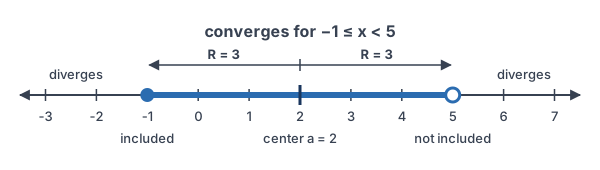
Find the radius and interval of convergence of \sum_{n=1}^{\infty} \dfrac{(x - 2)^n}{n \cdot 3^n}.
\left|\dfrac{a_{n+1}}{a_n}\right| = \dfrac{|x - 2|^{n+1}}{(n + 1)3^{n+1}} \cdot \dfrac{n \cdot 3^n}{|x - 2|^n}Use the ratio test with x as a variable.
\dfrac{|x - 2|^{n+1}}{(n + 1)3^{n+1}} \cdot \dfrac{n \cdot 3^n}{|x - 2|^n} = \dfrac{|x - 2|}{3} \cdot \dfrac{n}{n + 1}Cancel the powers (see exponent rules).
L = \dfrac{|x - 2|}{3}n/(n + 1) goes to 1.
\dfrac{|x - 2|}{3} \lt 1 \quad \Leftrightarrow \quad |x - 2| \lt 3Set L < 1 and multiply by 3. So R = 3.
-1 \lt x \lt 5
Solve the absolute value inequality: 2 − 3 < x < 2 + 3.
\text{At } x = 5: \quad \sum_{n=1}^{\infty} \dfrac{3^n}{n \cdot 3^n} = \sum_{n=1}^{\infty} \dfrac{1}{n}This is the harmonic series, which diverges. Leave out x = 5.
\text{At } x = -1: \quad \sum_{n=1}^{\infty} \dfrac{(-3)^n}{n \cdot 3^n} = \sum_{n=1}^{\infty} \dfrac{(-1)^n}{n}This converges by the alternating series test. Include x = −1.
Answer: R = 3, and the interval of convergence is −1 ≤ x < 5, written [−1, 5).
Example 4: Both endpoints included
Find the interval of convergence of \sum_{n=1}^{\infty} \dfrac{x^n}{n^2}.
\left|\dfrac{a_{n+1}}{a_n}\right| = \dfrac{|x|^{n+1}}{(n + 1)^2} \cdot \dfrac{n^2}{|x|^n} = |x|\left(\dfrac{n}{n + 1}\right)^2Use the ratio test and cancel.
L = |x| \lt 1
(n/(n + 1))² goes to 1. So R = 1.
\text{At } x = 1: \quad \sum_{n=1}^{\infty} \dfrac{1}{n^2}A p-series with p = 2 > 1, so it converges.
\text{At } x = -1: \quad \sum_{n=1}^{\infty} \dfrac{(-1)^n}{n^2}Its absolute values form the same p-series, so it converges absolutely.
Answer: R = 1, and the interval of convergence is −1 ≤ x ≤ 1, written [−1, 1].
Example 5: Where is a model valid? (word problem)
A signal model uses f(t) = \sum_{n=0}^{\infty} \dfrac{(n + 1)t^n}{4^n}. For which values of t does the model give a finite value?
\left|\dfrac{a_{n+1}}{a_n}\right| = \dfrac{(n + 2)|t|^{n+1}}{4^{n+1}} \cdot \dfrac{4^n}{(n + 1)|t|^n}Use the ratio test with t as the variable.
\dfrac{(n + 2)|t|^{n+1}}{4^{n+1}} \cdot \dfrac{4^n}{(n + 1)|t|^n} = \dfrac{|t|}{4} \cdot \dfrac{n + 2}{n + 1}Cancel the powers.
L = \dfrac{|t|}{4} \lt 1 \quad \Leftrightarrow \quad |t| \lt 4(n + 2)/(n + 1) goes to 1. So R = 4.
\text{At } t = 4: \quad \sum (n + 1) = 1 + 2 + 3 + \cdotsThe terms grow, so it diverges by the divergence test.
\text{At } t = -4: \quad \sum (-1)^n (n + 1) = 1 - 2 + 3 - \cdotsThe terms do not go to 0, so it diverges too.
Answer: the model is valid only for −4 < t < 4.
Common mistakes
| Mistake | Example of the error | Fix |
|---|---|---|
| Skipping the endpoints | Giving (−1, 5) for Example 3 | The ratio test says nothing at L = 1. Test each endpoint in the original series. |
| Using the ratio test at an endpoint | Getting L = 1 at x = 5 and calling it convergent | At an endpoint L is always 1. Use a p-series, alternating series or comparison test. |
| Forgetting the center | Writing |x| < 3 for a series in powers of (x − 2) | Keep x − a: |x − 2| < 3 gives −1 < x < 5. |
| Mixing up R and the interval | Saying “R = [−1, 5)” | R is a distance (3). The interval is a set of x values. |
| Missing a coefficient on x | For \sum (2x - 1)^n, saying R = 1 | |2x − 1| < 1 means |x − 1/2| < 1/2, so R = 1/2. |
| Dropping the absolute value | Writing (x − 2)/3 < 1, so x < 5 | Use |x − 2|/3 < 1, which bounds x on both sides. |
Related methods
Using the root test
If the terms are nth powers, such as \left(\frac{x}{n}\right)^n, the root test finds L more easily. Set the limit of \sqrt[n]{|a_n|} less than 1, exactly as with the ratio test.
Geometric series shortcut
For a geometric power series like \sum \left(\frac{x}{5}\right)^n, you can skip the ratio test: it converges exactly when |ratio| < 1, and both endpoints always diverge.
Practice problems
- Find the interval of convergence of \sum_{n=0}^{\infty} \dfrac{x^n}{5^n}.
- Find the interval of convergence of \sum_{n=1}^{\infty} \dfrac{x^n}{n}.
- Find the radius and interval of convergence of \sum_{n=1}^{\infty} \dfrac{(x + 1)^n}{n^2 \cdot 2^n}.
- Find the radius of convergence of \sum_{n=0}^{\infty} \dfrac{3^n x^n}{n!}.
- Find the radius of convergence of \sum_{n=1}^{\infty} n^n x^n.
- Find the radius and interval of convergence of \sum_{n=1}^{\infty} \dfrac{(2x - 1)^n}{\sqrt{n}}.
- Find the interval of convergence of \sum_{n=0}^{\infty} \dfrac{x^{2n}}{4^n}.
- Find the interval of convergence of \sum_{n=1}^{\infty} n(x - 3)^n.
- A power series centered at 2 converges at x = 6 and diverges at x = −4. What can you say about R?
- A model uses \sum_{n=1}^{\infty} \dfrac{v^n}{n \cdot 10^n}. For which values of v does it converge?
Show answers
1.
\sum_{n=0}^{\infty} \left(\dfrac{x}{5}\right)^n \quad \text{converges when } \left|\dfrac{x}{5}\right| \lt 1It is geometric with ratio x/5.
|x| \lt 5
Multiply by 5. So R = 5.
\text{At } x = \pm 5: \quad \sum 1^n \text{ or } \sum (-1)^nThe terms do not go to 0, so both endpoints diverge.
Answer: −5 < x < 5
2.
L = \lim_{n \to \infty} |x| \cdot \dfrac{n}{n + 1} = |x|Ratio test; R = 1.
\text{At } x = 1: \quad \sum \dfrac{1}{n}Harmonic series: diverges.
\text{At } x = -1: \quad \sum \dfrac{(-1)^n}{n}Converges by the alternating series test.
Answer: −1 ≤ x < 1
3.
L = \lim_{n \to \infty} \dfrac{|x + 1|}{2}\left(\dfrac{n}{n + 1}\right)^2 = \dfrac{|x + 1|}{2}Ratio test.
|x + 1| \lt 2 \quad \Leftrightarrow \quad -3 \lt x \lt 1
So R = 2 and the center is −1.
\text{At } x = 1: \; \sum \dfrac{1}{n^2}; \quad \text{at } x = -3: \; \sum \dfrac{(-1)^n}{n^2}Both converge (p-series with p = 2, and its alternating version).
Answer: R = 2; −3 ≤ x ≤ 1
4.
\left|\dfrac{a_{n+1}}{a_n}\right| = \dfrac{3^{n+1}|x|^{n+1}}{(n + 1)!} \cdot \dfrac{n!}{3^n |x|^n} = \dfrac{3|x|}{n + 1}Ratio test and cancel.
L = 0 \lt 1 \text{ for every } xThe bottom grows without bound.
Answer: R = ∞ (all real numbers)
5.
\sqrt[n]{|n^n x^n|} = n|x|The terms are nth powers, so use the root test.
\lim_{n \to \infty} n|x| = \infty \text{ for } x \ne 0It is less than 1 only at x = 0.
Answer: R = 0 (converges only at x = 0)
6.
L = \lim_{n \to \infty} |2x - 1|\sqrt{\dfrac{n}{n + 1}} = |2x - 1|Ratio test.
|2x - 1| \lt 1 \quad \Leftrightarrow \quad 0 \lt x \lt 1
|x − 1/2| < 1/2, so R = 1/2.
\text{At } x = 1: \; \sum \dfrac{1}{\sqrt{n}}; \quad \text{at } x = 0: \; \sum \dfrac{(-1)^n}{\sqrt{n}}The first is a p-series with p = 1/2 (diverges); the second converges by the alternating series test.
Answer: R = 1/2; 0 ≤ x < 1
7.
\sum_{n=0}^{\infty} \left(\dfrac{x^2}{4}\right)^n \quad \text{converges when } \dfrac{x^2}{4} \lt 1Geometric with ratio x²/4.
x^2 \lt 4 \quad \Leftrightarrow \quad |x| \lt 2
So R = 2.
\text{At } x = \pm 2: \quad \sum 1The terms are all 1, so it diverges.
Answer: −2 < x < 2
8.
L = \lim_{n \to \infty} |x - 3| \cdot \dfrac{n + 1}{n} = |x - 3|Ratio test; R = 1, center 3.
\text{At } x = 4 \text{ and } x = 2: \quad \sum n, \; \sum (-1)^n nThe terms do not go to 0, so both diverge.
Answer: 2 < x < 4
9.
|6 - 2| = 4 \le R
It converges at a distance of 4 from the center, so R is at least 4.
|-4 - 2| = 6 \ge R
It diverges at a distance of 6, so R is at most 6.
Answer: 4 ≤ R ≤ 6
10.
L = \lim_{n \to \infty} \dfrac{|v|}{10} \cdot \dfrac{n}{n + 1} = \dfrac{|v|}{10}Ratio test; R = 10.
\text{At } v = 10: \; \sum \dfrac{1}{n}; \quad \text{at } v = -10: \; \sum \dfrac{(-1)^n}{n}The first diverges; the second converges.
Answer: −10 ≤ v < 10
Interval of convergence FAQ
What is the radius of convergence?
It is the distance R from the center within which a power series converges. The series converges absolutely when |x − a| < R and diverges when |x − a| > R.
How do you find the interval of convergence?
Use the ratio test with x as a variable, set the limit less than 1 to find R, then test each endpoint separately in the original series.
Why do you have to check the endpoints?
At an endpoint the ratio test gives L = 1, which tells you nothing. The series might converge at both endpoints, one, or neither.
Can the radius of convergence be 0 or infinity?
Yes. If the series converges only at its center, R = 0. If it converges for every x, like the series for e^x, R = ∞.
Summary
- Use the ratio test with x as a variable, and set L < 1.
- Solve for |x − a| < R to get the radius of convergence R.
- Test both endpoints with other tests; include those that converge.
- R can be 0 (only the center), a positive number, or ∞ (every x).
- Inside the interval the series converges absolutely; outside it diverges.
Previous lesson: Power Series
Next lesson: Taylor Series
Back to the Calculus 2 Index